


Is EMDR Therapy in Spain for You?

Have you ever been overwhelmed by a memory that feels as raw as the day it happened? For many adults—especially expats in cities like Barcelona, Valencia, or Málaga—these intrusive memories can feel isolating when you’re far from home. If you are searching for EMDR Therapy Spain, here’s a quick overview:
- What is EMDR? Eye Movement Desensitisation and Reprocessing (EMDR) is a structured therapy that helps your brain reprocess distressing memories. It uses bilateral stimulation (like eye movements) to reduce the emotional charge of traumatic experiences.
- What does it treat? EMDR is highly effective for trauma and PTSD, and can also help with anxiety, depression, phobias, grief, and self-esteem issues.
- Where can I find a therapist? Look for licensed mental health clinicians with specialised, certified EMDR training. Clinics specialising in expat care in major Spanish cities are good starting points.
- Cost: EMDR is typically a private-pay service in Spain. Some therapists offer sliding scale fees, so it’s always worth asking.
Living abroad can amplify past emotional wounds, making you feel ‘stuck’ even in a vibrant new environment. EMDR helps your brain naturally process these difficult experiences. This guide explores five key signs that EMDR therapy could be the right choice to help you move forward.
1. You Feel ‘Stuck’ by Past Events or Traumatic Memories
This applies whether you’re in a busy city like Barcelona or a quieter part of the Costa del Sol, such as Marbella. Perhaps you moved to Spain for a fresh start, only to find certain things tagging along. It’s a common feeling among expats: being held back by something that happened long ago.
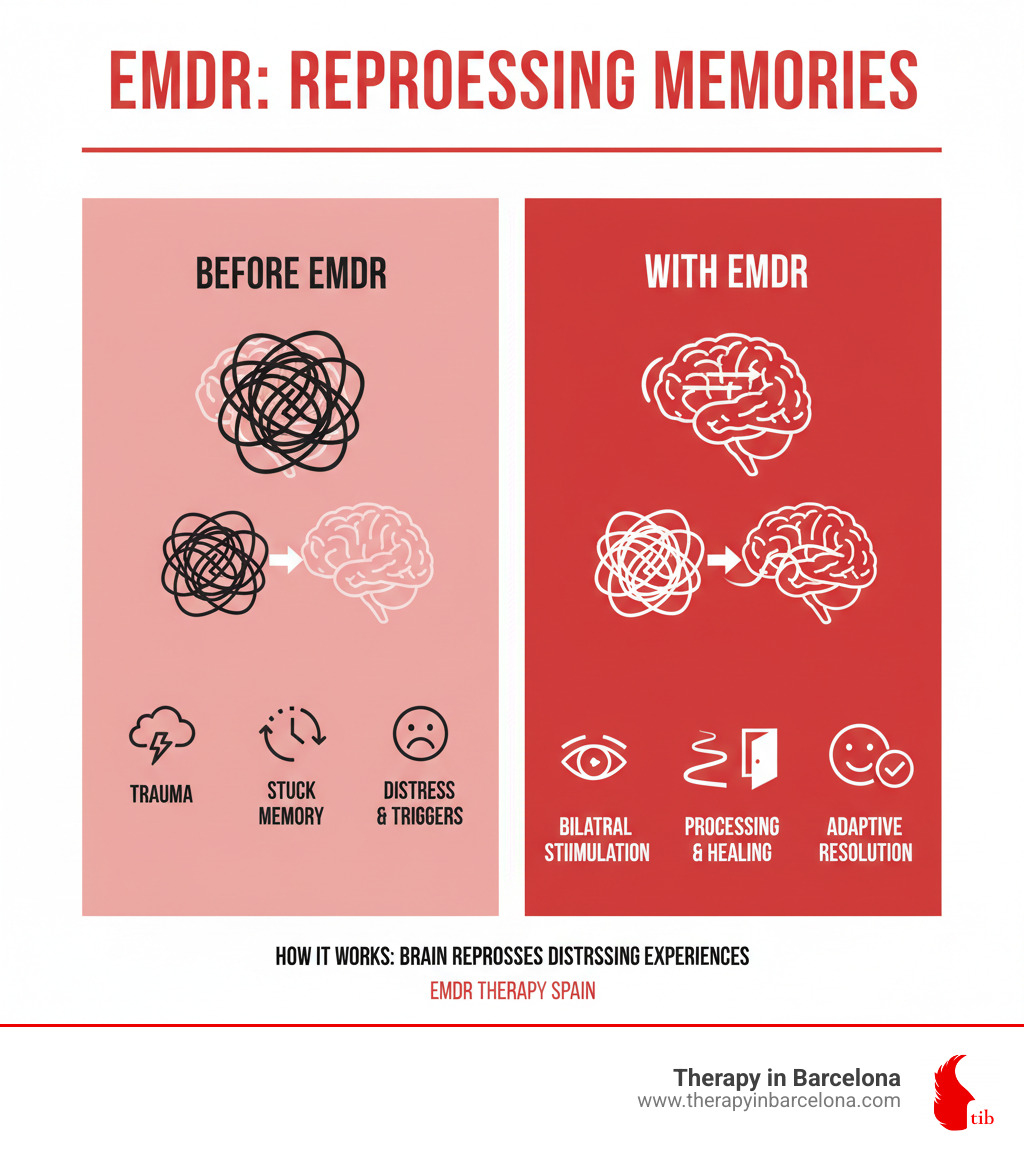
When a deeply upsetting event occurs, our brains can struggle to process it. The memory isn’t properly filed away and remains raw and vivid. Psychologists sometimes call this a “neurological knot,” where the memory isn’t integrated into our life story. This can manifest as PTSD, with distressing intrusive thoughts, flashbacks, or nightmares. You might also feel emotionally numb or disconnected from your new surroundings.
The Adaptive Information Processing (AIP) model suggests our brains are naturally equipped to heal. But when an event is too overwhelming, this process can get “stuck.” This applies to “Big T” traumas (accidents, abuse) and “small t” traumas (a difficult breakup, persistent bullying, or the stress of expat isolation). These can all create that ‘stuck’ feeling.
Take Emily, a fictional UK expat in Málaga. She moved for new beginnings but found herself constantly replaying a painful breakup. The memory felt fresh, triggering shame and anxiety that stopped her from forming new relationships. Emily felt stuck, unable to accept her present. If this resonates, our article Beyond the Blinks: Demystifying EMDR Therapy for Adults offers more insight into how EMDR Therapy Spain can help.
How EMDR helps process ‘stuck’ memories
EMDR Therapy reactivates your brain’s natural healing process. It doesn’t erase memories; it helps “unstick” them so they can be stored without intense emotional distress. This happens through bilateral stimulation, such as guided eye movements, alternating sounds, or gentle tapping.
During a session, you briefly focus on a distressing memory while engaging in this stimulation. This process is thought to mimic the brain activity of REM sleep, when we naturally process memories. By engaging both sides of the brain, EMDR helps reduce the memory’s emotional charge. You can then recall the event without the overwhelming feelings that once came with it. The memory becomes a neutral part of your history, no longer affecting your daily life. This approach has strong scientific backing, with both the American Psychological Association and the World Health Organisation recommending EMDR for trauma. You can explore the scientific evidence for EMDR’s effectiveness for more details.
2. Traditional Talk Therapy Hasn’t Fully Worked for You
Sometimes, talking about a problem isn’t enough, especially when the body holds the score. You might have spent months in traditional talk therapy, like Cognitive Behavioural Therapy (CBT). Perhaps you’ve learned to identify negative thought patterns and challenge them, yet the emotional distress remains. The knot in your stomach, the tightness in your chest, the urge to flee or freeze.
You might discuss the same event repeatedly, yet it still feels raw, and talking about it can even feel re-traumatising. This doesn’t mean therapy has failed. It suggests that trauma isn’t just stored in our thoughts; it lives in our bodies.
EMDR therapy offers a different path by working with your body and nervous system. Instead of focusing only on what you say, EMDR integrates somatic practices to help you process what your body is holding onto. It uses bilateral stimulation—eye movements, tapping, or auditory tones—to reprocess memories, often with less verbal recounting than traditional methods. This can be a relief if you find it hard to talk about your trauma. For those struggling with panic or intense anxiety, EMDR can be a profound tool, as explored in our article: Beyond Panic: How EMDR Therapy Can Transform Your Life

How EMDR differs from other therapies
While therapies like CBT focus on changing negative thought patterns, EMDR goes to the source: the memory itself. CBT might help you challenge the thought “I’m not good enough.” But if that belief stems from a deeply ingrained memory, changing the thought alone may not shift the emotional weight.
EMDR doesn’t aim to change your thoughts about an event. Instead, it alters how the memory is stored, reducing its emotional impact. It addresses the root cause by helping the brain integrate the fragmented memories—the “neurological knots”—that fuel current difficulties. Through bilateral stimulation, your brain reprocesses these stuck memories so they no longer trigger intense distress.
The goal is to change what the memory represents, allowing you to remember it without it dictating your present. After successful EMDR, the event becomes part of your history, not a force that shapes your present.
3. You’re Experiencing Persistent Anxiety, Low Mood, or Self-Esteem Issues
Moving to a new country like Spain, whether to Madrid, Valencia, or Sevilla, is an adventure. But it can also bring on feelings of anxiety, low mood, or self-esteem issues. These can feel particularly isolating for expats, far from their usual support network. The stress of cultural adjustment and language barriers can amplify existing vulnerabilities, leading to general anxiety, phobias, panic attacks, or even depression.
Often, these struggles are rooted in negative core beliefs formed during difficult past experiences, such as “I am not good enough” or “I am unlovable.” These underlying convictions can fuel anxiety and low self-esteem in adulthood. For expats, the added layer of isolation and cultural adjustment can make these issues even harder to manage.

How EMDR Therapy in Spain addresses negative beliefs
Instead of just managing symptoms, EMDR Therapy in Spain works by targeting the root memories where negative beliefs began. By reprocessing these experiences, EMDR reduces their emotional charge. It’s like untangling a knot, allowing the memory to be stored without its heavy emotional weight.
As this happens, it creates space to install more positive, adaptive beliefs. Imagine “I am not good enough” changing into “I did my best” or “I am worthy.” This internal shift can build self-worth and emotional resilience. EMDR is a recognised treatment for a broad range of conditions, including anxiety disorders, depression, and OCD. By processing underlying trauma, it can reduce feelings of hopelessness and worthlessness. Studies show its effectiveness: after just six 50-minute sessions, 77% of participants with multiple traumas no longer met the criteria for a trauma-related diagnosis, highlighting its ability to address long-standing issues.
4. You’re Looking for an Efficient, Structured, and Evidence-Based Approach
When you’re seeking therapy in a new country, you want clarity and a process you can trust. EMDR therapy in Spain offers a clear, well-researched framework that provides predictability during a vulnerable time.
Unlike some open-ended approaches, EMDR follows a structured eight-phase model. This systematic process takes you from assessment to re-evaluation, with clear objectives at each stage. You and your therapist always know where you are in the journey.
The scientific backing for EMDR is robust. Major health organisations, including the World Health Organisation, the American Psychiatric Association, and the UK’s National Institute for Health and Care Excellence (NICE), recommend EMDR as an effective treatment for PTSD.
A typical EMDR session lasts between 60 to 90 minutes. For a single traumatic event, you might see improvement in as few as 3 to 6 sessions. For more complex issues, such as childhood trauma, you might need 8 to 12 sessions or more. The efficiency is notable: one study found that after three 90-minute sessions, 84% to 90% of people with a single trauma reported complete remission of their symptoms—results that could take years to achieve with talk therapy alone.
This efficiency matters, especially for expats. Knowing EMDR has a clear structure and proven track record helps you commit to the process with confidence.
The 8 Phases of EMDR Therapy
EMDR’s structured approach ensures your healing journey is carefully managed. Here’s what the eight phases look like:
1. History & Treatment Planning: Your therapist takes a thorough history and identifies target memories for EMDR.
2. Preparation: You learn about EMDR and are taught coping skills to manage any distress that arises between sessions.
3. Assessment: You identify the target memory, along with the connected negative beliefs, emotions, and physical sensations.
4. Desensitisation: While focusing on the memory, you engage in bilateral stimulation (e.g., eye movements). You notice what comes up until the distress linked to the memory decreases.
5. Installation: The focus shifts to strengthening a positive belief, embedding it with the reprocessed memory.
6. Body Scan: You scan your body for any lingering tension related to the memory, which is then processed until you feel calm.
7. Closure: Each session ends with grounding techniques to help you feel stable before you leave.
8. Re-evaluation: At the start of the next session, your therapist checks on previously processed memories to ensure the distress remains low.
5. Finding the Right Support for EMDR Therapy in Spain
Finding the right therapist is a huge part of healing, especially when you’re an expat in Spain dealing with sensitive issues. It’s about more than just expertise; it’s about feeling truly understood.
When looking for an EMDR Therapy Spain professional, you need a licensed mental health clinician with specialised, certified EMDR training. For many internationals in Barcelona, Madrid, or Valencia, therapy in their native language, like English, is essential for expressing complex emotions without the stress of translation.
Cultural sensitivity is also key. A therapist with expat experience understands challenges like cultural adjustment, isolation, and homesickness. This shared understanding strengthens the therapeutic bond.
While Spain’s public health system, large online platforms, or local Spanish-speaking practices are options, they may not offer the specialised, culturally sensitive, and English-speaking care many expats need. Public system waiting lists can be long, and generic online platforms can miss the mark on finding a good personal fit.
In contrast, a service like Therapy in Barcelona, founded by Australian Psychologist and expat Leigh Matthews, has provided culturally sensitive support to the English-speaking community since 2011. We focus on personalised therapist matching, ensuring you connect with a psychology-trained professional who understands your journey.
What to look for in an EMDR therapist for expats in Spain
To summarise, when seeking an EMDR therapist, prioritise:
- Expat experience: A therapist who is an expat or has worked extensively with internationals will better understand your challenges.
- Multilingual support: Ensure the therapist can conduct sessions in your preferred language.
- Cultural understanding: A good therapist is sensitive to how your cultural background shapes your experiences.
- Professional qualifications: Work with psychology-trained professionals who adhere to high ethical standards.
- A safe space: The environment should feel confidential and non-judgemental. EMDR is typically a private-pay service, but some therapists do offer sliding scale fees, so it’s always worth asking.
Frequently Asked Questions about EMDR Therapy
What does an EMDR session actually feel like?
It’s not hypnosis. You remain fully awake and in control throughout the session. Your therapist guides you through a structured process.
You’ll be asked to briefly focus on a distressing memory while you engage in bilateral stimulation—usually following their finger with your eyes, or using alternating taps or sounds. You simply notice whatever thoughts, feelings, or sensations arise without pressure to analyse them. Your therapist checks in regularly to help you stay grounded. It’s normal to experience a temporary increase in distress as memories surface, but your therapist is trained to help you regulate these emotions and ensure you don’t feel overwhelmed.
How much does EMDR therapy cost in Spain?
EMDR therapy in Spain is typically a private-pay service and is not usually covered by public health insurance. Costs can vary depending on the therapist’s experience and location, whether in cities like Barcelona, Madrid, or smaller ones like Sevilla. Sessions usually last 60 to 90 minutes, which is longer than many standard therapy sessions to allow for thorough processing. While specific prices vary, some therapists offer sliding scale fees for those with financial needs, so it’s always worth asking during your initial consultation.
Can EMDR be used for children and adolescents?
Yes, EMDR is highly effective for children and adolescents, though the methods are adapted to be age-appropriate. For younger clients, therapists might use creative approaches like drawing, storytelling, or a sandbox during bilateral stimulation. This makes the process less intimidating and more accessible.
EMDR can be beneficial for childhood trauma, anxiety, fears, and behavioural issues stemming from distressing events like bullying, family conflict, or the challenges of being a Third Culture Kid. However, it requires a specially trained therapist experienced in working with younger people. If you’re considering therapy for your child in Spain, it’s important to find a therapist with specific training in child and adolescent EMDR.
Your Path to Healing in Spain
Feeling seen and understood is often the first step towards healing, especially when you’re far from home. The expat journey, while exciting, can amplify past hurts. Throughout this article, we’ve explored how EMDR Therapy Spain offers a structured, evidence-based way to process difficult experiences and help you move forward.
If the signs we’ve discussed—feeling stuck, finding talk therapy not enough, or struggling with anxiety and low self-esteem—resonate with you, EMDR might be the effective approach you’ve been looking for. It’s about leaving the weight of the past behind so you can accept your life in Spain.
Seeking support is a sign of strength. Finding the right therapist, one who understands both EMDR and the expat journey, can make all the difference. Our team of psychology-trained expat therapists is here to offer that culturally sensitive support.
If you’d like support, our team of expat therapists is here to help. Book your Free Discovery Call today.
