


Why Knowing What to Talk About in Therapy for Depression Matters

If you’re wondering what to talk about in therapy for depression, you’re not alone — and the fact that you’re asking is already a meaningful step. Here are the seven core areas that tend to make the biggest difference in sessions:
- Physical symptoms and daily rhythms — sleep changes, appetite shifts, fatigue, and unexplained aches
- Root causes and the “Expat Factor” — past trauma, life transitions, and the stress of living abroad
- Relationships and the “Loneliness Gap” — social withdrawal, communication with partners, and family dynamics
- Negative thought patterns and the inner critic — cognitive distortions, self-criticism, and depression’s harsh internal voice
- Coping mechanisms and daily habits — avoidance patterns, behavioural activation, and small daily wins
- Emotional fluctuations and “small” bothers — irritability, daily frustrations, and the feelings that seem out of proportion
- Future goals and values alignment — building hope, preventing relapse, and finding meaning again
Depression has a particular way of making everything feel heavier than it should. Simple tasks — getting out of bed, replying to a message, cooking a meal — can feel like climbing a mountain. And when you finally sit down with a therapist, a new challenge often appears: What do I actually say?
That blank, stuck feeling in the therapy room is far more common than most people realise. Many people hold back because they worry their problems aren’t serious enough, or they don’t know where to begin. According to research, 80–90% of people respond well to depression treatment — but getting the most from therapy depends, in large part, on what you bring into the room.
For internationals living in cities like Barcelona, Valencia, or Madrid, this challenge can feel even sharper. Depression doesn’t arrive in isolation. It often layers on top of cultural adjustment, language barriers, identity shifts, and the quiet grief of being far from home.
This article walks you through seven concrete topics to explore in therapy for depression, so you can walk into your next session with a clearer sense of direction — even if you still feel uncertain.
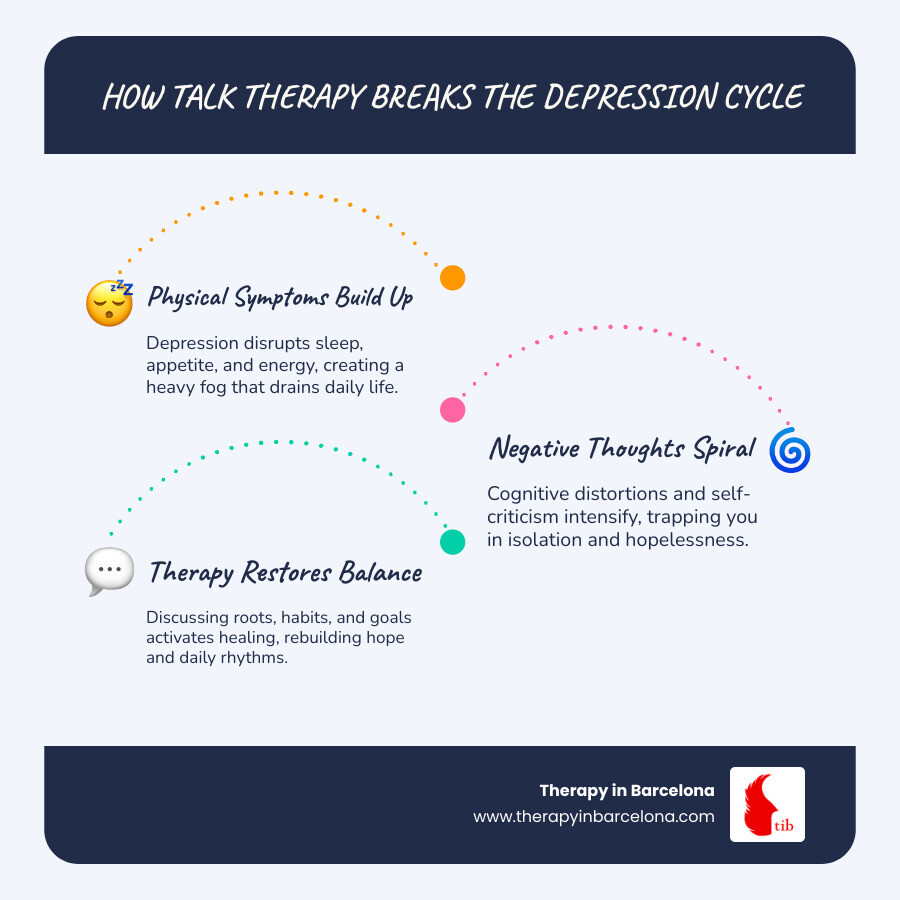
7 Things to Talk About in Therapy for Depression

When you are in the thick of it, depression can feel like a fog that makes it hard to see your own experiences clearly. You might experience emotional numbness or anhedonia—the technical term for when things you used to love, like a walk on the beach in Málaga or a dinner with friends in Gràcia, no longer bring you any joy.
Opening up about these feelings is the first step toward clearing that fog. You don’t need to have a perfect “agenda” for your session. In fact, many people find that What to Talk About in Therapy: Ideas to Consider starts with just being honest about how hard it was to even show up that day. Whether you are navigating Feelings Of Depression/ or trying to figure out Am I Sad Or Depressed A Guide For Internationals/, the following seven topics provide a roadmap for your sessions.
1. Physical symptoms and daily rhythms
Depression isn’t just “in your head”; it lives in your body. One of the most productive things you can discuss is your physical state. Have you noticed your sleep patterns shifting? Perhaps you’re struggling with insomnia, or conversely, you find yourself oversleeping but still waking up exhausted.
Discussing changes in appetite—whether you’re overeating for comfort or have lost interest in food entirely—is also vital. People often overlook unexplained physical aches, heavy limbs, or a general sense of fatigue. By tracking these symptoms in your sessions, you and your therapist can identify how depression is physically manifesting, which helps in creating a realistic plan for recovery.
2. Root causes and the “Expat Factor”
For internationals, depression often has a “hidden” layer. While past traumas or genetic predispositions play a role, the “Expat Factor” is a significant trigger. Moving to a new country like Spain involves massive life transitions that can shake your sense of identity.
In therapy, it’s helpful to explore how cultural adjustment might be triggering old wounds. Are you feeling a loss of status? Is the language barrier making you feel “smaller” or less capable? We often discuss how Is Isolation Fueling Your Depression What You Need To Know because living away from your primary support network can amplify every struggle. Identifying these root causes helps you understand that your feelings are a response to a very challenging set of circumstances.
3. Relationships and the “Loneliness Gap”
Depression often leads to social withdrawal. You might find yourself “masking”—pretending to be okay when you’re out, only to feel completely drained afterward. This creates a “Loneliness Gap” where you are physically around people but feel emotionally miles away.
In therapy, you can talk about:
- The effort it takes to maintain social connections in a vibrant city like Madrid or Valencia.
- Communication loops with your partner (e.g., feeling misunderstood or irritable).
- The complex dynamics of family back home versus your new life here.
- Feeling like a burden to new friends you’ve made in Spain.
According to What to talk about in therapy: Ideas and what to expect, these interpersonal issues are often the primary drivers of distress, and addressing them can lead to significant relief.
4. Negative thought patterns and the inner critic
Depression has a very specific “voice.” It’s often harsh, critical, and biased toward the negative. You might notice “all-or-nothing” thinking—where one small mistake makes you feel like a total failure.
In your sessions, you can work on identifying these cognitive distortions. Using evidence-based tools like Cognitive Behavioural Therapy (CBT) or Acceptance and Commitment Therapy (ACT), you can learn to challenge this inner critic. Even a Simple Exercise Increase Well Lower Depression Martin Seligman Founding Father Positive Psychology/ can help shift your focus from what is going wrong to what is working, helping you build resilience against the “depression voice.”
5. Coping mechanisms and daily habits
What do you do when the low mood hits? Some people binge-watch TV for hours, others withdraw into silence, and some might turn to alcohol or overworking. These are coping mechanisms, and talking about them without judgment is a core part of Depression Therapy.
Your therapist can help you implement “behavioural activation.” This means starting with small, manageable wins—like a five-minute walk in the sun or making one phone call. By identifying avoidance patterns, you can begin to replace unhelpful habits with routines that actually support your nervous system.
6. Emotional fluctuations and “small” bothers
Sometimes, the most important thing to talk about isn’t a major life event, but a “small” bother that felt surprisingly overwhelming. Maybe you felt an intense flash of irritability because a shopkeeper didn’t understand your Spanish, or you felt like crying because you missed a train.
These daily frustrations are often windows into deeper emotional states. Discussing them allows you to use sensory grounding techniques to manage the “spikes” in your mood. Keeping a mood journal between sessions can help you remember these moments, which often hold the key to understanding your triggers.
7. Future goals and values alignment
Depression can make the future look like a blank wall. Part of the healing process in depression management is slowly rebuilding a sense of hope.
This involves:
- Relapse prevention: Identifying early warning signs that your mood is dipping.
- Values alignment: Making sure your life in Spain actually reflects what matters to you.
- Finding meaning: Discovering what makes your life feel worth living, even on the days that still feel a bit grey.
Navigating the Therapy Process and Feeling Stuck

The bond you have with your therapist—known as the therapeutic alliance—is one of the strongest predictors of whether therapy will work for you. But even with a great therapist, you might feel stuck sometimes. This is completely normal.
If you’re wondering whether depression counselling is right for you, that feeling of being blocked is something you can talk about.
Starters for when you’re unsure what to say
If you find yourself sitting in silence, try these opening statements:
- “I’ve had a really heavy week, but I’m struggling to find the words to describe it.”
- “I felt a lot of resistance to coming today. Can we talk about why that might be?”
- “I noticed I’ve been feeling very irritable lately over small things.”
- “I want to talk about [X], but I’m worried you’ll judge me.”
Naming the discomfort is often the quickest way to move through it.
What to do when your mind goes blank
“Brain fog” is a common symptom of depression. If your mind goes blank, don’t panic. You can:
- Review any progress or setbacks since the last session.
- Look back at your initial goals to see if they still feel relevant.
- Ask your therapist to lead the way with some questions.
- Refer to Not Sure What to Talk About in Therapy? 12 Things to Consider for inspiration.
Understanding confidentiality and trust
In Spain, psychologists are bound by strict legal limits of confidentiality. Your sessions are a private, secure space. The only exceptions are if there is an imminent risk of harm to yourself or others. Knowing that you are in a safe, non-judgmental environment is what allows you to build the trust necessary for deep healing.
Choosing the Right Support in Spain
When you are dealing with depression as an international, finding the right fit for your mental health care is essential. Here is how the different options in Spain compare:
The Public Health System (CatSalut/SNS) The public system offers care through local centres (CAPs). While it is low-cost, it often comes with very long waitlists and you cannot choose your therapist. Most importantly for expats, sessions are almost always in Spanish or Catalan. If you are struggling to express complex, painful emotions, doing so in a second language can be an exhausting barrier.
Large Online Platforms Global apps are convenient and often cheaper. However, they frequently use generic algorithms for matching. There are often concerns about data privacy (some platforms have been known to sell user data) and a lack of understanding of the specific cultural nuances of living as an international in Spain.
Private Expat-Specialised Care (Therapy in Barcelona) At Therapy in Barcelona, we provide a high-quality, private-pay service specifically for the international community. We offer:
- Personalised Matching: We don’t just give you the next person on a list; we match you with a psychology-trained therapist who fits your personality and needs.
- Cultural Sensitivity: Our therapists are expats themselves. They “get” the specific stress of Spanish bureaucracy, the loneliness of being away from family, and the identity shifts of life abroad.
- Multilingual Support: We offer therapy in English, French, German, Spanish, and more.
- Privacy: We maintain the highest standards of private-pay confidentiality with no data selling.
Frequently Asked Questions
How do I know if my depression therapy is working?
You’ll notice gradual changes. You might find it a little easier to get out of bed, your “inner critic” might become slightly quieter, or you might start to feel a spark of interest in things again. It’s not about feeling “perfect” every day, but about improved functioning and a better relationship with yourself.
Are there any topics that are off-limits in therapy?
No. You can talk about anything—from intrusive thoughts to sexual health or past mistakes. Your therapist will help you pace the conversation so you don’t feel overwhelmed, especially if you are processing trauma.
How does therapy differ for postpartum or seasonal depression?
Seasonal depression (SAD) can happen even in sunny locations like Alicante or Marbella, often due to changes in light and routine. Postpartum depression involves specific hormonal and identity shifts. We use tailored approaches like Interpersonal Therapy (IPT) or CBT to address these specific life stages and triggers.
Conclusion
At Therapy in Barcelona, we understand that living abroad is a bold adventure, but it can also be a lonely one when depression strikes. Founded by Leigh Matthews—an Australian Psychologist who has been an expat in Barcelona since 2011—our practice was built to be the sanctuary she couldn’t find when she first arrived.
Whether you join us for a face-to-face session in our Barcelona office or prefer online therapy from anywhere in the world (including the USA and Canada), our team is here to support you. You don’t have to navigate the fog alone.
If you’re ready to start your journey back to feeling like yourself, book your Free Discovery Call today.
