


Why Therapeutic Questions Matter for Expats and Internationals

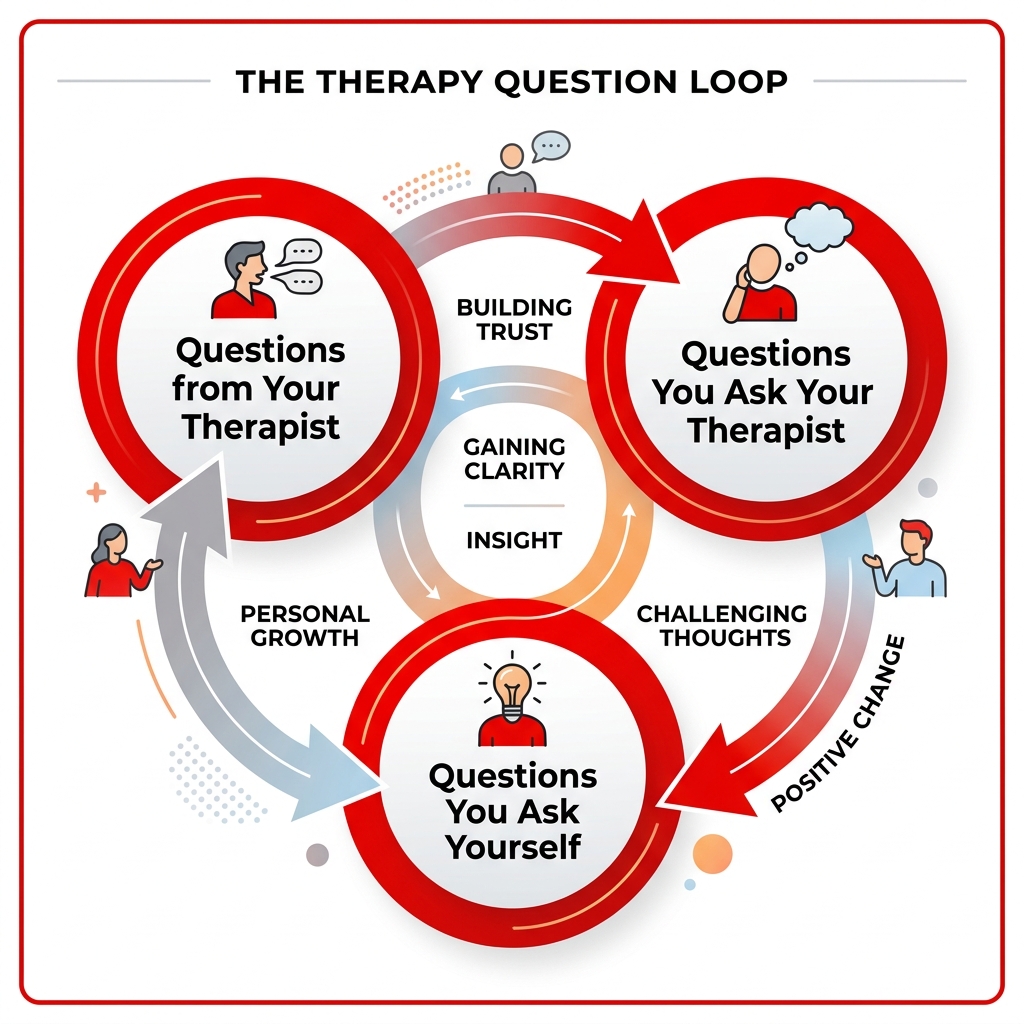
Therapeutic questions are the tools therapists use to help you understand yourself better, process difficult emotions, and work through life’s challenges. But they’re not just for sessions—they’re also questions you can ask yourself for self-reflection and questions you can ask a therapist to find the right support.
Here’s what therapeutic questions do:
- Help you explore emotions and thoughts – “What emotion shows up most often for you?” or “Where do you feel this emotion in your body?”
- Challenge unhelpful beliefs – “What is the evidence that supports this thought?” or “How might your best friend see this situation?”
- Guide self-discovery – “How has living abroad changed who you are?” or “What parts of your identity feel most authentic right now?”
- Strengthen relationships – “What patterns do you notice repeating in your relationships?” or “What boundary do you need to set right now?”
- Assess therapist fit – “Have you worked with people experiencing the same concerns I’m coming in with?” or “How do you measure progress in therapy?”
Most people think therapy is something that happens to them. You show up, your therapist asks insightful questions, and hopefully something profound open ups. But the reality is much more collaborative. Therapy works best when it’s something you co-create. Your questions, your curiosity, and your reflections are just as important as the therapist’s.
For internationals living in cities like Barcelona, Valencia, or Madrid, therapeutic questions take on special importance. They help you process the unique challenges of expat life—cultural adjustment, loneliness, identity shifts, relationship strain, and the constant question of where “home” really is. Asking the right questions can help you feel seen, understood, and less alone with the challenges of building a life abroad.
This guide will show you how therapeutic questions work, which ones to ask yourself between sessions, and how to use them to find the right therapist for your needs. Whether you’re new to therapy or a seasoned client, understanding the power of questions can transform your experience.
Understanding the Foundations of Therapeutic Questioning
At its heart, therapy is a conversation designed to alleviate mental pain and promote healing. The questions asked within this conversation are far from random; they are carefully considered tools that drive self-discovery and change. Questions are fundamental to how a therapist understands your situation and helps you move forward. While asking questions in therapy is a complex skill, using them well is central to making therapy successful.
The key principles of effective therapeutic questioning revolve around fostering an environment of trust, understanding, and exploration:
Open-ended questions: These are a core part of therapy because they invite more than a yes-or-no answer. Questions like “How did that feel for you?” or “Can you say more about that?” help people slow down, reflect, and put their experience into words. They also tend to feel less judgmental, which makes it easier to explore emotions, patterns, and meaning more openly.
Active Listening: This means fully paying attention so the person feels heard and understood. A therapist listens carefully, reflects back key points, and checks they have understood correctly. For example: “It sounds like you’re worried about how your mother will react to your new partner in Barcelona.” This helps build trust and invites clarification.
Building Rapport and Trust: Before delving into sensitive topics, therapists often use less threatening questions to “warm up” clients. This helps clients feel more comfortable and builds the crucial foundation of trust needed for meaningful work. Jumping straight into deep emotional issues can be counterproductive, potentially making a client feel scrutinised rather than supported.
Socratic Questioning: Often used in Cognitive Behavioural Therapy (CBT), Socratic questions gently challenge maladaptive thoughts by prompting clients to examine the evidence for and against their beliefs. For example, “What is the evidence that supports this thought?” or “How might your best friend see this situation?” These questions empower clients to critically evaluate their own thinking patterns.
The Therapist’s Role as a Guide: The therapist’s role is not to provide answers or dictate solutions, but to guide the client towards their own insights. By asking pertinent questions, therapists stimulate clients to think through their problems, explore alternative perspectives, and ultimately find their own path to change.
Central to all these principles is the importance of the therapeutic alliance. Study after study shows that the relationship between the therapist and client—often referred to as the therapeutic alliance or bond—is the most significant factor in determining the outcome of therapy. This alliance is built on mutual liking, good communication, and a shared commitment to working together towards agreed-upon goals. When a client feels safe, understood, and respected, they are more likely to engage deeply with the therapeutic process and achieve lasting change.

A Client’s Guide to Using Therapeutic Questions
The therapeutic process can feel daunting, especially when you’re an expat in a new city like Seville or Gran Canaria. However, by asking the right questions—both of potential therapists and yourself—you can actively shape your experience and ensure it’s as effective as possible.
Questions to Ask a Potential Therapist
Finding the right therapist is a lot like choosing a trusted friend for advice; you need someone who understands your specific situation and with whom you feel a genuine connection. This is particularly true for expats, who often face unique challenges like cultural adjustment, language barriers, and homesickness. Vetting a therapist thoroughly is crucial for establishing that all-important therapeutic alliance.
Here are some key questions you might consider asking during an initial consultation:
- “What types of therapy do you specialise in, and how might that approach help with my specific concerns?” (e.g., CBT for anxiety, psychodynamic for deeper exploration of past patterns, Solution-Focused Brief Therapy for immediate problem-solving).
- “Have you worked with people experiencing similar concerns to mine, especially those related to expat life, cultural adjustment, or living in cities like Barcelona or Malaga?”
- “What does a typical session with you look like? Do you give ‘homework’ or tools to work on between sessions?”
- “How do you measure progress in therapy, and how will we know if I’m getting better?”
- “What’s your communication style? Are you more reflective, or do you take a more direct approach?”
- “Do you have experience supporting people with my cultural background or identity?” (This is vital for culturally sensitive care, especially for internationals).
- “How do you handle boundaries, communication, and crisis situations between sessions?”
- “Based on my primary concerns, what would you expect this approach or treatment plan to include?”
At Therapy in Barcelona, we understand the importance of this match. That’s why we offer personalised therapist matching, taking your specific needs, preferences, and cultural background into account. Our team comprises psychology-trained expat therapists who speak various languages, including English, German, French, Spanish, Afrikaans, Portuguese, Austrian-German, and Swiss-German, making us uniquely equipped to support the international community.
[Mobile-Friendly Comparison] Comparing Therapy Options
When considering therapy in Spain, you’ll encounter various options. Understanding the pros and cons of each can help you make an informed decision about what best suits your needs as an expat.
Public System in Spain
- Pros: Access to mental health services at little to no direct cost. This can be a significant relief for those on a tight budget.
- Cons: Often involves long waiting lists, sometimes extending for months, which can delay urgent support. Session availability can be limited, potentially leading to infrequent appointments. There may be language barriers if you are not fluent in Spanish, and less choice in selecting a specific therapist or therapeutic approach.
Large Online Platforms
- Pros: Offer convenience and accessibility, allowing you to connect with therapists from anywhere, including cities like Madrid or Valencia. They often feature subscription models that can appear more affordable upfront.
- Cons: Therapist matching on these platforms is frequently algorithmic, which can feel impersonal and may not fully capture the nuances of your needs. There are often concerns about data privacy and how your personal information is handled. The quality of therapists and the consistency of care can vary widely, making it difficult to find a truly good fit.
Specialised Expat Practice (like Therapy in Barcelona)
- Pros: Provides personalised therapist matching by a qualified professional, ensuring you’re connected with someone who truly understands your situation. Our team has a deep understanding of expat challenges, offering culturally sensitive care. We uphold strict confidentiality and provide a high-quality, effective service customised to your individual needs. We also offer both in-person sessions in our Barcelona office and online therapy worldwide.
- Cons: This is a private-pay service, representing a higher financial investment than public options. However, some of our therapists offer sliding scale fees for those with financial need, so it’s always worth inquiring about this.
Questions for Self-Reflection Between Sessions
Therapy isn’t just what happens in the session; it’s also the work you do between sessions. For expats living in busy cities like Barcelona or the quieter charm of Alicante, self-reflection is a powerful tool for integrating therapeutic insights into daily life. Journaling can be particularly effective for slowing down thoughts, creating clarity, and tracking your emotional landscape. This active engagement can make your therapy far more effective.
Here are some key self-reflection questions, custom for the expat experience, to ask yourself between sessions:
- Which emotion felt the hardest to sit with this week, and what did it reveal about what I’m afraid of or protecting? (Consider how cultural differences might amplify or alter certain emotions).
- When did I feel empowered in a way that surprised me, and what does that say about the strengths I tend to overlook as an expat?
- What moments drained me? Not just because they were stressful, but because they touched an old wound, an unmet expectation from my expat life, or an unresolved pattern?
- In my relationships this week (whether local or back home), where did I react from habit instead of intention? And what might that pattern be trying to teach me about my expat connections?
- When did my body feel safe and regulated, and what conditions (e.g., a quiet moment in a park in Valencia, a conversation in my native language) allowed that to happen?
- What did I avoid because it felt uncomfortable (e.g., speaking Spanish, attending a local event)? And what story was I telling myself about why I couldn’t face it?
- When did I feel most aligned with my values, and what does that say about the life I’m trying to build as an international in Spain?
- Which thoughts kept looping, especially concerning my identity or belonging abroad? What might they be trying to communicate?
- Which coping strategies actually moved me forward this week (e.g., connecting with expat friends, exploring a new neighbourhood in Zaragoza)? Which ones soothed me in the moment but still kept me mentally stuck (e.g., excessive scrolling, isolating myself)?
- What truth about myself did I notice this week that I’m hesitant to say out loud, even to my therapist?
Reflecting on these questions can provide valuable insights to bring to your next session. For more in-depth exploration of your personal journey, consider individual therapy with a therapist who understands your unique context.
Questions to Ask During Therapy to Deepen Your Progress
Therapy is a co-created journey. Being an active participant means not just answering questions, but also asking them. Your curiosity can help you deepen your understanding, clarify your path, and ensure your sessions are always moving you towards your goals.
Here are some questions you might ask your therapist during a session to deepen your progress:
- “How do you think I’ve progressed since I started therapy? What changes have you observed?”
- “Are there themes you’re hearing across our sessions that I might not be noticing?”
- “What should I focus on between sessions to get the most out of our work?”
- “What skills would help me cope better with [specific challenge, e.g., cultural stress, loneliness]?”
- “What do you think is underneath this feeling or reaction I keep having?”
- “Is there anything you think I’m avoiding that might be important for us to explore?”
- “What progress have you noticed that I might not be giving myself credit for?”
- “Is there anything I need to let go of in order to move forward?”
- “What emotions do you think I need to get more curious about?”
- “How can I tell the difference between discomfort that leads to growth and discomfort that signals something is off?”
- “Do you think I’m being honest with myself about this issue?”
- “What are some strategies I can use in moments when I feel triggered?”
- “How can I challenge the beliefs that keep showing up for me?”
Asking these questions empowers you to take ownership of your healing process and ensures your therapy remains client-centred and aligned with your personal goals.
Examples of Therapeutic Questions for Common Expat Challenges
Expat life in Spain, whether in the vibrant streets of Barcelona or the sunny coasts of Marbella, comes with its own set of unique challenges. Therapeutic questions can be specifically tailored to address these experiences, helping internationals manage cultural shifts, identity evolution, and relationship dynamics.
Navigating Emotions and Cultural Adjustment
Living abroad can stir up a complex mix of emotions, from excitement to profound homesickness and isolation. Learning to identify and process these feelings is crucial for well-being. Naming emotions can actually reduce their intensity and build emotional regulation skills.
Here are some questions to explore your emotions and cultural adjustment:
- “What emotion shows up most often for you when you think about your life in Spain?”
- “Where do you feel this emotion in your body?”
- “When did you last cry, and what brought it on? Was it related to missing home or something new here?”
- “What emotion feels most difficult to express in your new cultural context, and why?”
- “How do you usually calm yourself when homesickness or cultural overwhelm strikes?”
- “Who in your new city (e.g., Barcelona, Málaga) makes you feel safe and understood, and how do you connect with them?”
- “What is one small thing that brought you joy this week in Málaga, and how did you allow yourself to experience it?”
- “How do you speak to yourself when things go wrong or when you make a cultural faux pas?”
- “Which feelings feel safe to share with your new friends or partner, and which do you hide?”
Exploring Thoughts, Beliefs, and Your Evolving Identity
Moving to a new country often challenges our long-held thoughts and beliefs, prompting a re-evaluation of who we are. Cognitive Behavioural Therapy (CBT) excels at helping individuals identify and challenge unhelpful thought patterns that can arise from these shifts.
As detailed in The Science and Art of Asking Questions in Cognitive Therapy, CBT uses Socratic questions to critically examine thoughts. For example:
- “What is the evidence that supports this thought (e.g., ‘I don’t belong here’)?”
- “What evidence suggests this thought might not be entirely true?”
- “How might your best friend see this situation if they were living in Valencia?”
- “What unhelpful thoughts appear under stress, especially when dealing with bureaucracy or new social norms?”
- “Which belief about yourself would you like to change, now that you’re living abroad?”
- “How has living abroad changed who you are, and what aspects of your identity feel most authentic right now?”
- “What cultural beliefs have you adopted or challenged since moving to Spain?”
- “What message would you give your younger self, knowing what you know now about expat life?”
Our team of therapists at Therapy in Barcelona are skilled at guiding these explorations, helping you to understand your evolving identity and to challenge any limiting beliefs that may arise. You can learn more about our team of therapists and their diverse specialisations.
Improving Relationships and Setting Boundaries
Expat life can put a unique strain on relationships, both new and old. Intercultural relationships bring their own complexities, and maintaining connections with loved ones back home while building new ones in cities like Barcelona or Alicante requires conscious effort. Questions can help uncover patterns and empower you to set healthy boundaries.
- “What patterns do you notice repeating in your relationships, both with locals and other expats?”
- “What do you want most from your closest relationships here in Spain, and how does that differ from what you sought back home?”
- “What boundary do you need to set right now to protect your energy or time, especially in new social settings?”
- “How has the expat experience affected your intimate relationships, and what challenges arise in your intercultural relationships?”
- “Who drains your energy, and who replenishes it in your new social circle?”
- “How do you tend to handle conflict, particularly when cultural differences are at play?”
- “How do you maintain connections with friends and family back home while building new ones in Spain?”
- “What is something you’re afraid of in relationships now that you’re living abroad?”
Handling these dynamics can be challenging, and couples often find immense value in exploring these questions together. Couples counselling can provide a safe space to address these issues and strengthen your bond.

Frequently Asked Questions about Therapeutic Questions
What are the different types of therapeutic questions?
Therapists employ a range of question types, each serving a specific purpose in fostering insight and change:
- Open-ended questions: As discussed, these invite detailed responses, such as “How did that make you feel?” or “Can you tell me more about that?”
- Clarifying questions: These ensure the therapist fully understands the client’s meaning. For example, “Did I understand you correctly when you said that you hated your boss?”
- Socratic questions: Predominantly used in CBT, these help clients examine their thoughts critically, like “What is the evidence that supports this thought?”
- Scaling questions: Often used in Solution-Focused Brief Therapy, these ask clients to rate their experience on a scale (e.g., “On a scale of 1 to 10, how motivated are you to make this change?”).
- The “Miracle Question”: A classic Solution-Focused question: “If you woke up tomorrow and, miraculously, your problem was solved, what would be the first thing you’d notice that was different?”
How do therapists tailor questions to different approaches like CBT or Solution-Focused Therapy?
The way a therapist asks questions is highly influenced by their theoretical orientation:
- Cognitive Behavioural Therapy (CBT): CBT often uses Socratic questioning to help people examine unhelpful thoughts rather than simply accept them as facts. A therapist might ask about evidence, alternative explanations, or how a thought affects emotions and behaviour. As explored in The Science and Art of Asking Questions in Cognitive Therapy, the goal is to build insight and more flexible thinking.
- Solution-Focused Brief Therapy (SFBT): As outlined in Solution-focused therapy, this approach pays more attention to strengths, next steps, and the future you want to create than to analysing every past cause. Questions are designed to highlight what is already working and what change could look like, such as “What would be different if things were a little better?”
- Dialectical Behaviour Therapy (DBT): DBT is related to CBT but places stronger emphasis on emotional regulation, distress tolerance, relationships, and acceptance. Questions may help you name emotions, notice triggers, weigh consequences, and practise accepting reality while still working toward change.
- Motivational Interviewing (MI): MI uses thoughtful, non-judgmental questions to help people work through ambivalence about change. A therapist may ask about readiness, confidence, values, and personal reasons for doing things differently, helping motivation come from within rather than from pressure.
- Psychodynamic Approaches: Psychodynamic therapy uses questions to explore how past experiences, attachment patterns, and unconscious dynamics may shape present emotions and relationships. These questions often look at recurring themes, important early relationships, and patterns that show up across different areas of life.
What are some potential pitfalls in therapeutic questioning?
While questions are powerful, their misuse can hinder the therapeutic process. Some common pitfalls include:
- Asking too many questions at once: This can overwhelm the client and make the conversation feel like an interrogation rather than a supportive dialogue.
- Using leading questions: These suggest a “right” answer, which can make clients feel pressured and inhibit genuine self-exploration. For example, asking “You don’t feel sad about that, do you?”
- Asking “why” in a judgmental way: While “why” questions can be useful for exploration, if delivered with an accusatory tone, they can make clients feel defensive or ashamed. Instead, phrasing like “What led you to that decision?” can be more effective.
- Not actively listening to the client’s response: If a therapist is too focused on their next question, they might miss crucial cues or depth in the client’s answer, breaking rapport and trust.
- Jumping into sensitive topics too soon: As mentioned earlier, warming up clients with less threatening questions helps build trust. Addressing highly emotional or traumatic topics without sufficient rapport can be counterproductive.
- Perpetual questioning: A therapist who hides behind constant questions risks limiting the development of a therapeutic alliance. The social expectation to answer can feel like a demand, making the client feel scrutinised.
Effective therapists are mindful of these pitfalls, using questions strategically and with empathy to facilitate authentic connection and meaningful change.
Your Next Question
Therapeutic questions are incredibly powerful tools. They’re not just for the therapist in the session; they’re for you, the client, to use for self-reflection, to better understand your journey, and to actively shape your path to healing and growth. From managing the unique challenges of expat life in Barcelona, Madrid, or Valencia, to simply understanding your own emotional landscape, the right question can open up profound insights.
The journey of self-discovery is a continuous, compassionate conversation. It’s about asking, listening, reflecting, and gently guiding yourself towards a more fulfilling life. Our team of psychology-trained expat therapists at Therapy in Barcelona are skilled at facilitating these conversations, providing culturally sensitive support both online (worldwide) and in our welcoming office in Barcelona. We understand the challenges of international life because we live it too, and we’re committed to helping you find your answers.
If you’d like support exploring your own questions, book a Free Discovery Call today. Let us help you take that next step.
