


The First Big Step: Visas and Legal Requirements
Moving your family from America to Spain is an exciting prospect, but the first step involves working through Spanish bureaucracy to secure your legal status. While Americans can visit for up to 90 days visa-free under the Schengen Agreement, a long-term stay requires a specific visa. This means choosing the right path, preparing paperwork, and meeting health insurance requirements. For more detailed information on making the move, visit More info about moving to Spain or talk to our partners, Alistair and Alison, at Moving to Spain and use our discount code TIB10 to get a discount on any of their services.
Choosing Your Path: Primary Visa Options for American Families
Your family’s circumstances will determine which visa is the right fit.
Non-Lucrative Visa (NLV): Ideal for those with passive income (like retirees or investors) who will not work in Spain. You must prove substantial funds, around $32,000 annually for the main applicant plus $8,000 for each family member. Working is not permitted. You can find more details here for a non-lucrative residence visa.
Digital Nomad Visa (DNV): Designed for remote workers with foreign employers. It typically requires a minimum monthly income of around €2,762, a university degree or three years of relevant experience, and an existing work relationship. It may also offer tax advantages under the Beckham Law. Learn more about Spain’s digital nomad visa and Discover the Digital Nomad Visa in Spain.
Work Visa (Cuenta Ajena): For those with a job offer from a Spanish company. The employer handles the initial application.
Student Visa: An option for full-time students (20+ hours/week). It may allow part-time work and can be extended to family members.
Preparing Your Paperwork: The Essentials
Whichever visa you choose, expect a lot of paperwork. Staying organised is key. You’ll need to get an NIE (foreigner identification number) for all official transactions and a TIE (residence card) after you arrive. Other essential documents include valid passports, visa forms, photos, proof of funds, private health insurance, an apostilled and translated FBI background check, and a medical certificate. More information is available at Obtaining an NIE and Foreigner Identity Card (TIE).
Healthcare: A Non-Negotiable for Your Visa and Well-being
Comprehensive private health insurance is a strict requirement for most long-term visas.
Private Health Insurance: For your visa, you’ll need a private plan with no co-payments (sin copago) and full coverage in Spain. This ensures you have immediate access to medical services. Insurers like Sanitas or Adeslas offer various plans.
Public Healthcare (Sistema Nacional de Salud – SNS): Spain has one of the world’s best public healthcare systems. Once you are a legal resident and contributing to social security (e.g., through work), you and your family can typically access the SNS. Learn more at Spain’s public healthcare system.
Comparing Your Options:
Public System
Spain’s public healthcare is excellent, but you can typically only access it once you are a legal resident contributing to social security. Wait times for specialists can be long, and dental care is often not included.
Large Online Platforms
International insurance providers are convenient and have English-speaking support, but they may lack local knowledge of the Spanish system.
Local Practices
Local insurance brokers in Spain can offer custom plans and in-person help, but the language barrier can be an issue.
Therapy in Barcelona
While we do not provide health insurance, we understand the stress of dealing with new healthcare systems. We support the emotional side of this transition and can refer you to trusted professionals for practical help.
Setting Up Your New Life: Housing, Finances, and Schools
Once you’ve secured your visas, the real adventure begins: building a life in Spain. For an American family moving to Spain, this means finding a home, understanding the tax system, and choosing a school for your children. With some planning, you can find your footing. For more insights, check out More info about moving to Spain for Americans.
Finding a Home for Your Family in Spain
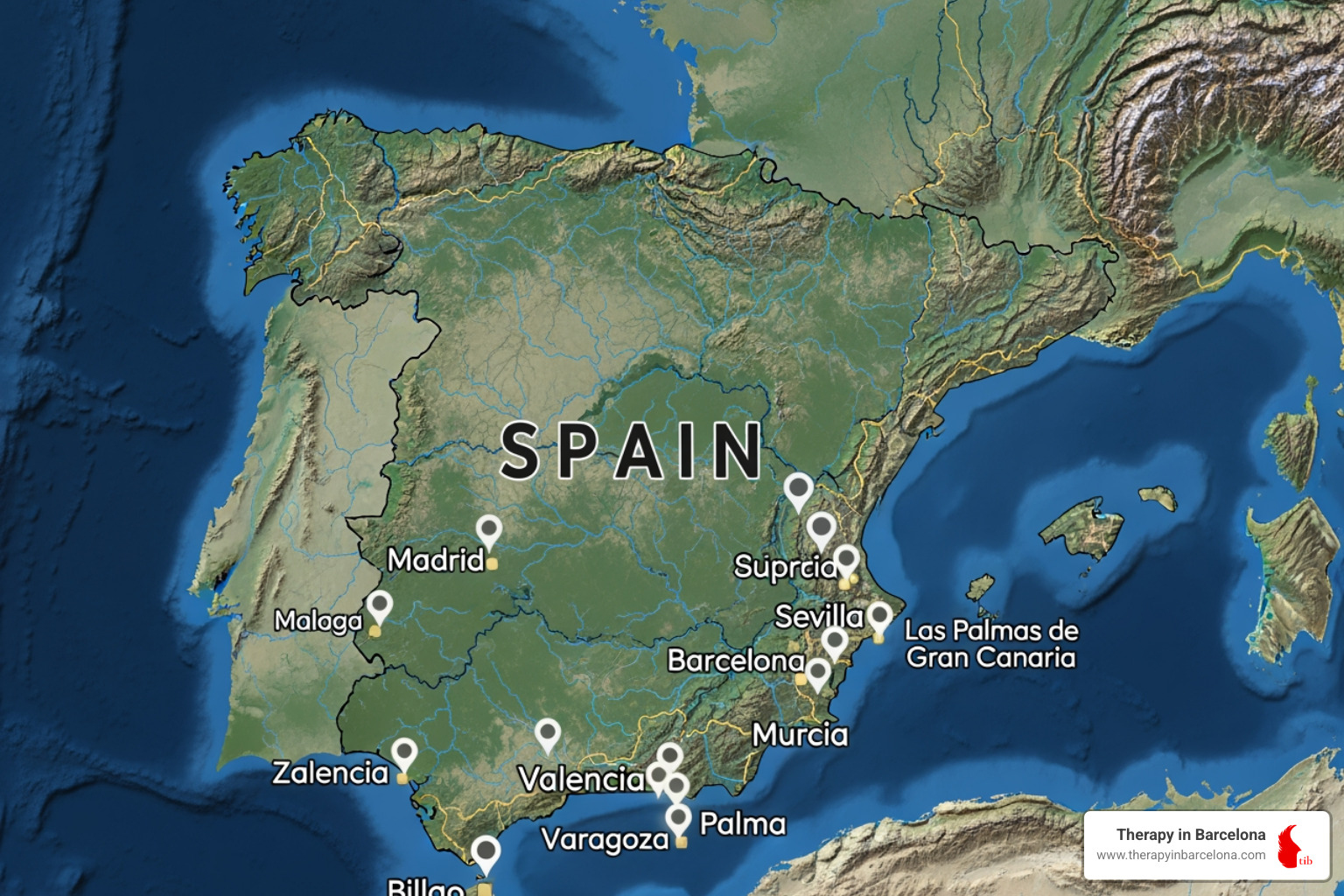
Where you live will shape your entire experience. Most expat families start by renting rather than buying to test out different neighbourhoods before committing. Spain’s property market varies wildly, from affordable inland towns to pricey coastal hotspots.
Madrid and Barcelona are the most expensive, cosmopolitan hubs, with monthly living costs for a single person easily topping €3,000. Valencia offers a great balance of city life and coastal charm at a lower cost. Down south, Málaga and Alicante are popular for their warm climates and relaxed pace, with Málaga also becoming a tech hub. Smaller cities like Girona or upscale towns like Marbella offer their own unique lifestyles.
Overall, Spain has a significantly lower cost of living than the US. Rent in Madrid can be 50-60% lower than in New York City. You can explore detailed comparisons on Numbeo cost of living data. When you’re ready to search, Idealista and Fotocasa are the main housing portals. A local estate agent (inmobiliaria) can be a great help, especially with language and contracts.
Managing Your Finances: Taxes and Banking
As an American citizen, you must file US tax returns annually on your worldwide income, along with FBAR or FATCA forms if applicable. The U.S.-Spain Tax Treaty helps prevent double taxation. Once you become a tax resident in Spain (after 183 days in a year), you’ll pay Spanish tax (IRPF) on your worldwide income, with rates from 19% to 47%.
Spain also has a Wealth Tax on assets over €700,000, though Madrid offers a 100% exemption. The Beckham Law is a special regime for qualifying foreign workers, offering a flat 24% tax rate on Spanish income up to €600,000 for six years. You may also need to declare foreign assets over €50,000 via Form 720, filed electronically through the Agencia Tributaria.
You will need to open a Spanish bank account for rent and utilities, usually with your NIE, passport, and proof of address. Traditional banks can be bureaucratic, so many expats also use online banks and money apps like N26, Revolut, or wise-style international services such as Wise to manage everyday spending and international transfers more easily.
Comparing Your Options:
Spanish Tax Offices (Agencia Tributaria)
These offices offer official guidance and resources but comprehensive English support is limited, which can be stressful.
Large Online Platforms
Services like Taxes for Expats specialise in US expat taxes, offering convenience but a less personal service.
Local Practices
A local gestor or tax advisor provides bespoke advice on the Spanish system, but finding an English-speaking expert is key.
Education in Spain: A Critical Choice for an American Family Moving to Spain
Choosing a school is one of your biggest decisions. We love our partner, Anya at My BCN School for finding schools in Barcelona or Sinead at Steps into Spain who helps find schools in Madrid.
Public schools (colegios públicos) are free and offer full immersion in Spanish language and culture, which is great for younger children. The teaching style may focus more on memorisation, and support for learning differences can be more limited than in the US.
Semi-private schools (concertados) are partially government-funded, have lower fees than private schools, and often have a religious affiliation. They can be a middle ground.
Private and international schools follow American, British, or IB curricula, making for a smoother academic transition. They offer bilingual education and cater to the international community, but annual fees can range from €6,000 to over €20,000.
When choosing, consider language goals, curriculum, location, and your child’s integration needs. If your child has learning differences, research the support available at each school carefully.
Comparing Your Options:
Public Schools
Free and offer deep cultural immersion, but can be challenging for older children without Spanish. Support for learning differences may be limited.
Large Online Platforms
School search tools provide lists but lack the nuanced, personal advice your family needs.
Local Practices
School consultants offer personalised guidance but may not fully understand the needs of American expat children.
Therapy in Barcelona
We understand that adapting to a new school is challenging. Our culturally sensitive therapy supports adolescents, and families as they adjust. If you’re concerned about how your child is adjusting, we’re here to help. For more information, visit Help for international families in Barcelona.
The Human Side of the Move: Culture, Language, and Family Well-being
Beyond visas and housing, moving to Spain is a deeply human experience. The emotional adjustment of uprooting your life and adapting to a new culture can be immense, and it affects everyone in the family differently. For your family moving from America to Spain, understanding these emotional dimensions is as important as sorting out your NIE. For more on this topic, explore The Hidden Challenges of Expats in Spain.
Embracing a New Culture: From Siestas to Social Life
Spanish culture is vibrant, but it requires adapting to some key differences. Trust is often built through personal connection and time spent together, a more “relationship-based” approach compared to the task-oriented style common in the US. You can learn more in Erin Meyer’s Culture Map.
Work-life balance is a genuine priority, with more paid leave and a focus on quality of life. Social life revolves around long, leisurely meals with family and friends, with dinner often starting after 9 pm. The language barrier is real, and learning even basic Spanish is crucial for daily life and deeper integration. For adaptation strategies, see Navigating Change as an Expat.
The Emotional Journey: Supporting Your Family Through the Transition
Relocation brings a mix of highs and lows. Expect to move through the stages of culture shock: from the initial honeymoon phase to frustration, adjustment, and finally, adaptation. Understanding this process helps you cope. For more, see Culture Shock Therapy Explained.

Expat fatigue—the mental drain of living in a foreign culture—is normal. Children and teenagers often struggle with leaving friends and adapting to a new school. It’s important to create a supportive space for their feelings. Our team of therapists specialise in helping teenagers through these changes.
The stress of a move can also strain couples, as partners may adapt at different paces. Couples therapy can provide tools to improve communication and reconnect. More on this at The Strain of Moving Abroad on Relationships.
Finding Your Support System in Spain
Building a support system is essential. Expat communities in cities like Madrid, Barcelona, and Valencia offer a network of people who understand your challenges. At the same time, connecting with locals will deepen your experience. Sometimes, however, professional support is the best path forward.
Comparing Support Options:
Public System
Spain’s public healthcare includes mental health services, but wait times can be long, and finding English-speaking therapists is not guaranteed.
Large Online Platforms
These platforms offer quick access to therapists but may lack the cultural sensitivity for the expat experience in Spain. Some also have data privacy concerns.
Local Practices
Local therapists offer in-person support, but finding one who speaks English and has specific expat experience can be a challenge.
Therapy in Barcelona
We offer a tailored service for internationals. Our psychology-trained therapists are expats themselves, so they understand these challenges. We provide bespoke therapist matching to help you or your family find the right fit. Founded by Australian Psychologist Leigh Matthews, in Barcelona since 2011 and experienced in supporting internationals, our practice is a trusted private-pay option. We offer culturally sensitive support in English, as well as German, French, Spanish, Afrikaans, Portuguese, Austrian-German and Swiss-German, with strict privacy policies. We provide online therapy worldwide, including the USA and Canada, and in-person sessions in Barcelona. If you’d like support, book a Free Discovery Call to find the right therapist for your family.
Your Practical Checklist for an American Family Moving to Spain
Moving your family from America to Spain is a long process, not a quick one. An organised checklist can reduce stress by breaking the process into manageable steps. For more guidance, visit More info on the challenges of family relocation.

Before You Go: US-Based Preparations
Start early. The administrative process can take months.
Visa Application: Begin three to six months before your planned departure. Gather all required documents, including passports, financial proofs, and medical certificates. Some documents, like your FBI background check, need to be apostilled and translated by a sworn translator, which takes extra time.
Health Insurance: Secure comprehensive private health insurance that meets Spanish visa requirements (no co-payments and full coverage in Spain).
Housing Research: Start your initial housing search online. Researching neighbourhoods and costs in cities like Madrid, Barcelona, or Valencia will help you make quicker decisions upon arrival.
Learn Spanish: Even basic Spanish will make your first weeks much smoother. Apps like Duolingo or Babbel are good starting points, and you can deepen your skills later with local language schools or online tutors.
Upon Arrival: First Month in Spain
The first month is for formalising your residency. Meet your deadlines to avoid complications.
Apply for your TIE card: Within 30 days of arrival, book a cita previa (prior appointment) and apply for your Foreigner Identity Card at the designated police station. This is your physical residence card.
Register at the Town Hall (Empadronamiento): This official registration in your municipality is required for many services, including school enrolment and healthcare access. Bring your passport, NIE, proof of address, and check your local council’s website for any extra requirements; you can read more about typical steps in guides like this overview of moving to Spain.
Open a Bank Account: With your NIE and empadronamiento, you can open a Spanish bank account for rent, utilities, and daily expenses.
Finalise School Enrolment: Complete the registration process for your children’s school.
Set up Utilities: Arrange for electricity, water, gas, and internet in your new home.
Settling In: Long-Term Integration for an American Family Moving to Spain
Long-term integration requires ongoing effort, but it is also where the rewards of expat life are found.
Build Community: Actively seek out expat groups and local clubs. Whether you’re in Madrid, Barcelona, or on the coasts of Málaga or Alicante, these connections become your support network.
Improve Your Spanish: Immersion is the best teacher, but formal classes can accelerate your progress. The more you learn, the more doors will open.
Explore Your Region: Embrace Spain’s diversity by exploring your local area, whether it’s the culture of Sevilla or the beaches near Valencia.
Be Patient with Bureaucracy: Spanish administrative tasks can be slow. Patience, persistence, and keeping copies of all documents are your best allies.
Maintain Connections: Balance staying connected to home with engaging in your new life. For strategies on well-being abroad, read Staying Sane Abroad. Settling in takes time. Give yourself and your family permission to adjust at your own pace.
Frequently Asked Questions about Moving to Spain
How much money does a family need to move to Spain?
The financial requirements for your American family moving to Spain depend on your visa and location.
For the Non-Lucrative Visa, you must prove passive income of at least $32,000 annually for the main applicant, plus about $8,000 for each additional family member. The Digital Nomad Visa requires a minimum monthly income of €2,762 from foreign sources.
Your cost of living will also vary. Madrid and Barcelona are the most expensive cities. For a family of four, monthly expenses can range from €2,500 to €4,000, excluding rent. In contrast, cities like Valencia, Málaga, and Alicante are more affordable, with family expenses often ranging from €2,000 to €3,500 before rent.
Remember to budget for upfront costs like visa fees, flights, rent deposits (typically two months), and a financial buffer for unexpected expenses.
Can I work in Spain if my family is on a Non-Lucrative Visa?
No. The Non-Lucrative Visa explicitly prohibits any work or professional activity in Spain. It is designed for individuals who can support themselves with passive income or savings.
If you plan to work, you need a different visa. The Digital Nomad Visa is for remote work with foreign companies, and a Work Visa (Cuenta Ajena) is for employment with a Spanish company. Attempting to work on an NLV can lead to serious legal consequences, including fines and visa revocation. Choose the correct visa from the start.
Is Spain a safe country for American families?
Yes, Spain is a very safe country for families. It consistently ranks high on the 2023 Global Peace Index, with significantly lower rates of violent crime than the United States. Gun violence is virtually non-existent, a fact many American families find reassuring.
Children often have more freedom to play outdoors and walk in their neighbourhoods. While petty crime like pickpocketing can occur in major tourist areas like Barcelona or Madrid, basic precautions are usually enough to minimise risk.
Overall, Spain offers a secure and welcoming environment, making it an attractive destination for an American family moving to Spain seeking a safer, more relaxed lifestyle.
Support for Your Family’s New Chapter in Spain
Starting a new life in Spain is a huge step for any American family. While there will be challenges like bureaucracy and homesickness, there are also incredible rewards: your children could grow up bilingual, and your family can enjoy a culture where work-life balance is a priority.
The adjustment is a journey, and it’s okay to feel overwhelmed. You don’t have to steer it alone. The team at Therapy in Barcelona understands what it’s like to be far from home. Many of us are expats ourselves, and we are dedicated to supporting the international community.
We offer culturally sensitive therapy for individuals, couples, teenagers and families, helping you process the emotional side of relocation and find your footing in Spain. We work online with clients worldwide (including the USA and Canada) and offer in-person sessions in Barcelona.
If your family is feeling the ups and downs of this transition, we are here to help. If you’d like support, book a Free Discovery Call to see how our therapy services can support you in feeling at home in Spain.
