


Why Work-Life Balance Counseling Could Be Your Game-Changer

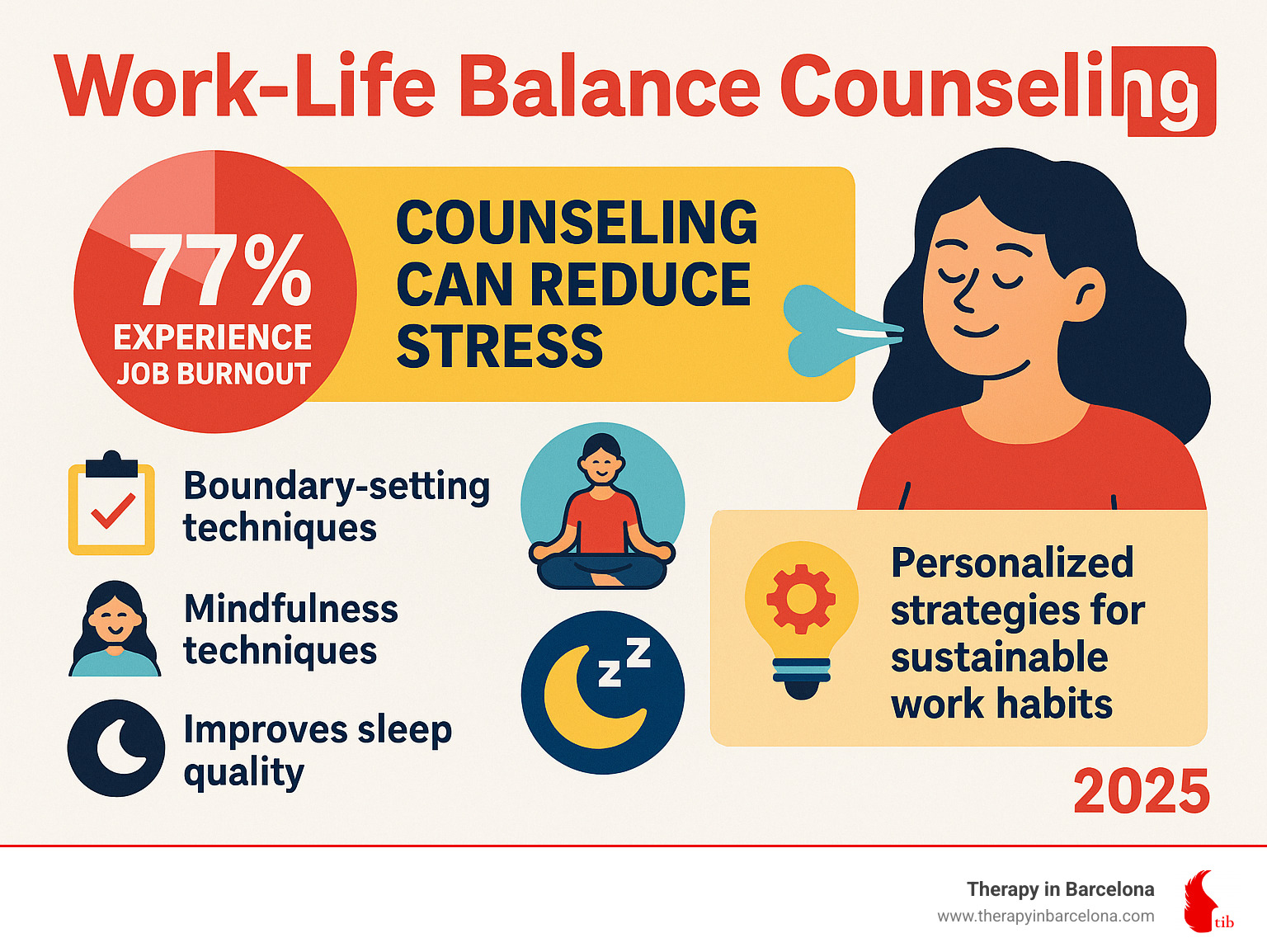
Work-life balance counseling helps you develop practical strategies to manage stress, set boundaries, and create sustainable habits that prevent burnout whilst enhancing both your professional success and personal wellbeing. Here’s what it offers:
- Boundary setting techniques – Learn to say no and protect your personal time
- Stress management tools – Master mindfulness, breathing exercises, and cognitive reframing
- Values clarification – Align your time with what truly matters to you
- Communication skills – Steer workplace demands and personal relationships assertively
- Personalised action plans – Create sustainable routines that fit your unique situation
Does work keep spilling into your evenings, weekends, or family time? If so, it may be a sign your boundaries are under pressure. When work starts taking over your personal life, stress builds, rest suffers, and it becomes harder to feel present anywhere.
For expats living in Barcelona, the challenge intensifies. You’re already juggling cultural adaptation, language barriers, and being far from your support network. Add demanding work schedules to the mix, and it’s no wonder many internationals feel overwhelmed, exhausted, and disconnected from the life they imagined abroad.
Work-life balance isn’t about perfect equality between work and personal time – it’s about creating boundaries that allow you to thrive in both areas. When you’re struggling to switch off, constantly checking emails, or feeling guilty about taking breaks, counselling provides the tools and perspective you need to reclaim control.
What “Balance” Really Means for Modern Expats
The traditional image of work-life balance—leaving the office at 5 PM and forgetting about work until 9 AM—feels almost quaint in today’s interconnected world. For expats navigating international careers in 2024, balance has evolved into something far more nuanced and personal.
True balance isn’t about perfect equality between work and personal time. Instead, it’s about creating an integrated life where different aspects complement rather than compete with each other. Think of it less like a rigid scale and more like a skilled juggler who knows when to give more attention to one ball without dropping the others.
Values-based time allocation forms the foundation of modern balance. Your schedule should reflect what genuinely matters to you, not just what screams loudest for attention. This might mean fiercely protecting family dinners, scheduling regular runs along Barcelona’s beaches, or ensuring you have time to explore the city’s incredible cultural offerings.
The concept of flexible boundaries has replaced the old “leave work at work” mentality. Modern balance requires adaptable boundaries that bend without breaking. You might work later one evening to attend your child’s school event the next day, or take a longer lunch break to manage personal errands. The key is that these adjustments serve your overall wellbeing rather than just work demands.
For expats, balance includes a unique dimension: cultural integration. Time for cultural exploration, language learning, and maintaining connections with home aren’t luxuries—they’re essential for mental health and successful integration.
Research from the BBC highlights that work-life balance isn’t a destination you reach, but an ongoing process of adjustment and recalibration.
Why It Matters to Your Mind & Body
The ripple effects of poor work-life balance extend far beyond feeling a bit tired after a long day. When you’re constantly “on,” your mind and body begin to pay a price that compounds over time.
Mental health takes the first hit. Your brain needs downtime to process information and reset for tomorrow’s challenges. Without this natural rhythm, you might find yourself feeling foggy, overwhelmed, or emotionally reactive. Increased anxiety, depression, and irritability often signal that your mental resources are running on empty.
The physical toll manifests in ways you might not immediately connect to work stress. Disrupted sleep patterns become the norm. Your immune system weakens, leaving you more susceptible to illness. Chronic stress lifts cortisol levels, which can lead to heart health issues, weight gain, digestive problems, and persistent muscle tension.
Paradoxically, creativity and productivity actually decline when you’re overworked. Your brain makes its most innovative connections during rest periods. Those “aha!” moments rarely happen during your tenth hour at the desk—they occur in the shower, during walks, or while chatting with friends.
The encouraging news? Research consistently shows that individuals who maintain better work-life balance demonstrate higher work performance, increased productivity, and the ability to sustain their careers longer.
Red Flags & Real Costs of Poor Balance
When you’re caught up in the daily grind of expat life, it’s easy to dismiss warning signs as just part of “adjusting to a new country.” But recognising these red flags early can save you from serious burnout down the line.
Your body often speaks first. That persistent fatigue that doesn’t lift even after a full weekend? Those tension headaches that seem to appear every afternoon? Changes in your sleep patterns or appetite can signal that your work-life balance has tipped too far. Many expats find themselves getting sick more frequently, as chronic stress weakens your immune system.
Emotionally, the signs can be subtler but equally telling. Perhaps you’ve noticed yourself snapping at your partner over small things, or feeling a knot of anxiety in your stomach when you see work emails piling up. That guilt you feel when you’re not working—even during your designated time off—is a classic red flag.
Behaviourally, poor work-life balance shows up in the choices you make daily. Working through lunch becomes the norm rather than the exception. You cancel dinner plans because of an “urgent” project that somehow always seems to appear. Your phone buzzes with work notifications during family time, and you find yourself checking emails compulsively, even on holiday.
Poor work-life balance is common, and for expats it can feel even heavier. On top of job pressure, you may also be adjusting to a new culture, speaking another language every day, and living far from your usual support system. That mix can make stress build faster and recovery take longer.

When to Seek Work-Life Balance Counseling
The question isn’t whether you’re struggling—most expats face work-life balance challenges at some point. The real question is when those challenges require professional support.
Chronic exhaustion that persists despite adequate sleep is often the first clear indicator. If you’re waking up tired, feeling drained during holidays, or finding that rest doesn’t actually restore your energy, your stress response system may be stuck in overdrive.
When boundaries become invisible, it’s time to seek help. This might look like checking emails at midnight, taking work calls during family dinners without thinking twice, or feeling genuinely distressed when you can’t access work communications.
Physical symptoms deserve serious consideration. Insomnia, persistent headaches, digestive issues, or frequent minor illnesses aren’t character flaws—they’re your body’s way of saying the current situation isn’t sustainable.
Relationship strain often provides the clearest mirror. When family or friends start commenting on your availability, mood, or presence, it’s worth listening. If you find yourself consistently choosing work over personal relationships, professional guidance can help you recalibrate.
The key insight here is that seeking help demonstrates strength and self-awareness, not weakness. Just as you wouldn’t ignore a persistent physical injury, chronic work-life imbalance deserves the same level of attention and care.
Work-Life Balance Counseling: How It Works & Why It Helps
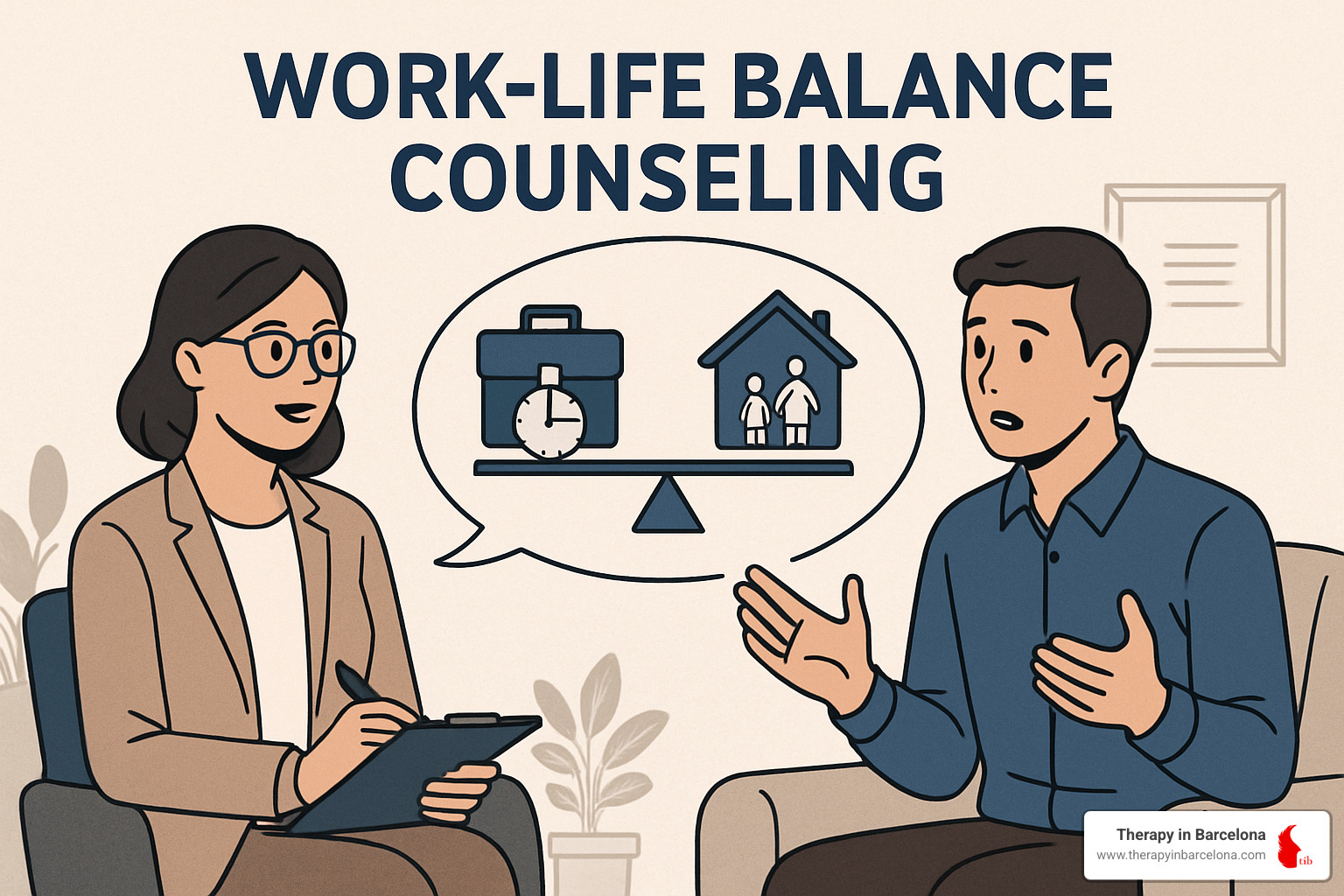
Work-life balance counseling takes a specialised approach that’s quite different from general therapy. Rather than exploring your entire life history, this focused method zeros in on the specific challenges where your professional and personal worlds collide.
The journey typically begins with your counsellor getting a comprehensive picture of your current reality. They’ll want to understand your work demands and schedule patterns, but they’ll also dig deeper into your personal values and life priorities. What matters most to you? Are you actually living according to those values, or has work gradually taken over?
For expats, there’s an added layer of complexity that experienced counsellors understand well. Cultural factors play a massive role in work-life integration. The Spanish approach to work-life balance might feel completely foreign if you’re coming from a culture where 60-hour weeks are celebrated.
The evidence-based approaches used in work-life balance counselling are specifically chosen for their effectiveness in addressing boundary issues, stress management, and sustainable behaviour change.
Cognitive Behavioural Therapy (CBT) helps you identify and challenge those sneaky thought patterns that keep you trapped in unhealthy work habits. You know the ones – “I must be available 24/7 or I’ll lose my job” or “Taking breaks means I’m lazy.” CBT gives you tools to question these beliefs and develop more balanced, realistic thinking patterns.
Acceptance and Commitment Therapy (ACT) focuses on your values and helps you take committed action towards a more balanced life, even when workplace pressures feel overwhelming.
Mindfulness-Based Stress Reduction (MBSR) teaches you to stay present and manage stress more effectively. This isn’t just about meditation apps – it’s about developing the ability to notice when work stress is creeping into your personal time and having practical tools to address it.
| Work-Life Balance Counseling | Life Coaching | General Stress Management | |
|---|---|---|---|
| Focus: | Specific work-life integration challenges | Goal achievement and performance
| General stress reduction |
| Duration: | Typically 8-16 sessions | Ongoing as needed
| Varies widely |
| Approach: | Evidence-based therapeutic techniques | Motivational and action oriented
| Relaxation and coping skills |
| Depth: | Addresses underlying patterns and beliefs | Surface-level behaviour change | Symptom management |
At Therapy in Barcelona, the personalised matching process ensures you work with someone who truly understands expat life. Your counsellor isn’t just professionally qualified; they’re also someone who gets what it’s like to steer work pressures in a foreign country.
Core Techniques in Work-Life Balance Counseling
The practical techniques used in work-life balance counselling are designed to give you concrete tools you can use immediately.
Time audit exercises often surprise people because they reveal the gap between where you think your time goes and where it actually goes. This awareness becomes the foundation for making more intentional choices.
Values mapping involves identifying your core values and honestly examining how well your current schedule aligns with them. If family connection is a core value but you haven’t had dinner with your partner in three weeks, that’s valuable information.
Boundary rehearsal provides a safe space to practice those difficult conversations you’ve been avoiding. Whether it’s negotiating flexible hours with your manager or explaining to colleagues why you won’t check emails after 8 PM, rehearsing these conversations builds confidence.
Cognitive reframing techniques help you challenge those unhelpful thoughts about work and productivity. Instead of “I should be working right now,” you might learn to reframe this as “Rest helps me be more effective tomorrow.”
For more detailed information about managing work-related stress that complements counselling work, you can explore additional stress management techniques.
Benefits You Can Expect from Work-Life Balance Counseling
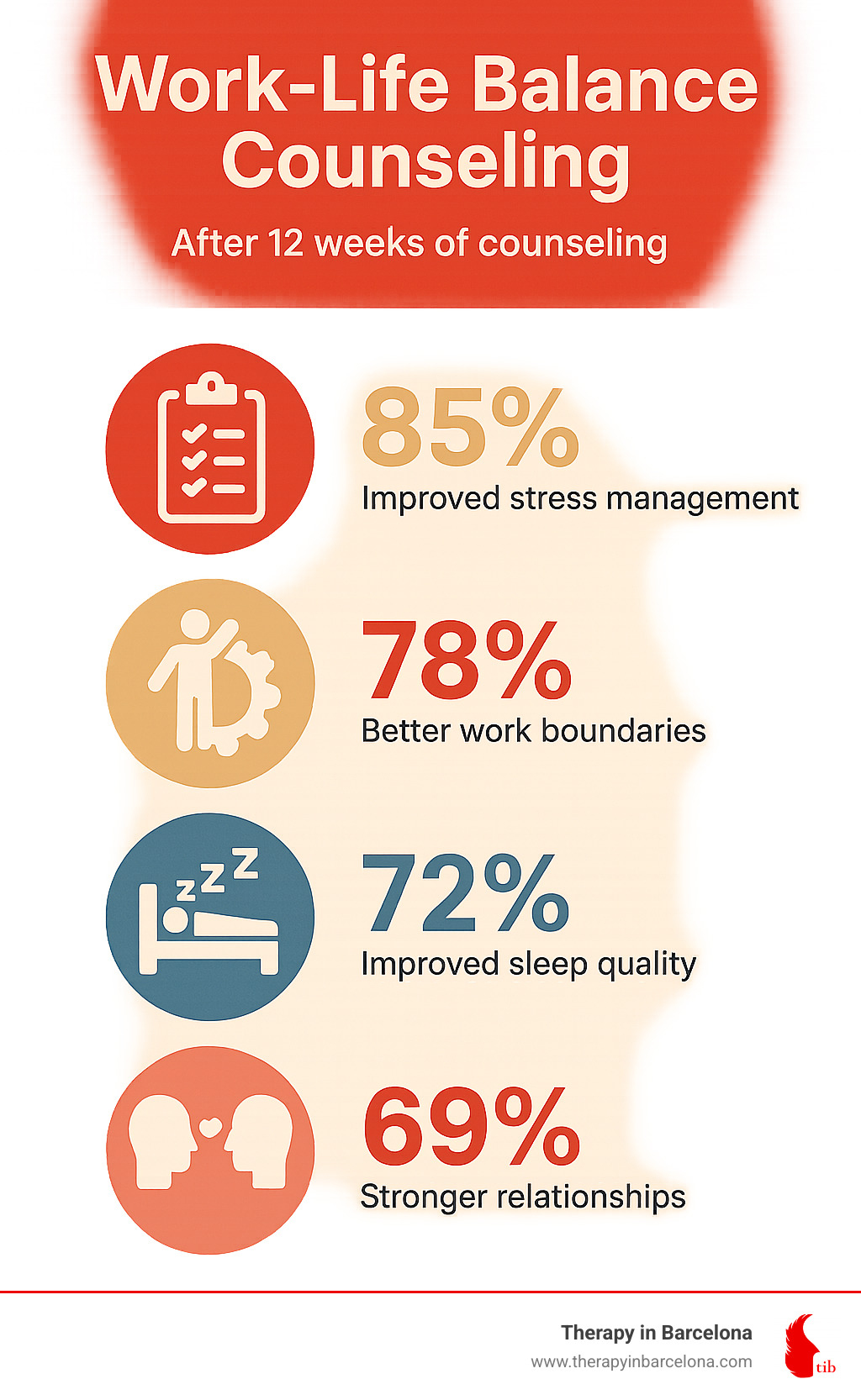
The benefits of work-life balance counselling extend far beyond simply feeling less stressed. Clients typically report improvements across multiple areas of their lives.
Reduced stress and anxiety often emerge within the first few sessions as you learn immediate coping strategies and begin to challenge unhelpful thought patterns.
Improved productivity might seem counterintuitive – after all, if you’re working fewer hours, shouldn’t you get less done? The reality is quite the opposite. When you’re well-rested, focused, and not constantly stressed, you accomplish more in less time.
Better sleep quality improves as you learn to mentally transition from work mode to rest mode. This isn’t just about turning off devices; it’s about creating mental boundaries that allow your mind to truly rest.
Stronger relationships often improve as you become more present and emotionally available. When you’re not constantly preoccupied with work concerns, you can engage more fully with family and friends.
Long-term maintenance skills ensure that the changes you make are sustainable. Rather than quick fixes that fade over time, counselling provides you with tools you can use throughout your career to maintain balance as circumstances change.
Your DIY Toolkit: Strategies & Apps You’ll Practise Between Sessions
The real magic of work-life balance counselling happens between sessions. While your weekly meetings provide guidance and support, the daily practice of new strategies is where lasting change takes root.
Digital companions can become your allies in this journey. The Quenza app offers customised exercises custom to your specific challenges, along with mood tracking that helps you spot patterns before they become problems. RescueTime works quietly in the background, automatically tracking how you spend time on your devices—many clients are surprised to find they’re spending two hours daily on social media when they thought it was just “a few minutes here and there.”
Toggl helps you understand where your work time actually goes, which is often quite different from where you think it goes. Meanwhile, Cozi can be a lifesaver for busy families, coordinating schedules and reducing the mental load of constant planning.
Time-blocking transforms your calendar from a passive record into an active tool for balance. Instead of letting work expand to fill every available moment, you’ll schedule specific activities—including personal time—just as you would important meetings.
Micro-breaks throughout the day can prevent stress from building up like pressure in a kettle. Even two to three minutes of deep breathing or gentle stretching can reset your nervous system. Your counsellor might teach you the “4-7-8” breathing technique or simple desk stretches.
Learning delegation strategies often surprises people with how much time it can free up. This includes both work tasks and household responsibilities. The key is recognising that delegation isn’t laziness—it’s strategic time management.
The art of saying no requires practice and, often, prepared scripts. Your counsellor will help you develop polite but firm ways to decline requests that don’t align with your priorities.
Unplugging protocols establish clear boundaries around technology use. This could mean turning off work notifications after 8 PM, designating phone-free zones in your home, or creating a “charging station” outside the bedroom to improve sleep quality.
Step-by-Step: Building New Habits
Change happens gradually, then suddenly. Your counsellor will guide you through structured exercises that make abstract concepts concrete and actionable.
The clock day exercise provides a powerful visual reality check. You’ll draw a circle representing 24 hours and fill in how you currently spend your time versus how you’d ideally spend it. Most people find surprising discrepancies.
The wheel of life assessment helps you rate your satisfaction in different life areas: career, relationships, health, personal growth, finances, and recreation. This creates a visual map of which areas need attention.
SMART goals provide structure for turning good intentions into concrete actions. Instead of vague commitments like “work less,” you might set a goal like “leave the office by 6 PM four days per week for the next month.”
Weekly reflection practices help you notice what’s working and what isn’t. You might spend 15 minutes each Sunday reviewing the previous week: What went well? What was challenging? What would you do differently?
The research is clear: fewer than 3% of people actually plan their goals, which explains why so many struggle with work-life balance. Work-life balance counselling provides the structure and support to move from good intentions to sustainable change.
Busting Myths & Creating Supportive Environments
The path to better work-life balance counselling often begins with clearing away the misconceptions that keep us stuck. Let’s tackle some of the most persistent myths that might be sabotaging your efforts before you even start.
The myth that you can “have it all” is perhaps the most damaging belief in modern work culture. This unrealistic expectation sets you up for constant disappointment and self-criticism. The reality? Balance involves conscious trade-offs and intentional choices. You can absolutely have a fulfilling career and rich personal life, but not necessarily everything you want at exactly the same time.
Perfect 50/50 splits between work and personal time sound appealing in theory, but they’re neither realistic nor necessary. True balance isn’t about equal time distribution; it’s about allocation that aligns with your values and current life circumstances.
Perhaps most destructively, many people believe that successful people don’t need balance. This myth glorifies burnout and suggests that struggling with work-life integration means you’re not ambitious enough. Research consistently contradicts this narrative, showing that sustainable high performance requires recovery and renewal.
Integration versus separation represents a more nuanced approach to modern work-life balance. Some people thrive with clear boundaries—switching off completely at 6 PM and never checking emails from home. Others prefer a more fluid approach, perhaps working flexibly throughout the day while attending their child’s afternoon school event. Neither approach is inherently superior.
Perfectionism and workaholism often masquerade as dedication or high standards, but they’re actually barriers to sustainable success. These patterns can be particularly challenging for expats who feel pressure to “prove themselves” in a new country.
For expats dealing with the additional pressures of establishing careers in a new country, career stress therapy addresses the unique intersection of professional demands and cultural adaptation challenges.
How Employers Can Champion Balance
Whilst individual strategies are crucial, organisational support dramatically impacts your ability to maintain work-life balance. Progressive employers are finding that investing in employee wellbeing isn’t just altruistic—it’s good business.
Flexible working arrangements go beyond simple remote work options. This might include core collaboration hours when everyone’s available, with flexibility around start and end times to accommodate different chronotypes and personal responsibilities.
Leadership modelling sends the most powerful message about company values. When managers consistently work excessive hours, respond to emails at midnight, or skip holidays, they create unspoken pressure for others to do the same.
Employee Assistance Programmes (EAPs) often provide confidential counselling and support services, yet many employees remain unaware of these resources. Well-designed programmes offer more than crisis intervention—they provide proactive support for managing stress and maintaining mental health.
Creating a supportive environment requires ongoing commitment rather than one-off initiatives. Companies that successfully champion balance often see improvements in employee satisfaction, reduced turnover, and better business outcomes.
Frequently Asked Questions about Work-Life Balance Counseling
Is work-life balance counseling different from general therapy?
Work-life balance counselling takes a laser-focused approach to the specific challenges where your professional and personal worlds collide. While general therapy might explore your childhood experiences or broader mental health concerns, work-life balance counselling zeroes in on the practical, day-to-day struggles of managing career demands alongside your wellbeing.
The sessions tend to be more structured and solution-oriented, with your counsellor helping you develop concrete strategies for boundary setting, time management, and stress reduction. You might spend time doing practical exercises like auditing how you actually spend your time, clarifying what truly matters to you, or rehearsing difficult conversations with your manager.
What makes this particularly valuable for expats is that your counsellor understands the additional layers of complexity you’re dealing with. They recognise that saying no to overtime requests feels different when you’re trying to prove yourself in a new country.
How long does it usually take to see results?
The encouraging news is that most people notice some positive changes within their first few sessions. You might find yourself sleeping better, feeling clearer about your priorities, or simply experiencing less anxiety about taking a proper lunch break.
Initial improvements typically emerge within 2-4 weeks and might include better awareness of your stress triggers, improved sleep quality, clearer boundaries around work time, and reduced guilt about taking breaks.
The more substantial, lasting changes usually develop over 8-16 sessions, depending on how entrenched your current patterns are and how complex your situation is. Deeper changes – like shifting long-held beliefs about productivity or changing perfectionist tendencies – often take several months of consistent practice.
The key is that work-life balance counselling isn’t about quick fixes; it’s about developing a toolkit of strategies and a new way of thinking about work and life that serves you throughout your career.
Can remote or digital-nomad workers benefit equally?
Absolutely – in fact, remote workers and digital nomads often find work-life balance counselling particularly transformative because their challenges are so unique and often misunderstood by others.
Remote workers face the peculiar challenge of their sanctuary becoming their office. When your dining table doubles as your workspace and your bedroom is just steps away from your computer, creating boundaries becomes both more crucial and more difficult.
Digital nomads steer an entirely different set of complexities. You’re managing work demands while constantly adapting to new environments, time zones, and cultural contexts. The romantic notion of working from a beach in Bali quickly loses its appeal when you realise you’re answering client calls at 3 AM.
The counselling process for location-independent workers often focuses on creating structure where traditional workplace boundaries don’t exist. This might involve developing portable routines that work whether you’re in Barcelona or Bangkok, establishing clear communication protocols with clients about your availability, or learning to maintain social connections when your “office” is wherever you happen to be.
The beauty of online counselling is that it travels with you. Whether you’re struggling with boundaries in your Barcelona apartment or trying to maintain work-life balance while exploring Southeast Asia, your counsellor can provide consistent support regardless of your location.
Conclusion
Creating sustainable work-life balance isn’t about achieving perfection or finding a magical formula that works for everyone. It’s about developing self-awareness, practical skills, and the courage to make choices that align with your values and support your wellbeing.
Work-life balance counselling provides the structured support and evidence-based strategies you need to make meaningful changes. Whether you’re struggling with chronic stress, blurred boundaries, or simply feeling overwhelmed by the demands of expat life, professional support can help you develop a more sustainable approach to work and life.
As an expat in Barcelona, you’re already demonstrating remarkable courage by building a life in a new country. That same strength can help you create boundaries that protect your wellbeing. The cultural richness of Barcelona, from its vibrant food scene to its stunning architecture, shouldn’t be sacrificed on the altar of work demands.
Seeking support is a sign of strength and self-awareness, not weakness. Just as you wouldn’t ignore a persistent physical injury, chronic work-life imbalance deserves professional attention. The skills you learn in counselling will serve you throughout your career, helping you steer future challenges with greater resilience and clarity.
At Therapy in Barcelona, we understand that your work-life balance challenges are intertwined with the broader experience of living abroad. Our team of English-speaking therapists, who are expats themselves, recognise how cultural adaptation, distance from family, and the pressure to succeed in a new country can complicate your relationship with work. The personalised matching process ensures you work with someone who truly understands your situation.
If you’re ready to take the first step towards better work-life balance, the initial consultation helps ensure you’re matched with a therapist whose approach and expertise align with your specific needs. You don’t have to steer this alone – support is available, and change is possible.
Your wellbeing matters, and you deserve support in creating a life that feels both professionally fulfilling and personally meaningful. The balance you’re seeking is achievable, and with the right tools and support, you can build a sustainable approach that honours both your career ambitions and your need for a rich, fulfilling life in Barcelona.
For more information about how counselling can support your work-life balance journey, visit our work-life balance page or contact us to discuss your specific situation.
