


Why Scaling Questions Matter in Therapy

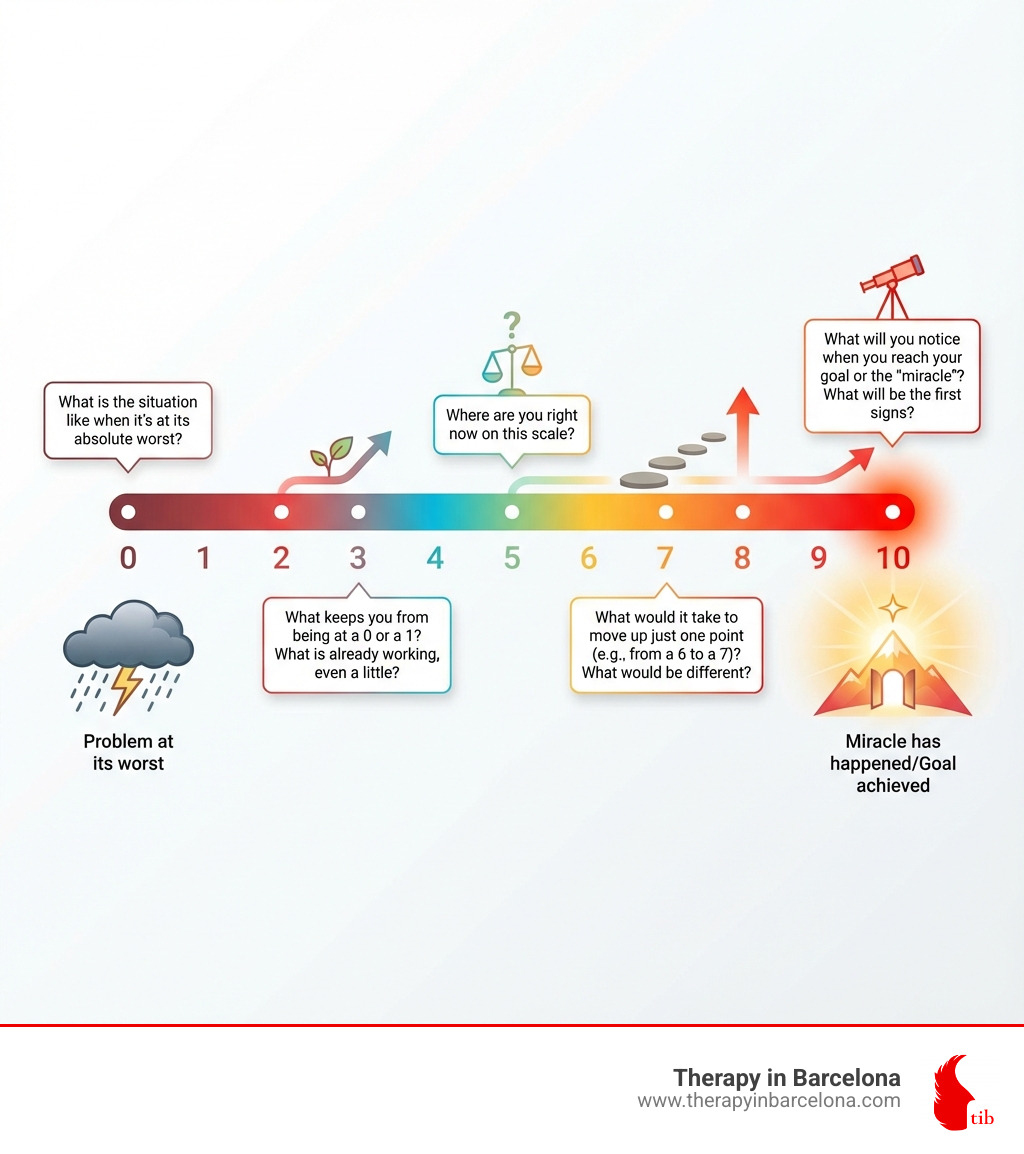
What are scaling questions in solution focused therapy? They are a core technique where therapists ask you to rate your experience, progress, or confidence on a numbered scale—typically 0 to 10. This simple act transforms vague feelings like “I’m struggling” into something tangible: “I’m at a 3 today, but last month I was at a 1.” That shift creates clarity, reveals progress you might not have noticed, and helps you identify small, actionable steps forward.
Quick answer for those searching:
- The scale: Usually 0 to 10, where 0 represents the problem at its worst (or no progress) and 10 represents your goal achieved (or the “miracle” future you envision).
- The purpose: To make subjective experiences concrete, identify what’s already working, set realistic goals, and track progress over time.
- The power: Instead of dwelling on problems, scaling questions shift focus to solutions, strengths, and the small changes that lead to bigger changes.
- The follow-up: After you give a number, your therapist asks questions like “What keeps you from being lower?” or “What would move you up one point?” These uncover your existing coping strategies and clarify next steps.
If you’ve recently moved to Barcelona, Valencia, or another Spanish city and feel overwhelmed by culture shock, loneliness, or relationship stress, scaling questions can help. They don’t ask you to unpack every problem first. Instead, they help you spot what’s already working, measure where you are now, and identify one small next step. For many internationals, that feels practical, manageable, and hopeful when life feels uncertain.
A person who has recently moved to Barcelona might come to therapy feeling far more isolated than expected. When asked to rate their sense of social connection from 0 to 10, they might say “2.” The key follow-up, “What keeps it from being a 0?”, can uncover important strengths: perhaps they have met one friendly person at a yoga class or started greeting neighbours with a “hola.” Those small moments matter. They show that connection has already begun, and they help define a realistic next step toward a 3, such as going to one social event that week.
What Are Scaling Questions in Solution-Focused Therapy?
Solution-Focused Brief Therapy (SFBT) helps people move toward change by focusing on solutions, strengths, and small next steps. In this approach, scaling questions are a simple but powerful tool. They turn feelings and progress into something more concrete, making it easier to see what is already working and what could help next.
Scaling questions ask clients to rate their feelings, progress, or confidence on a scale, usually from 0 to 10. In Solution-Focused Therapy, this helps turn vague experiences like anxiety, hope, or communication into something clearer and easier to discuss. It also shifts the conversation away from getting stuck in the problem and toward noticing where the client is now and what might help them move forward.
This approach is particularly helpful for internationals and expats in cities like Madrid, Sevilla, or Málaga, who might be struggling with complex, often unspoken, emotional states related to cultural adjustment or isolation. By using a scale, clients can gain a clearer perception of their current standing and envision potential paths forward. You can learn more about this approach in our guide to An Essential Guide to Solution-Focused Therapy.
The Core Purpose: Clarifying Perceptions and Building Hope
The primary purpose of using scaling questions in SFBT is multifaceted. They help clients:
- Quantify Experience: Many emotional or behavioural concerns feel vague. A scaling question helps to put a number on it, making it easier to discuss and track. For instance, instead of “I feel anxious,” a client might say, “My anxiety is at a 6 today.”
- Articulate Feelings: By assigning a number, clients are encouraged to reflect on why they chose that specific number, prompting deeper insight into their current state and what might be influencing it.
- Measure Progress: Over time, revisiting the scale allows clients to see even small increments of progress, which can be incredibly motivating. A move from a 3 to a 4 might seem small, but it signifies a positive shift.
- Identify Existing Resources: When a client rates their situation, a crucial follow-up question is often “What keeps it from being a lower number?” This helps uncover existing coping mechanisms, strengths, and times when the problem was less severe. These are the client’s hidden resources.
- Build Motivation and Hope: Focusing on what’s working, even minimally, and identifying small, achievable steps to move up the scale instils a sense of agency and hope. It shows clients that change is possible and that they have a role in making it happen.
How Scaling Questions Align with SFBT Principles
Scaling questions are not just a random technique; they are deeply rooted in the core principles of Solution-Focused Brief Therapy:
- Future-Focused: SFBT is inherently forward-looking. Scaling questions help clients define their desired future (a “10” on the scale) and identify the steps to get there, rather than dwelling on past failures or the origins of the problem.
- Competency-Based: The emphasis is always on the client’s strengths, resources, and successes. By asking “What keeps you from being lower?” or “What have you done to get to this number?”, the therapist highlights the client’s existing competencies and coping abilities.
- Client as Expert: SFBT positions the client as the expert in their own life. Their rating on the scale is their subjective truth, and the therapist respects and explores that perspective, empowering the client to find their own answers.
- Small Change Fosters Bigger Change: Moving up just one point on the scale is a significant achievement in SFBT. Scaling questions encourage clients to identify these small, actionable steps, understanding that incremental progress builds momentum towards larger changes.
- Solution-Building, Not Problem-Solving: Instead of analysing what went wrong, scaling questions guide clients to think about what a solution looks like and what they can do to build it. It’s a pragmatic, action-oriented approach.
This focus on solutions and strengths is what makes SFBT so empowering, especially for individuals trying to steer the complexities of expat life in Barcelona or other international hubs. Explore more about this approach in Beyond Problems: Discovering the Power of Solution-Focused Therapy.
The Art of Asking: How to Use Scaling Questions Effectively
Using scaling questions effectively is an art that combines precise questioning with empathetic listening. It’s about creating a therapeutic dialogue where the client feels heard, understood, and empowered to explore their own path forward. The implementation process involves a collaborative effort between the client and therapist, aimed at identifying strengths and setting achievable goals.

The Step-by-Step Process in a Therapy Session
A typical scaling exercise in a therapy session unfolds in a structured yet flexible manner:
- Introduce the Scale: The therapist first explains the concept of the 0-10 scale. “Imagine a scale from 0 to 10, where 0 is when your problem is at its absolute worst, and 10 is when your problem is completely solved, or you’ve achieved your ideal situation.” It’s important to clarify that 10 isn’t necessarily “perfect,” but “desired” or “good enough.”
- Ask the Initial Question: The therapist then poses a specific scaling question related to the client’s concern or goal. For example: “On a scale of 0 to 10, where would you say you are right now regarding your confidence in managing stress?”
- Explore the Rating: Once the client provides a number, the therapist accepts it without challenge and asks for clarification. “What is your thinking behind this rating? What makes it a 5 and not a 4?” This helps the client articulate their current situation and the subtle nuances of their experience.
- Identify What’s Working (‘Why not lower?’): This is a critical step. If a client rates themselves a 3, the therapist might ask, “What have you done so far that has helped you get to this number? What keeps it from being a 0 or a 1?” This question immediately highlights the client’s existing resources, resilience, and coping strategies, reinforcing their competencies.
- Find Small Steps for Improvement (‘What would a +1 look like?’): The focus then shifts to the next achievable step. “What would it take for you to move from a 3 to a 4? What would be the very first small sign that things are one point better?” This breaks down overwhelming goals into manageable actions, making progress feel attainable.
- Track Progress Over Time: In subsequent sessions, the therapist revisits the scale. “Last time you said you were at a 3. Where are you today?” This allows both the client and therapist to monitor changes, celebrate successes, and adjust strategies as needed.
Powerful Follow-Up Questions to Deepen Insight
The magic of scaling questions often lies in the follow-up. These questions help to peel back layers, reveal underlying strengths, and clarify the path forward:
- “What tells you you’re at a [number]?” This prompts clients to describe concrete behaviours, thoughts, or feelings associated with their rating.
- “What did you do to get from a [lower number] to here?” This helps clients recognise their active role in any positive shifts and identify repeatable strategies.
- “How confident are you that you can take one small step?” This assesses their belief in their ability to act and helps fine-tune the action plan to ensure it’s realistic.
- “Who in your life would notice you’ve moved up a point?” This question introduces a social dimension, helping clients consider the impact of their changes on others and gain external validation.
- VIP Perspectives (Very Important People): “Suppose we asked your partner/best friend/colleague, on a scale of 0 to 10, what number would they give you regarding [the issue]?” This can provide valuable external insights, foster empathy, and help clients consider different viewpoints. “What keeps their number from being lower?” can reveal aspects the client might overlook.
Scaling in Action: Practical Examples for Common Expat Challenges
Scaling questions are incredibly adaptable and can be custom to a wide range of issues, making them particularly useful for the diverse challenges faced by the international community in places like Barcelona, Valencia, and Málaga.

Example: Managing Anxiety and Cultural Adjustment in Valencia
Consider a common example: someone who has recently moved to Valencia and feels overwhelmed by the new culture. They may enjoy the sunshine and fresh start, but still find daily life, building friendships, and understanding local customs surprisingly stressful.
- Scaling Question for Anxiety: “On a scale of 0 to 10, where 0 is feeling completely overwhelmed by cultural adjustment anxiety and 10 is feeling completely at ease and integrated, where would you say you are today?”
- Example Answer: A person might rate themselves a 3, explaining that everyday tasks still bring tension, especially when speaking Spanish or navigating unfamiliar social situations.
- Follow-up: Identifying Coping Mechanisms: “That makes sense. What keeps it from being a 0 or a 1? What are you already doing that helps, even a little?”
- Example Insight: This can help them notice small but important strengths, like attending a Spanish class, successfully ordering a coffee, or finding one familiar place where they feel more relaxed.
- Follow-up: Small, Actionable Steps for Social Connection: “Those moments matter. What would it take to move from a 3 to a 4? What would be the first sign that you’re one point more at ease?”
- Example Goal: A realistic next step might be starting a brief conversation in class or going to a local meet-up for internationals.
What are scaling questions in solution focused therapy for relationships?
Consider a couple in Barcelona struggling with communication after their move. The stress of relocation and new jobs can leave partners feeling disconnected, with arguments becoming more frequent. This is a common challenge that scaling questions can help explore in a clear, practical way.
Scaling Communication Effectiveness: “On a scale of 0 to 10, where 0 means communication feels completely stuck and 10 means you both feel heard, understood, and connected, where would you place your communication as a couple right now?”
- One partner might say a 4.
- The other might say a 3.
Follow-up: Identifying Exceptions: “What makes it a 4 and not a 2? When are the moments, even small ones, when communication works a little better?”
- One person might notice they talk more easily while cooking together or making plans.
- The other might realise things go better when they slow down, make eye contact, and let each other finish speaking.
Follow-up: Pinpointing Specific Actions: “Those better moments show that connection is already happening sometimes. What’s one small thing you could both do this week to move from a 3 or 4 to a 4 or 5? What would that look like?”
- A useful shared goal might be a 10-minute, distraction-free check-in each evening to talk about the day.
For more support with relationship dynamics, explore our More info about couples counselling in Barcelona.
What are scaling questions in solution focused therapy for work-life balance?
Think of a remote worker in Málaga who feels burnt out. The flexibility of working online can easily turn into being “always on,” with work spilling into evenings and weekends, blurring boundaries and leading to exhaustion and anxiety.
- Scaling Satisfaction with Work-Life Balance: Instead of asking “How stressed are you?” (problem-focused), a solution-focused therapist might ask, “On a scale of 0 to 10, where 0 is completely exhausted and dissatisfied with your work-life balance, and 10 is feeling fully energised and balanced, where are you today?”
- Follow-up: Shifting from Problem-Focus to Solution-Focus: If the answer is a low number, the therapist might respond, “That sounds tough. What keeps it from being a 0? What small things, even without planning them, are already helping a little?” This helps spotlight existing resources and moments that are already working.
- Follow-up: Defining Personal Goals: From there, the therapist might ask, “What would moving up by just one point look like? What would be the first small sign that your work-life balance is improving?” That could lead to simple, realistic goals like protecting one work-free evening each week or taking a proper lunch break away from the screen.
This approach helps people define what work-life balance means to them and identify small, realistic steps that move them closer to it.
The Bigger Picture: Benefits, Limitations, and Finding the Right Approach
Understanding scaling questions in solution focused therapy reveals their utility, but see them in context. While they offer significant benefits, like any therapeutic tool, they have potential challenges and are best used as part of a comprehensive approach.
The Main Benefits: Empowerment, Clarity, and Motivation
Scaling questions offer several key advantages:
- Simplicity and Clarity: The 0-10 scale is universally understood, making complex emotional states easier to grasp and communicate. This provides a clear, shared language for both client and therapist.
- Fosters a Sense of Agency: By asking clients to rate themselves and identify what keeps them from being lower, the technique highlights their active role in their current situation and their capacity for change. This cultivates a sense of control over their problems.
- Makes Progress Visible: For many, therapeutic progress can feel slow or invisible. Scaling questions provide a tangible way to track even small shifts, validating the client’s efforts and building confidence.
- Encourages a Positive Mindset: By focusing on what’s working and what a “plus one” step looks like, scaling questions naturally steer the conversation towards solutions and strengths, fostering a more hopeful and optimistic outlook.
- Flexible and Adaptable: Scaling questions can be adapted to almost any issue—mood, symptoms, relationships, confidence, motivation, work-life balance, and more. They are useful across various client populations and therapeutic contexts, from individual therapy in Alicante to family therapy in Zaragoza.
Potential Challenges and Considerations
While powerful, scaling questions aren’t without their nuances:
- Client Difficulty with Numbers: Some clients may find it challenging to quantify their feelings or experiences with a number, or they might feel arbitrary about their choice. A skilled therapist will acknowledge this and explore the client’s hesitation, focusing on the meaning behind the number rather than the number itself.
- Cultural Variations: The interpretation and comfort level with numerical scales can vary across cultures. Therapists, especially those working with diverse international clients like those at Therapy in Barcelona, must be culturally sensitive and adapt their approach as needed.
- Risk of Oversimplification: Complex issues cannot be reduced to a single number. Scaling questions are a starting point for deeper exploration, not the entirety of the therapeutic work. The follow-up questions are crucial to avoid superficiality.
- Importance of Therapist Expertise: The effectiveness of scaling questions heavily relies on the therapist’s skill in asking the right follow-up questions, listening empathetically, and guiding the conversation towards solutions. As one academic study noted, the effectiveness of scaling may depend on skilled application, particularly in isolation or brief online formats. You can review some of the Scientific research on the effectiveness of scaling questions.
Scaling Questions vs. Other Approaches: Finding the Right Fit
In Solution-Focused Brief Therapy, scaling questions are used differently than in problem-focused approaches. Instead of asking, “How bad is your anxiety from 1 to 10?”, a therapist might ask, “How confident are you in handling your anxiety from 1 to 10?” The shift is small, but important: it moves attention from what is wrong to what is already helping.
SFBT is one of several effective therapy approaches. Unlike CBT, which works on unhelpful thought patterns, or psychodynamic therapy, which explores past experiences and unconscious patterns, SFBT focuses on strengths, goals, and small next steps. Many therapists also blend approaches to fit each person’s needs.
When seeking support in Spain, you have several options: the public health system, large online platforms, or local private practices. The public system might offer limited English-speaking services and longer waiting lists. Large online platforms might lack the personalised matching and cultural sensitivity crucial for expats. Local practices, like Therapy in Barcelona, offer a different experience.
At Therapy in Barcelona, we pride ourselves on:
- Bespoke Therapist Matching: We don’t just assign you to the next available therapist. We take the time to understand your needs and match you with a psychology-trained therapist who best fits your specific concerns, whether you’re in Barcelona, Valencia, Madrid, or even online from Gran Canaria.
- Expat-Specific Cultural Sensitivity: Our team members are often expats themselves, including our Australian Psychologist founder, Leigh Matthews. They understand the unique challenges of living abroad—cultural adjustment, isolation, language barriers, and finding your footing in a new country. This lived experience informs a deeply empathetic and effective approach.
- Strict Privacy: We operate as a private-pay service with a strong commitment to your privacy, ensuring your data is handled with the utmost care, unlike some platforms that might sell client information.
- Quality Private-Pay Service: While we don’t discuss specific prices, we offer a high-quality, professional service. Some of our therapists offer sliding scale fees for those with financial need, and prospective clients can inquire about this.
For more information on finding the right support for you, explore our guide to More info about individual therapy in Barcelona.
Frequently Asked Questions about Scaling Questions in SFBT
What is the difference between problem-focused and solution-focused scaling?
Problem-focused scaling asks how severe something feels, such as “How bad is your anxiety from 1 to 10?” Solution-focused scaling asks about progress, confidence, or what is already helping, such as “How confident are you in handling your anxiety?” That shift matters. Instead of centering the problem, solution-focused scaling highlights strengths, builds hope, and helps clients notice their ability to move forward.
Can scaling questions be used for issues like depression or trauma?
Yes, scaling questions are highly adaptable and can be used for a wide range of issues, including depression and trauma, always with great care and sensitivity. For depression, a therapist might ask about hopefulness, energy levels, or engagement in activities. For example: “On a scale of 0 to 10, where 0 is feeling completely hopeless and 10 is feeling full of hope and energy, where are you today?”
For trauma, the questions would be framed around feelings of safety, control, or resilience: “On a scale of 0 to 10, where 0 is feeling completely unsafe and 10 is feeling completely secure, how secure do you feel right now?” The key is to frame the scale around a desired feeling or state, rather than the intensity of the trauma itself, to maintain a solution-focused perspective and avoid re-traumatisation.
What if a client gives a very low score, like a 0 or 1?
A low score is valuable information, not a failure, and a skilled therapist sees this as a starting point. If a client rates themselves a 1, the therapist might ask, ‘What keeps you from being at a zero?’ This acknowledges the client’s struggle while gently shifting focus towards any existing coping mechanisms, no matter how small.
If the rating is a 0, the therapist might ask, ‘What would be the very first sign that you’ve moved to a 1?’ or ‘What would need to happen for you to notice a tiny shift, even just a 0.5?’ This respects the client’s current experience while inviting them to envision the smallest possible positive change. The goal is to identify even the most minute indicators of progress and build from there.
Your First Step Towards a Solution
Scaling questions are a collaborative tool that empowers you to see your strengths and map a path forward, one step at a time. They embody the hopeful, practical spirit of Solution-Focused Therapy. While the technique is powerful, the crucial element is your connection with a therapist who understands your unique context as an international in Spain.
At Therapy in Barcelona, our team of psychology-trained expat therapists specialises in providing this kind of culturally sensitive support. We offer in-person sessions in Barcelona and online therapy for expats worldwide, including those in Madrid, Valencia, Málaga, Alicante, Sevilla, Marbella, Gran Canaria, and Zaragoza. If you’d like support to find your own solutions, book a Free Discovery Call.
