


Why Finding Your English-Speaking Community Changes Everything

An English speaking community can transform your experience of living abroad from isolation to belonging. Whether you’re understanding healthcare in Barcelona, seeking job opportunities in Valencia, or simply craving conversations that flow naturally, these communities offer practical support and genuine connection.
Here are the key ways English-speaking communities support internationals:
- Practical assistance: Help with forms, translations, and handling local systems
- Professional networks: Job banks and career opportunities for bilingual candidates
- Health and social services: Access to English-speaking professionals and interpreters
- Social connection: Regular events, volunteer opportunities, and friendship-building
- Advocacy and representation: Protecting language rights and ensuring equitable access to services
- Newcomer support: Welcome kits, orientation sessions, and integration guidance
- Cultural bridge-building: Joint events connecting English and local language communities
Take Emily, a fictional 34-year-old from the UK. She moved to Barcelona for adventure but found unexpected loneliness. Her story is a fictional composite example representing common expat challenges, not a real client. The excitement of a new city can give way to administrative problems, language barriers, and the challenge of building meaningful relationships from scratch.
Research shows that formal community networks like Voice of English-speaking Québec (VEQ) can serve thousands of members through partnerships with dozens of organisations Source: VEQ Annual Report 2022-2023. These communities don’t just offer social connection—they provide essential services from translation support to mental health resources, proving that organised English-speaking communities can be genuine lifelines for internationals.
However, sometimes the challenges run deeper than what community connection alone can address. Persistent feelings of worry, difficulties with cultural adjustment, or relationship strain may require professional support alongside community involvement.
The Expat’s Lifeline: Why Connection Matters for Your Wellbeing
The honeymoon phase of living abroad doesn’t last forever. One day you’re marvelling at tapas culture in Valencia, and the next you’re staring at a tax form written entirely in Spanish.
For many internationals, initial excitement gives way to unexpected challenges. Isolation creeps in when simple conversations feel exhausting. Homesickness hits hard. The cultural adjustment feels overwhelming when you realise understanding a new country goes far deeper than learning the language.
An English speaking community can be a lifeline in these moments. It offers something invaluable: people who genuinely understand what you’re experiencing. Whether you’re handling healthcare bureaucracy in Málaga or trying to understand workplace culture in Barcelona, a network of people who speak your language can help you thrive.
Social connection is essential for mental wellbeing. When you’re already dealing with the stress of adapting to a new culture, having practical support from others who have been there becomes crucial. They can share tips on everything from finding English-speaking doctors to understanding local customs.
Beyond the practical, these communities provide emotional validation. There’s profound relief in finding that your struggles are shared experiences, not personal failings. This sense of belonging can significantly reduce stress and help you build confidence in your new environment.
If you’re struggling with the emotional weight of homesickness, professional support can complement community connection. More info about our services for homesickness.
The challenge of starting over
Starting fresh in a new country can feel like being thrown back to square one, but in a foreign language.
Language barriers turn everyday tasks into puzzles. Even when your Spanish or Catalan is decent, expressing nuanced thoughts or emotions feels frustratingly limited.
Then there are the administrative challenges. Opening a bank account or registering for healthcare can involve confusing forms and unfamiliar processes, reminding you how much you don’t know.
Perhaps most challenging is the social aspect. Making friends as an adult is difficult anywhere, but cultural differences add complexity. You might find yourself smiling and nodding through conversations, feeling like you’re performing rather than connecting. The result is often feeling like an outsider even when surrounded by friendly people.
How an English-speaking community helps
An English speaking community acts as a bridge, offering both practical solutions and emotional support.
The social connection is immediate. Conversations flow naturally again, creating space for genuine relationships to develop without the mental fatigue of translation.
Practical support flows freely. Members share insider knowledge about understanding local systems—which government office is most efficient, how to find English-speaking professionals, or where to get familiar foods when homesickness strikes.
Many formal organisations offer structured support. For example, community networks in places like Quebec provide translation assistance, help with form-filling, and maintain directories of English-speaking professionals. Some even offer navigator services to help you access healthcare.
Professional networking opportunities within these communities can be transformative. Many maintain job banks for bilingual positions, host networking events, and offer volunteering opportunities that help you build local references.
Most importantly, these communities provide emotional validation. Hearing from others who’ve faced similar challenges reminds you that adaptation takes time and that your feelings are normal.
Finding Your Tribe: Where to Look for an English-Speaking Community
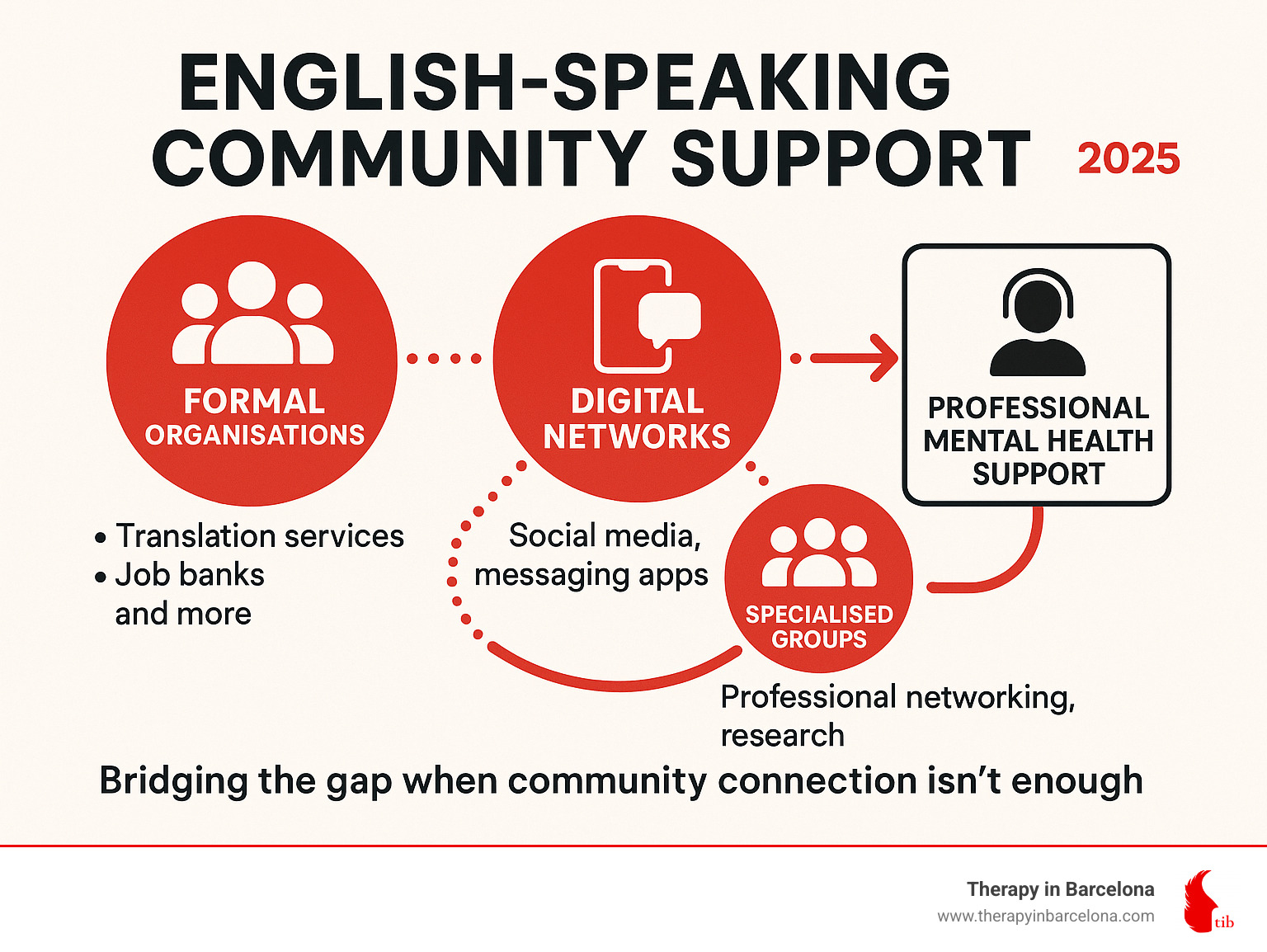
Once you recognise the value of an English speaking community, the next step is finding one. Fortunately, there are many avenues, from formal organisations to informal digital networks and niche groups.

Formal and Regional Networks
These are often non-profit organisations dedicated to supporting English-speaking residents. They act as central hubs, offering a wide array of services. For example, in Québec, organisations like the Voice of English-speaking Québec (VEQ) serve thousands of members by providing welcome kits, community directories, and regular events for newcomers. Similar organisations exist worldwide, advocating for community rights and providing vital support.
These formal networks typically offer services such as:
- Information and referrals
- Translation and administrative help
- Library access with English resources
- Recreation and cultural programmes
- Advocacy and policy engagement
- Newcomer orientation sessions
- Volunteer opportunities
- Job banks and employability services
Digital and Informal Groups
Beyond structured organisations, a vast number of digital and informal groups exist, connecting English speakers globally and locally.
- Online Forums and Social Media Groups: Platforms like Facebook host countless groups for English speakers in specific cities. For example, “English speakers in Barcelona” is a thriving Facebook group where expats share advice and organise meet-ups. Similar groups exist for Valencia Expats, Expats in Malaga, Alicante Expats, and English Speaking Families in Seville. These groups are invaluable for real-time information.
- Messaging Apps (Telegram, Discord): These apps facilitate quick communication. The “English Chatting | International group” on Telegram has over 17,000 members for global practice. You can also find hyper-local groups, like “Anglophones in Aachen” on Discord or “English Cologne” on Reddit and Telegram.
- Language Exchange Clubs: Organisations like the English Talks Club provide a fun environment to practice English and meet new friends. Similarly, HIROHIRO The Language Learning Community connects English speakers learning Japanese with Japanese speakers learning English.
These digital spaces are excellent for daily interactions, quick answers, and finding local events.
Specialised and Professional Hubs
For those with specific interests or career goals, specialised networks can be particularly beneficial:
- Business and Professional Networking Groups: Many cities have groups dedicated to connecting English-speaking professionals for career advancement and mentorship.
- University Research Networks: Academic networks like QUESCREN (Quebec English-Speaking Communities Research Network) focus on specific topics, providing resources like their Bibliography on English-speaking Quebec.
- Volunteer Opportunities: Engaging with local projects, often advertised through formal networks or social media, is an excellent way to meet like-minded people and contribute to your new home.
From Newcomer to Neighbour: How to Actively Engage and Build Your Network
Finding an English speaking community is the first step; active engagement is what builds a true network. This means taking proactive steps and sometimes overcoming shyness to create lasting connections.

Becoming part of your new community takes intention and patience. But the rewards—genuine friendships, practical support, and a sense of belonging—make the effort worthwhile.
Your First Steps
Your integration journey begins with gathering information and making initial connections. Many organisations offer structured support for newcomers.
Welcome kits and community directories serve as a roadmap to local life. They are curated guides that can save you months of trial and error, helping you find everything from a reliable dentist to information on local customs.
Attending newcomer sessions provides invaluable orientation and a chance to meet others in a similar situation. These sessions offer vital information on local services and create natural networking opportunities that often become the foundation for friendships.
Joining newsletters and following social media channels keeps you connected to your community’s pulse. Subscribing to updates from local English-speaking organisations ensures you won’t miss workshops, social events, or important news.
Deepening Your Connections
Once you’ve made initial contacts, the work of building meaningful relationships begins.
Volunteering is a powerful way to integrate. When you volunteer, you build relationships with people who share your values while gaining local experience and references that can be valuable for your job search.
Attending cultural events like book clubs or social gatherings provides relaxed settings where conversations can flow naturally. Shared cultural references and experiences often create instant bonds.
Joining libraries and participating in workshops opens up learning and social opportunities. English libraries can serve as quiet gathering spaces, while workshops attract people with similar interests, fostering the kind of regular, low-pressure interactions that develop into friendships.
Bridging the Language Divide
While your English speaking community provides essential support, true integration often means engaging with the broader local community.
Look for joint events that bring together English-speaking and local language communities. These gatherings create natural opportunities to practice local languages while sharing your own culture. Building bilingual friendships enriches your understanding of local customs and perspectives.
Supporting local businesses helps you integrate economically and socially. Even if initial conversations are challenging, regular interactions with local shop owners and café staff build familiarity and comfort, helping you move beyond the expat bubble.
Sometimes the challenges of integration require more support than community connection alone can provide. Recognising when you might benefit from professional guidance is part of taking care of yourself during this significant life transition.
When Community Isn’t Enough: Finding Professional Support in English
While an English speaking community offers vital support, sometimes the challenges of living abroad run deeper. Persistent feelings of loneliness, worry, relationship strain, or the disorientation that comes with adapting to a new culture can be overwhelming. In these moments, professional help is a necessary step.

Recognising When You Need More Support
If socialising feels draining or feelings of sadness and worry persist and impact your daily life, it might be time to seek professional guidance. While friends can offer empathy, they often lack the training to help you work through difficult past experiences or manage overwhelming feelings of worry. A trained therapist brings structured, evidence-based interventions that can create lasting change.
Options for English-Language Therapy
Finding a therapist who speaks your language is crucial. Here are your main options for English-language therapy.
Public Health Systems
Many countries offer mental health services through their public health systems. However, accessing English-speaking clinicians can be challenging, with potential for long wait times and therapists who may not understand expat-specific issues.
Large Online Platforms
Platforms like It’s Complicated list thousands of therapists, offering convenience and filters for language and specialty. They can be a good starting point, though it’s important to review their privacy policies and ensure the quality of care matches your needs.
Local Private Practices
For personalised care that understands the expat experience, local private practices often excel. These practices frequently specialise in working with international communities, offering culturally sensitive support with therapists who may be expats themselves. They prioritise strict privacy and often provide a higher quality of service.
A Personalised Approach to Your Wellbeing
Therapy in Barcelona provides multilingual therapy, both in-person and online, specialising in support for the English speaking community of expats. Founded by Leigh Matthews, an Australian Psychologist and expat who moved to Barcelona in 2011, the practice emerged from recognising the need for a sanctuary where cultural adaptation and the stresses of living abroad could be addressed with empathy and expertise.
Our team of qualified, English-speaking therapists—many of whom are also expats—truly understand struggles like cultural shock, relocation stress, and homesickness. We speak English, and some of our therapists also speak German, French, Spanish, Afrikaans, Portuguese, Swedish, Austrian-German and Swiss-German.
What sets Therapy in Barcelona apart is personalised therapist matching. We carefully match clients with therapists who best fit their specific needs, aiming to optimise therapeutic outcomes from the start. As a trusted practice established since 2011, we offer a collaborative approach with highly qualified psychology-trained therapists.
Our holistic approach blends evidence-based practices including Cognitive Behavioural Therapy (CBT), Acceptance and Commitment Therapy (ACT), Internal Family Systems (IFS), Person-Centred therapy, the Gottman Method for couples, and more.
The practice offers a confidential space for adults, couples, children, teenagers, and families. You can learn more about our team of therapists and explore our individual therapy services.
Sessions are available at our Barcelona offices at C/ de París, 162-164, 3o, 1a, in the Eixample district. We also provide online therapy to expats worldwide. While this is a privately-paid service, some therapists offer sliding scale fees.
Our services extend beyond Barcelona to various cities across Spain, including Madrid, Valencia, Málaga, Alicante, and Sevilla, supporting a broad English speaking community.
Frequently Asked Questions about English-Speaking Communities
How can I find English-speaking doctors or dentists?
Many formal community networks maintain directories of vetted, English-speaking professionals. These lists are valuable because they often include professionals recommended by other community members. Online expat forums and city-specific Facebook groups for places like Marbella or Gran Canaria are also excellent for personal recommendations. Members regularly share their experiences and can help you find trusted medical contacts quickly.
Are there opportunities for my children to connect with other English speakers?
Yes, this is a top concern for many expat families. Community organisations frequently run early childhood programs, playgroups, and family-friendly events. These gatherings give children a natural opportunity to maintain their language skills and make friends. Facebook groups like “English Speaking Families in Seville” also cater specifically to parents looking to organise playdates and other social events for their children.
I’m a job seeker. How can these communities help me?
An English speaking community can be a powerful ally in your job search. Here’s how:
- Job Banks: Many established communities maintain dedicated job banks listing roles for bilingual or English-speaking candidates.
- Volunteering: When you volunteer, you build a professional network, gain local references, and demonstrate your commitment to the community—all valuable assets to employers.
- Networking: The informal networking that happens at community events can lead to opportunities that never make it to official job boards. You might hear about a role that fits your background or find a new career path.
Community and Care: Your Path Forward
Finding and engaging with an English speaking community is a lifeline that can transform your experience of living abroad. These communities offer everything from help with administrative headaches to the deep friendships that make a new country feel like home.
The journey is not always smooth. It is normal to experience loneliness, feelings of worry, or the weight of cultural adjustment. Recognising when you need more than peer support is a sign of strength.
Professional therapy can be a powerful companion to community connection. While friends offer understanding, a skilled therapist provides structured tools to process complex emotions and build resilience. For expats, therapy in your native language—where you can express yourself without translation—is especially important.
At Therapy in Barcelona, we understand this intersection of community and professional care. Our team of expat therapists has walked a similar path. We know what it is like to steer new systems and feel far from home.
We offer both the practical understanding of expat life and the clinical expertise to help you thrive. Whether you are in Barcelona, Madrid, Valencia, or connecting with us online from anywhere in the world, including the USA and Canada, we are here to support your journey.
If you’d like support, book a Free Discovery Call with us. Sometimes the best step towards building your community starts with taking care of yourself first.
