


Why Mental Health Support Matters for Immigrants

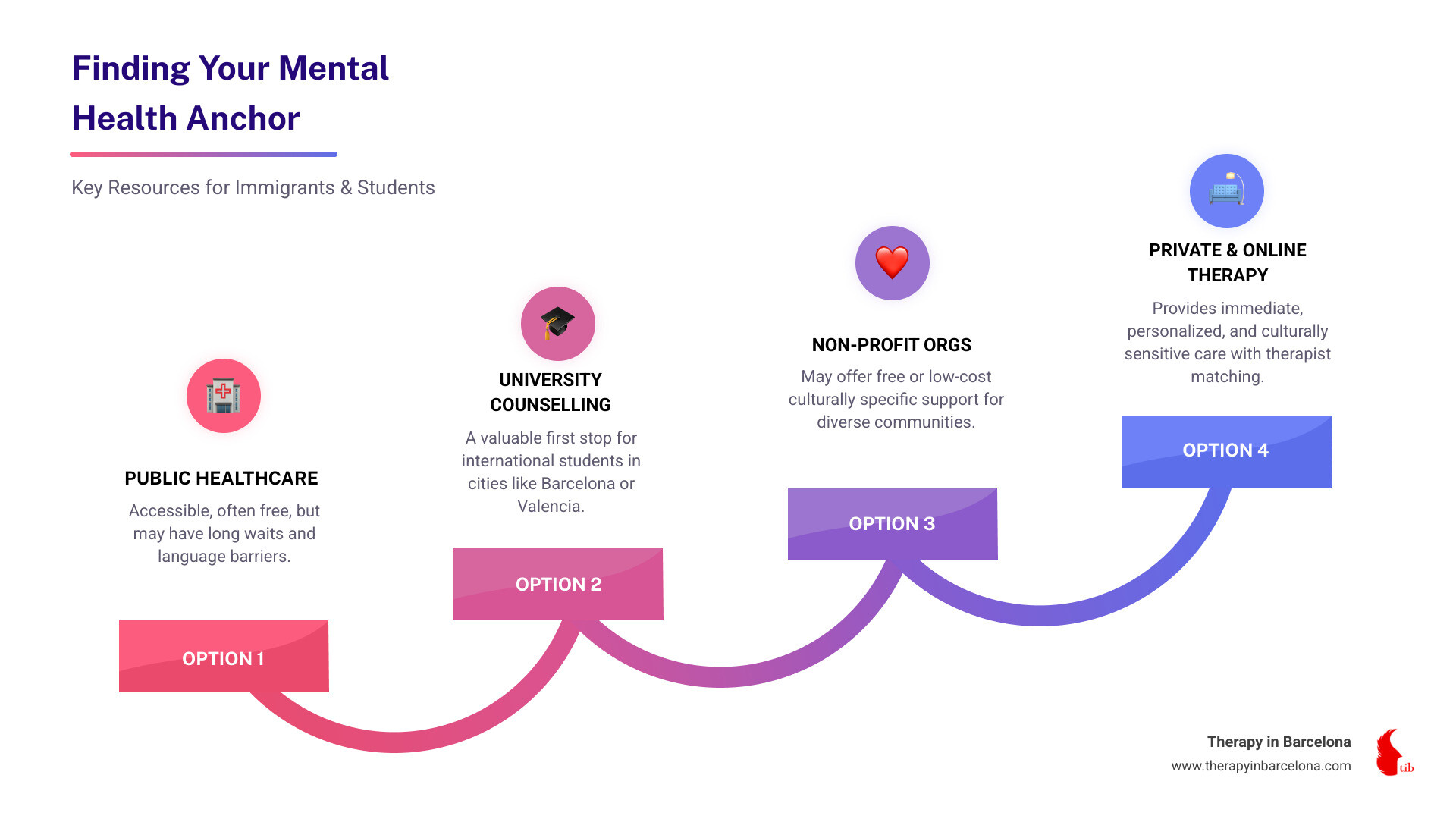
Mental health immigrants face unique challenges that can deeply impact their well-being. If you’re looking for support, here are the key resources available:
- Public healthcare systems – Often free but may have long waits and language barriers.
- University counselling centres – A good first option for international students.
- Non-profit organisations – May offer free or low-cost culturally specific support.
- Private therapy practices – Provide immediate, personalised care with therapist matching.
- Online therapy – Accessible worldwide for those seeking culturally sensitive support.
Moving to a new country brings excitement, but also unexpected emotional challenges. Research shows that approximately 29% of immigrants report experiencing emotional problems, with stress often increasing over time. The initial “honeymoon phase” can give way to culture shock, loneliness, and a sense of not belonging.
Whether you’re a recent arrival in Barcelona, a student in Valencia, or someone who’s been abroad for years, your feelings are valid. The mental health challenges of immigration aren’t a sign of weakness—they’re a natural response to a major life transition.
This guide offers insight into what you might be experiencing and helps you find the right resources. While prices vary, support ranges from free public services to private therapy, with many therapists offering sliding scale fees for those with financial constraints. Don’t hesitate to ask about this when you enquire.
Understanding the Mental Health Landscape for Immigrants
Moving to a new country can feel like stepping into another world. One day you’re ordering coffee in your native language, and the next you’re struggling at a pharmacy in Barcelona or Valencia. For mental health immigrants, this transition brings unexpected emotional challenges.
Common Mental Health Challenges
Statistics show that approximately 29% of immigrants report emotional problems. Behind that number are real people dealing with loneliness, or worry over simple tasks like opening a bank account.
Feelings of deep sadness and persistent worry are common. The sadness isn’t just homesickness; it’s often grief for the life and identity you left behind. Many people question who they are when their professional credentials aren’t recognised or their sense of humour doesn’t translate.
Chronic stress can become a constant, as your nervous system stays on high alert decoding new social rules. For those who have fled conflict, post-traumatic stress (PTS), a condition that can arise after experiencing or witnessing terrifying events, adds another layer of complexity.
Scientific research on immigration and mental health confirms these are significant challenges that deserve proper support.
Key Stressors Along the Way
The immigration journey is a long and often challenging process. Pre-migration trauma from fleeing violence or persecution creates psychological wounds that don’t heal just by reaching safety.
Once you arrive, a new set of challenges begins. Language barriers go beyond vocabulary; they can make you feel like you’ve lost your personality. Discrimination and racism, even when subtle, create a constant question of whether you truly belong.
Underemployment is a major blow for skilled professionals, forcing them into jobs that don’t use their expertise. This isn’t just about money—it’s about losing a core part of your identity. Family separation creates its own pain, as parents worry about children left behind or partners manage long-distance relationships.
The research shows that refugees are significantly more likely to report high stress due to the additional layers of trauma and uncertainty they face.
The “Healthy Immigrant Effect” and Its Decline
Many immigrants arrive healthier than the local population, a phenomenon known as the “healthy immigrant effect.” This suggests that those who migrate are often resilient to begin with.
However, research on the healthy immigrant effect shows this advantage often fades. Over time, as daily stressors accumulate, mental health tends to decline. This isn’t a personal failure but the result of the cumulative impact of constant adaptation.
Understanding this pattern is crucial. It means support isn’t just for the first few months; it’s often needed years into the journey, when the initial adrenaline has worn off and the reality of building a new life has set in.
Who is Most Affected? Specific Needs and Risks
Understanding that mental health immigrants face different challenges depending on their circumstances can help you find the right support. Acknowledging that some groups carry heavier burdens allows for more appropriate care.
The Refugee Experience
Refugees arrive with burdens other immigrants may not know. They flee unimaginable circumstances like war and persecution, which fundamentally shapes their mental health journey.
Refugees are at a significantly higher risk for mental health problems, with post-traumatic stress (PTS), deep sadness, and persistent worry being common. Witnessing trauma and losing everything leaves lasting marks on the nervous system.
Reaching a new country doesn’t end the challenges. Refugees often face profound uncertainty about their legal status and grief from family separation. Some have experienced detention, adding institutional trauma to personal ones.
With 122.6 million forcibly displaced people worldwide in mid-2024, the scale of need is staggering. Most are in low- and middle-income countries that may lack resources for mental health support, making healing even more complex.
The Impact on Women and Families
Immigrant women often carry invisible burdens. Research shows that females are more likely to report experiencing emotional problems than males—in Canada, 33% of immigrant women reported emotional problems compared to 24% of men.
Gender-specific stressors create unique challenges. Many women feel isolated at home, cut off from their professional identities. They may face pressure to maintain cultural traditions while adapting to new social norms.
Take Sofia, for example, a 38-year-old professional who moved to Madrid with her family. While supporting her children’s adjustment, she struggles with the loss of her own career identity and support network. (Sofia is a fictional composite character created to represent common challenges faced by expats, not a real client.)
Family dynamics add another layer of complexity. Children often adapt faster, creating generational tensions. Parents may grieve the loss of their heritage as their children accept new ways of life. These intergenerational conflicts are about changing family structures and cultural continuity.
How Socio-Economic Status Shapes Mental Health
Financial instability makes anxiety a constant companion. For many immigrants, professional qualifications become worthless, forcing them into low-income jobs with little security.
Housing insecurity creates chronic stress that affects everything from sleep to relationships. Living in survival mode leaves little energy for the self-care that supports mental health.

The difficult reality is that those who most need support often have the least access. This is why many therapists, including those at Therapy in Barcelona, offer sliding scale fees for those with financial need—because your economic situation shouldn’t be a barrier to mental health care.
Barriers to Accessing Mental Health Care
Even when mental health immigrants recognise they need support, getting help isn’t always straightforward. The barriers are real, ranging from practical challenges to deep-seated cultural concerns.
Systemic and Practical Barriers
Imagine arriving in Spain, feeling overwhelmed, only to find that getting public mental health support could mean waiting months. This is a common reality.
The Spanish public healthcare system, while accessible to residents, often has long waiting lists for specialist mental health services. A wait of three to six months can feel impossible when you’re struggling. The cost of private therapy is a faster alternative but can be prohibitive for many.
Beyond cost, there’s often a lack of clear information about what services exist and how to access them, leaving many feeling confused and frustrated.
Past policies in countries like the United States, such as the “Public Charge rule,” have created lasting fear among immigrants about seeking public assistance, even for mental health. Though policies change, the fear remains. Systemic barriers can also limit access to affordable care based on immigration status.
Cultural and Linguistic Barriers
Perhaps the most profound barrier is the stigma surrounding mental health in many communities. Seeking therapy can be seen as admitting failure or bringing shame to one’s family. Discussing private struggles with a stranger may feel deeply uncomfortable.
Cultures also have varying understandings of mental distress. Psychological pain might be expressed through physical symptoms, which can be missed by professionals without cultural awareness.
Language barriers add another layer of complexity. Expressing deep fears through an interpreter can feel inadequate. There’s something irreplaceable about speaking directly with a therapist who understands your words and the cultural context behind them.
The shortage of culturally competent therapists who speak diverse languages means many immigrants feel unheard. Similarly, large online therapy platforms may use algorithms for matching, which can feel impersonal and fail to account for cultural nuances. Concerns over data privacy on these platforms can also be a significant barrier, as clients need to trust that their personal information is secure.
The Challenge for International Students
International students face their own pressures. Beyond the usual challenges of immigration, they deal with intense academic pressure, often in a second language. The stress of maintaining grades and managing visa requirements can be overwhelming.
Homesickness hits hard during exams or holidays. Building a social circle while managing coursework and finances is a constant juggling act. Many students don’t know that university counselling services exist or worry that seeking help might affect their academic or visa status. The cumulative effect can leave students feeling isolated and overwhelmed.
At Therapy in Barcelona, our team of expat therapists has lived through similar experiences, allowing us to offer the culturally sensitive, linguistically accessible support that many immigrants struggle to find.
Building Resilience: Protective Factors and Support Systems
Despite the challenges, mental health immigrants possess remarkable resilience. The key is to recognise and build upon the protective factors that support your well-being as you create a new life abroad.
The Power of Community and Social Connection
A sense of belonging is invaluable. Building strong social networks is one of the most powerful ways to protect your mental health. Whether it’s an expat group in Valencia or a cultural community in Madrid, these connections become lifelines.
Research shows that social support buffers against the stresses of immigration. A study of recent immigrants found that those who participated in groups were less likely to experience emotional problems. When you have people who understand your journey, challenges feel more manageable.
Community comes in many forms. You might find your people in a hiking group near Málaga, at a language exchange in Sevilla, or through professional networks. These connections offer practical help, emotional support, and the reassurance that you’re not alone.

Personal Coping Strategies and Protective Factors
Your inner resources matter just as much as external support. Maintaining your cultural identity while adapting helps create a blended sense of self. Cooking familiar dishes, celebrating holidays, and speaking your native language provide stability when everything else feels uncertain.
Strong family ties, even across continents, remain crucial for emotional support. Developing positive coping mechanisms is also essential, whether it’s mindfulness, hobbies, or journaling. A modern approach to therapy acknowledges the character strengths and cultural values you bring with you. You’re not just someone who needs help; you’re a resilient person navigating a big life change.
For more information about our approach, which is built on these strength-based principles, you can explore how we work with the resources you already possess.
The Role of a Stable Environment
A stable environment plays a fundamental role in your well-being. Secure employment that matches your skills reduces the chronic stress that fuels anxiety. Access to quality education creates a sense of future and belonging. Safe and affordable housing provides a foundation of security.
When these basic needs are met, you have the emotional energy to focus on the enriching parts of your international adventure rather than just surviving. Recognising how these factors affect your well-being can help you advocate for yourself and make informed decisions.
Finding Help: A Guide to Mental Health Support in Spain and Online
When you’re ready to reach out, knowing where to look can feel overwhelming. The good news is that there are several pathways mental health immigrants can explore, both in Spain and online.
Your Options for Care
Public healthcare in Spain offers mental health services, but they often come with long waiting lists and language barriers. Many internationals find themselves stuck in this gap between needing help and being able to access it.
For international students in cities like Barcelona or Valencia, your university counselling centre is an excellent first stop. These services are typically free or low-cost, and staff often understand the pressures of studying abroad.
Non-profit organisations across Spain focus on specific immigrant communities, offering culturally appropriate support that feels familiar and safe.
Private therapy practices offer immediate access to specialised care. At Therapy in Barcelona, our approach centres on personalised therapist matching. We take time to understand your needs and connect you with a psychology-trained therapist who is the best fit. Our team includes expat therapists fluent in English and other languages like German, French, Spanish, Afrikaans, Portuguese, Swedish, Austrian-German and Swiss-German. We offer both in-person sessions in Barcelona and online therapy worldwide.
As expats ourselves, we understand what it’s like to feel lost between two worlds. Our therapists use evidence-based approaches like Cognitive Behavioural Therapy (CBT) and Acceptance and Commitment Therapy (ACT), always through a lens of cultural sensitivity.
Online therapy has opened doors for people living outside major cities or for those who prefer the convenience of sessions from home. While large online platforms offer convenience, they often use algorithms for matching and may have data-sharing policies that concern users. In contrast, at Therapy in Barcelona, we guarantee strict client confidentiality with no data selling, and our bespoke matching is done by a qualified psychologist—not an algorithm—ensuring a thoughtful, human-centred connection in your native language.
Where to Find Culturally Sensitive Support
Finding a therapist who understands your background makes a huge difference. Local expat community boards and social media groups in cities like Málaga or Alicante often have great recommendations. University international student offices also maintain lists of professionals who understand diverse cultural backgrounds.
At Therapy in Barcelona, our entire model is built around culturally sensitive care. Because our therapists are also expats, we bring both professional training and personal understanding to our work. Whether you’re dealing with homesickness in Valencia or career challenges in Madrid, we understand the cultural layers involved. You can learn more about our team and services to find someone who resonates with your needs.
In Case of Crisis
If you or someone you know is in immediate danger or experiencing a mental health crisis, please seek help right away.
- In Spain, call 112 for emergency services (medical, fire, or police).
- For suicide prevention in Spain, call the dedicated helpline at 024.
For those outside of Spain, similar crisis support exists in most countries. Search online for local mental health crisis lines in your area.
Frequently Asked Questions about Mental Health for Immigrants
Is it normal to feel down or worried after moving to a new country?
Yes, absolutely. What you’re experiencing is incredibly common. Mental health immigrants often struggle with these feelings, and you are not alone.
Moving to a new country is a major life transition. You’re adapting to new customs, a different language, and building a life from scratch without your usual support systems. Feelings of sadness, worry, or loneliness are a natural part of cultural adjustment.
While these feelings are normal, they shouldn’t be ignored if they persist or interfere with your daily life. If your sadness feels overwhelming or your worry is making it hard to function, reaching out to a mental health professional is a healthy and proactive step.
How can I find a therapist who understands my cultural background?
Finding the right therapist can feel daunting. The good news is there are strategies to help you find someone who gets your experience.
Look for therapists who are expats themselves. Working with someone who has walked a similar path can be powerful. Many therapists at Therapy in Barcelona have personal experience with living abroad, which provides invaluable insight.
Seek out culturally sensitive therapists. A therapist’s training in cultural competency is key. They understand that your cultural context is central to who you are and how you experience the world.
Use your initial conversation wisely. During a Free Discovery Call, ask about a therapist’s experience with clients from diverse backgrounds. This is your opportunity to gauge if they are a good fit. Ask questions like, “How do you approach cultural differences in therapy?”
What if I’m worried about the language barrier in therapy?
This concern is completely valid. Language isn’t just about words; it’s about feeling truly understood, especially when you’re vulnerable.
Prioritise your comfort. If speaking in your native language or a language you’re fluent in allows you to express yourself without effort, that should be your priority. Therapy is hard enough without the added stress of searching for words.
Feeling truly heard is essential. You need a therapist who can grasp the subtleties of your expression. It’s not just about translating words but understanding the emotional weight and cultural context behind them.
Many private practices, including Therapy in Barcelona, specialise in offering therapy in multiple languages. Our therapists are fluent in English, and many also speak German, French, Spanish, Afrikaans, Portuguese, Swedish, Austrian-German and Swiss-German. This ensures you can engage in deep, meaningful conversations without a language barrier getting in the way. The therapeutic relationship is built on trust and clear communication, so finding a therapist you can speak with comfortably is worth the effort.
Conclusion

Building a new life abroad takes extraordinary courage. The journey of settling in—whether in Barcelona, Valencia, or anywhere else in Spain—can feel overwhelming at times.
Mental health immigrants face unique challenges, from homesickness to the exhaustion of constant cultural translation. These feelings don’t make you weak; they make you human.
You don’t have to handle these challenges alone. A supportive therapeutic relationship provides a safe space to process your experiences, develop coping skills, and find your footing. It’s about having someone who understands your journey walk alongside you.
Therapy in Barcelona was founded by Leigh Matthews, an Australian Psychologist living in Barcelona since 2011 she experienced the search for mental health support in a foreign country and couldn’t find an English-speaking therapist who understood the specific challenges of adapting to a new culture.
That gap drove her to create a sanctuary where the unique experience of living abroad could be addressed with professional expertise and genuine empathy.
Our team of qualified, English-speaking expat therapists understands your journey because we’ve lived it too. We know what it’s like to feel caught between cultures. This shared experience shapes our work.
We offer personalised, culturally sensitive therapy both online worldwide (including the USA and Canada) and in our welcoming Barcelona office. Our commitment to matching you with the ideal therapist is central to what we do, as we believe therapy works best when you feel genuinely understood.
Your courage brought you this far. Let it carry you one step further.
If you’d like support, book a Free Discovery Call with us today.
