


Why Navigating Cultural Differences Matters More Than You Think

Navigating cultural differences is essential for building meaningful connections and thriving in multicultural environments. Here’s what you need to know:
- Communication varies dramatically – Direct vs. indirect styles, non-verbal cues, and unspoken rules shape every interaction
- Time and hierarchy perceptions differ – Punctuality expectations and power dynamics vary widely between cultures
- Self-awareness is your starting point – Understanding your own cultural lens helps you approach differences with curiosity rather than judgment
- Practical adaptation strategies work – Learning language basics, trying local customs, and asking respectful questions build bridges
- Professional support helps when stuck – Persistent culture shock, overwhelming worry, or relationship strain may need therapeutic guidance
Take Emily, a 34-year-old from the UK living in Barcelona. While Emily is a composite character and not a real person, her story is common. She speaks decent Spanish and loves the city’s energy, yet she feels constantly misunderstood at work. Her British directness comes across as rude to colleagues, whilst their indirect feedback style leaves her confused about her performance. Emily’s story mirrors many internationals’ experiences – language skills alone aren’t enough when cultural codes remain invisible.
Whether you’re settling in Valencia, navigating workplace dynamics in Madrid, or building relationships along the Costa del Sol, cultural adaptation challenges everyone who crosses borders. The good news? These differences, whilst initially overwhelming, often become sources of personal growth and enriched perspective.
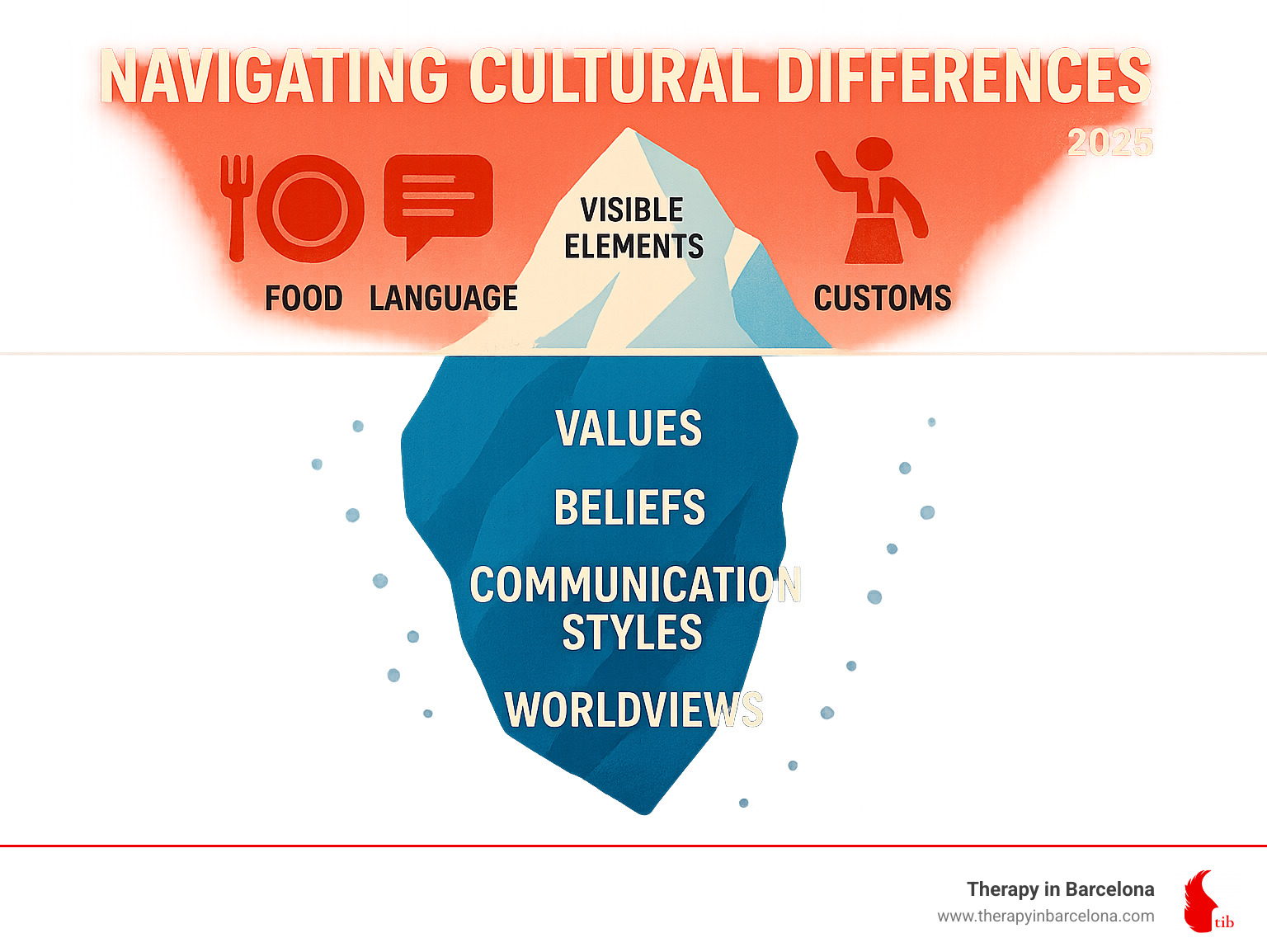
Much of what we “say” happens beneath the surface. Tone, pace, gestures and context carry meaning that words alone can’t. Noticing these hidden layers can turn frustrating misunderstandings into chances for deeper connection.
Understanding the ‘Why’: Common Cultural Differences
Picture this: you walk into your first team meeting in Madrid, ready to impress with your punctuality and direct communication style. But as the meeting starts twenty minutes late and your colleagues speak in what feels like code, you realise you’re navigating cultural differences that run much deeper than language barriers.
When you step into a new culture, everyone else seems to be playing by an invisible rulebook. What feels natural and polite in one place might come across as confusing or even rude elsewhere. Understanding these unspoken rules is your first step towards thriving rather than just surviving in your new environment.
The Unspoken Rules: Communication Styles and Non-Verbal Cues
Here’s something that might surprise you: a lot of meaning travels without words. Gestures, eye contact, posture and tone all carry weight, and the meanings shift from culture to culture.
Take directness, for instance. If you’re from the US or Germany, saying exactly what you mean feels efficient and honest. “The report needs more data” gets straight to the point. But in many Asian or Latin American cultures, this same directness can feel like a slap in the face. Instead, you might hear something like, “Perhaps we could explore additional sources to improve this excellent foundation.” Same message, completely different delivery.
The concept of “saving face” explains much of this difference. In high-context culturesthink Japan, Thailand, or many Arab countriespreserving dignity (yours and others’) often matters more than immediate clarity. It’s not about being dishonest; it’s about maintaining harmony and respect in relationships.
Then there’s the minefield of non-verbal communication. Eye contact offers a perfect example. In Barcelona, looking someone in the eye during conversation shows you’re engaged and trustworthy. But try this same approach in parts of Asia or with elders in many traditional cultures, and you might accidentally signal disrespect or aggression.
Personal space creates another invisible boundary that varies wildly. Mediterranean cultures often accept closer physical proximity during conversations, whilst Nordic cultures prefer more breathing room. Neither approach is right or wrongthey’re just different comfort zones shaped by cultural norms.
Even something as simple as a gesture can cause confusion. That innocent thumbs-up that signals approval in most Western countries? It can trigger serious offense in parts of the Middle East and West Africa. The two-finger peace sign becomes insulting in the UK and Australia if you flip it around. When in doubt, observe before you gesture.
Facial expressions add another layer of complexity. Whilst happiness, anger, and sadness translate universally, when and how we express these emotions follows cultural scripts. In Thailand, a smile might indicate embarrassment or even frustration, not joy. This explains why navigating cultural differences in communication requires such careful attention to context.
Research continues to explore how universal facial expressions work across cultures, revealing both our shared humanity and our beautiful diversity.
Different Worlds: Perceptions of Time, Hierarchy, and Feedback
Beyond communication lies an even trickier territory: how cultures view time, authority, and feedback. These invisible frameworks shape everything from business meetings to family dinners, often catching newcomers completely off guard.
Time operates differently around the world. Monochronic cultures like Germany or Switzerland treat time as a finite resource to be managed precisely. If your meeting starts at 9 AM, arriving at 9:05 feels disrespectful. Every minute has a purpose, and schedules run like clockwork.
Polychronic cultures flip this script entirely. In much of Latin America, relationships often trump rigid scheduling. Building genuine connections might mean your 9 AM meeting naturally starts at 9:20 because someone stopped to properly greet a colleague they hadn’t seen in weeks. It’s not about being careless with timeit’s about prioritising human connections over clock-watching.
Spain offers a fascinating example of this flexibility. Whilst business meetings in Madrid increasingly follow European punctuality standards, social gatherings still accept a more relaxed approach to time. Understanding this difference helps expats avoid unnecessary stress and cultural missteps.
Hierarchy creates another cultural divide. High power distance cultures maintain clear authority structures where questioning your boss feels inappropriate and decision-making flows strictly from top to bottom. Croatia exemplifies this approach, where respect for authority runs deep and challenging superiors publicly would seem shocking.
Low power distance cultures like the Netherlands encourage flatter organisational structures. Employees expect to contribute to decisions affecting their work, and direct communication with leadership feels normal rather than rebellious. Imagine a Croatian employee’s surprise when their Dutch manager asks for honest feedback about company policies during their first team meeting.
Feedback styles reveal these cultural differences most clearly. Some cultures accept direct criticism as a tool for improvement”Your presentation lacked focus and needs restructuring” feels helpful and constructive. Others wrap feedback in layers of context and positivity, delivering criticism so gently that the recipient might miss the message entirely.
The concept of “saving face” influences feedback across many cultures. In Vietnam, for example, public criticism can cause deep shame and damage working relationships. A well-meaning Danish manager learned this lesson when asking a Vietnamese employee to brainstorm ideas publicly without preparationthe resulting embarrassment harmed rather than helped their professional relationship.
These differences aren’t obstacles to overcome but rather cultural wisdom to understand and respect. Whether you’re settling in Valencia’s vibrant expat community or building professional relationships in Mlaga’s growing international business scene, recognising these patterns helps you connect more authentically with the people around you.
The Expat’s Toolkit: Practical Strategies for Navigating Cultural Differences
Understanding cultural differences is just the beginning. Navigating cultural differences successfully requires rolling up your sleeves and getting practical. The good news? You don’t need to transform overnight. Small, intentional steps can bridge even the widest cultural gaps.
Cultivating a Mindset of Curiosity and Self-Awareness
Before you can truly connect with others, you need to understand yourself. Your cultural background acts like invisible glasses, shaping how you see everything from punctuality to personal space. The trouble is, most of us don’t realise we’re wearing these glasses at all.
Start by reflecting on your own cultural lens. What feels “normal” to you? When you find yourself thinking someone’s behaviour is “weird” or “rude,” pause. That reaction often reveals more about your cultural assumptions than their actions.
We all carry unconscious bias—automatic associations we make about people based on limited information. A British expat in Madrid might assume their Spanish colleagues are “disorganised” because meetings start ten minutes late. But what if punctuality simply means something different here? Recognising your biases doesn’t make you a bad person; it makes you human. And more importantly, it’s the first step toward genuine understanding.
Curiosity becomes your superpower when everything feels foreign. Instead of judging something as wrong, try asking, “Why might they do things this way?” This shift from judgment to observation opens doors you didn’t know existed. When your Valencian neighbour doesn’t return your smile in the lift, maybe it’s not rudeness—perhaps eye contact with strangers feels intrusive in their culture.
Empathy pairs perfectly with curiosity. The Golden Rule tells us to treat others as we’d want to be treated. But the Platinum Rule works better for navigating cultural differences: treat others as they want to be treated. Your desire for direct feedback might clash with a colleague’s need to save face. Neither approach is wrong—they’re just different.
Actionable Steps for Adapting and Connecting
Once your mindset shifts, practical strategies can work wonders. These aren’t about changing who you are; they’re about building bridges.
Learning the local language shows respect, even if you only master “por favor” and “gracias.” Studies show that learning a second language boosts brainpower and helps delay cognitive decline. Don’t worry about perfection—locals appreciate the effort far more than flawless grammar. When fluency feels overwhelming, translation apps can bridge the gap for complex conversations.
Food opens cultural doors like nothing else can. Sampling paella in Valencia, tapas in Málaga, or pintxos in Bilbao connects you to traditions passed down through generations. Even if a dish isn’t to your taste, approaching it with genuine interest shows respect for the culture behind it.

Engaging with popular culture offers surprising insights. Watching a Spanish series or reading local news helps you understand humour, values, and social dynamics. You might find shared interests that spark conversations with colleagues or neighbours.
When you’re unsure about customs, ask questions respectfully. “Could you tell me more about why this is done?” or “What’s the best way to approach this here?” signals genuine interest rather than judgment. Most people appreciate curiosity about their culture.
Finding a local guide—whether it’s a colleague, classmate, or friendly neighbour—can save you from countless cultural missteps. They can explain why everyone goes quiet during lunch hour or why certain topics make people uncomfortable. Sometimes, simply observing how locals interact teaches you more than any guidebook could.
These strategies aren’t just about fitting in—they’re about building genuine connections across cultural lines. Each small step forward makes the next one easier, gradually changing the foreign into the familiar.
Bridging the Gap: Applying Your Skills in Work and Life
The ability to steer cultural differences isn’t just about avoiding awkward moments; it’s about building stronger relationships and achieving better outcomes in both your professional and personal life.
Thriving in a Multicultural Workplace
Multicultural teams are common. Understanding and adapting to different work styles can improve collaboration, boost productivity, and foster a more inclusive environment.
Managers, in particular, play a crucial role in navigating cultural differences within their teams. They need to create a neutral environment where everyone feels treated fairly, actively working to mitigate their own biases. By showing interest in their team members’ cultural backgrounds, holidays, and customs, managers can build bridges and foster a sense of belonging. For example, a manager in Madrid could encourage team members to share insights about their home country’s holidays or traditions.
Effective communication is key. Managers should communicate with curiosity and respect, asking sincere questions to understand differing work styles. Instead of assuming, ask, “Why do you work this way?” or “What is expected of me in this situation?” This direct but respectful questioning can resolve misunderstandings and prevent resentment.
To improve collaboration, consider creating a “collaboration code” for your team. This might involve allowing pre-meeting work by sharing documents in advance, giving everyone time to prepare their thoughts, especially those from cultures less inclined to speak up spontaneously. It also means asking better, more open-ended questions during discussions to encourage participation from all. Fostering psychological safety means ensuring everyone feels comfortable sharing ideas and opinions without fear of judgment.
Take Mark, a project manager in Madrid. While Mark is a composite character and not a real person, his story represents a common challenge for expats moving from a direct work culture. He initially struggled with his Spanish team’s emphasis on relationship-building before diving into tasks. By cultivating curiosity, he learned to appreciate the value of “small talk” in fostering trust and adjusted his meeting agendas to allow for more informal chat before tackling complex problems. This simple adaptation significantly improved his team’s morale and efficiency.
Our team of therapists at Therapy in Barcelona, many of whom are expats themselves, understand these workplace nuances deeply. You can learn more about our diverse and culturally sensitive team here: More info about our team of therapists.
Building Stronger Personal Relationships Across Cultures
Personal relationships, whether with partners, friends, or even new acquaintances, are deeply impacted by cultural differences. These relationships can be incredibly enriching, but they also require effort and understanding.
In cross-cultural relationships, partners often bring vastly different cultural lenses to the table. Loyalty to one’s own culture can make it difficult to understand a partner’s experiences, creating unintentional friction. A common pitfall is “colour blindness” the well-intentioned belief that one should not acknowledge racial or ethnic differences. However, denying these differences can be harmful, as it invalidates a core part of a person’s identity and lived experience.
Instead, open communication is vital. Partners need to have difficult conversations about cultural differences, discussing how certain comments or actions made them feel. This means being able to articulate why something felt insensitive and working to understand each other’s perspectives. For example, a communication exercise might involve reflecting on a culturally insensitive moment, identifying the feelings it evoked, and then calmly communicating that to your partner, explaining the cultural context behind your reaction. This process, while challenging, is necessary to avoid building resentment and to foster deeper connection and understanding.
Building international friendships also benefits from this open and curious approach. Perhaps you’re making new friends in Sevilla or on Gran Canaria. Be prepared for different social norms, whether it’s how plans are made, how emotions are expressed, or how personal stories are shared. Adapting your communication style to be less direct, or focusing on relationship-building before discussing business, can be crucial depending on the cultural context.
If you find yourselves struggling to bridge these cultural gaps in your relationship, couples counselling can offer invaluable support. At Therapy in Barcelona, we offer couples counselling in Barcelona with therapists who are experienced in working with multicultural partnerships, providing a safe space to explore and steer these complexities. Our couples therapists may draw on evidence-based approaches such as the Gottman Method or Imago Relationship Therapy.

When You Need More Support
Sometimes, despite your best efforts at navigating cultural differences, the weight of cultural adaptation can become overwhelming. If you find yourself struggling persistently, seeking professional help isn’t a sign of weaknessit’s a wise step towards healing.
Recognising When Professional Help is Needed for Navigating Cultural Differences
Living as an expat in vibrant cities like Barcelona or settling into new communities in Mlaga brings excitement, but it also carries unique emotional challenges. You might experience what therapists call persistent culture shocka deep sense of displacement that goes far beyond initial adjustment difficulties.
Overwhelming worry and a persistent low mood often emerge when cultural adaptation becomes too demanding. These aren’t just occasional sad moments; they’re feelings that interfere with your daily life and relationships. You might notice symptoms of an identity crisis, where you feel caught in a liminal space—no longer fully belonging to your home country yet not quite settled in your new one. This cultural limbo can shake your sense of self profoundly.
Loneliness and isolation can affect many internationals, even when surrounded by people. You might find yourself unable to form deep connections beyond surface-level expat social circles. Meanwhile, relationship strain can develop when cultural differences create ongoing friction with partners, friends, or family members, leading to frequent misunderstandings or emotional distance.
Perhaps most concerning is feeling persistently lost or stuck—an inability to adapt that manifests as constant criticism of local customs, exhaustion from daily interactions, or bitter resentment towards your new culture. This emotional state can lead to unhealthy coping mechanisms or what therapists call “void compensation” through excessive entertainment or other distracting behaviours.
These struggles can resonate with third culture kids who grew up crossing borders and now face complex identity questions as adults. If these feelings persist or intensify rather than gradually improving, professional support can provide the tools you need to move forward.
Finding the Right Support for Navigating Cultural Differences
When seeking therapeutic support, you’ll encounter various options. Public health system clinicians often have lengthy waiting lists and may not offer services in your preferred language or understand expat-specific challenges. Large online platforms can provide quick access to therapists but typically lack personalised matching and deep cultural understanding. Local practices might be available, but they may not specialise in the unique issues internationals face.
Specialised expat-focused care can help. At Therapy in Barcelona, we’ve built our approach around understanding the international experience because we’ve lived it ourselves.
Our bespoke therapist matching goes beyond simply connecting you with the next available professional. We take time during our thorough intake process to understand your specific needs, cultural background, and therapeutic goals. This careful matching significantly improves the likelihood of positive therapeutic outcomes from your very first session.
Our expat therapist team brings unique insight to your experience. As internationals ourselves, we understand the complexities of cultural adjustment, homesickness, identity questions, and the subtle challenges of building a life abroad. This shared experience creates an immediate foundation of understanding that can accelerate your therapeutic progress.
We provide culturally sensitive support custom to life in cities like Barcelona, Valencia, Madrid, Mlaga, Alicante, Sevilla, Marbella, Gran Canaria, and Zaragoza. Our therapists recognise how cultural contexts shape mental health and relationships, offering interventions that respect your multicultural identity. We work with adults, couples, teens, and families.
Evidence-based approaches form the backbone of our work. We employ scientifically supported therapies including Cognitive Behavioural Therapy (CBT), Acceptance and Commitment Therapy (ACT), and other proven methods, always tailoring them to your individual circumstances and cultural context.
Privacy remains paramount in our practice. We create a safe, confidential environment where you can explore sensitive cultural and personal issues without concern about data sharing or privacy breaches—a crucial consideration for many internationals.
As a private-pay service, we focus entirely on delivering high-quality, personalised care rather than managing insurance constraints. Some of our therapists offer sliding scale fees for those facing financial difficulties, so we encourage you to inquire about options during your initial contact.
Our multilingual capabilities extend beyond English to include German, French, Spanish, Afrikaans, Portuguese, Swedish, Austrian-German, and Swiss-German, ensuring you can work in the language where you feel most comfortable expressing complex emotions. We work online with clients worldwide and offer face-to-face sessions in our Barcelona office.
If you are in crisis or feel at risk of harm, please contact emergency services (112 in Spain), go to your nearest emergency department, or call Spain’s 024 mental health support line. We do not provide crisis care.

Your Journey in Cultural Adaptation
Navigating cultural differences isn’t something you master overnight. It’s more like learning to dance with uncertainty—sometimes you’ll step on toes, sometimes you’ll find your rhythm, but each experience teaches you something new about yourself and the world around you.
The strategies we’ve explored—cultivating curiosity over judgment, learning language basics, trying local customs, and asking respectful questions—aren’t just tools for avoiding awkward moments. They’re pathways to deeper connections and richer experiences. When you approach cultural differences with genuine interest rather than frustration, you open doors to relationships and perspectives that can genuinely transform how you see the world.
This journey of cultural adaptation often leads to something unexpected: profound personal growth. Many expats find that living between cultures doesn’t just teach them about others—it reveals new facets of themselves. You might find yourself becoming more patient, more adaptable, or more appreciative of nuance than you ever imagined possible.
But sometimes this journey feels heavy. The constant translation between worlds, the moments of feeling misunderstood, the exhaustion of always being “on” in social situations can wear you down. Persistent culture shock, relationship strain, or that nagging sense of not quite belonging anywhere are real challenges that many internationals face.
If you’re struggling with the challenges of expat life, you’re not alone in this experience. At Therapy in Barcelona, we understand these unique challenges because we’ve lived them ourselves. Our team of expat therapists has walked similar paths—from the excitement of first arrival to the deeper work of building a meaningful life across cultures.
Since 2011, we’ve been creating a safe space for internationals to process these experiences, whether you’re in Barcelona, Valencia, Madrid, or anywhere else in the world. Our approach isn’t one-size-fits-all; we take time to match you with a therapist who truly understands your specific situation and cultural background.
If you’d like support from a team that understands the international experience, book a Free Discovery Call. We see clients online worldwide, and we also offer face-to-face sessions in our Barcelona office.
