


Why Finding a Therapist in English Near Me Matters for Your Mental Health Journey

If you’re searching for a therapist in Spanisg near me, you’re not alone. Many Spanish speakers—whether you’re a native speaker, grew up bilingual, or simply feel most comfortable expressing yourself in Spanish—find that therapy in your native language offers something deeper than translation can capture. Here’s what you need to know to start your search:
Quick Guide to Finding a Spanish-Speaking Therapist:
- Start with online directories that let you filter by language, location, and specialty (Psychology Today, It’s Complicated, Latinx Therapy)
- Consider online therapy to access therapists beyond your immediate area, including those who specialise in expat and cross-cultural experiences
- Look for cultural competence, not just language skills—a therapist who understands familismo, immigration stress, or bicultural identity
- Check qualifications such as psychologist, LPC, LCSW, or LMFT, and ask about their experience with Spanish-speaking clients
- Ask about fees—this is typically private-pay, but many therapists offer sliding scale options for those with financial need
- Book a consultation to see if the fit feels right; rapport matters as much as credentials
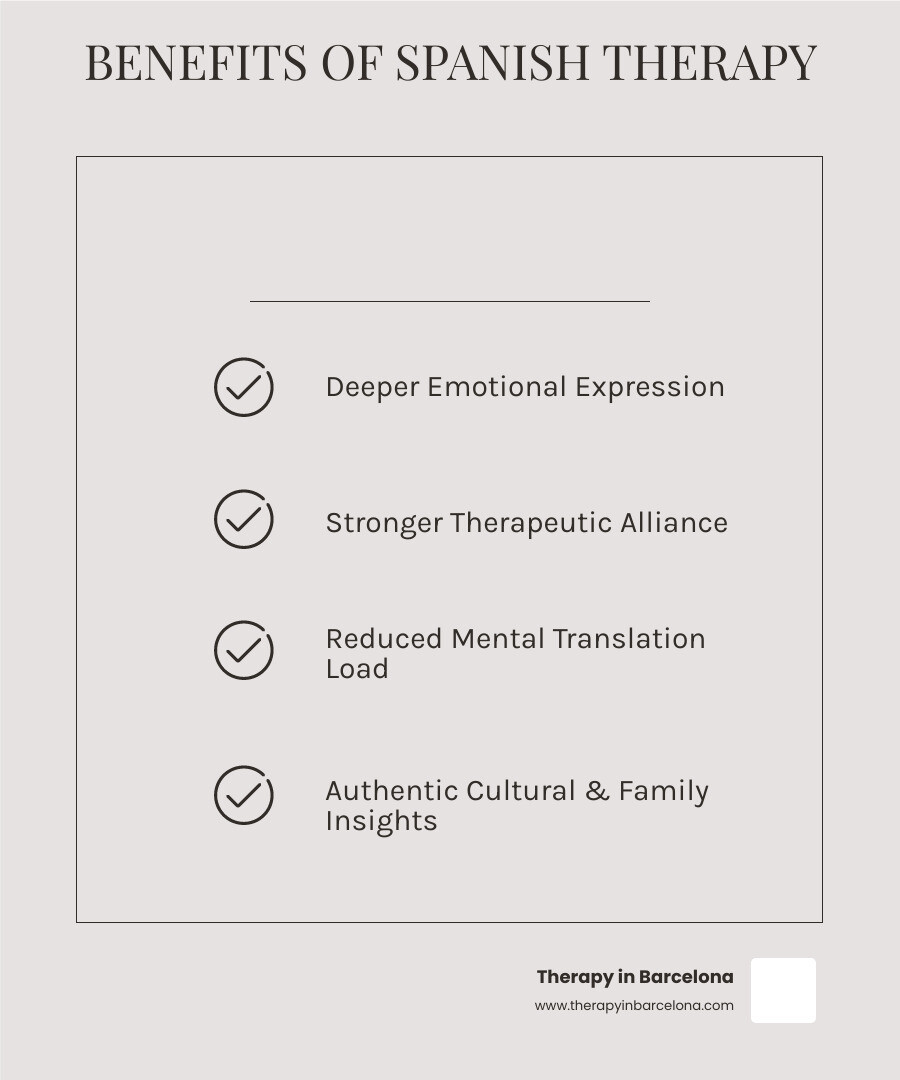
Language isn’t just about words. When you’re trying to explain how you feel—ese nudo en el pecho, that knot in your chest, or la presión of family expectations—sometimes only Spanish captures it fully. Research shows that the therapeutic relationship is one of the most important factors in successful therapy outcomes (American Psychological Association, https://www.apa.org/topics/psychotherapy/understanding), and being able to speak freely in your native language strengthens that connection. You’re not translating your emotions or filtering your thoughts; you’re simply being understood.
Yet finding a Spanish-speaking therapist who also understands your cultural context can feel overwhelming. Do you search locally or go online? What qualifications matter? How do you know if someone will truly “get” your experience as a Latina professional in Barcelona, or a first-generation student in Valencia, or a couple in an intercultural marriage in Málaga? This guide will walk you through the process step by step, from understanding why language matters in therapy to preparing for your first session.
The Power of Language and Culture in Therapy
When it comes to therapy, language is far more than just a tool for communication; it is a direct conduit to our deepest emotions, memories, and cultural identity. Speaking in your mother tongue can help you feel more connected to your culture and allow you to explain emotions more effectively. When you can speak naturally, without searching for words, it can feel empowering and create a stronger sense of being understood.
For many, especially those from Spanish-speaking backgrounds, cultural nuances play a significant role in mental health and well-being. Concepts like familismo (the emphasis on family loyalty and solidarity), cultural norms around privacy, and the impact of generational trauma can be difficult to convey in a non-native tongue. A therapist who shares your language and understands these cultural contexts can help build trust more quickly and avoid misinterpretations.
If you are an expat living in Spain – whether in Barcelona, Madrid, Valencia, or Málaga – you may also face culture shock, relocation stress, homesickness, and the emotional impact of moving away from support networks. Leigh Matthews, an Australian Psychologist in Barcelona since 2011, founder of Therapy in Barcelona and experienced in supporting internationals, created the practice after struggling to find an English-speaking therapist who understood her situation as a foreigner. Her experience underlines how important it can be to find a therapist who understands both language and context.

The journey of migration, whether for work, family, or personal growth, often involves strain and adjustment. Having a therapist who understands these experiences, and who may even be an immigrant or expat themselves, can help you feel seen and heard without judgement.
A culturally sensitive therapist goes beyond merely speaking the language; they aim to be curious and respectful about your background. For Spanish-speaking individuals, this might involve a therapist who appreciates the importance of family dynamics, understands cultural attitudes towards therapy (which can sometimes carry stigma), and can sit with you as you explore cultural stressors or first-generational hardships.
The ability to switch between languages, or to express yourself solely in Spanish, offers distinct advantages in therapy. When you can articulate complex emotions in your native tongue, it often feels more natural. This reduces the “mental load” of constantly translating your thoughts and feelings, and can free up energy for reflection and change.
At Therapy in Barcelona, some of our psychology-trained therapists speak Spanish as well as English and other languages such as German, French, Portuguese, Afrikaans, Austrian-German and Swiss-German. We see adults, couples, teens, and families online worldwide and face to face in our Barcelona office, and we pay close attention to language preferences when matching you with a therapist.
How to Find a Spanish-Speaking Therapist Near Me and Online
Finding a therapist in spanish near me might seem daunting, but there are many options, both online and in person.
Using Online Directories and Resources
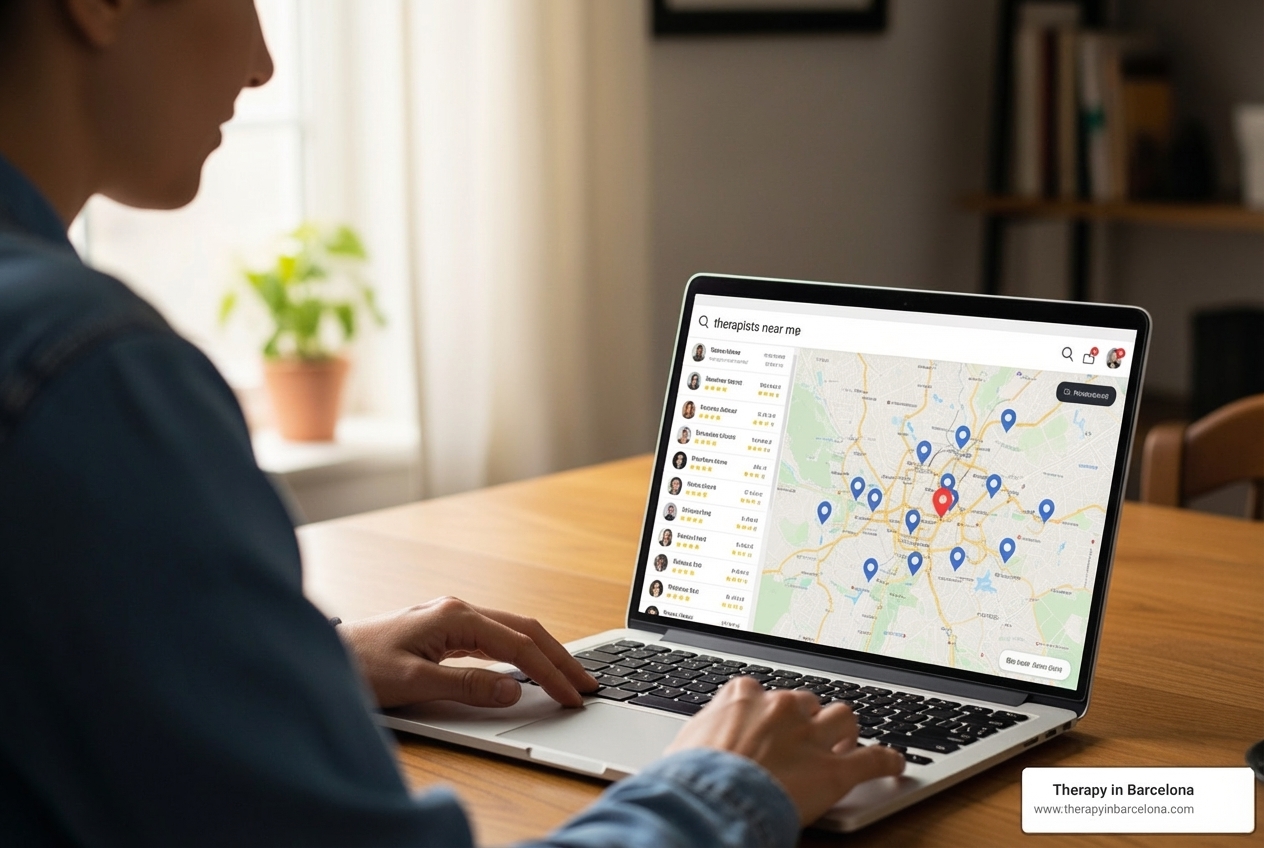
Online directories are often a helpful starting point. Platforms like Psychology Today, It’s Complicated, and the Latinx Therapy directory allow you to filter therapists by language, location, and specialty.
If you are in Spain, you might search for a “Spanish-speaking therapist in Barcelona,” “therapist in Spanish in Madrid,” or “expat therapist in Valencia” and nearby hubs like Málaga or Alicante.
You can also look at local practices, public system clinicians, and large online platforms. Public mental health services may offer low-cost or free support but can involve long waiting lists and limited language options. Large international platforms often have many therapists and lower fees, but may not always offer custom matching or expat-specific cultural understanding. Local private practices, like Therapy in Barcelona, usually work on a private-pay basis and can offer more personalised care.
Here are some questions to keep in mind when you are filtering your search:
- What are your main concerns? For example, stress, low mood, relationship difficulties, or feeling lost abroad.
- What kind of support feels right? Some people prefer a practical, skills-based approach like CBT (Cognitive Behavioural Therapy) or ACT (Acceptance and Commitment Therapy). Others prefer a more exploratory style such as psychodynamic, systemic, or narrative therapy.
- What is the therapist’s experience? Read their profile and look for experience with internationals or expats, cross-cultural issues, or the themes you are living with.
- What languages does the therapist speak? Check whether you can work in Spanish, English, or move between languages.
- Do you want in-person or online sessions? Online sessions can open up far more options.
Finding Affordable Care: Sliding Scale and Other Options
Cost can be a real barrier. Many therapists in private practice, including some therapists at Therapy in Barcelona, work with a private-pay model but offer reduced-fee or sliding-scale spots where possible.
You can also explore:
- Public and community services: In some areas, public health centres or community mental health services offer low-cost therapy, often in Spanish. These can be helpful, but waiting lists may be long.
- University counselling services: If you are a student in Madrid, Barcelona, Valencia or elsewhere, check whether your university offers free or reduced-cost counselling.
- Insurance: If you have private health insurance, ask about reimbursement for therapy, including international providers.
The Rise of Online Therapy for a Therapist in Spanish Near Me
Online therapy has opened access to therapists far beyond your city. You are no longer limited to the small number of Spanish-speaking therapists near you in Sevilla, Zaragoza, or Gran Canaria.
You can work with:
- Therapists based elsewhere in Spain who offer Spanish sessions online.
- Bilingual or multilingual therapists who understand expat life and can move between languages.
At Therapy in Barcelona, our psychology-trained therapists offer online therapy worldwide, including the USA and Canada, as well as in-person sessions in our Barcelona office. We focus on internationals and expats, and we take language, culture, and time zones into account when matching you with someone from our team.
What to Look For: Qualifications and Therapeutic Fit
Once you start identifying potential therapists, it helps to consider both their professional background and how it feels to talk with them. The relationship you build together is often one of the strongest predictors of how helpful therapy will be.
Understanding Therapist Qualifications
Titles and credentials can vary across countries, which can be confusing when you are searching in a place like Spain from abroad.
In Spain, you will often see:
- Psychologist (Psicólogo/a): A university-trained professional in Psychology. Clinical psychologists may have further training in working with mental and emotional difficulties.
If you are looking at therapists from other countries, you might see:
- Licensed Professional Counsellor (LPC)
- Licensed Clinical Social Worker (LCSW)
- Licensed Marriage and Family Therapist (LMFT)
Each of these reflects specific training to support people with emotional, relational, or life challenges. When looking for a therapist, check their website or profile to see how they are trained, what professional bodies they belong to, and where they are registered to practise.
At Therapy in Barcelona, all our therapists are psychology-trained and offer their services as therapists in Spain. We are a trusted group practice established in 2011, and we work as a team to support adults, couples, teens, and families.
Common Therapeutic Approaches You Might Encounter
Therapists use different approaches, often combining more than one. You do not need to know all the details to start, but a quick sense of the style can help:
- Cognitive Behavioural Therapy (CBT): Focuses on how thoughts, feelings, and actions influence each other, and supports you to try new ways of responding.
- Acceptance and Commitment Therapy (ACT): Helps you make space for difficult thoughts and feelings while moving towards what matters to you.
- Schema Therapy or Ego-State approaches: Look at long-standing patterns and parts of self that formed in earlier life.
- Psychodynamic Therapy: Explores how past experiences and unconscious patterns show up in the present.
- Systemic Therapy: Pays attention to family, relationship, and cultural systems.
- Third Wave and mindfulness-based approaches (like MBSR, Somatic IFS, or Narrative Therapy): Bring in body awareness, story, and values.
- Couples approaches such as the Gottman Method or Imago Relationship Therapy: Help partners understand patterns, improve communication, and rebuild connection.
Our therapists at Therapy in Barcelona draw on evidence-based approaches including CBT, ACT, Systemic, Psychodynamic, mindfulness-based, Interpersonal Therapy, Existential, creative and somatic approaches, depending on your needs and preferences.
Finding the Right “Fit” Beyond Credentials
Credentials and methods matter, but they are only part of the picture. You also need to feel reasonably safe and understood with the person you are speaking to.
Many public services, local practices, and large online platforms will match you algorithmically or place you with the first therapist who has availability. This can work, but you may not always feel it is the right fit, especially if you are an international or expat and need someone who really understands that lens.
At Therapy in Barcelona, we offer bespoke therapist matching. We read what you share with us, think about language, culture, identity, lived experience, schedule, and therapeutic style, then suggest the therapist who seems the best fit from our team. If something does not feel right after you start, we help you consider a different match.
You can usually tell a lot from a first conversation. Notice:
- Do you feel listened to rather than rushed?
- Can you imagine telling this person more about your life?
- Do they explain things clearly?
Many private therapists, including our team, offer a Free Discovery Call so you can ask questions and get a sense of their style before committing. If, after a few sessions, the connection still does not feel quite right, it is okay to say so and explore other options. A good therapist will respect this.
Your First Steps: Preparing for and Starting Therapy
Starting therapy, especially in a different country or language, can bring a mix of hope, relief, and nerves. A little preparation can help you feel more grounded.
How to Prepare for Your First Session with a Spanish-Speaking Therapist
- Reflect on what brings you here: This might be anxiety, tension in your relationship, feeling alone in Barcelona, or struggling to adjust to life in Sevilla, Valencia, or another city.
- Jot down a few points: You do not need a perfect story. A few notes about recent events, how you have been feeling, and what you are hoping for can be enough.
- Note your language preferences: Let your therapist know if you want to speak only in Spanish, only in English, or move between the two.
- Bring questions: You might ask about their experience with internationals, the approaches they use, or how they imagine you will work together.
- Be gentle with yourself: It is okay to feel unsure or emotional. You do not have to share everything at once.
What to Expect in Your First Session
The first session is usually about getting to know each other and understanding what you would like support with. Your therapist might ask about:
- Your life now: work or study, relationships, where you live (for example, in Barcelona, Madrid, or Málaga).
- Your history: important relationships, moves between countries, key experiences.
- What you are hoping will feel different.
You can also ask your therapist how they tend to work. Some are more structured and skills-focused; others are more conversational and reflective.
At Therapy in Barcelona, we use what you share before and during the first session to confirm that you are matched with the right person on our team. If you would like to get a sense of us before booking, you can arrange a Free Discovery Call. We offer online therapy worldwide, including the USA and Canada, and in-person sessions in our Barcelona office.
Common Concerns Addressed by Spanish-Speaking Therapists
Spanish-speaking therapists address a wide array of mental health concerns, often with an added layer of understanding for cultural context. These can include:
- Anxiety and Low Mood: Feelings of worry, stress, or persistent sadness that can be made worse by life changes or cultural adaptation.
- Impact of Traumatic Events: Many individuals, particularly those who have migrated, may have experienced deeply distressing events that affect their adjustment and well-being.
- Relationship Issues: Conflicts within families, couples, or friendships, often influenced by cultural expectations.
- Cultural Adjustment and Identity Struggles: Adjusting to a new culture in places like Madrid or Zaragoza, or struggling with a bicultural identity.
- Family Conflict: Addressing complex family dynamics, familismo, and generational differences.
- Grief and Loss: Coping with bereavement, which can be particularly challenging when far from traditional support networks.
- Self-Esteem: Building confidence and self-worth, especially when feeling “othered” or facing new challenges.
Navigating Expat and Cross-Cultural Challenges
For expats in Spain, the challenges of living abroad can be profound. Therapists who specialise in expat support, like those at Therapy in Barcelona, are uniquely equipped to help with:
- Isolation and Loneliness: The feeling of being disconnected in a new country.
- Career Burnout: Stress from work, possibly compounded by language barriers or cultural differences in the workplace.
- Homesickness: Longing for home and familiar routines.
- Bicultural Identity: The complexities of living between two cultures, and sometimes feeling like you don’t fully belong to either.
- Relocation Stress: The emotional toll of moving, settling in, and adapting.
Therapy in Barcelona’s team, all expats themselves, deeply understand these struggles and offer a sanctuary for internationals facing these unique challenges. They can help you explore these issues in individual therapy. Learn more about how they can support you: More info about individual therapy.
Support for Relationships and Families
Relationships and family dynamics are central to many Spanish-speaking cultures, and these can become complex when living abroad or navigating cultural shifts. Spanish-speaking therapists can provide invaluable support for:
- Communication Issues: Helping couples and families improve how they interact.
- Intercultural Couples: Addressing the unique challenges and strengths of relationships between partners from different cultural backgrounds. Leigh Matthews, founder of Therapy in Barcelona, has personal experience with intercultural marriage and its complexities.
- Parenting Abroad: Figuring out parenting styles, educational systems, and cultural influences on child-rearing in a foreign country.
- Family Dynamics: Understanding and addressing family roles, boundaries, and expectations within a cultural context, whether in Gran Canaria or Sevilla.
If you’re experiencing challenges in your relationships, seeking support from a culturally sensitive therapist can make a significant difference. Therapy in Barcelona offers specialised support for couples: More info about couples counselling.
Conclusion
Looking for a therapist in spanish near me is often about more than language. It is about wanting to feel understood in the way you think, feel, and relate to others.
You might find support through public health services in Spain, local Spanish-speaking clinicians, or large online platforms. These can all be valid paths, especially if you need something low-cost or very local. If you are looking for more tailored support as an international or expat, a practice like Therapy in Barcelona can offer something different: psychology-trained therapists, careful and personal matching, expat-specific cultural sensitivity, and strict privacy with no data selling.
If you would like support in Spanish, English, or another language, we are here to help. We have been working with internationals in Barcelona and across Spain since 2011, and we offer online therapy worldwide, including the USA and Canada, as well as in-person sessions in our Barcelona office.
If you’d like support, book a Free Discovery Call. Together we can explore what you are going through and see which therapist on our team might be the right fit for you.
