


When Panic Strikes: Understanding Your Path to Relief

EMDR for panic attacks is a structured therapy that helps you reprocess the memories and beliefs fuelling your panic, reducing their emotional charge and physical intensity. Unlike traditional talk therapy, EMDR doesn’t require you to relive traumatic events in detail. It uses bilateral stimulation—such as guided eye movements—to help your brain process stuck memories in a way that brings lasting relief.
Quick overview: What you need to know about EMDR for panic attacks
- What it helps with: Frequent panic attacks, performance anxiety, specific fears (phobias), and panic related to past distressing events.
- How it works: Targets the root memories and beliefs behind your panic, not just the symptoms.
- Timeline: Many people see improvement within 6-12 sessions; panic linked to a single event may resolve in 3-6 sessions.
- Success rates: Studies show that up to 84% of people with a single distressing memory find significant relief after just three 90-minute sessions
- Who it helps: Adults, teens, and expats facing panic amplified by cultural stress or life transitions.
- Delivery: Available face-to-face in Barcelona and online worldwide.
You’re in a meeting when your heart starts racing and your chest tightens. A wave of terror crashes over you. You escape to the bathroom, waiting for the storm to pass. This is panic—and if you’re reading this, you know how it hijacks your life.
For internationals adjusting to life in Barcelona, Valencia, or anywhere in Spain, panic attacks can feel even more isolating. You’re adjusting to a new culture, and your usual support systems may be far away. The unpredictability of panic makes you second-guess yourself and avoid situations that might trigger an attack. You wonder if you’ll ever feel safe in your own body again.
EMDR therapy offers a different path. Developed by psychologist Francine Shapiro, EMDR is clinically validated by more than 30 randomised controlled studies and endorsed by the World Health Organisation and the American Psychiatric Association. Instead of just teaching you to manage panic, EMDR helps you reprocess the underlying memories that keep it alive. It’s like updating your brain’s threat detection system so it stops sounding false alarms.
This guide explains what EMDR is, how it addresses panic attacks, what to expect during treatment, and how it compares to other approaches. Whether you’re an expat in Spain struggling with adjustment stress or someone tired of living in fear, you’ll find clear, actionable information here.
What is EMDR Therapy and How Does It Work?

Eye Movement Desensitisation and Reprocessing (EMDR) is a psychotherapy approach designed to help people heal from distressing life experiences. Developed by Dr. Francine Shapiro, it was first recognised for its impact on the severe distress that can follow a traumatic event (often called Post-Traumatic Stress Disorder or PTSD), but is also effective for anxiety, specific fears (phobias), and panic attacks. The therapy targets the root memories that keep panic alive, rather than just managing symptoms.
When a frightening event occurs, the brain can struggle to process it. The memory gets stuck in its raw, unprocessed form, complete with the original images, sensations, and emotions. Your brain continues to treat it as a present threat.
EMDR uses bilateral stimulation—often guided eye movements, but also alternating sounds or taps—to help your brain reprocess these stuck memories. While you focus on the distressing memory, the bilateral stimulation activates both sides of the brain, jumpstarting its natural processing system. This doesn’t erase the memory, but it changes how it’s stored. It loses its emotional charge, allowing you to recall the event without the flood of panic.
The evidence for EMDR is substantial, with more than 30 randomised controlled studies validating its effectiveness. It is endorsed by major health organisations like the American Psychiatric Association and the World Health Organisation. For internationals in Spain, EMDR is a great option as it relies less on extensive talking, which can be helpful when having therapy in a second language. Therapy in Barcelona, we offer multilingual care. We work in English, and some of our therapists also speak German, French, Spanish, Afrikaans, Portuguese, Swedish, Austrian-German and Swiss-German.
The Science Behind Healing: The AIP Model
The theory behind EMDR is the Adaptive Information Processing (AIP) model. This model suggests your brain has a natural ability to process experiences, much like your body heals a physical wound. However, an overwhelming event can disrupt this system. The memory gets frozen in time, complete with the original distressing sensations and emotions.
These unprocessed memories act like unhealed mental wounds, ready to be triggered by anything that reminds your brain of the original event. This is why a crowded metro or a tight chest can make you feel like the first panic attack is happening all over again. Your brain hasn’t received the message that the danger has passed.
EMDR helps restart this natural processing system. The bilateral stimulation allows the brain to connect the distressing memory with more adaptive information. The emotional intensity fades, physical sensations calm, and catastrophic beliefs shift. You’re not forgetting what happened; you’re filing it away as a past event that no longer poses a present threat.
The 8 Phases of EMDR Treatment
EMDR follows a structured, eight-phase approach to ensure the work is done safely and effectively. Your therapist will guide you through each phase at a pace that feels right for you.
- Phase 1: History and Treatment Planning. Your therapist gets to know you, understands your concerns, and determines if EMDR is a suitable approach.
- Phase 2: Preparation. You learn about the EMDR process and are taught coping skills and relaxation techniques to manage distress during and between sessions.
- Phase 3: Assessment. You identify a specific target memory, the negative belief associated with it (e.g., “I am helpless”), and a preferred positive belief (e.g., “I can handle this”).
- Phase 4: Desensitisation. While holding the target memory in mind, you engage in bilateral stimulation. You simply notice whatever thoughts, feelings, or sensations arise as your brain reprocesses the memory.
- Phase 5: Installation. Once the distress has decreased, you focus on strengthening the positive belief, associating it with the original memory.
- Phase 6: Body Scan. You scan your body for any lingering physical tension related to the memory and process it until you feel calm.
- Phase 7: Closure. At the end of each session, your therapist helps you return to a state of equilibrium and reminds you of coping strategies.
- Phase 8: Re-evaluation. At the beginning of the next session, you and your therapist review the progress made and identify any new targets.
How EMDR for Panic Attacks Provides Targeted Relief
Many people associate EMDR with major accidents or combat trauma, but EMDR for panic attacks works because panic itself can be traumatic. The first time your heart races out of control or you’re convinced you’re dying, that experience leaves a mark on your nervous system.
The physical symptoms—a pounding heart, shortness of breath, dizziness—are terrifying. For internationals in Barcelona or elsewhere in Spain, these attacks can feel even more frightening when happening far from home, possibly in a language you’re still learning.

EMDR for panic attacks treats these “panic memories” just like other traumatic experiences. Research shows that your brain can file a panic attack under “life-threatening danger,” meaning even small reminders can set off the alarm system again.
Here’s how EMDR provides targeted relief:
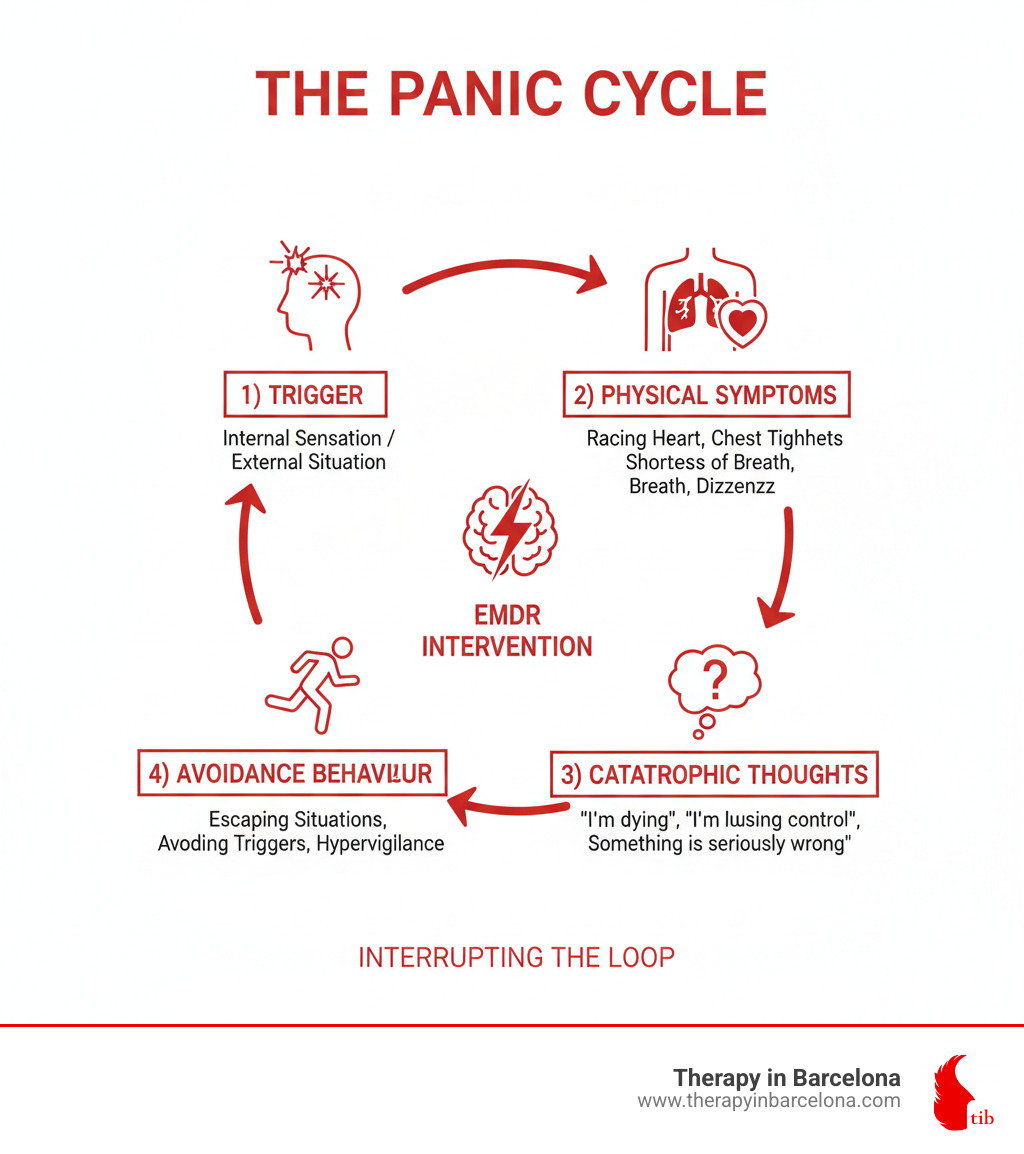
- Desensitising Triggers: It reduces your sensitivity to the internal and external cues that spark panic, like a rising heart rate or a crowded space. EMDR helps your brain learn that these sensations aren’t dangerous.
- Reprocessing Catastrophic Thoughts: It targets the terrifying beliefs that flood your mind during an attack, such as “I’m dying” or “I’m losing control.” EMDR helps change how your brain stores and responds to these thoughts, replacing them with more realistic perspectives.
- Calming Somatic Sensations: It addresses the intense physical symptoms that make panic so overwhelming. By desensitising your body’s reaction, you can experience these sensations without the accompanying terror.
Addressing the Root Cause, Not Just the Symptoms
What makes EMDR for panic attacks different is its focus on the root cause. For many, the first panic attack becomes a template for future ones. Your nervous system takes a snapshot of that moment and files it as “extreme danger.”
But the roots can go deeper. Stressful life events or earlier experiences can make you vulnerable to panic. For expats in Barcelona, Madrid, or elsewhere in Spain, the stress of adapting to a new life can create the perfect conditions for panic to take hold. These experiences often lead to negative beliefs like, “I am not safe” or “I am powerless.”
EMDR identifies and reprocesses these root causes. By working through the original distressing memories and their associated negative beliefs, you can shift your perspective to more accurate ones, such as “I am safe” and “I am capable.” This dismantles the foundation of panic rather than just managing its surface symptoms. For more information, you can read about Feelings of Anxiety.
A Specific Application of EMDR for Panic Attacks
When applying EMDR for panic attacks, a therapist targets specific “panic memories” that keep the cycle alive. This includes:
- Past Panic Attacks: You’ll work through the most frightening attacks, reprocessing them until they lose their emotional intensity.
- Initial Triggers: By desensitising your reaction to the situations, thoughts, or sensations that first sparked your panic, your brain learns to respond differently.
- Underlying Traumatic Events: Processing earlier life stressors or difficult transitions can significantly reduce your vulnerability to future panic.
- Anticipatory Anxiety: EMDR helps reduce the fear of future attacks, which is often more debilitating than the attacks themselves. This breaks the cycle of fear-about-fear and helps you reclaim your freedom.
The goal is to reprocess these memories so your brain no longer perceives them as immediate threats, which naturally reduces the frequency and intensity of panic attacks.
Your EMDR Journey: What to Expect
Starting EMDR for panic attacks can feel like a big step, but knowing what to expect can make it easier. The process is structured, collaborative, and tailored to your unique experience, whether you’re an expat in Barcelona struggling with adjustment stress or someone who has battled panic for years.

Typical Duration, Frequency, and Outcomes
An EMDR session usually lasts 60 to 90 minutes. The total length of treatment varies based on your history.
For panic linked to a single event, you might find significant relief in just three to six sessions. Research on single-trauma cases shows that up to 84% of people reported no longer experiencing symptoms of post-traumatic stress after three 90-minute sessions.
For more complex histories with multiple triggers or ongoing stress, treatment typically takes eight to 12 sessions or more. A study found that 77% of participants with multiple distressing experiences were free of post-traumatic stress symptoms after 12 sessions
Outcomes often go beyond just fewer panic attacks. Many people experience a dramatic drop in the frequency and intensity of panic, less anticipatory anxiety, and stronger emotional regulation skills. Negative beliefs like “I’m not safe” often shift to more empowering ones, helping you feel more confident and in control.
It’s common for your brain to continue processing after a session, which might lead to vivid dreams or heightened emotions for a day or two. This is temporary and a sign that the therapy is working.
Who is an Appropriate Candidate for EMDR?
EMDR for panic attacks is effective for a wide range of people, not just those with “big T” trauma.
You might find EMDR helpful if you’re dealing with:
- Recurrent Panic: If you experience frequent, unexpected attacks that leave you on edge.
- Distress Following Trauma: If panic is a key symptom connected to a past distressing event.
- Other Forms of Anxiety: Including persistent worry, specific fears (such as agoraphobia or social anxiety).
- Performance Anxiety: Where physical panic symptoms undermine your confidence.
- Unresolved Trauma: Past experiences that may contribute to an overactive stress response.
For expats living in Spain—whether in Barcelona, Valencia, or Madrid—the therapy can be especially valuable. The stress of cultural adjustment, language barriers, and distance from support systems can amplify panic. Our therapists, many of whom are expats themselves, understand these unique pressures.
EMDR is adaptable for adults and teenagers, with protocols tailored to different developmental stages. The best way to know if it’s right for you is to have an assessment with a qualified EMDR therapist. If you’d like support, you can book a Free Discovery Call with us to discuss your concerns. We offer therapy both in person at our Barcelona office and online to clients worldwide.
Navigating EMDR: Myths, Challenges, and Alternatives
Like any powerful therapy, EMDR for panic attacks is surrounded by misconceptions. Understanding the facts can help you make an informed choice about your therapy.
Common Myths About EMDR Therapy
Let’s clear up some common misunderstandings.
- Myth: “EMDR is a magic wand.” While EMDR can work quickly, it’s a collaborative process that requires your active participation. It’s a process, not an instant fix.
- Myth: “You have to relive your trauma in detail.” This is untrue. Unlike some therapies, EMDR doesn’t require you to describe distressing events at length. You hold the memory in mind while the bilateral stimulation does the work, which many find less overwhelming.
- Myth: “EMDR only works for major trauma.” EMDR is highly effective for panic attacks, specific fears (phobias), and performance anxiety. If an experience is causing you distress, it’s worth addressing, regardless of how “traumatic” it seems.
- Myth: “It’s unproven or experimental.” EMDR is endorsed by organisations like the World Health Organisation and the American Psychiatric Association. It’s backed by decades of research, including over 30 randomised controlled studies.
EMDR and Other Therapy Approaches
It’s helpful to know how EMDR for panic attacks compares to other options. No single approach works for everyone, and the best fit is personal.
EMDR Therapy stands out by reprocessing the memories and beliefs that fuel panic. It uses bilateral stimulation to help your brain process stuck material, often leading to faster relief for specific traumas with less homework between sessions.
Other Evidence-Based Approaches offer different paths. At Therapy in Barcelona, we provide a range of options. Cognitive Behavioural Therapy (CBT) focuses on changing unhelpful thought patterns and behaviours. You can learn more in our guide to CBT Therapy for Stress Management. Acceptance and Commitment Therapy (ACT) helps you accept difficult feelings rather than fighting them. Other approaches like Schema Therapy and Internal Family Systems (IFS) explore deeper emotional patterns.
Making a Choice is a personal decision. When seeking support in Spain, you might consider the public health system, though wait times can be long. Large online platforms offer convenience but may lack cultural sensitivity. Private local practices like Therapy in Barcelona offer a different experience: bespoke therapist matching to ensure you connect with a professional who understands the challenges of expat life in cities like Barcelona, Madrid, or Valencia. We are a private-pay service committed to quality and privacy—we never sell your data. Some therapists offer sliding scale fees for those with financial need, which you can ask about during your Free Discovery Call.
Frequently Asked Questions about EMDR for Panic Attacks
When considering EMDR for panic attacks, it’s natural to have questions. Here are some of the most common ones we hear.
How long does it take for EMDR to work for panic attacks?
There’s no single timeline. If your panic stems from one specific event, you might see significant improvement in just three to six sessions. For more complex histories involving multiple traumas or long-standing anxiety, it may take eight to 12 sessions or more. On average, most clients start to notice meaningful changes within six to twelve sessions. Your therapist will help you set realistic expectations based on your unique situation.
Are the results of EMDR permanent?
This is one of the most encouraging aspects of EMDR. For many people, the results are permanent. Because EMDR reprocesses the root memories that fuel your panic, it changes how your brain responds to them for good. Once a memory is fully processed, it typically stays that way, and old triggers lose their power. This doesn’t mean you’ll never feel anxiety again, but the foundation of your panic is dismantled. Some people find occasional “booster sessions” helpful during stressful periods.
Can EMDR therapy be done online?
Absolutely. EMDR is delivered effectively online, which is how many of our clients at Therapy in Barcelona work with us. This is especially valuable for expats living anywhere in Spain—from Madrid to Málaga—or around the world. Therapists use various methods for bilateral stimulation, such as on-screen light bars, alternating audio tones, or self-tapping techniques. Online EMDR offers the same benefits from the comfort of your own home, providing access to specialised, English-speaking therapists who might not be available locally. You can learn more about our services here: Online Therapy.
Find Your Calm with an Expert Guide
Panic attacks don’t have to control your life. EMDR offers an evidence-based path to reprocess the memories and beliefs driving your fear, helping you reclaim a sense of safety in your own body.
For internationals living in Barcelona, Valencia, Málaga, or anywhere across Spain, this approach can make daily life feel more manageable. The stressors of expat life—cultural adjustment, isolation, and being far from home—can intensify panic. EMDR can help you work through these pressures.
At Therapy in Barcelona, we are a trusted practice in Spain, established in 2011. We are a group practice of psychology-trained therapists who work with adults, couples, teens and families. Many of us are expats ourselves. We offer culturally sensitive care and take time to match you with the therapist who fits you best.
Sessions are available face to face in our central Barcelona office or online worldwide. Languages: we work in English, and some of our therapists also speak German, French, Spanish, Afrikaans, Portuguese, Swedish, Austrian-German and Swiss-German.
Therapy in Barcelona is a private-pay service that maintains high standards of care and privacy. Some of our therapists offer sliding scale fees for those with financial need.
If you’d like support, book a Free Discovery Call. It’s a no-pressure conversation to discuss what you’re going through, answer your questions, and find the right therapist to support you in this process.
We do not provide crisis care. If you are in immediate danger or thinking of harming yourself, call 112 in Spain or your local emergency number (for example, 999 in the UK or 911 in the USA/Canada).
