


Why Solution-Based Therapy Might Be What You Need Right Now

Solution based therapy (also known as Solution-Focused Brief Therapy or SFBT) is a forward-thinking therapeutic approach that emphasises building solutions rather than analysing problems. Here’s what makes it different:
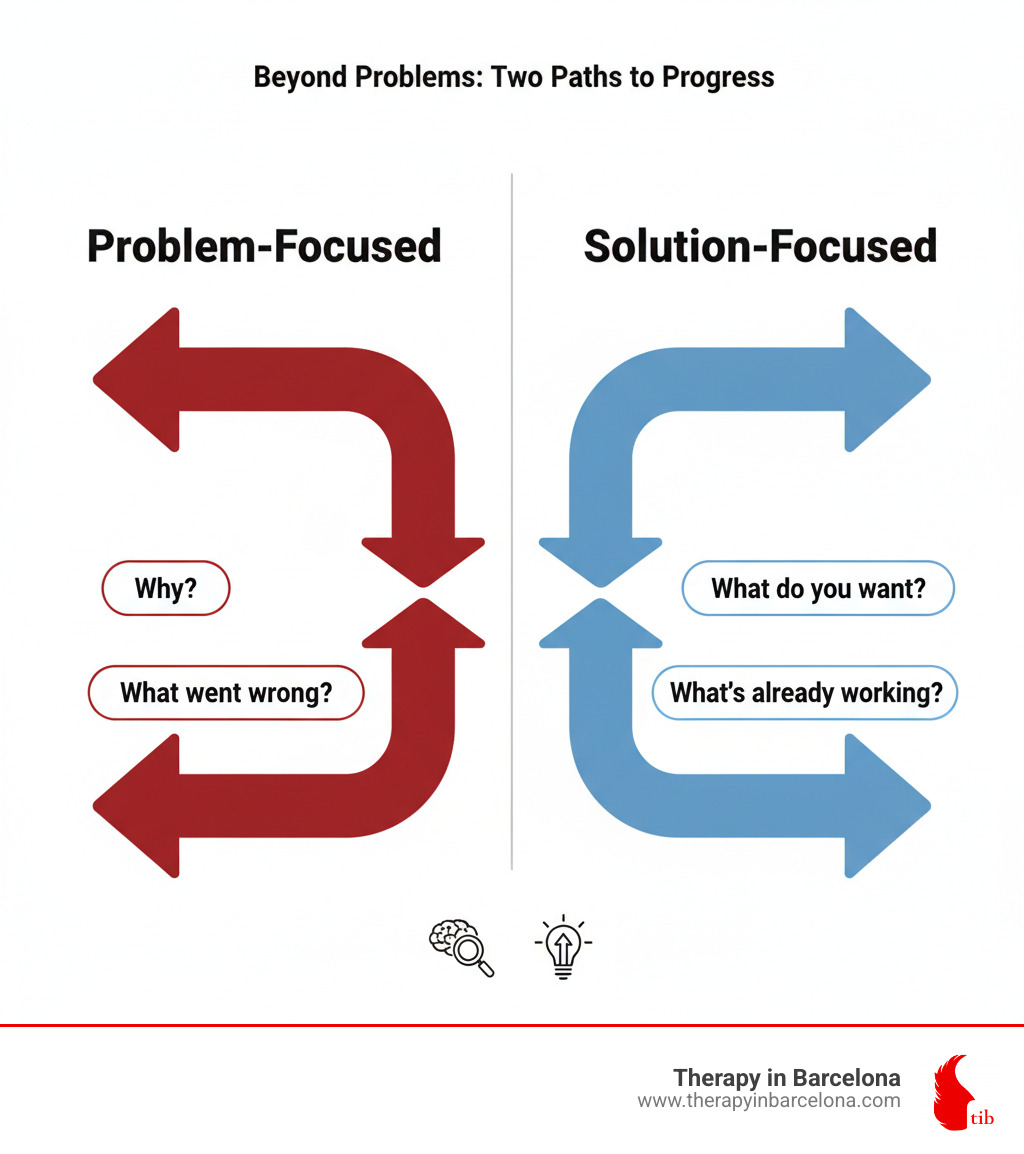
- Future-focused: Instead of dwelling on what went wrong, it asks, “What do you want instead?”
- Brief and practical: Typically 4-8 sessions, designed to create change quickly.
- Strengths-based: Builds on what’s already working in your life.
- Collaborative: You’re the expert on your own life; the therapist helps you find your own solutions.
- Hopeful: Assumes change is not only possible but already happening.
If you’re an expat in Barcelona, Valencia, Málaga, or anywhere in Spain, you might feel stuck. Cultural adjustment, isolation, relationship strain, or career uncertainty can feel overwhelming. While traditional therapy often explores the roots of problems, sometimes what you need most is a way forward.
Solution-based therapy offers a direct path. Rather than spending weeks unpacking why you feel the way you do, this approach asks: what would your life look like if things were better? And more importantly, what small steps can you take to get there?
Developed in the late 1970s by Steve de Shazer and Insoo Kim Berg at the Milwaukee Brief Family Therapy Centre, this approach emerged from a simple observation: talking about problems doesn’t always lead to solutions. By focusing on what clients want to achieve and identifying moments when they’re already coping well, therapists can help people move forward more quickly.
This isn’t about ignoring your struggles. It’s about shifting your energy from what’s wrong to what’s possible. For many expats and internationals, this practical, hopeful approach offers a refreshing alternative to feeling trapped in analysis.
What is Solution-Focused Therapy (SFT)? A Shift from Problems to Possibilities
Solution based therapy (SFBT) flips the traditional therapy script. Instead of unpacking the history of your struggles, it asks: what do you want your life to look like, and how can we help you get there?
This isn’t about ignoring pain. It’s about recognising that you already have strengths and resources, even if they feel buried. The therapy focuses on amplifying what’s working and building practical solutions from there.
SFBT was developed in the late 1970s by Steve de Shazer and Insoo Kim Berg at the Milwaukee Brief Family Therapy Centre. They noticed that focusing on problems didn’t always lead to change, so they asked: what if we focused on what works instead? That simple shift became the foundation of solution-focused therapy.
At its heart, this approach is future-oriented and strengths-based. It helps you envision a life where the problem no longer dominates, then works backwards to identify the steps to get you there. It’s also collaborative, treating you as the expert on your own life while the therapist acts as a guide. The fundamental belief is that you already possess the tools to resolve your difficulties. The therapist doesn’t have the answers—you do. They just help you find them.
One of the core assumptions is that change is constant. Even when problems feel overwhelming, there are always moments when things are slightly better. These moments—called “exceptions”—are crucial. They show that change is already happening and offer clues about how to create more of it. This philosophy fosters client autonomy and builds resilience.
This approach aligns with positive psychology, which also emphasises human strengths. And true to its name, SFBT is designed to be brief and practical. It’s about creating tangible progress by concentrating on solutions and hope for the future. For expats in Barcelona, Valencia, or Málaga, this can feel especially empowering. Moving forward doesn’t require you to fully understand why you’re struggling; it just requires you to take the next small step.
If you’re curious about how therapy like this generally works, you can find more info about how therapy works.
How Solution-Focused Therapy Differs from Traditional Approaches
If you’ve tried therapy before, you might be wondering how solution based therapy compares to other approaches. While all good therapy aims to help you feel better, the paths can look quite different.
The focus is different. In solution based therapy, the spotlight is on the present and future. Instead of analysing why you feel stuck, the therapist asks, “What do you want instead?” It’s not that your history doesn’t matter, but SFT doesn’t assume you need to unpack every chapter of your past to move forward. Traditional therapy, on the other hand, often explores your history in depth to understand the roots of current difficulties, believing that understanding the “why” helps resolve the “what.”
The duration is usually shorter. Solution-focused therapy is designed to be brief and goal-oriented, with many people finding meaningful change in four to eight sessions. The aim is efficient, practical resolution. Traditional therapy can span months or even years, particularly when it involves deeper exploration of long-standing patterns.
The therapist’s role shifts. In solution based therapy, your therapist is a collaborative partner. They adopt a “not-knowing stance,” respecting you as the expert on your own life. Their job is to ask empowering questions and help you construct your own solutions. In more traditional approaches, therapists may take a more interpretive or directive role, offering insights or analysing patterns.
The goals are framed differently. SFT builds solutions and highlights your strengths. The goal is to help you envision a preferred future and identify small, actionable steps to move towards it. Traditional therapy may focus more on analysing problems and processing emotions tied to past experiences.
Think of it this way: if you have a leaky tap, traditional therapy might explore the history of your plumbing system. Solution based therapy would ask, “What kind of tap do you want instead?” and “What small steps can you take to get a new one installed?” Both approaches have their place. But if you’re an expat in Barcelona or Valencia feeling overwhelmed by adjustment struggles, SFT offers a direct, forward-moving path that can bring relief quickly.
The Core Toolkit: Key Techniques in Solution-Based Therapy
Solution based therapy isn’t just a philosophy; it comes with a powerful toolkit of techniques designed to shift your perspective and activate your inner resources. These tools are used in a collaborative conversation, empowering you to find your own way forward.

The Miracle Question: Envisioning Your Preferred Future
One of the most famous tools in SFBT is the Miracle Question. It’s designed to help you bypass problem-talk and directly envision your desired future.
The question goes something like this: “Suppose that tonight, while you are sleeping, a miracle happens and the problem that brought you here is solved. When you wake up tomorrow morning, what would be the first small sign that would tell you the miracle has happened?”
This question isn’t about magic; it’s about goal setting. It helps you articulate concrete, observable changes. For an expat in Valencia struggling with isolation, the answer might be: “I’d wake up feeling excited to go to that Spanish language exchange.” These small, concrete steps become the building blocks for your solutions.
Finding What Already Works: Identifying Exceptions
Even when a problem feels constant, there are almost always times when it’s less severe or even absent. These are called “exceptions,” and they are goldmines in solution based therapy.
A therapist might ask: “Can you think of times when the problem was not present?” or “What was different about the times when this was less of a problem?” By exploring these moments, you can identify hidden strengths and coping mechanisms. For example, a parent in Alicante might realise that on days they spend 15 minutes playing with their child after school, the evenings are calmer. This helps them build on what already works.
For more detailed strategies on setting therapeutic goals, you can explore more info about defining therapy goals.
Measuring Progress with Scaling Questions
Scaling questions provide a simple way to track progress and build confidence.

A therapist might ask: “On a scale from 0 to 10, where 10 means your problem is solved, where are you today?” If you say “3,” the next question might be, “What makes it a 3 and not a 2?” This helps you acknowledge existing strengths. Later, if you move to a “4,” the therapist can ask, “What did you do to move up one point?” This makes progress tangible and highlights your role in the change process.
Other Powerful Tools in Solution-Based Therapy
- Coping Questions: When facing immense difficulty, a therapist might ask, “How have you managed to carry on despite all this?” These questions highlight your inherent resilience.
- Compliments: These are genuine acknowledgements of your strengths, efforts, and progress, which can be incredibly motivating.
- Pre-Session Change: A therapist might ask, “What’s different or better since you booked this appointment?” This helps you notice and build on positive momentum.
Is Solution-Focused Therapy Effective? What the Research Says
If you’re considering solution based therapy, you’re probably wondering: does it actually work? The short answer is yes—and there’s solid research to back that up.
SFBT is an evidence-based practice. A recent comprehensive meta-analysis of nearly 150 randomised clinical control studies found that participants experienced a 59% reduction in psychosocial outcomes. Even when compared to other established treatments, SFBT still produced a 32% reduction in difficulties.
This was the eighth meta-analysis on the topic, with previous ones also consistently finding that SFBT works across diverse populations for issues like low mood, stress, anxiety, and relationship problems . Its practicality and optimistic nature translate well across different cultures, which is why its use in research has more than doubled in non-Western countries since 2013 . So if you’re an expat in Barcelona, Valencia, or anywhere else, you can feel confident that solution based therapy is grounded in real evidence.
Who Can Benefit from SFT?
One of the strengths of solution based therapy is its versatility. It can offer practical support to individuals, couples, and families.
- For individuals, SFBT is helpful for anxiety, stress management, and self-esteem issues. If you’re feeling stuck as an expat in Málaga or Madrid, this approach can help you identify what you want to change and take concrete steps to get there.
- For couples and families, research shows a strong impact on marital functioning and well-being. It helps couples improve communication and resolve conflicts. For families dealing with child behavioural problems, SFBT works well as an early intervention, making it a great option for expat families in cities like Barcelona or Sevilla.
- For expats specifically, SFBT’s focus on future goals and existing coping skills can be incredibly helpful for cultural adjustment challenges like homesickness, isolation, or language barriers. If adjustment difficulties resonate with you, you can find more information about support for adjustment challenges.
Benefits and Potential Limitations of a Solution-Based Therapy Approach
Like any therapy, solution based therapy has its own advantages and considerations.
The benefits are significant. It’s brief and cost-effective, typically lasting 4 to 8 sessions. It’s empowering and motivating, building hope by focusing on your strengths. The approach is positive and non-judgemental, and it strengthens your resilience by equipping you with tools for future challenges.
But there are also limitations. SFBT may not suit everyone, particularly those dealing with severe trauma who feel they need to process deep-seated emotional wounds. While it can be supportive, for those experiencing profound or long-term mental health crises, it is often used as part of a broader care plan rather than as the sole treatment. For some, the rapid shift to solutions might feel like their pain is being minimised, though therapists are trained to validate your experiences first. Finally, it requires your active participation; it works best when you’re ready to focus on what you want to change.
Finding the Right Support: What to Look for in a Therapist
The therapeutic relationship is everything. With SFBT, where the approach is deeply collaborative, feeling understood and comfortable is essential.
Look for a therapist with experience in SFBT, but the therapeutic alliance—the bond and trust you share—is the most important factor for a successful outcome. Choose someone with whom you feel a genuine connection.
At Therapy in Barcelona, we offer personalised therapist matching. We take the time to understand your needs and match you with a therapist whose specialisations and approach align with you. This increases the likelihood of a positive outcome from the start.
For internationals living in Barcelona, Valencia, Málaga, or other parts of Spain, it’s helpful to work with a therapist who understands the challenges of expat life. Our team comprises psychology-trained therapists who are also expats. We bring a deep, empathetic, and culturally informed perspective because we’ve lived it too.
We also offer therapy in a multilingual environment. While all our therapists work in English, some also speak German, French, Spanish, Afrikaans, Portuguese, Swedish, Austrian-German, and Swiss-German. We provide online therapy worldwide, including to clients in the USA and Canada, and in-person sessions at our offices in Barcelona.
You can learn more about our team by visiting more info about our team of therapists.

Alternatives to Private Therapy in Spain
When seeking mental health support in Spain, it’s helpful to understand your options.
- Public system clinicians: Spain’s public healthcare system includes mental health services, but waiting lists can be long, and finding English-speaking, culturally sensitive care can be difficult, especially outside major cities.
- Large online platforms: These offer convenience but may not provide personalised matching or the deep cultural understanding that expats need. Some platforms also have less stringent privacy policies.
- Local practices: These are scattered across Spain and can vary widely in quality, language offerings, and specialisation, often requiring significant research.
Our Differentiators at Therapy in Barcelona:
We offer a distinctive service custom to the international community.
- Personalised therapist matching: Our thorough intake process ensures we make the best match between your needs and a therapist’s expertise.
- Expat-specific cultural sensitivity: Our therapists are expats themselves, bringing a unique lived experience and empathy to the challenges of living abroad.
- Strict privacy: As a private-pay service, we maintain the highest privacy standards and do not sell your data.
- High-quality, private-pay service: We are committed to providing effective, evidence-based interventions. Some of our therapists offer sliding scale fees for those with financial need, which you can inquire about during your Free Discovery Call.
- Established since 2011: We have a long-standing reputation for professional excellence and compassionate care within the international community.
Frequently Asked Questions about Solution-Based Therapy
You might have a few lingering questions about this forward-looking approach. Let’s clear them up.
How long does solution-based therapy typically last?
One of the defining characteristics of solution based therapy is its brevity, typically lasting between 4 to 8 sessions. However, this is not a rigid rule. The duration is flexible and depends on your individual goals. Some clients find resolution in just one or two sessions, while others might benefit from more. The focus is always on achieving your desired outcomes efficiently.
Is SFT just about positive thinking?
No, solution based therapy is much more than just “positive thinking.” It’s a structured, evidence-based therapeutic approach. It doesn’t ignore your problems; it acknowledges your struggles and then strategically shifts the focus. It asks what you want instead of the problem, identifies what’s already working by exploring your strengths, and breaks down goals into small, actionable steps. It’s about constructing practical solutions, not pretending everything is fine.
Can SFT be combined with other therapies?
Absolutely. Solution based therapy is versatile and can be used as a standalone approach or integrated with other therapeutic modalities. Therapists often blend SFBT techniques with other evidence-based models to create a customised approach.
For example, a therapist might combine it with Cognitive Behavioural Therapy (CBT) to address unhelpful thought patterns or with Acceptance and Commitment Therapy (ACT) to foster psychological flexibility. At Therapy in Barcelona, our diverse team employs a range of approaches, including Internal Family Systems (IFS), Person-Centred therapy, and Schema Therapy, to ensure you receive comprehensive care that is truly customised to your journey.
Building Your Best Future, One Solution at a Time
Solution based therapy isn’t about ignoring what’s difficult. It’s about acknowledging where you are, then asking a more useful question: where do you want to go from here?
This approach offers something many expats crave: a practical, empowering way forward that is rooted in the belief that you already have the resources you need. Whether you’re in Barcelona, Valencia, or Málaga, solution-focused work can help you build clarity and momentum. It’s not about toxic positivity; it’s about constructing solutions that fit your life, your values, and your goals.
At Therapy in Barcelona, we’ve been supporting internationals since 2011. Our team of psychology-trained therapists are also expats, so we understand the unique pressures of living abroad. Our personalised matching process ensures you’re paired with a therapist whose approach and experience align with what you need.
We offer therapy online worldwide and in-person sessions at our Barcelona office. This is a private-pay service, though some therapists offer sliding scale fees. If you’d like support, book a Free Discovery Call. If you’re ready to shift your focus from what’s been holding you back to what’s possible, learn more about our therapy services and take that first step.
