


Why the Couple Therapy Intake Form Matters More Than You Think

A couple therapy intake form is the first step in couples therapy. It’s a structured questionnaire that gathers essential information about both partners, their relationship history, current challenges, and goals for therapy. Far from being just another administrative hurdle, this document is the foundation upon which effective therapy is built, helping your therapist understand your unique situation and prepare for your first session.
An effective intake form serves several key purposes at once. It gathers demographic details, relationship history, and individual mental health backgrounds. It helps you and your partner articulate what you hope to achieve, and it allows the therapist to screen for serious concerns like domestic violence or substance abuse. Most importantly, it gives your therapist a head start, making your first session more productive from the moment you walk in.
For couples seeking therapy—whether you’re international partners dealing with cultural differences in Barcelona, or a couple managing the stress of an expat move—this document is where your story begins to unfold. Research shows that the intake process provides crucial opportunities to capture information about clients’ needs and hopes for treatment. For couples, this is especially nuanced because it involves two individual perspectives on a shared relationship, and those perspectives don’t always align.
The best intake forms go beyond basic questions. They ask about your relationship timeline, communication patterns, and moments of contentment alongside the struggles. They acknowledge that every couple has strengths worth building on, not just problems to solve. Critically, they also address sensitive topics like infidelity and domestic violence in a way that prioritises safety and honesty.
This guide will walk you through what makes an effective couple therapy intake form, why certain questions matter, and how the process differs from individual therapy. Understanding this foundational tool can make all the difference in your therapeutic journey.
The Foundation: Why the Intake Form is More Than Just Paperwork
When you first reach out for couples therapy, it’s tempting to see the couple therapy intake form as just another administrative task. But this document does something far more important than simply collecting your contact details. It’s where your therapist begins to truly understand who you are as individuals and as a couple.
The form captures the essential information that shapes how therapy will unfold: your relationship history, the challenges that feel overwhelming, and the strengths you might have forgotten you possess. This isn’t busywork. It’s the foundation that allows your therapist to prepare thoughtfully for your first session, tailoring their approach to your specific situation rather than starting from scratch.
Think of it this way: would you rather spend your first session reciting basic facts, or getting to the heart of what matters? The intake form gives your therapist a head start, so when you walk through the door—whether that’s a physical office in Barcelona or a virtual session—they are ready to meet you where you are.
Establishing the Therapeutic Alliance from Day One
First impressions matter, even in therapy. A well-designed couple therapy intake form is often your first real interaction with the therapeutic process, and it sets the tone for everything that follows. When the form is thoughtfully constructed, it demonstrates professionalism and care, telling you that this therapist takes your situation seriously.
This initial step is central to building the therapeutic alliance. When you see that your therapist has taken time to understand your concerns before you’ve even met, it builds confidence. You feel heard before you’ve spoken a word. For couples who might arrive feeling uncertain or tense, this matters enormously. It signals that this process will be thorough, collaborative, and genuinely focused on you.
At Therapy in Barcelona, we believe in personalised therapist matching. The intake process is where this begins, allowing us to understand your specific needs and connect you with someone who can truly help. You can learn more about our approach to couples counselling and how we support international couples.
How Intake Differs for Couples vs. Individuals
The intake process for couples therapy is fundamentally different from individual therapy. It’s not just about asking the same questions twice. It’s about understanding a more complex system.
Individual therapy focuses on one person’s history and goals. But couples therapy involves two clients and one relationship—a system with its own patterns and dynamics. Each partner arrives with their own perspective, and those perspectives often don’t match. The intake form needs to capture both individual viewpoints while also beginning to reveal how they interact.
This is why a good couple therapy intake form asks about interactional patterns. How do you communicate when things get tense? What happens when conflict arises? Understanding this dance is essential for effective therapy. There’s also the matter of confidentiality, which works differently in couples therapy. Many therapists use a “no secrets” policy, meaning information shared individually may be brought into joint sessions to serve the relationship. This must be clearly explained from the start.
Finally, the intake form helps assess the health of the relationship as a system. For international couples—perhaps dealing with cultural differences, language barriers, or the stress of living abroad—these questions take on additional layers. An intercultural couple in Barcelona might face challenges that a monocultural couple wouldn’t, and the intake process should be sensitive enough to capture these nuances.
Core Components of a Comprehensive Couple Therapy Intake Form
A well-designed couple therapy intake form is a diagnostic tool that reveals the texture of a relationship—its history, strengths, wounds, and hopes. It should be comprehensive enough to provide a meaningful overview, yet focused enough not to overwhelm couples who may already feel vulnerable.
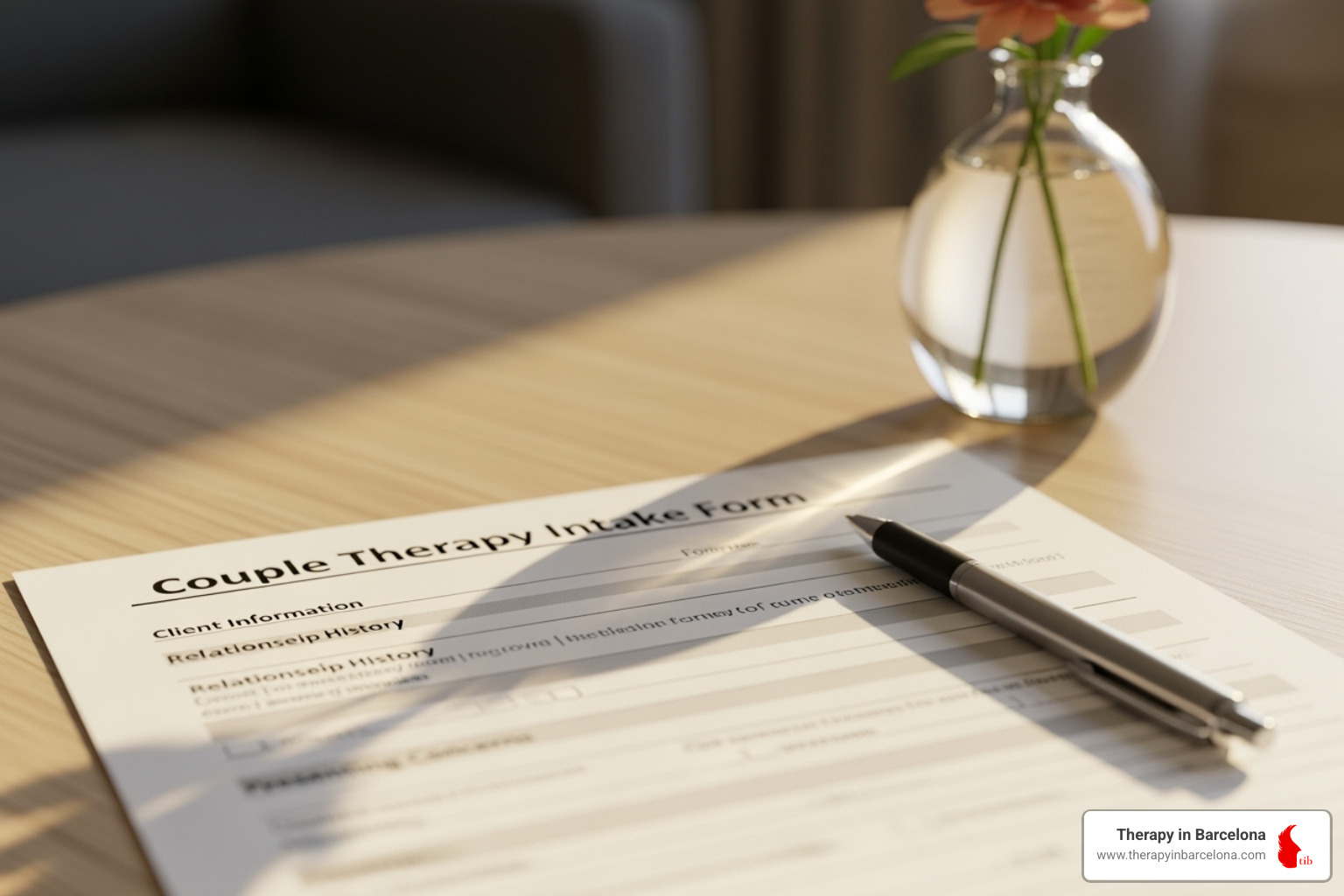
An effective form typically includes:
- Demographics and Contact Information: Names, ages, occupations, and any religious or spiritual preferences for both partners.
- Relationship History: Are you married, cohabiting, dating? How long have you been together? Have there been significant transitions like marriage, children, or an international move to a city like Barcelona or Madrid?
- Presenting Problems and Goals: What specific issues brought you here? What does each partner hope to accomplish?
- Previous Therapy Experiences: Has either partner tried individual or couples counselling before, and what was the outcome?
- Individual Health and Substance Use: This includes mental health history, medications, and direct questions about alcohol or drug use.
- Safety Screening: Direct, sensitively worded questions about physical violence, threats, or emotional abuse.
- Relationship Strengths: What are your biggest assets as a couple? What do you admire about each other? These questions remind everyone that even struggling relationships have foundations worth building on.
Capturing the Relationship’s Story
Every relationship has a narrative. Understanding that story helps therapists see patterns that couples themselves might miss. A thoughtful couple therapy intake form asks partners to trace their journey: How did you meet? What drew you to each other initially?
The form might ask about significant life events: marriage, the birth of children, career changes, or relocations. Each of these milestones can strengthen or strain a relationship. Some therapists use a relationship timeline or satisfaction graph, asking couples to chart their contentment over time. This visual exercise can be remarkably revealing, showing patterns of highs and lows and highlighting whether the couple has weathered storms together before.
The form should also ask directly: When did things start to decline? Sometimes couples can pinpoint a moment, and sometimes the decline feels more gradual. Both answers are valuable. For a more detailed approach, a Couple Counseling Relationship History Assessment can be particularly helpful.
Assessing Strengths, Challenges, and Communication
An effective couple therapy intake form focuses on both strengths and struggles. It’s easy for couples in distress to fixate on what’s wrong, so asking about relationship strengths is crucial. What are your biggest assets as a couple? When do you feel most content together? These questions identify resources the couple can draw on and remind partners why they’re fighting for the relationship.
At the same time, the form must dig into communication and conflict patterns. How do you handle disagreements? What topics are most difficult to discuss? These questions reveal whether couples fall into destructive patterns like criticism or stonewalling, which are key markers of relationship distress according to models like the Gottman Method. Questions about individual strengths and weaknesses in conflict resolution can also be illuminating. For expat couples, these communication challenges can be intensified by cultural differences or the isolation of living far from home. For more on this, see From Misunderstandings to Meaningful Conversations: A Guide to Couples Communication Therapy.
Understanding Individual Contexts
While couples therapy focuses on the relationship, the individuals within it bring their own histories. A comprehensive couple therapy intake form explores each partner’s individual mental health history, including any diagnoses, medications, or previous therapy experiences. This helps therapists understand underlying factors like depression or anxiety that may impact the relationship.
Questions about family of origin can also provide insight into the relationship patterns we learn growing up. Substance use deserves direct, non-judgmental inquiry, as it can both reflect and exacerbate relationship problems. Finally, the form should assess overall stress levels and personal well-being. For expats, these individual contexts often include unique challenges related to cultural adjustment and isolation, as explored in The Strain of Moving Abroad on Relationships: Why Couples Therapy Can Be Your Lifeline.
The Intake Process: Best Practices for Therapists
The way a couple therapy intake form is designed and administered can significantly impact the therapeutic journey. Therapists aim to make this process as smooth and informative as possible, setting the stage for productive sessions.

There’s a delicate balance to strike. The form needs to be comprehensive enough to give the therapist a meaningful understanding, but not so lengthy that it overwhelms clients. Common mistakes include forms that are too long, overly clinical, focused only on problems, or unclear about confidentiality.
For couples seeking therapy online, whether through virtual love doctors or local providers, understanding these best practices can help you know what to expect from a quality intake process.
The Power of Separate Forms
One of the most effective strategies is having both partners complete the couple therapy intake form individually. This isn’t about creating secrecy—it’s about creating space for honesty.
When partners fill out forms separately, they can express their thoughts without the immediate influence of their partner. This often leads to more candid responses and reveals invaluable misalignments in perception. For example, one partner might describe arguments as happening “sometimes,” while the other writes “nearly daily.” These discrepancies aren’t problems; they’re starting points for therapy.
Separate forms also provide a safer space to disclose sensitive information, especially when screening for domestic violence or substance abuse. Finally, it encourages individual accountability, as each person reflects on their own contributions to the relationship’s dynamics.
Integrating Technology into Your Intake Process
Technology has transformed the intake process, making it smoother for everyone. Online forms and secure client portals offer several practical advantages.
Efficiency is a key benefit. Digital forms can be completed at the couple’s convenience, reducing paperwork during the first session and allowing more time for therapeutic conversation. For expats in cities like Barcelona or Valencia, online forms are essential for managing busy international schedules.
Security is also paramount. Reputable online platforms use robust security measures to protect sensitive personal information, often adhering to privacy regulations. Platforms such as Quenza offer ready-made tools for telehealth, as highlighted in helpful information on telehealth forms.
Online intake can also seamlessly integrate consent forms for telehealth, which is particularly relevant for the growing number of couples choosing online therapy for couples. This makes the intake process feel less like a bureaucratic hurdle and more like a thoughtful first step toward healing.
Navigating Sensitive Topics: Ethics and Safety
The couple therapy intake form is where ethical boundaries and safety protocols begin. For therapists, this document carries real weight, shaping how we handle confidential information and respond to concerns about harm. Getting this right from the start protects everyone and sets the foundation for honest, effective work.
A Clear Policy on Confidentiality and Secrets
One of the trickiest aspects of couples therapy is how confidentiality works. Unlike individual therapy, where your therapist holds your secrets close, most couples therapy models operate differently. The therapist’s primary client is the relationship itself, not either partner individually.
This often means a “no secrets” policy. If you share something privately with your therapist that affects the relationship, they may need to bring it into the joint sessions. This policy isn’t meant to feel uncomfortable; it’s designed to foster transparency and trust within the therapy room. The intake form and informed consent process should spell this out clearly, so you understand the boundaries from the outset.
A clear informed consent for therapy agreement outlines these limits explicitly. This is particularly important for expat couples dealing with unique stressors. For more on how we approach these nuances, see Love Across Borders: A Guide to Expat Couples Therapy.
How to Ask About Domestic Violence on a Couple Therapy Intake Form
Screening for domestic violence is a non-negotiable part of the intake process. These questions exist to protect your safety and help determine if couples therapy is appropriate, or if individual support and safety planning should come first.
Good intake forms use neutral, non-judgmental language and ask about physical, emotional, and sexual abuse. These questions are often included in the individual sections of the form, allowing each partner to answer privately.
Examples of questions you might see:
- “Have either you or your partner ever struck, physically restrained, or injured the other person?”
- “Do you ever feel afraid of your partner?”
- “Has your partner ever threatened you or made you feel unsafe?”
- “Do you feel controlled or manipulated by your partner?”

If any answer raises concerns, the therapist will follow up with a safety assessment. This isn’t about judgment—it’s about making sure everyone is safe. At Therapy in Barcelona, we take these concerns seriously. While we don’t provide crisis care, we ensure clients know where to turn in an emergency. In Spain, resources like the 016 helpline for gender-based violence are available 24/7.
Frequently Asked Questions about the Couple Therapy Intake Form
Starting couples therapy can bring up several questions. Here are some common ones that internationals in Barcelona, Madrid, and across Spain often ask about the couple therapy intake form:
How long should a couple therapy intake form be?
A good form walks a fine line. It needs to be comprehensive enough for your therapist to prepare, but not so long that it feels overwhelming. Most well-designed forms are between 4 and 8 pages, focusing on what truly matters: the issues bringing you to therapy, your relationship’s story, and any safety concerns. It should feel purposeful, not like homework.
Should we fill out the form together or separately?
The best practice is for both partners to complete the form individually. This allows you to reflect honestly without your partner’s immediate influence, leading to more candid responses. The therapist can then review both forms to see where your perspectives align and differ. This also provides a safer space for disclosure if there are power imbalances or safety concerns.
What happens if I’m uncomfortable answering a question?
It’s absolutely okay to leave a question blank. Therapy is a process that unfolds at your own pace, and you should never feel pressured to disclose everything at once. You can discuss any discomfort with your therapist during your first session. A good therapist will understand and respect your boundaries, ensuring the therapy space feels safe. The purpose of the form is to help, not to interrogate.
Finding the Right Support for Your Relationship
The couple therapy intake form is the foundation of your therapeutic journey. By completing it thoughtfully, you give your therapist the insights needed to understand your relationship, prepare for your sessions, and tailor their approach to your unique situation. It’s where clarity begins.
When you’re looking for couples therapy, especially as an expat, you’ll find several options. Public health services in Spain often have long waiting lists and may not offer English-speaking therapists. Large online platforms can work for some, but the matching process is often less personalised.
At Therapy in Barcelona, we’ve built something different. Since 2011, we’ve specialised in supporting the international community—not just in Barcelona, but in Valencia, Madrid, Málaga, and beyond, as well as online worldwide. Our approach centres on bespoke therapist matching. We take time to understand your specific concerns and cultural background, then match you with a therapist whose expertise aligns with your needs.
Our team of expat therapists understand what it’s like to build a life in a foreign country. This lived experience, combined with high-level professional training, means you’re working with someone who truly gets it. We also prioritise your privacy and offer a high-quality, private-pay service. Some of our therapists offer sliding scale fees for those with financial need, so don’t hesitate to ask.
We offer both in-person sessions at our Barcelona office and online therapy to internationals worldwide.
If you and your partner are ready to build a stronger connection, our team is here to help. Book a Free Discovery Call to learn more about our approach to couples counselling and how we can support your journey. You can also visit Your Guide to the Best Couples Counseling in Your Area for more information.
