


Why Narrative Therapy Offers a Unique Path for Intercultural Couples

When partners from different cultures seek therapy, they are often told their problems stem from their cultural differences. Narrative therapy with intercultural couples shows another perspective.
It suggests the real issue isn’t the cultures themselves, but the stories we inherit about what those differences mean. This approach helps couples work through their unique challenges without blaming their relationship or each other.
Key Insights from Narrative Therapy with Intercultural Couples:
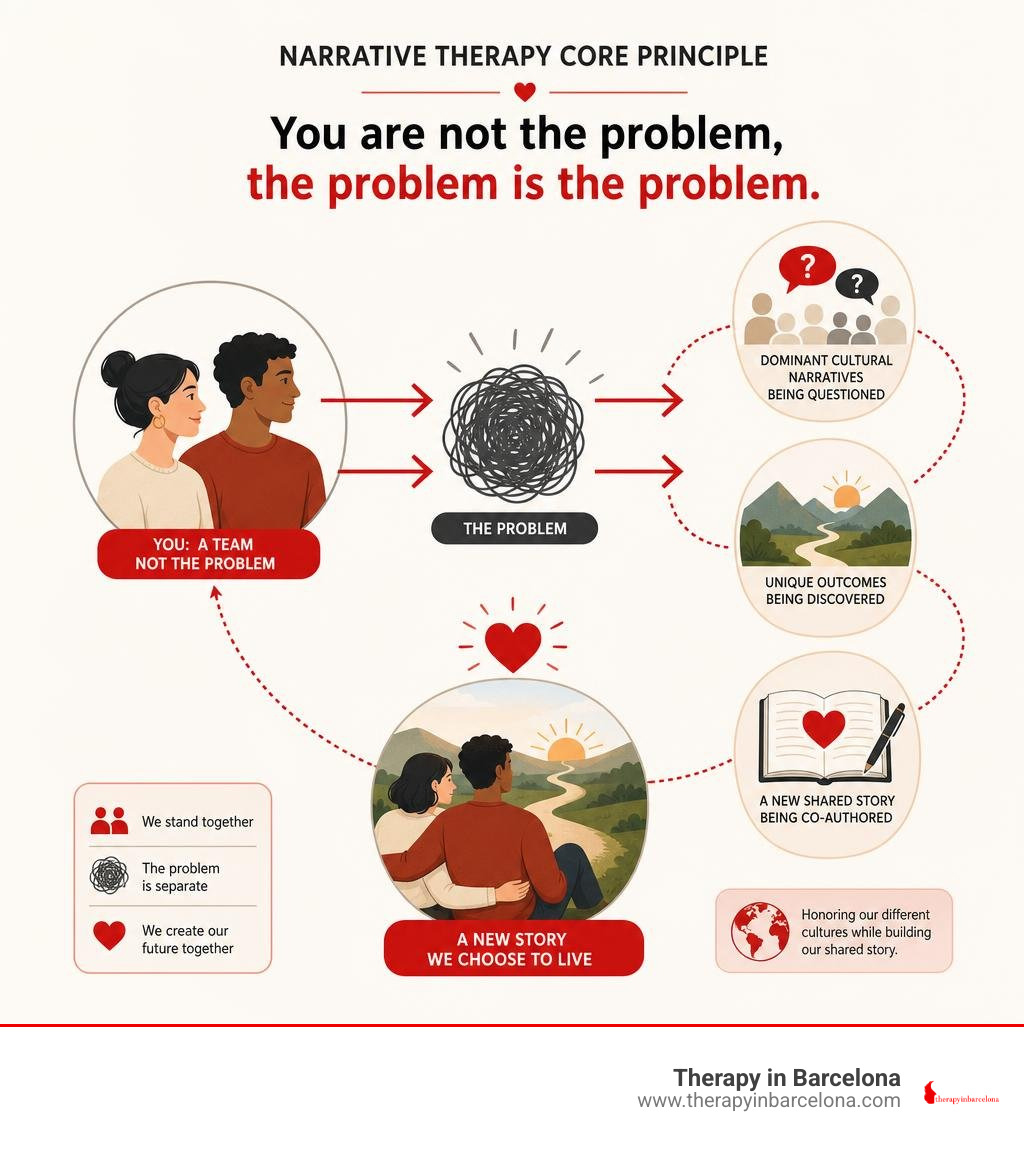
Externalising the Problem – Rather than blaming each other for cultural differences, couples learn to see “the conflict” as something separate from their identities, making it easier to tackle together.
Deconstructing Dominant Narratives – The therapy explores how societal messages, family expectations, and cultural stereotypes shape each partner’s assumptions and reactions.
Co-authoring New Stories – Partners move from problem-saturated narratives to finding unique outcomes—moments where they’ve successfully worked through their differences—and build on these to create a shared intercultural identity.
Cultural Humility in Practice – The therapist takes a “not-knowing” stance, positioning each partner as the expert in their own cultural experience, which is especially vital for expat couples in cities like Barcelona, Valencia, or Málaga.
If you’re part of an intercultural couple in Spain—whether you’re both internationals or one local and one expat—you might recognise this pattern. The same argument keeps surfacing, perhaps about money, family obligations, or how to raise children.
On the surface, it looks like a communication issue. But beneath it often lie unspoken cultural narratives about what’s “normal” or “right,” inherited from families, communities, and broader societal messages.
Intercultural couples face unique challenges, from cultural differences and societal disapproval to microaggressions, alongside the everyday stresses of relationships.
Narrative therapy, developed by Michael White and David Epston in the 1980s, offers something different. Rather than labelling your relationship as “broken” or trying to fix one partner, it invites you both to examine the stories you’re living by—and to decide whether those stories still serve you.
For expat couples living in Barcelona or elsewhere in Spain, this approach can be particularly powerful. It acknowledges that your challenges exist within a broader socio-political context, not just within your relationship.
Through a detailed case study using fictional avatars, this article illustrates narrative therapy in practice, exploring its effectiveness for intercultural couples and what the process involves for those building their lives in a city like Barcelona.
Understanding Narrative Therapy and Its Role in Couples Counselling
Narrative therapy is built on a simple but powerful idea: people are not their problems. Instead, problems are seen as separate things that influence people’s lives. This is a core principle that makes it a powerful tool in couples counselling, particularly for intercultural relationships.
One of the central tenets is that people are the experts of their own lives. A narrative therapist takes a “not-knowing stance,” meaning they approach each session with genuine curiosity, allowing the couple to lead the way in defining their experiences and challenges.
This stance is crucial because it respects the unique cultural backgrounds and individual perspectives each partner brings. The therapist acts as an active facilitator, helping couples to articulate their stories rather than imposing a pre-defined framework.
A key technique is “externalising the problem.” Instead of saying, “You are a bad communicator,” a narrative therapist might ask, “How does ‘The Communication Breakdown’ try to trick you into misunderstanding each other?”
This simple shift in language separates the problem from the person, making it an external entity that the couple can unite against. This is particularly liberating for couples, as it removes blame and fosters collaboration.
Often, couples arrive in therapy with “problem-saturated stories”—narratives where the problem has taken centre stage, overshadowing their strengths and moments of connection.
Narrative therapy helps deconstruct these stories, questioning their origins and impact. It then moves towards “co-authoring new stories,” inviting couples to identify “unique outcomes” or “sparkling moments”—times when they successfully resisted the problem’s influence.
By amplifying these moments, couples can begin to weave richer, more preferred narratives about their relationship and their shared future. By creating new stories together, couples find a way to change their relationship for the better.

The Unique Landscape of Intercultural Relationships
Intercultural couples, by their nature, bring together a mix of different traditions, values, and expectations. While all couples face common issues like communication, intimacy, and finances, intercultural pairs encounter additional layers of complexity.
For instance, research highlights that while interracial couples often seek counselling for the same reasons as monoracial couples, they also face unique stressors.
These include managing societal disapproval, understanding how racialised histories and privilege have shaped each partner’s life, and confronting microaggressions (Killian, 2001, Journal of Marital and Family Therapy).
Consider the expat couple building a life in Barcelona, Valencia, or Málaga. One partner might come from a culture where family privacy is paramount, while the other grew up in a more communal society with frequent family visits.
These differing beliefs about gender roles, finances, or child-rearing can lead to profound misunderstandings. What one partner considers a fundamental value, the other might see as an arbitrary preference.
Broad issues like managing societal disapproval can be a heavy burden. Despite progress, interracial relationships have historically faced challenges, with race-based marriage restrictions only being overturned relatively recently in many places.
This historical context can still subtly influence societal perceptions and support networks. Moreover, differences in cultural beliefs about gender roles or expectations can create tension, as can individual racial identity issues.
Therapists need to recognise that while couples may present with common problems such as communication issues or financial struggles, underlying these are often profound, unacknowledged cultural dynamics.
These aren’t just minor differences; they are deeply ingrained belief systems that shape each partner’s worldview.
For couples seeking support in Spain, Therapy in Barcelona understands these nuances and offers specialised couples counselling services designed to help partners bridge these cultural gaps.
You can find more information about our approach to couples counselling here: More info about couples counselling services.
A Narrative Therapy with Intercultural Couples a Case Study: Meet “Ana” and “Ben”
Here’s how a narrative therapy with an intercultural couple might look in practice. Meet Ana, a 32-year-old from Colombia, and Ben, a 34-year-old from the UK.
Ana and Ben are a fictional composite example representing common expat challenges, and their story reflects a pattern we often see in our work with intercultural couples. They met in Barcelona, where Ben works in tech and Ana is a graphic designer.
They’ve been together for five years and recently moved in together. While deeply in love, they find themselves in a recurring conflict cycle, primarily around money and family obligations.
Their presenting problem seems straightforward: Ben feels Ana is too generous with her family back home, sending money more frequently than he believes they can afford. Ana, in turn, feels Ben is cold and unsupportive, prioritising financial independence over family connection.
This leads to heated arguments, often ending with Ana feeling criticised and Ben feeling resentful. For them, “The Conflict” has become a pervasive “truth” in their relationship, making it difficult to address.

The First Steps: Externalising “The Conflict”
In their first sessions, the therapist, adopting a not-knowing stance, invited Ana and Ben to tell their story of “The Conflict.” Instead of focusing on who was right or wrong, the therapist helped them to externalise the problem.
“Ana, when ‘The Financial Strain’ visits your home, what does it whisper in your ear about Ben?” the therapist might ask. Or, “Ben, how does ‘The Burden of Obligation’ try to convince you that Ana is being irresponsible?”
This allowed them to name the issue—they settled on “The Unseen Divide”—and discuss its effects without personal attacks.
Ana described how “The Unseen Divide” made her feel unloved and disconnected from her roots. Ben articulated how it created anxiety and a sense of instability for their shared future.
Through this externalising conversation, they began to deconstruct the beliefs that fuelled “The Unseen Divide.” The therapist explored the dominant cultural narratives each partner had internalised.
For Ana, the narrative of “Family First” was deeply embedded, stemming from her Colombian upbringing where extended family support, including financial, was a given. Not providing this support felt like a betrayal of her identity and her family’s love.
For Ben, the narrative of “Individual Responsibility and Financial Prudence,” common in British culture, meant that one should stand on their own two feet and save for future security. He saw his parents model this, and it felt like the only “responsible” way to live.
These weren’t just personal opinions; they were powerful family stories and cultural scripts.
Re-authoring Their Story: Finding Unique Outcomes
As Ana and Ben continued to externalise “The Unseen Divide,” the therapist helped them search for “unique outcomes”—moments when “The Unseen Divide” didn’t dominate their relationship.
Ana recalled a time when Ben had, without question, supported her sending money to her mother for an unexpected medical expense.
Ben remembered when Ana had thoughtfully budgeted for a trip to visit his family, showing consideration for their shared finances.
These “sparkling moments” were crucial. They showed that “The Unseen Divide” wasn’t absolute; it had exceptions. By remembering conversations about these moments, Ana and Ben began to see a different story emerging—a story where they could navigate their differences with love and mutual respect.
The therapist then facilitated the co-creation of a new, preferred story. They started to envision “The Intercultural Team”—a narrative where their different cultural backgrounds became a source of strength, not division.
They discussed what “The Intercultural Team” would look like in action. It involved open dialogue about financial decisions, creating a specific family support budget that both could agree on, and finding alternative ways for Ana to feel connected to her family that didn’t solely rely on money.
Ben committed to understanding the emotional significance of family support for Ana, and Ana committed to exploring Ben’s anxieties about financial security. They started to build a shared intercultural identity, one that honoured both their individual stories.
A look at a narrative therapy with an intercultural couple case study in practice
In a session, the dialogue might sound like this:
Therapist: “Ana, when ‘The Intercultural Team’ is in charge, how do you feel about discussing your family’s needs with Ben?”
Ana: “I feel heard. And I feel like Ben isn’t judging my culture, but trying to understand my love for my family. ‘The Intercultural Team’ helps me explain why it’s so important.”
Therapist: “And Ben, what does ‘The Intercultural Team’ allow you to do when Ana shares these needs?”
Ben: “It allows me to listen without immediately feeling that familiar grip of ‘The Financial Strain.’ I can see Ana’s perspective more clearly, and together, we can figure out a plan that works for both of us, rather than me just shutting down.”
The therapist might also use therapeutic documents, such as letters written to the couple, summarising their progress and reinforcing their new narrative.
These letters highlight their strengths, their unique outcomes, and their efforts in battling “The Unseen Divide” to build “The Intercultural Team.” This tangible record helps them remember and reinforce their preferred story outside of therapy sessions.
Why Narrative Therapy? A Comparison with Other Approaches
When considering therapy for intercultural couples, it’s helpful to understand why narrative therapy is often a good fit. While other modalities offer valuable insights, narrative therapy’s core principles align particularly well with the intricate nature of cultural differences.
One of the primary benefits of narrative therapy is its focus on the socio-political context of problems. It recognises that problems are shaped by cultural messages, power dynamics, and social norms.
This is crucial for intercultural couples who frequently face external pressures like societal disapproval or microaggressions.
Narrative therapy helps deconstruct these dominant cultural narratives, allowing couples to challenge assumptions and create their own definitions of a healthy relationship, rather than conforming to prescriptive “normative scales.”
This approach contrasts with modalities like The Gottman Method, which is highly effective for many couples and based on over 40 years of research with over 3,000 couples.
It focuses on increasing positive interactions, managing conflict, and building “love maps.” While Gottman’s tools for communication and conflict resolution are powerful, they might require adaptation for intercultural couples.
Research indicates that counsellors using the Gottman Method with intercultural couples need to be comfortable broaching difficult racial conversations and minimising microaggressions to apply the model effectively (Johnson, 2018, The Family Journal).
Similarly, Psychodynamic Therapy digs into interpreting mental and emotional processes, often exploring past experiences and unconscious beliefs, including concepts like transference. While valuable for understanding individual histories, it may need careful cultural adaptation.
For instance, metaphors used in psychodynamic therapy might need to be culturally relevant to resonate with diverse racial groups.
Narrative therapy, however, inherently champions client empowerment. It positions the couple as the experts of their own lives, rather than the therapist holding all the answers.
This “not-knowing” stance is particularly empowering for intercultural couples, as it validates their unique experiences and perspectives without imposing a Western-centric view of relationships.
The externalisation of issues in narrative therapy is also a significant advantage; it allows couples to address biases or deeply held beliefs without attributing them directly to a partner, fostering a safer space for dialogue.
This can be especially protective when dealing with sensitive topics related to race or culture, preventing conversations from becoming personal attacks.
Narrative therapy can be especially effective for international and minority clients, offering a culturally adaptable approach that helps partners understand each other’s experiences.
You can learn more about narrative therapy’s application in couples therapy through academic resources such as this chapter on Narrative Therapy with Couples: Narrative Therapy With Couples | 23 | Case Studies in Couples Therapy .
When considering therapeutic options, alternatives exist, such as large online therapy platforms or the public health system.
These services, however, may not offer the same level of personalised, culturally sensitive care and often lack bespoke therapist matching. Furthermore, clients may have valid concerns about data privacy on large platforms.
In contrast, Therapy in Barcelona provides a specialised private-pay service that guarantees strict client confidentiality (we never sell data), offers bespoke therapist matching to find the right fit, and provides culturally informed support from expat therapists who understand intercultural life in Spain.
Our team also offers therapy in multiple languages, ensuring you can express yourself in the language you feel most comfortable with, a level of personalisation not always available elsewhere.
The Therapist’s Role: Cultural Humility and Ethical Practice
Working with intercultural couples requires a high degree of cultural humility and competence from the therapist.
Cultural humility means approaching each couple with an openness to learn, acknowledging that you cannot be an expert in every culture.
Instead, the therapist actively seeks to understand the couple’s unique cultural landscapes, values, and experiences. This is an ongoing process of self-reflection and continuous learning.
The “not-knowing stance” in narrative therapy is central to this approach. It prevents the therapist from inadvertently imposing their own cultural assumptions or therapeutic frameworks onto the couple.
Instead, it empowers each partner to be the primary storyteller and expert on their own cultural realities. This is especially vital when discussing sensitive topics like traditional gender roles, family honour, or religious practices, where a therapist’s misstep could easily alienate one or both partners.
Ethical practice is essential. Therapists must be acutely aware of power dynamics, both within the couple and within the therapeutic relationship itself. Cultural differences can sometimes manifest as power imbalances, and it is the therapist’s responsibility to ensure that all voices are heard and respected.
This involves being mindful of language barriers and understanding how cultural values might influence communication styles or expectations of therapy. For example, some cultures may value indirect communication, while others prefer directness, requiring the therapist to adapt their approach.
For expat therapists, having lived experience abroad provides a unique perspective and empathy towards clients’ experiences.
Leigh Matthews, an Australian Psychologist and founder of Therapy in Barcelona, has been an expat in the city since 2011 and understands these challenges firsthand. She built a team of highly qualified, English-speaking therapists from various cultural backgrounds.
This allows them to offer culturally sensitive and understanding support, ensuring that clients feel seen and heard in their unique context, whether they are in Barcelona, Sevilla, or Gran Canaria.
Our team of therapists at Therapy in Barcelona are committed to maintaining cultural competence and continuously refining their skills to best serve the international community.
Frequently Asked Questions about Narrative Therapy for Intercultural Couples
How long does narrative therapy take for couples?
Narrative therapy is a goal-oriented approach, but its duration varies significantly from couple to couple. It’s not about a fixed number of sessions but rather about empowering the couple to deconstruct problem-saturated stories and co-author new, preferred narratives.
Some couples may find resolution in a shorter period, while others benefit from longer-term support as they steer deeper cultural complexities or long-standing patterns. The focus is always on the couple’s unique journey and their readiness to accept change, rather than adhering to a strict timeline.
Can narrative therapy help if we don’t think culture is our main problem?
Absolutely. While culture might not be explicitly named as “the problem,” narrative therapy is adept at exploring the unspoken stories and assumptions that underpin conflict.
Often, what appears to be a communication issue or a disagreement over finances can have hidden cultural narratives influencing each partner’s perspective.
Narrative therapy helps uncover these underlying stories, allowing couples to understand how their individual backgrounds, even if not overtly cultural, shape their reactions and expectations. It’s about exploring the broader socio-political context of their lives, which inevitably includes cultural influences, whether acknowledged or not.
What if my partner is hesitant to try therapy?
It’s completely normal for one or both partners to feel hesitant about starting therapy.
Narrative therapy, with its non-blaming approach and focus on externalising the problem, can often feel less intimidating than other modalities. It frames the work as tackling “the problem” together, rather than identifying a “problematic” partner.
If your partner is reluctant, consider inviting them to learn more about the approach, perhaps by sharing this article.
You could also suggest a Free Discovery Call. This initial, no-obligation conversation allows both partners to ask questions and get a sense of the process without committing to full sessions. It’s a low-pressure way to explore whether therapy feels like a good fit.
Conclusion
Intercultural relationships can bring unique challenges, and narrative therapy helps couples explore their stories, honour their differences, and build a stronger future together.
By externalising problems, deconstructing dominant cultural narratives, and celebrating unique outcomes, couples can move beyond blame and build a shared intercultural identity.
This approach fosters empathy, understanding, and resilience, equipping partners with the tools to handle life’s challenges as “The Intercultural Team.”
At Therapy in Barcelona, our team of psychology-trained expat therapists provides culturally sensitive support for intercultural couples across Spain, from Barcelona to Valencia, Madrid, and Málaga.
We understand the challenges of living abroad and offer a safe, empathetic space to explore your stories and build a more fulfilling relationship. If you are ready to take the next step, we invite you to book a Free Discovery Call.
