


When the Past Feels Present

EMDR therapy for adults is a structured psychotherapy designed to help you heal from distressing life experiences by enabling your brain to process memories that feel stuck. Unlike traditional talk therapy, EMDR uses bilateral stimulation (like eye movements or tapping) alongside memory recall to reduce emotional distress and help you see painful events in a new, less overwhelming way.
Quick overview of EMDR therapy for adults:
- What it is: Eye Movement Desensitisation and Reprocessing, a therapy that helps you process traumatic memories without needing to discuss every detail.
- How it works: You briefly focus on a difficult memory while your therapist guides you through bilateral stimulation, allowing your brain to ‘digest’ the experience.
- Who it helps: Adults who feel stuck by past events or struggle with overwhelming feelings, intrusive thoughts, or intense fears—including expats adjusting to life in Spain.
- What to expect: Typically 6–12 sessions of 60–90 minutes each, though single-incident trauma may resolve faster.
- The outcome: Reduced distress, reformulated negative beliefs, and a sense of empowerment, with lasting, research-supported results.
Have you ever been overwhelmed by a memory that feels as raw as the day it happened? For many adults—especially expats in cities like Barcelona, Valencia, or Málaga—these intrusive memories can feel isolating when you’re far from home.
Emily, a 34-year-old from the UK, knows this feeling. She moved to Barcelona for adventure but found herself replaying a difficult breakup, feeling the same shame and anxiety each time. She’s fictional, but her story mirrors what many internationals experience: the past intruding on the present.
This is where EMDR therapy for adults comes in. It helps your brain process these ‘stuck’ memories, allowing you to heal without reliving every painful detail. EMDR doesn’t erase what happened, but it changes how you experience it, turning distress into an integrated part of your story.
This guide will walk you through what EMDR is, how it works, and who it’s for. Whether you’re in Barcelona, Madrid, or joining us online, this is your starting point for understanding how EMDR can offer a path to healing.

What is EMDR Therapy and How Does It Help?
EMDR stands for Eye Movement Desensitisation and Reprocessing. It’s a psychotherapy approach that helps you heal from the emotional distress caused by disturbing life experiences. The core idea is that your mind has a natural capacity to heal, much like your body mends a physical wound.
Developed in 1987 by Dr. Francine Shapiro, EMDR began when she noticed that certain eye movements seemed to reduce the intensity of her own distressing thoughts. Her scientific study of this phenomenon led to a groundbreaking therapy. Today, major organisations like the American Psychological Association and the World Health Organisation recognise EMDR as an effective approach for helping people recover from traumatic experiences. You can read more about Dr. Shapiro’s legacy.
At the heart of EMDR therapy for adults is the Adaptive Information Processing (AIP) model. This model suggests that when a traumatic event happens, your brain’s natural healing process can get overwhelmed. The memory becomes ‘stuck’ in an unprocessed state, complete with the original images, sounds, and feelings. These unprocessed memories can trigger a fight-flight-freeze response, leading to flashbacks, nightmares, and other symptoms.
The Core Principles of the AIP Model
The AIP model explains that traumatic memories are stored differently from ordinary ones. During a traumatic event, the brain can go “offline,” preventing the memory from being properly processed and connected with other life experiences. Think of it like a splinter in a wound that won’t heal. These disconnected memories can be easily reactivated by sensory triggers—a sight, sound, or smell—making you feel as if you’re reliving the trauma.
EMDR therapy for adults aims to repair this mental injury by reprocessing the memories. It helps your brain resume its natural healing process, integrating the memory into your life story in a way that no longer causes intense emotional pain.
How EMDR Works Without Extensive Talking
One of the unique aspects of EMDR therapy for adults is that it doesn’t require you to talk extensively about the traumatic details. While traditional talk therapy often involves recounting experiences in depth, EMDR focuses on internal processing. You briefly focus on a distressing image or thought related to the memory, but you don’t need to narrate the entire event out loud.
This approach is helpful if you find it difficult or re-traumatising to talk about your experiences. EMDR creates a learning state that allows problematic experiences to be “digested” and stored appropriately. This process empowers your brain’s own capacity to heal, leading to insights that come from within you. For those seeking to heal from past emotional wounds, this can be a profound path to recovery. You can explore more about Therapy for Emotional Trauma: A Path to Recovery.
The 8 Phases of EMDR: Your Step-by-Step Guide to Reprocessing
EMDR therapy for adults is a structured, eight-phase process designed to keep you safe and moving steadily towards healing. Think of it as a roadmap where your therapist acts as a compassionate guide, never pushing you faster than you’re ready. This structure ensures the work is manageable, even when processing difficult memories. Let’s walk through what each phase involves.

Phase 1 & 2: Building a Foundation of Safety
Before any processing begins, your therapist needs to understand your story and build a foundation of trust.
Phase 1: History Taking and Treatment Planning. Your therapist takes a thorough history to understand your background and concerns. Together, you’ll identify potential “target” memories and create a treatment plan.
Phase 2: Preparation. Your therapist explains how EMDR works and teaches you relaxation and self-calming techniques, such as creating a “Safe Place” in your mind. This phase is vital for building trust and ensuring you feel in control. You won’t move on until you both feel you’re ready.
Phase 3-6: The Core Processing Work
Once the foundation is solid, the reprocessing begins.
Phase 3: Assessment. You’ll focus on a target memory, identifying a key image, a negative belief about yourself (e.g., “I am helpless”), and a positive belief you’d prefer (e.g., “I am strong now”). You’ll also rate the memory’s disturbance on the Subjective Units of Disturbance (SUD) scale (0-10) and how true the positive belief feels on the Validity of Cognition (VOC) scale (1-7).
Phase 4: Desensitisation. While holding the memory in mind, your therapist guides you through sets of bilateral stimulation (eye movements, tones, or tapping). After each set, you simply notice what comes up. The goal is to let your brain process the memory until the SUD rating drops significantly.
Phase 5: Installation. Once the distress has eased, you’ll focus on the positive belief while engaging in more bilateral stimulation. The aim is to strengthen this belief until it feels true (a VOC of 6 or 7).
Phase 6: Body Scan. Your therapist will ask you to scan your body for any lingering tension. If any is found, further bilateral stimulation is used until the sensations dissipate, ensuring the memory is fully processed.
Phase 7 & 8: Integration and Looking Forward
The final phases ensure your progress sticks and you leave each session feeling stable.
Phase 7: Closure. At the end of every session, your therapist ensures you feel calm and grounded. They’ll use techniques to contain any remaining distress until your next appointment and remind you of your self-calming strategies.
Phase 8: Re-evaluation. Each new session starts with a check-in. Your therapist will review previously processed targets to confirm the healing is holding and identify any new issues that need attention. This ensures the changes are lasting.
Is EMDR Therapy for Adults the Right Choice for You?

EMDR therapy for adults is effective for a wide range of challenges rooted in distressing life experiences. It’s not just for major traumas, but also for painful memories that chip away at your self-worth and sense of safety. If you’re wondering if EMDR can help you, this section outlines the experiences it addresses and how it compares to other approaches.
Experiences EMDR Can Help With
While well-known for helping people overcome the lasting effects of traumatic events, EMDR’s reach is far broader. For example, one foundational study found that after just three 90-minute sessions, 84% to 90% of people who had experienced a single traumatic event reported a complete remission of their distressing symptoms. It can also help with:
- Feelings of intense fear or panic, by reprocessing the memories that fuel them.
- Persistent low mood or feelings of hopelessness, especially when linked to unresolved past events.
- Feeling stuck in grief after a significant loss.
- Performance-related fears, such as public speaking or stage fright.
Who Might Benefit from EMDR Therapy for Adults?
EMDR can be transformative if you feel “stuck” by past events and find memories intruding on your present. It is effective for both single-incident trauma (like an accident) and complex trauma (like ongoing neglect). It’s also a good option if you find traditional talk therapy challenging, as it requires less detailed verbalisation. For expats in Valencia, Málaga, or other Spanish cities, EMDR can help process the unique stresses of living abroad, such as cultural shock and isolation.
How EMDR Differs from Other Approaches
Understanding how EMDR compares to other therapies can help you decide what’s right for you.
EMDR and Talk Therapy: Unlike talk therapy, which relies on in-depth conversation, EMDR’s healing happens internally. You focus on the memory while using bilateral stimulation, often with minimal talking, which can feel less re-traumatising.
EMDR and Other Evidence-Based Therapies: Other approaches like Cognitive Behavioural Therapy (CBT) or Acceptance and Commitment Therapy (ACT) focus on changing present-day thoughts and behaviours. EMDR is unique in its use of bilateral stimulation and a structured protocol to directly reprocess maladaptively stored memories.
Alternatives in Spain: When seeking support in Spain, you have options like the public health system, large online platforms, or local private practices. While these options can be helpful, they may not offer the strict privacy, expat-specific cultural sensitivity, or bespoke therapist matching that is crucial when you’re living away from home.
Our Difference: At Therapy in Barcelona, we specialise in supporting internationals. Our key difference is personalised therapist matching—we connect you with a psychology-trained therapist who is often an expat themselves and truly understands your journey. We offer culturally sensitive care in English and other languages, online worldwide and face-to-face in Barcelona. We provide a compassionate sanctuary where you feel safe and understood.
If you’re curious whether EMDR is right for you, we invite you to book a Free Discovery Call. This is a private-pay service, though some therapists offer sliding scale fees.
The Science, Benefits, and What to Expect in a Session
What does EMDR therapy for adults actually look like, and what can you expect? A typical session is 60 to 90 minutes, usually weekly. The total number of sessions varies. A single, disturbing event might resolve in as few as three to six sessions. More complex or long-standing trauma often requires eight to 12 sessions or more.
EMDR can work quickly. Studies show that people can experience benefits that once took years of traditional therapy. For instance, one key study showed that **84% to 90% of individuals with single-incident trauma reported they were free of distressing symptoms after just three 90-minute sessions**. Another study found that after six 50-minute sessions, **100% of single-trauma participants and 77% of multiple-trauma participants no longer experienced the symptoms that had previously led to a trauma-related diagnosis**.
The benefits go beyond symptom reduction. Clients often report feeling less emotionally charged when recalling distressing memories. The memory doesn’t vanish, but the overwhelming fear or panic fades. Negative self-beliefs like “I’m powerless” are replaced with adaptive beliefs like “I am strong.” This leads to a renewed sense of control and resilience.
The scientific backing for EMDR is robust, with more than 30 controlled studies demonstrating its effectiveness. It’s recognised as a highly recommended approach for trauma by the American Psychological Association and the World Health Organisation. You can review the scientific evidence for EMDR’s effectiveness in helping people recover from trauma.
While EMDR is generally safe, some clients experience a temporary increase in distress or vivid dreams as the brain processes memories. This is a normal part of the process, and working with a trained and qualified therapist is essential to ensure your safety and guide you through it.
How EMDR Therapy for Adults Affects the Brain
What’s happening in your brain during EMDR? The process appears to mimic what occurs during REM (rapid eye movement) sleep, when your brain consolidates memories. EMDR seems to activate a similar mechanism while you’re awake.
When a memory is “stuck,” it’s linked to heightened activity in the amygdala (your brain’s fear centre). EMDR helps to reprocess these memories, reducing the amygdala’s overactivity and increasing involvement from the prefrontal cortex (your logic centre). This allows the memory to be integrated into your brain’s adaptive networks. The event no longer hijacks your nervous system, becoming a manageable memory rather than a present-tense threat.
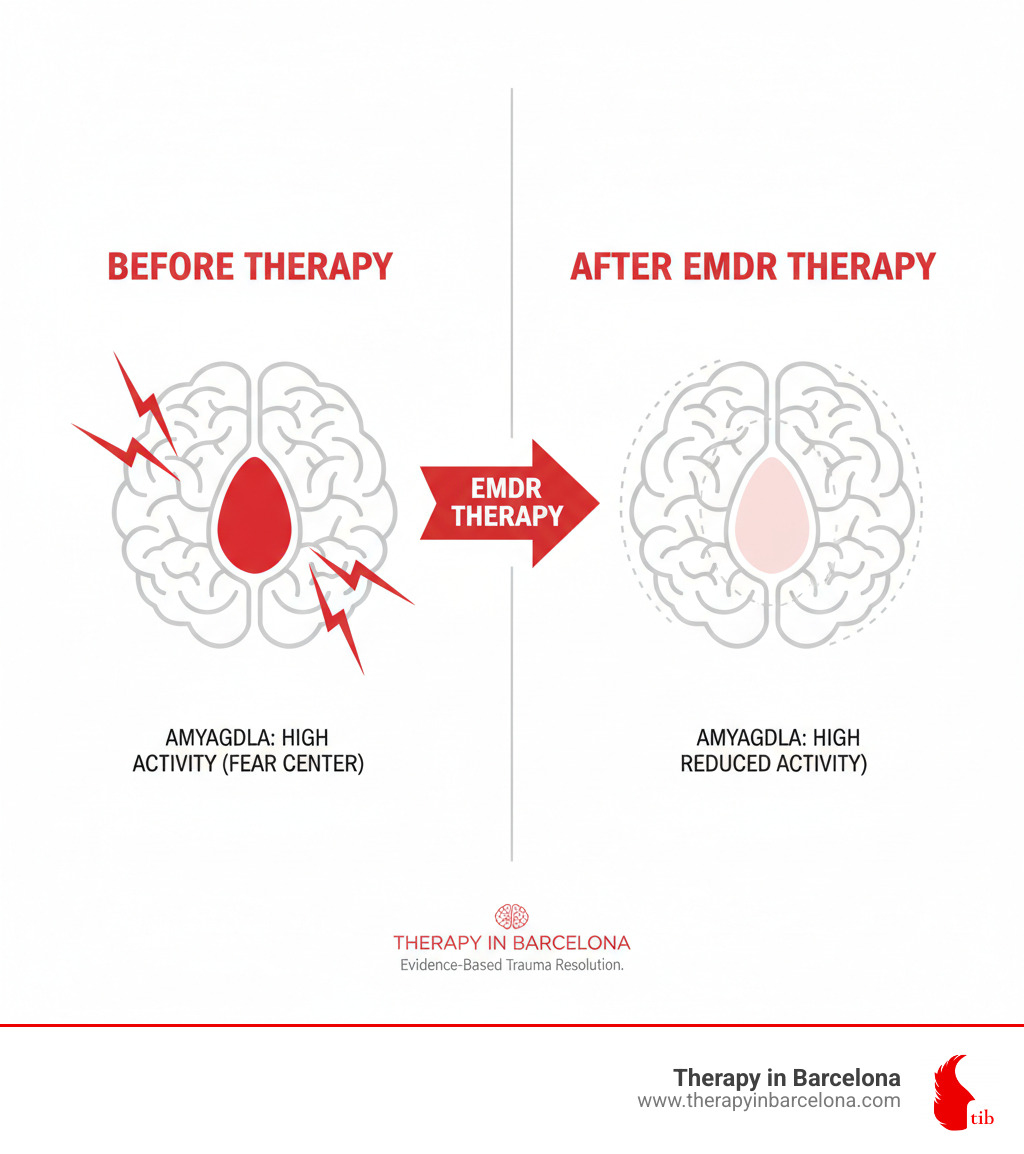
Brain imaging studies show these measurable shifts, which can change not just how you think about the past, but how you feel and move through your daily life.
Frequently Asked Questions About EMDR Therapy
Here are some common queries about EMDR therapy for adults.
What is the therapist’s role and what qualifications should they have?
In EMDR, your therapist is a skilled guide who facilitates the process and ensures your safety. They create the optimal conditions for your brain’s natural healing to take over. It’s crucial that your therapist is a licensed mental health clinician who has completed specialised, certified EMDR training, often through an EMDR International Association (EMDRIA) approved programme. At Therapy in Barcelona, all our therapists are psychology-trained professionals with the necessary qualifications to guide you with expertise.
What are common misconceptions about EMDR?
It’s not hypnosis. You remain fully conscious and in control during EMDR. The goal is to process distress, not induce a trance.
It’s not a magic cure. EMDR is powerful and often works more rapidly than other therapies, but it requires your active participation.
It doesn’t erase memories. EMDR changes how the memory is stored, reducing its emotional impact. You can recall it without the intense distress.
It’s more than just eye movements. Bilateral stimulation is one tool within a comprehensive, eight-phase psychotherapy framework.
What is the typical outcome after successful EMDR?
The main outcome is that the distressing memory is no longer emotionally charged. You can recall the event without feeling overwhelmed. Negative self-beliefs like “I am worthless” are replaced with positive, empowering ones like “I am capable” or “I did the best I could.” This change leads to a significant reduction in symptoms like flashbacks and anxiety, and the results are typically lasting. You can integrate your past experiences in a healthy way and move forward with your life.
Taking the Next Step Towards Healing in Barcelona and Beyond
EMDR therapy for adults is an evidence-based approach to healing from distressing life experiences. By working with your brain’s natural ability to process difficult memories, it offers a structured way to move forward. If you feel held back by past events, EMDR could be a way to find relief and regain a sense of control.
At Therapy in Barcelona, we have supported internationals since 2011. We understand the unique challenges of expat life—whether you’re in Barcelona, Valencia, Málaga, or another Spanish city. Our practice was founded by Leigh Matthews, an Australian Psychologist who saw the need for culturally sensitive mental health care for the international community.
What sets us apart is our commitment to personalised therapist matching. We take time to understand your needs and connect you with a psychology-trained therapist who specialises in EMDR therapy for adults and genuinely understands your expat journey. Our collaborative team of qualified professionals ensures you receive the highest quality care.
We offer therapy in English and several other languages, both online with clients worldwide and face-to-face at our office in Barcelona. This is a private-pay service, and some of our therapists offer sliding scale fees—please enquire when you reach out.
If you’d like support and are considering EMDR therapy for adults, our team of expat therapists is here to help. Book a Free Discovery Call today to learn more about how we can support your healing journey. We’re here to provide the compassionate, culturally sensitive care you deserve.
