


Understanding Trauma’s Grip on Expat Life

EMDR for PTSD is an evidence-based therapy that helps you process traumatic memories using bilateral stimulation—like eye movements or taps—while you briefly recall distressing events. Unlike traditional talk therapy, you don’t need to describe your trauma in detail. EMDR helps your brain reprocess stuck memories so they lose their emotional charge and no longer trigger overwhelming reactions.
Here’s what you need to know:
- What it is: A structured, 8-phase therapy targeting how traumatic memories are stored.
- How it works: Combines memory recall with bilateral stimulation to facilitate natural healing.
- Duration: Typically 1-3 months of weekly 50-90 minute sessions but varies.
- What it treats: The effects of trauma, such as flashbacks, hypervigilance, overwhelming anxiety, and intense fears.
- Key difference: Requires less verbal processing of trauma.
Perhaps you moved to Barcelona for a fresh start, but something from your past won’t let you go. Whether the trauma happened before you arrived or the stress of the move stirred up old wounds, you now feel trapped by flashbacks and a constant sense of being on edge. You’re not alone. Many internationals find that the stress of cultural adjustment, isolation from support systems, and language barriers can amplify unprocessed trauma, making healing feel impossibly distant.
EMDR therapy offers a different path forward. Recognised by organisations like the World Health Organisation and the American Psychological Association as an effective treatment for PTSD, it is designed to help your brain’s natural healing process. It’s not about forgetting what happened, but about changing how those memories affect you today, so you can reclaim your sense of safety and build the life you came here for.
What is EMDR Therapy and How Does It Help Reprocess Memories?
EMDR for PTSD stands for Eye Movement Desensitisation and Reprocessing. It’s a structured psychotherapy for people who have experienced distressing events that continue to affect their daily lives. The core idea is that traumatic memories can become “stuck” in the brain, creating ongoing difficulties.
This concept comes from the Adaptive Information Processing (AIP) model, developed by Dr. Francine Shapiro. The model suggests our brains have a natural system for processing disturbing experiences. When trauma overwhelms this system, the memory gets stored dysfunctionally, triggering symptoms like flashbacks, nightmares, and intense emotional reactions whenever something reminds you of the event.
EMDR for PTSD helps “unstick” these memories through bilateral stimulation (BLS)—rhythmic left-right stimulation of the brain. This can be done with eye movements (following a therapist’s finger), auditory tones (listening to alternating sounds), or tactile tapping (holding alternating pulsators).
While engaging in BLS, you briefly focus on the traumatic memory. This dual attention helps your brain reprocess the information, moving it from a raw, emotionally charged state to a more resolved one. The goal is to reduce the memory’s emotional intensity so you can recall what happened without the debilitating reactions. What makes EMDR different is its focus on changing how the memory is stored, rather than requiring extensive verbal recounting. This can be particularly helpful for expats who find it hard to articulate trauma in a new language, offering a path to healing from emotional trauma.
The Science Behind the Blinks
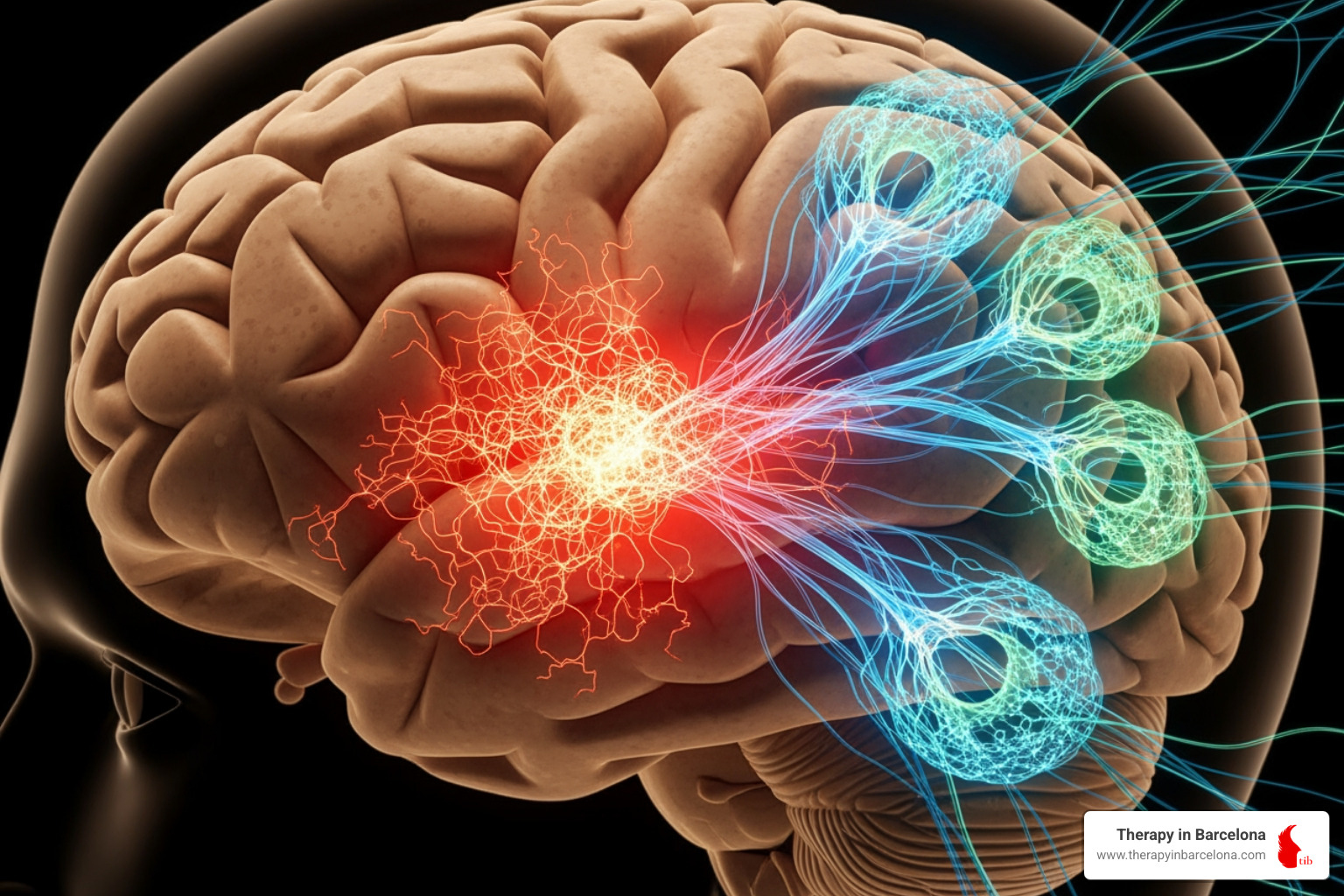
Post-Traumatic Stress Disorder involves changes in key brain regions. The amygdala (the brain’s “fear centre”) can become hyperactive, while the prefrontal cortex (responsible for reasoning) may show reduced activity, making it harder to manage emotions. The hippocampus, crucial for memory, can also be affected.
EMDR is thought to improve communication between these regions. The bilateral stimulation may mimic brain activity during REM sleep, a natural process for memory consolidation. This “dual attention” task—focusing on the memory while engaging in BLS—is believed to reduce the memory’s emotional intensity. It helps integrate the traumatic memory, leading to “fear extinction”, where the memory no longer triggers the same fight, flight, or freeze response.
Because of this strong evidence base, EMDR is widely recognised. The World Health Organisation (WHO) and the American Psychological Association (APA) both recommend EMDR as an effective treatment for PTSD. The APA’s clinical practice guideline for PTSD suggests EMDR for PTSD as a treatment option, noting its benefits often outweigh potential harms. Organisations like the EMDR International Association (EMDRIA) also provide extensive resources on the therapy’s efficacy.
The 8-Phase Journey: What to Expect from Your EMDR Sessions
EMDR for PTSD is a structured journey, typically unfolding over weekly 50-90 minute sessions. A complete course of treatment usually takes one to three months, though this can vary with complex trauma. The benefits, however, tend to be long-lasting.
Let’s follow Ana, a fictional composite based on common expat experiences. She’s a 30-year-old living in Valencia who survived a car accident a few years ago. Since then, she has struggled with nightmares and a fear of driving, which is impacting her new life in Spain.

Phases 1 & 2: Building a Foundation of Safety
Before processing begins, your therapist will take your history and create a treatment plan (Phase 1). This is about understanding your story and identifying which memories are causing distress. In Phase 2, you’ll learn about the EMDR process and develop coping skills. A key tool is creating a “Safe Place”—a mental image where you feel calm and secure. This preparation phase is crucial for building a trusting therapeutic relationship, which serves as an anchor for the work ahead.
Phases 3-6: Actively Processing the Trauma
This is where the core processing work begins.
- Phase 3 (Assessment): You and your therapist identify a target memory (e.g., Ana’s car accident), the negative belief it created (“I’m not safe”), and a desired positive belief (“I am safe now”). You’ll rate the memory’s disturbance (SUD scale) and how true the positive belief feels (VOC scale) to track progress.
- Phase 4 (Desensitisation): While holding the memory in mind, your therapist guides you through sets of bilateral stimulation (e.g., eye movements). You simply notice what comes up without judgement. The goal is to lower the SUD score, reducing the memory’s emotional punch.
- Phase 5 (Installation): Once the memory is less distressing, you focus on strengthening the positive belief while continuing with bilateral stimulation, aiming for a high VOC score.
- Phase 6 (Body Scan): You’ll mentally scan your body for any remaining tension, using more bilateral stimulation to release it.
Phases 7 & 8: Integration and Looking Forward
The final phases ensure the changes stick.
- Phase 7 (Closure): Every session ends with helping you return to a calm state, often using your Safe Place. Your therapist will prepare you for what to expect between sessions, as your brain may continue processing.
- Phase 8 (Re-evaluation): At the start of each new session, your therapist checks in on your progress and ensures previously processed memories remain resolved. The goal is for you to recall the event without the old debilitating reaction.
Over time, EMDR can also include “future templates,” where you imagine handling future situations with confidence. The process is structured but paced to your needs. You can learn more in our guide, Beyond the Blinks: Demystifying EMDR Therapy for Adults.
Is EMDR for PTSD the Right Choice for You?
Deciding if EMDR for PTSD fits your healing journey is a personal choice. It’s a powerful, research-backed therapy, but it’s not a universal solution. Your unique experiences and needs are what matter most.
EMDR is particularly effective for the aftermath of traumatic events, whether it’s a single incident like an accident or assault, or more layered trauma from childhood (sometimes referred to as complex trauma). For expats, the stress of adjusting to a new culture can amplify trauma symptoms. EMDR’s approach, which doesn’t rely on extensive talking, can be helpful when you’re already exhausted from living in a foreign language.
Who Can Benefit from EMDR for PTSD?
EMDR can help if you’re experiencing the effects of trauma, such as flashbacks, nightmares, and avoidance. It also addresses related struggles like overwhelming anxiety, sudden panic, intense fears, and persistent low mood. If you’ve tried talk therapy and felt stuck, EMDR offers a different route that focuses less on verbal articulation. For expats feeling overwhelmed by how the move has stirred up old pain, its structured approach can be a great relief.
Comparing EMDR with Other PTSD Therapies
Other evidence-based therapies for PTSD include Cognitive Behavioural Therapy (CBT) and Prolonged Exposure (PE). CBT focuses on changing negative thought patterns, while PE involves gradually confronting feared memories and situations. EMDR is different. You focus on the memory while using bilateral stimulation, but you don’t need to describe it in detail and the therapy targets how the memory is stored rather than directly challenging your thoughts.
In Spain, the public health system offers mental health services, but access can be limited, and finding English-speaking therapists is often difficult. Large online platforms offer convenience but may lack the personalised matching, strict privacy standards, and deep understanding of the expat experience that we provide. At Therapy in Barcelona, we take the time to pair you with a therapist whose expertise genuinely fits. Our therapists are expats themselves, living in cities like Barcelona, Madrid, and Valencia, so they understand your challenges from lived experience.
Potential Benefits and Risks of EMDR for PTSD
The benefits can be significant. Many people experience lasting relief, as EMDR helps reduce the distress traumatic memories trigger. This shift can bring a greater sense of control and empowerment. Because it doesn’t require detailed recounting, it can feel more manageable than other trauma therapies.
There are also things to prepare for. During processing, you might experience a temporary increase in distressing emotions or vivid dreams. This is a normal part of the brain’s healing process. A properly trained therapist is crucial to guide you safely. At Therapy in Barcelona, our EMDR therapists are qualified professionals who understand both the technique and the expat context. If you’re ready to move forward, please enquire about our services during your Free Discovery Call.
Finding Culturally Sensitive EMDR in Spain and Online
For expats in Barcelona, Madrid, Valencia, or other Spanish cities like Málaga or Alicante, finding the right mental health support can be a challenge. When you’re dealing with trauma, language barriers and cultural differences can feel like extra problems.
Cultural sensitivity in therapy is vital. A therapist who understands the expat experience—the feeling of being caught between two worlds, the homesickness, the isolation—can make all the difference. At Therapy in Barcelona, we’re a group practice of highly qualified, psychology-trained therapists who work with adults, couples, teens and families. Many of us are expats ourselves. This shared experience creates a space where you are truly understood.
Language matters, too. Discussing deep-seated pain requires the comfort of your native tongue. We speak English, and some of our therapists speak other languages like German, French, Spanish, Afrikaans, Portuguese, Austrian-German and Swiss-German. This means you can express yourself fully without having to translate your feelings.
EMDR therapy is highly adaptable and has been used successfully in many contexts, including with refugees and through virtual sessions. This flexibility makes it well-suited for the expat community.
Online EMDR has made this therapy accessible regardless of your location. Whether you’re in a remote part of Spain or prefer the comfort of your home, online sessions provide effective treatment. Therapy in Barcelona offers online therapy to expats worldwide, with the same quality of care and cultural sensitivity as our in-person sessions. We also offer face to face therapy sessions in our Barcelona office.
When seeking a therapist, look for certification from organisations like EMDRIA (EMDR International Association) to ensure they have undergone rigorous training. While you can search for therapists through professional directories, it can be daunting in a foreign country.
At Therapy in Barcelona, we simplify this process. Our bespoke therapist matching service takes the time to understand your needs and pair you with the best fit from our team. As a private-pay service, we maintain high standards of care and strict privacy with no data selling. Some of our therapists offer sliding scale fees, which you can ask about during your Free Discovery Call. Our article, Trauma Therapy for Expats: Because Moving Countries Shouldn’t Mean Moving Problems, offers more insight into these challenges.
Frequently Asked Questions about EMDR Therapy
Will I have to talk about my trauma in detail?
No, not in great detail. This is a common concern, but one of the key features of EMDR for PTSD is that it doesn’t require you to verbally recount the traumatic event over and over. You will identify the memory and focus on it internally, but the processing happens with the guidance of bilateral stimulation. You remain in control and can pause at any time. This can be a relief, especially if talking about the trauma feels too distressing or difficult in a second language.
Is EMDR a form of hypnosis?
No, it is not. During an EMDR session, you are fully conscious, awake, and in control. You maintain a “dual awareness,” meaning you are present in the room with your therapist while also focusing on the memory. You are an active participant, not a passive recipient in an altered state.
How quickly will I see results?
Healing doesn’t follow a fixed timeline, and the pace of EMDR for PTSD varies for each person. For a single traumatic event, some people feel significant relief within three to six sessions. For more complex or repeated trauma, it may take eight to twelve sessions or more.
Many people notice a shift after just a few sessions—the memory might feel less vivid or the physical reactions may lessen. The goal is not a quick fix, but lasting change. By helping your brain reprocess the memory, EMDR aims for enduring results.
Taking the First Step Towards Healing
Living with unprocessed trauma as an expat can be an isolating experience. The flashbacks, the avoidance, the constant feeling of being on edge—these are not signs of weakness. They are signs that your brain is still trying to protect you from a past event that hasn’t been fully processed.
But healing is possible. Not the kind that erases the past, but the kind that changes how it affects your present. EMDR for PTSD offers a path to help your brain’s natural healing process. Recognised by leading bodies like the World Health Organisation and the American Psychological Association, it helps reprocess stuck memories so they lose their grip, giving you the freedom to build the life you want.
At Therapy in Barcelona, we understand. We’re expats too. Our team of qualified, psychology-trained therapists in cities like Barcelona, Madrid, and Valencia have lived the challenges of adapting to a new country. We’re a group practice working with adults, couples, teens and families. We don’t just match you with the next available therapist; we take the time to find the right fit for you.
We have been a trusted presence in the international community since 2011, offering both in-person and online therapy. We believe in personalised matching and maintain strict privacy standards. While we are a private-pay service, some therapists offer sliding scale fees—just ask about this during your Free Discovery Call. We work online worldwide and offer face to face sessions in our Barcelona office.
If you are ready to move beyond the flashbacks and reclaim your sense of safety, we are here to help with evidence-based care delivered by people who get it.
Book a Free Discovery Call today. Because healing doesn’t mean doing it alone.
We don’t provide crisis care. If you’re in immediate danger or thinking about harming yourself, call 112 in Spain, or the national 024 Suicide Prevention Line. If you’re outside Spain, contact your local emergency number.
