Why Sexual Communication Matters for Your Relationship

If you’re looking for a book about using sex as a tool to communicate, you’re not alone. Many couples struggle to talk openly about their sexual needs, even when they’re otherwise close. The good news? A handful of well-researched, practical books can help you build the vocabulary and confidence to have these conversations—and transform your relationship in the process.
Top books about using sex as a communication tool:
- Come As You Are by Emily Nagoski – Understand the science of desire and how to talk about what turns you on (and off).
- Sex Talks by Vanessa Marin – Learn five essential conversations with sample scripts for real-life use.
- Tongue Tied by Stella Harris – Explore boundaries, fantasies, and dirty talk with confidence and consent.
- Mating in Captivity** by Esther Perel – Reignite passion in long-term relationships by balancing intimacy and autonomy.
- Come Together by Emily Nagoski – Create lasting sexual connections through pleasure, not just desire.
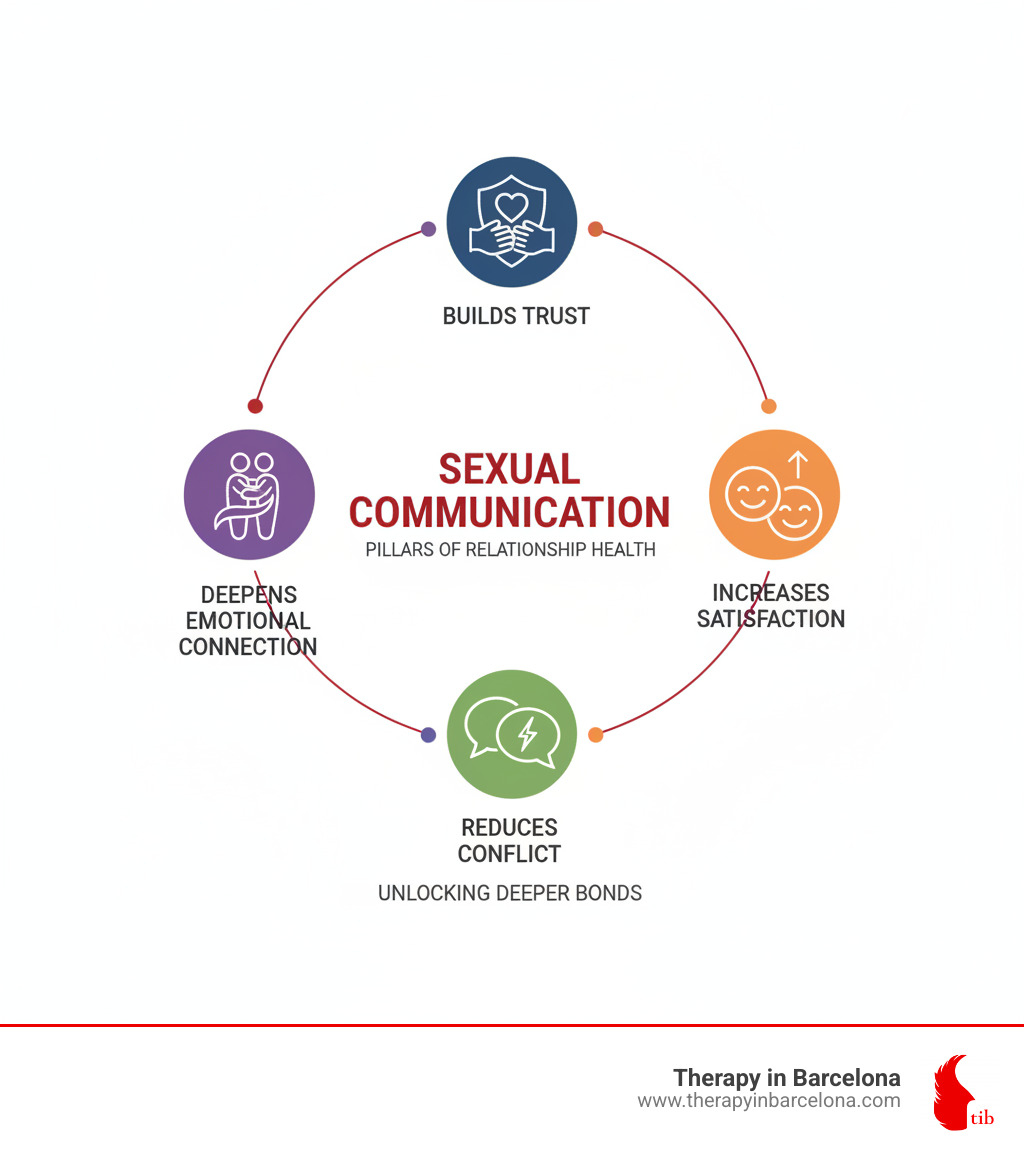
Let’s be honest: talking about sex can be awkward. Even in a long-term relationship, it can feel vulnerable or embarrassing to find the right words. But couples who talk openly about sex report higher intimacy, satisfaction, and trust. For internationals in Barcelona, Valencia, or Málaga, the added strain of expat life makes clear communication even more vital.
Sexual communication isn’t just about the bedroom; it’s about feeling heard, understood, and valued. It’s about building a shared language for your desires and boundaries. The good news is that it’s a skill you can learn, one conversation at a time.
The Core Principles of Sexual Communication
Before you pick up a book about using sex as a tool to communicate, it helps to understand the foundations of what makes it work. These are practical principles that create safety, trust, and genuine connection.
Vulnerability is where intimacy begins. Opening up about your wants and fears takes courage, especially for expats in Barcelona or Valencia who are already navigating cultural differences. But this vulnerability is what transforms sex from a physical act into a way to deepen your bond.
Honesty keeps you both on the same page. Being truthful about your preferences, comfort levels, and fantasies is essential. This includes saying when something feels amazing and, just as importantly, when it doesn’t. Holding back breeds resentment, while honesty gives your partner the gift of knowing how to please you.
Active listening means truly hearing your partner. When your partner shares something vulnerable, put your phone down and listen without planning your response. Research from The Gottman Institute, known for its ‘Love Lab’ studies, shows that couples who master this skill are far more likely to stay together. Their research can even predict divorce with over 90% accuracy based on communication patterns. You can explore more about their scientific research on couple communication.
Non-judgement creates safety. To encourage your partner to share their fantasies or what’s not working, you must create a space free from criticism. A non-judgemental attitude doesn’t mean you have to agree with everything; it means you can disagree without making your partner feel small.
Expressing needs clearly prevents mind-reading disasters. Your partner can’t know what you want unless you tell them. Use ‘I’ statements to express yourself. Instead of, “You never touch me the way I like,” try, “I really love it when you touch me here.” This kind of assertive communication turns complaints into invitations.
Building confidence takes practice. Feeling shy when discussing sex is normal, especially if you grew up where it was taboo. Confidence starts with understanding your own body and pleasure. Practice, patience, and positive reinforcement from your partner all help.
Overcoming barriers is part of the journey. Fear of rejection, shame, and cultural taboos are common obstacles. For internationals in cities like Málaga or Alicante, these challenges can feel magnified. Even difficult conversations, when handled with care, can strengthen your relationship.
The Best Books for Using Sex as a Tool to Communicate Your Needs
Finding the right book about using sex as a tool to communicate is about matching your current needs. Some offer science, others provide scripts, and some are for long-term couples looking to reignite a spark. Here’s a guide to five standout books that can help you find your voice, whether you’re in Barcelona, Valencia, or anywhere else.
For the Science-Lover: Understanding Your Body and Sexual Communication
Emily Nagoski’s Come As You Are is a therapist-recommended classic. Grounded in science but written in plain language, it makes the complex world of female sexuality accessible. At its heart is the “brakes and accelerator” model. Your sexual response has an accelerator (turn-ons) and brakes (turn-offs). Everyone’s system is different. Understanding your own balance—and your partner’s—is the foundation of meaningful sexual communication.
Nagoski also debunks common myths about sex, explaining how stress and body image shape our experiences. She does it all with wisdom and humour, making the book feel like a conversation with a trusted friend. If you want to understand the why behind your desires, this is your starting point. Explore more of Emily Nagoski’s work here: this foundational sex therapy.
For the Action-Taker: Practical Scripts for Real Conversations

If you’re tired of vague advice, Vanessa Marin’s Sex Talks is for you. This New York Times bestseller is practical, direct, and refreshingly honest. The book centres on five essential conversations every couple needs to have, covering everything from normalising sex as a topic to exploring what you each need to feel turned on.
What makes Sex Talks stand out are the sample scripts. Marin provides actual phrases and questions, which is incredibly helpful if you don’t know how to start. It’s a clear path forward for dealing with mismatched libidos, articulating desires, or simply deepening your connection. Learn more about the book here: Sex Talks: The Five Conversations That Will Transform Y… .
For the Adventurous: Exploring Desires and Boundaries
Stella Harris’s Tongue Tied: Untangling Communication in Sex, Kink, and Relationships is for anyone wanting to explore beyond the basics. It treats explicit communication as a learnable skill that can open up new dimensions of intimacy. Whether you’re curious about dirty talk, have fantasies you’ve never shared, or are interested in kink, Harris offers practical tools to articulate and negotiate your desires.
The book includes negotiation checklists and real-life examples that make sensitive conversations feel manageable. The emphasis is on consent and mutual comfort, creating a space where both partners feel safe enough to be honest. That honesty, Harris argues, is what makes sex more exciting and connected. Explore more about this empowering guide: Tongue Tied: Untangling Communication in Sex, Kink, and Relationships.
For the Long-Term Couple: Reigniting Passion and Connection
Esther Perel’s Mating in Captivity tackles a common dilemma: how to keep desire alive in a long-term relationship. Perel, a renowned couples therapist, argues that the very things that create security—familiarity and routine—can dampen erotic energy. Her core insight is that desire thrives on a balance of intimacy and autonomy. Too much closeness can flatten the spark, while too much distance erodes connection.
Perel encourages readers to cultivate erotic intelligence—an awareness of the dynamics that fuel desire. This is especially relevant for expat couples in Barcelona, Valencia, or Málaga, where relocation stress can strain relationships. Her work reminds us that passion isn’t about working harder; it’s about creating the right conditions for it to flourish. Explore more about this insightful book: Mating in Captivity — The Seattle Public Library .
For Building Lasting Connection: Pleasure Over Performance
Emily Nagoski’s Come Together: The Science (and Art!) of Creating Lasting Sexual Connections shifts the focus from individual desire to shared pleasure. This book is about moving away from performance pressure and toward a sexual relationship rooted in genuine connection. Nagoski offers strategies for dealing with mismatched desire, performance anxiety, and life stress.
For couples facing the challenges of expat life in Barcelona or beyond, Come Together offers a compassionate, science-backed roadmap for maintaining sexual connection. It’s a reminder that the goal isn’t perfection—it’s pleasure, authenticity, and intimacy that deepens over time.
Practical Takeaways: From the Page to Real Life
Reading a book about using sex as a tool to communicate is a great first step. The real change happens when you apply what you’ve learned. Here are some practical techniques inspired by the experts we’ve covered.
The ‘Brakes and Accelerator’ Check-in is a useful tool from Emily Nagoski’s work. Set aside time to check in about what’s hitting your sexual “accelerator” (things that make you feel aroused or connected) and what’s pressing your “brakes” (stress, body image worries, exhaustion). This practice normalises the factors that influence desire and helps you problem-solve together without blame.
Using ‘I’ statements can change the tone of a conversation. Instead of saying, “You never initiate sex,” which sounds accusatory, try, “I feel a bit disconnected when we go a while without intimacy, and I need to feel desired.” This approach invites empathy rather than defensiveness and keeps the focus on your feelings and needs.
Scheduling ‘sex talks’ might sound unromantic, but it’s incredibly helpful. Just like date nights, setting aside dedicated time to talk about sex removes the pressure of spontaneous, awkward conversations. By scheduling it, you create a safe, intentional space where both partners are prepared to talk openly.
Creating a ‘yes, no, maybe’ list is a fun, low-pressure way to explore desire and boundaries. Each partner separately lists sexual activities they feel like a clear “yes” to, a firm “no” to, and a “maybe” to. When you compare lists, you’ll often spot surprises, shared interests, and easy conversation starters.
Non-verbal cues matter just as much as words. Your body language, sounds, and reactions during sex are powerful forms of communication. Pay attention to your partner’s responses—their breathing, movements, and sounds—and communicate your own pleasure. This creates a feedback loop that improves mutual understanding. For more on this, consider exploring mindful sex practices: Mindful Sex with Therapy in Barcelona’s Collaborating Sexologist.
These are practical tools you can start using today. The more you practise, the easier these conversations become.
When Books Aren’t Enough: Getting Support for Your Relationship
Books about using sex as a tool to communicate can be transformative, but sometimes couples get stuck. The exercises feel forced, conversations still trigger defensiveness, or deeper issues like past trauma or long-standing resentment get in the way. This is where a trained professional can help.
Sex therapy is a specialised form of psychotherapy for concerns like a persistent lack of sexual desire, mismatched desires, or feeling disconnected. It’s a safe, non-judgemental space to explore what’s going on and learn new skills.
Similarly, couples therapy can help you improve communication and steer conflict. For internationals in Barcelona, Valencia, or Madrid, the stress of cultural adjustment and distance from support networks can intensify relationship struggles. Couples Therapy: Strengthening Relationships Abroad explores how therapy can support expat relationships.
At Therapy in Barcelona, we’ve supported the international community since 2011. We’re a group practice of psychology-trained therapists working with adults, couples, teens, and families. As expats, we understand the added strain of life abroad. Sessions are available in English, German, French, Spanish, Afrikaans, Portuguese, Austrian-German, and Swiss-German. We also offer personalised therapist matching to help you find the right fit. This is a private-pay service, and some therapists offer sliding scale fees.
We respect the many excellent clinicians working across Spain. But different options come with different trade-offs: public healthcare can mean long waits and limited language choice, big online platforms can feel one-size-fits-all, and local practices vary widely in expat experience. We focus on expat-specific cultural sensitivity, strict privacy (we never sell your data), and carefully matched, high-quality care. Our work is evidence-based, including approaches informed by the Gottman Method, so support feels practical and aligned.
We offer in-person sessions in Barcelona and online therapy worldwide, including the USA and Canada. If you’re unsure where to start, book a Free Discovery Call to discuss your needs and see how we can help.

Frequently Asked Questions about Sexual Communication
How can I start a conversation about sex without making it awkward?
While there’s no magic formula, choosing a neutral time and place makes a huge difference. Instead of bringing it up in the heat of the moment, pick a relaxed time, like during a walk or over coffee. You could start with, “I’ve been thinking about ways we could feel even more connected, and I’d love to talk about our sex life sometime soon.”
Using “I” statements is also key. Instead of, “You never do X,” try, “I really enjoy it when we do Y, and I’d love to explore more of that.” This invites your partner into a conversation rather than putting them on the defensive. The more you do it, the less awkward it becomes.
What if my partner and I have very different sexual desires?
It’s completely normal for couples to have different desires. The key isn’t to make your desires identical, but to find common ground and be willing to explore together. A “Yes, No, Maybe” list (mentioned earlier) can help you both identify what you’re enthusiastic about, what’s off the table, and what you’re curious to try. You might be surprised by the overlap.
It also helps to expand your definition of sex beyond intercourse. Intimacy can include sensual massage, oral sex, or mutual masturbation, creating more opportunities for mutual pleasure.
If you’re struggling to bridge the gap, a sex therapist can provide invaluable support. At Therapy in Barcelona, our therapists understand the pressures on expat relationships in cities like Barcelona, Valencia, or Madrid. You can book a Free Discovery Call to explore if therapy is right for you.
How does better sexual communication help the rest of our relationship?
Sexual communication is rarely just about sex. When you can talk openly about your desires and boundaries, you build trust and psychological safety that benefits every other area of your relationship. If you can discuss something as intimate as sex, conversations about money or household chores feel less daunting. You’ve proven that your relationship is a space where honesty is welcomed.
Couples who can talk openly about sex tend to feel closer, more understood, and more satisfied in their relationship overall. It is not about having perfect conversations or matching libidos 100% of the time. It is about building a shared language for needs, boundaries, and reassurance. For internationals living in Spain, that matters even more because expat life can add stress, cultural differences, and less privacy or support. When sexual communication improves, it often lifts the whole relationship with it.
Your Next Step Towards Deeper Connection
A more fulfilling intimate life doesn’t require perfection—just a willingness to start the conversation. The books we’ve explored offer different paths, but all point to the same truth: vulnerability and honesty can transform your entire relationship. Each book about using sex as a tool to communicate is a step in that direction.
Communication is a skill that gets easier with practice. Every time you share a desire or a boundary, you build trust. Every time your partner listens without judgement, they are showing you that you’re safe. These moments accumulate, deepening intimacy far beyond the bedroom.
You don’t have to do this alone. While books offer great frameworks, sometimes you need personalised support, especially when dealing with the pressures of expat life in Barcelona, Madrid, or Málaga. At Therapy in Barcelona, our team of couples and sex therapists understands these challenges firsthand. We offer personalised therapist matching to connect you with someone who truly gets your situation.
We provide online therapy for internationals worldwide, including those in the USA and Canada, and face-to-face sessions at our Barcelona office. If you’re unsure if therapy is right for you, start with a Free Discovery Call. It’s a no-pressure way to explore your options.
Your next step doesn’t have to be big. Pick up a book. Try one conversation. Or reach out for support. Whatever you choose, you’re investing in a relationship where both partners feel seen, heard, and desired.
If you’d like support with your relationship, our team of couples and sex therapists can help.