


What Is the Difference Between Biculturalism and Multiculturalism?

Biculturalism and multiculturalism are two distinct frameworks for understanding how cultures coexist within a society — and knowing the difference matters, especially if you are living between worlds yourself.
Here is a quick breakdown:
- Biculturalism refers to the coexistence of, and relationship between, two distinct cultures. At a societal level, it often describes a formal partnership between an indigenous people and a settler group — most famously in New Zealand, where the Treaty of Waitangi established a bilateral agreement between Māori and the Crown. At an individual level, it describes someone who feels at home in two cultures.
- Multiculturalism refers to the coexistence of many different ethnic, cultural, and religious groups within one society. It prioritises equal recognition, inclusion, and group-differentiated rights for all communities, regardless of how many there are.
- The key distinction is one of scope and power: biculturalism is a two-way partnership that addresses historical and political power imbalances, while multiculturalism is a broader, more pluralistic framework designed to accommodate diversity at scale.
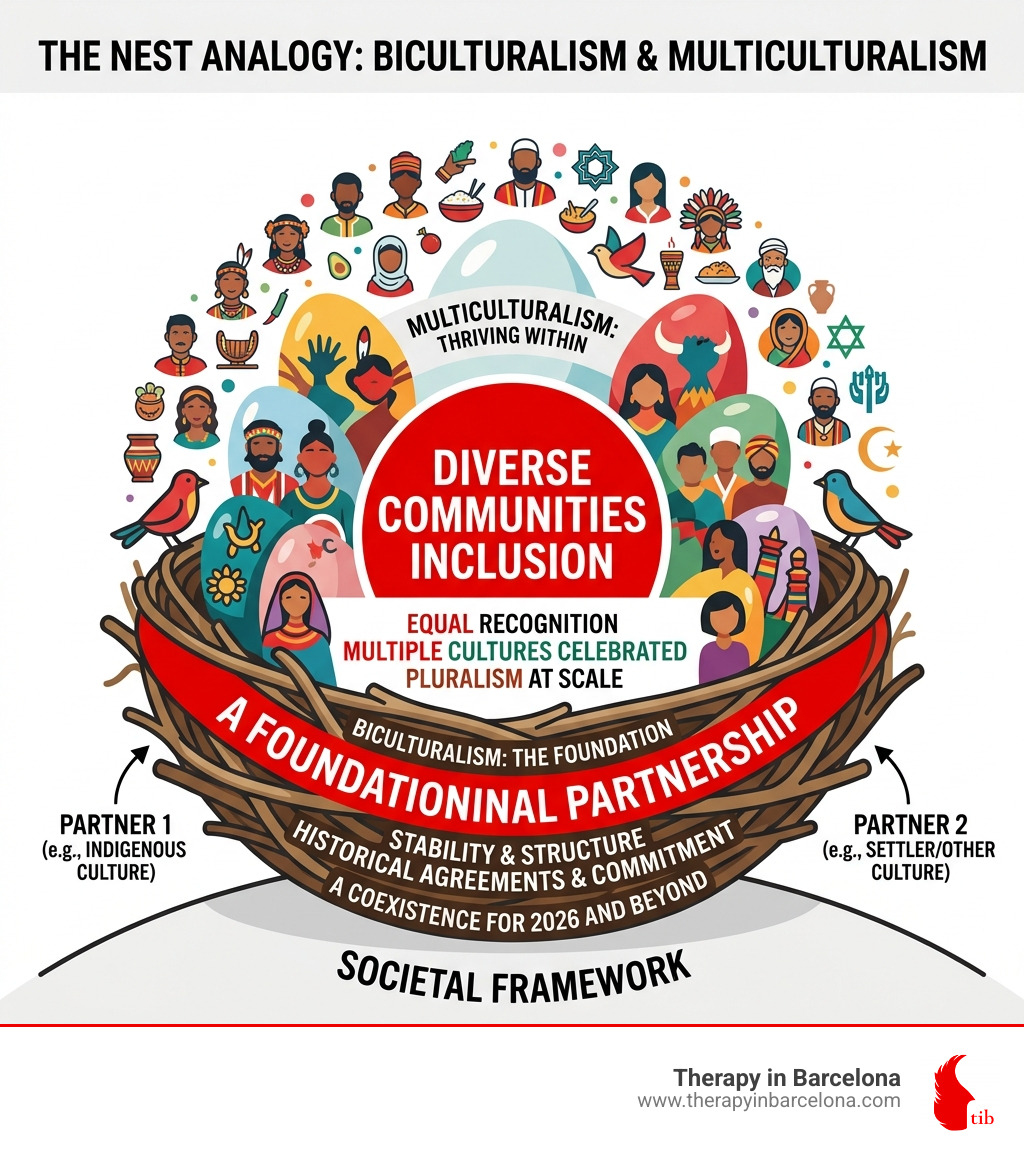
- They are not mutually exclusive. A society can hold both at once — biculturalism as the foundation, and multiculturalism as the diverse community that grows within it.
If you are an expat or international living in Spain, this distinction is more than academic. Many people find themselves sitting between two — or more — cultural identities, unsure where they belong. That experience of being “neither fully here nor fully there” has a name, and it is far more common than you might think.
This article explores what biculturalism and multiculturalism actually mean, how they interact, and what navigating multiple cultural identities can look like in practice — including the psychological weight it can carry.
Defining Biculturalism and Multiculturalism in a Modern Context
The way we define our cultural frameworks continues to evolve. To understand our current landscape, we must look at how these terms are used in both political policy and personal identity.
At its core, bicultural identity involves the condition of combining two cultures within oneself or a nation. While multiculturalism is often used as a catch-all for “diversity,” it specifically refers to a policy of pluralism where multiple ethnic groups are recognised as equal members of the state.
The Foundations of Biculturalism
The most prominent example of a bicultural framework is found in Aotearoa New Zealand. It is rooted in Te Tiriti o Waitangi (The Treaty of Waitangi), signed in 1840. This wasn’t just a cultural agreement; it was a bilateral political partnership between the British Crown and Māori hapū (sub-tribes).
In this model, the relationship is between:
- Tangata whenua: The indigenous “people of the land.”
- Tangata tiriti: “People of the Treaty,” which includes everyone who has come to the country since the signing.
Unlike a “melting pot” where everyone is expected to blend into one national identity, biculturalism focuses on a partnership of equals. It acknowledges that Māori hold unique indigenous rights that are distinct from the rights of later migrants. For many expats, understanding more info about biculturalism is the first step in recognising that cultural adaptation isn’t just about fitting in—it’s about understanding the existing power dynamics of your new home.
Understanding Multiculturalism
While biculturalism focuses on the relationship between two primary groups, multiculturalism embraces the reality of global migration. It is about pluralism—the idea that a society can be made up of many different cultural streams, each maintaining its own customs, languages, and religions.
Multiculturalism goes beyond tolerance toward active recognition. Research on how immigrants manage biculturalism suggests integration works better when diversity is treated as a strength, not a problem.
The Core Differences: Partnership vs. Pluralism

The tension between biculturalism and multiculturalism often comes down to how a nation views its past and its future. Is the goal to honour a specific historical partnership, or to create a broad space for everyone?
Bicultural Frameworks
These focus on a bilateral political agreement. In New Zealand, for example, biculturalism is tied to Te Tiriti o Waitangi and the relationship between Māori and the Crown. It is not just about cultural inclusion. It is a framework for addressing historical injustice, protecting indigenous rights, and supporting shared power at the highest levels. Research on biculturalism also shows how context shapes whether bicultural identity feels adaptive or strained.
Multicultural Frameworks
These focus on cultural pluralism: the idea that many cultural, ethnic, religious, and language groups can belong within one society. In diverse cities like Auckland, multiculturalism helps migrant and minority communities stay visible and supported, rather than being pushed into a “one-law-for-all” model that often defaults to the dominant Western culture.
Policy Goals
- Biculturalism aims for equity between the “first peoples” and the settlers.
- Multiculturalism aims for equal access for all migrant groups, often supported by human rights legislation.
The challenge, as explored in Biculturalism and Context: What Is Biculturalism, and When Is It Adaptive?, is that these two goals can sometimes feel like they are in competition. If a government focuses solely on biculturalism, newer migrants may feel invisible. If it focuses only on multiculturalism, indigenous groups may feel their unique status as “first peoples” is being erased.
Managing the Layers of a Bicultural-Multicultural Identity
Living in a “superdiverse” city—where over 200 ethnicities coexist—creates a complex psychological landscape. In Auckland, roughly one-quarter of residents were born in countries like China, India, or the Philippines. This rapid growth means that many people are navigating a bicultural foundation (Māori-Crown) while living a multicultural reality.
For the individual, this requires significant psychological adaptation. A daily diary study of bicultural identity and psychosocial functioning suggests that those who can successfully integrate these layers often experience higher levels of well-being.
How Biculturalism and Multiculturalism Coexist
The “Nest Analogy” is a helpful way to visualise this. Imagine biculturalism as the nest—the foundational partnership and legal framework (like the Treaty) that provides the structure. Multiculturalism represents the birds within the nest—the diverse groups that live, thrive, and contribute to the society within that protective structure.
By honouring the bicultural partnership, a society actually creates a safer environment for multiculturalism. It challenges the idea of a single dominant culture, making room for many. This is the essence of understanding bicultural theory: it’s not about choosing one over the other, but about seeing how they support each other.
The Impact on Mental Health for Internationals
For expats living in Spanish hubs like Madrid, Valencia, or Alicante, the struggle is often about “cultural frame switching.” This is the ability to shift your behaviour and mindset depending on the cultural context you are in.
However, this can lead to a sense of being in a “liminal space”—a threshold where you feel you belong neither to your home culture nor your host culture. This can result in profound loneliness. Our guide to bicultural identity explores how to bridge these worlds without losing your sense of self.
Psychological Benefits and Challenges for Individuals

Being bicultural or multicultural isn’t just a political status; it’s a cognitive experience. Research on biculturalism suggests that people who navigate multiple cultures often develop “cognitive complexity”: the ability to see the world from more than one perspective at the same time.
Benefits of a Multi-Layered Identity
- Expanded Worldview: You realise there isn’t just “one way” to do things.
- Mindset Shifts: Exposure to different values challenges monocultural assumptions.
- Belonging: As discussed in the TED talk Bi-culturalism for belonging in the world, belonging is about more than a passport; it’s about the ability to navigate different social norms with ease.
It’s important to note that being bilingual is not the same as being bicultural. You can speak Spanish perfectly but still feel completely alienated by Spanish social obligations or family dynamics. True biculturalism involves absorbing the underlying cultural norms and values.
Challenges in Adaptation
Many internationals feel “in between” after moving abroad. Local norms can feel unfamiliar, while home may no longer feel quite the same. This “belonging nowhere” feeling can be painful, but it is also a common part of adapting to life across cultures.
Common challenges include:
- Acculturation Gaps: Family members often adapt at different speeds. Children might become “local” quickly, while parents remain rooted in their home culture, leading to conflict.
- Stereotype Threat: The fear of confirming negative stereotypes about your culture can cause you to feel significantly anxious in social or professional settings.
- Identity Integration: Low Bicultural Identity Integration (BII) can lead to feeling that your two selves are in constant opposition.
For the children of expats, these issues are even more pronounced. Therapy for third culture kids focuses on helping young people find a sense of home within themselves when their external world is constantly shifting.
Philosophical Justifications and Policy Evolution
The shift toward multiculturalism in the late 20th and early 21st centuries was driven by the “politics of recognition.” Philosophers like Charles Taylor argued that “misrecognition” or “non-recognition” can be a form of oppression. If a society ignores your cultural identity, it is essentially saying your way of life has no value.
Will Kymlicka furthered this by arguing for “group-differentiated rights.” He suggested that because minorities are often at a disadvantage in a dominant culture, they need specific protections to ensure true equality. This might include:
- Language rights (e.g., French in Québec).
- Self-government rights for indigenous peoples.
- Polyethnic rights for immigrant groups (e.g., funding for cultural associations).
However, neoliberal migration policies since 2010 have sometimes hindered these ideals. In many countries, the shift toward temporary visas has created a stratified system where migrants are welcomed for their labour but denied the security needed to truly integrate. Understanding Social Distance in Intercultural Communication is vital here; the further apart two cultures feel, the harder it is to build the trust needed for a healthy multicultural society.
Other Paths to Support for Cultural Adjustment
Navigating the “messiness” of life abroad is a heavy task. If you are struggling to find your footing in Spain, there are several paths you might consider for support.
Public Health Systems
In major hubs like Madrid, Valencia, or Sevilla, the public health system provides support for emotional well-being. It is a vital resource, but it comes with limitations. Wait times can be long, and you are unlikely to be matched with a specialist who understands the specific cultural nuances of the expat experience. Finding a professional who speaks your native language fluently is also a significant hurdle.
Large Online Platforms
Global platforms can be convenient and affordable. But automated matching may miss the nuance of cultural adjustment, and privacy concerns can make them feel less personal or secure.
Local Private Practices
You can find excellent local therapists in cities like Mālaga, Alicante, or Marbella. They offer the benefit of face-to-face connection and understand the local Spanish context. However, they may not be expats themselves. There is often a “missing link” in understanding the specific feeling of being an outsider or the unique stresses of navigating Spanish bureaucracy as a foreigner.
Bespoke Private Care at Therapy in Barcelona
We offer a different approach. Since 2011, we have focused exclusively on the international community. We are a group practice of psychology-trained therapists who are also expats ourselves. We understand that your “cultural adjustment” isn’t a disorder—it’s a normal response to a major life transition.
We provide:
- Personalised Matching: We don’t just give you the next person on the list. We look at your specific needs, personality, and goals.
- Expat-to-Expat Empathy: Our therapists have lived the journey. We know what it’s like to balance multiple identities.
- Strict Privacy: We are a private-pay service. We do not sell your data, and your confidentiality is our highest priority.
- Holistic Support: We acknowledge that you are a whole person—including your culture, faith, and history.
Frequently Asked Questions about Biculturalism and Multiculturalism
Can a society be both bicultural and multicultural?
Yes. A society can recognise a foundational relationship between two major cultural groups while also supporting many other communities within everyday life. Biculturalism can provide a shared historical or political framework, while multiculturalism reflects the broader reality of migration, language, religion, and mixed identities.
What is the difference between being bilingual and bicultural?
Bilingualism is a linguistic skill—the ability to speak two languages. Biculturalism is a psychological and social state—the ability to function comfortably within the values and norms of two cultures. You can be bilingual without being bicultural, but biculturalism is often deeper and more adaptive for long-term expat life.
Why do tensions exist between these two frameworks?
Tensions usually arise over the distribution of resources and recognition. Indigenous groups may fear that multiculturalism will “dilute” their specific treaty rights. Conversely, migrant groups may feel that a bicultural focus excludes them from the national story. Balancing these requires constant dialogue and “shared sovereignty.”
Finding Your Balance
If you are finding it hard to balance different parts of your identity in Spain, you don’t have to do it alone. Leigh Matthews, an Australian Psychologist and founder of Therapy in Barcelona, has been supporting internationals since 2011. She moved to Barcelona for love and stayed to build a sanctuary for others navigating the same challenges she faced.
Our team offers high-quality, culturally sensitive care for adults, couples, teens, and families. We use evidence-based approaches like CBT, ACT, and Gottman Method couples therapy, all tailored to the expat experience.
We see clients face-to-face at our offices in Barcelona and online worldwide. While we are a private-pay service, some of our therapists offer sliding scale fees for those with financial need; please inquire about this.
If you’d like support, book a Free Discovery Call.
