


Living Between Two Worlds: What Biculturalism Looks Like in Real Life

Biculturalism example: When someone steers life with comfort and proficiency in two distinct cultures, integrating practices, values, and identifications from both. Here are some concrete examples:
- New Zealand – The Treaty of Waitangi establishes a bicultural partnership between the Crown and Māori, with te reo Māori recognised as an official language and protected Māori representation in Parliament.
- Paraguay – 90% of the population speaks Guaraní and 99% speaks Spanish, creating a deeply integrated bicultural national identity.
- Second-generation immigrants – A British-South Asian person in the UK celebrating both Diwali and Guy Fawkes Night, seamlessly moving between ancestral traditions and British customs.
- Chinese Americans – Individuals who blend traditional Asian values with American individualism, speak “Chinglish,” and mix social groups from both cultural worlds.
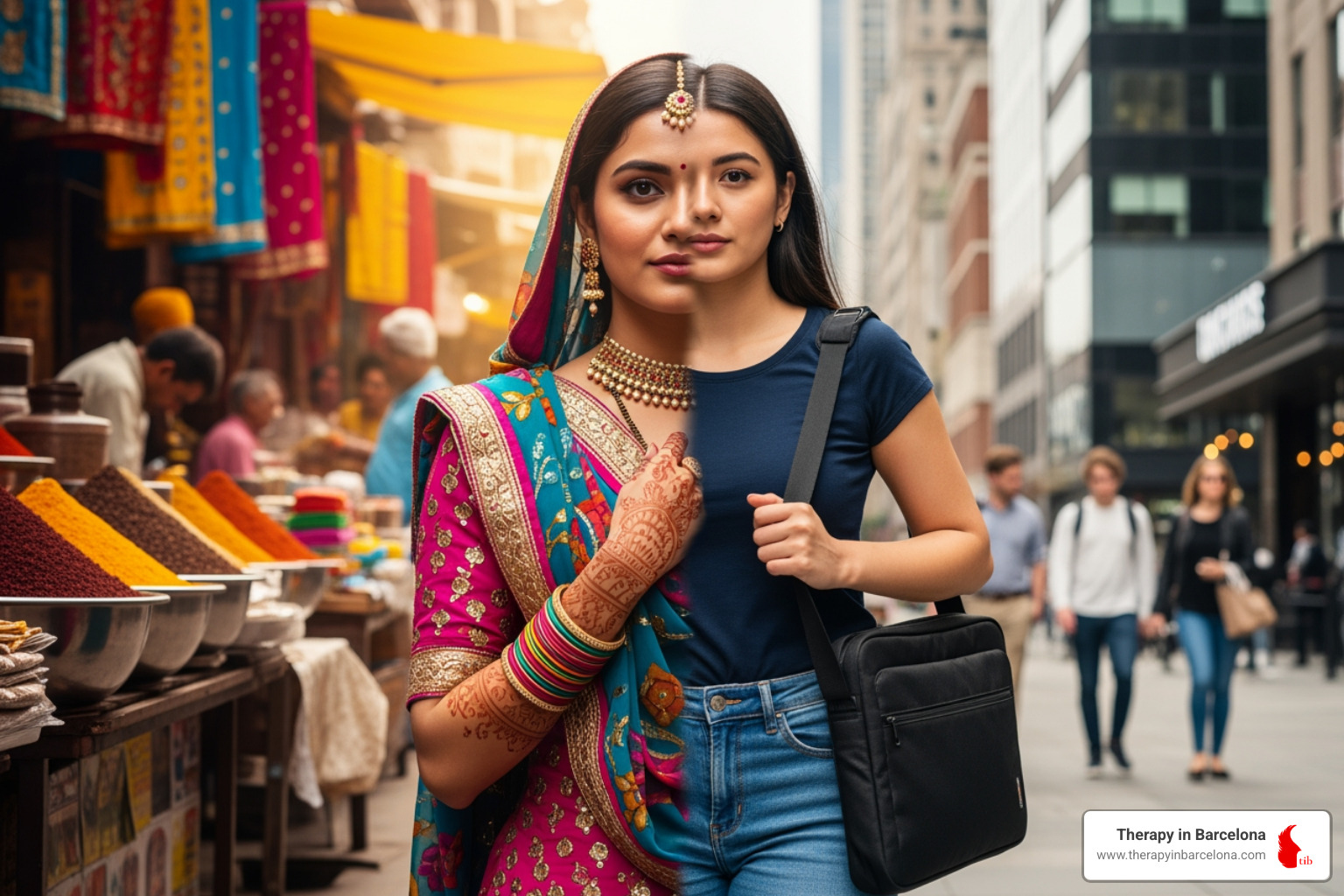
You’ve probably felt it yourself if you’ve moved abroad. That odd sensation of being “in-between.” You celebrate Christmas with your family back home via video call, then join your Spanish colleagues for Three Kings Day. You think in English but dream in fragments of Catalan. You’re not quite “from here” anymore, but you’re not entirely “from there” either.
This is biculturalism—the experience of integrating two distinct cultural frameworks into your identity. It’s not about choosing one culture over another. It’s about holding both, sometimes harmoniously, sometimes with tension, but always as part of who you are.
If you’re reading this in Barcelona, Valencia, or elsewhere in Spain as an international resident, you may be living this every day. Some moments, biculturalism feels like a strength. Other moments, it can feel draining or confusing. Research on bicultural identity shows this tension is common: many people move between pride, conflict, and uncertainty rather than feeling one clear emotion all the time. That mix does not mean something is wrong. It often reflects the real complexity of building a life between cultures.
This guide looks at what biculturalism is in practice, from real-world examples in New Zealand and Paraguay to the psychological impacts—both positive and challenging. We also offer practical strategies for thriving with a bicultural identity. Whether you’re a long-term expat, a Third Culture Kid, or someone who’s just beginning to feel caught between cultures, this is for you.
What is Biculturalism? Understanding the Dual Identity
At its heart, biculturalism describes the co-existence, to varying degrees, of two originally distinct cultures within an individual or a society. It means being able to steer and accept the values, customs, and traditions of two different cultures simultaneously. Think of it as having two cultural lenses through which you view the world, and you can switch between them, or even blend them, depending on the situation.
For individuals, this often manifests as bicultural competence, which is a level of proficiency and comfort in both their heritage culture and the culture of their current environment. This isn’t just about language; it extends to understanding subtle social cues, humour, and underlying values. For instance, a bicultural person might know when to use direct communication versus indirect communication based on the cultural context, or how to show respect in different cultural settings.
A key aspect of biculturalism is cultural frame-switching. This is the psychological process where individuals shift between two culturally based interpretive lenses in response to cultural cues. Imagine a Spanish-speaking expat in Barcelona who grew up in the UK. They might switch their internal “frame” when speaking Spanish with local friends versus English with their British family, adjusting not just their language but also their communication style, humour, and even their emotional expression. This ability to adapt to different cultural contexts is a hallmark of bicultural identity.
The concept of acculturation is closely related to biculturalism. Acculturation refers to the process of cultural and psychological change that results from continuous contact between individuals of different cultural backgrounds. Biculturalism is often seen as an adaptive strategy within this broader acculturation process, where individuals integrate aspects of both cultures rather than assimilating entirely into one or separating from one.
The degree to which a person feels their two cultural identities are compatible or oppositional is known as Bicultural Identity Integration (BII). Research by Nguyen and Benet-Martínez (2007) highlights that individuals with high BII perceive their two cultures as compatible and integrated, leading to more harmonious cultural frame-switching. Conversely, those with low BII might experience their cultures as conflicting, which can lead to different psychological responses, sometimes even a “reverse priming effect” where they react oppositely to cultural cues. This shows that biculturalism isn’t always a smooth journey; it can involve periods of harmony and conflict within one’s identity.
Bicultural identity development is about how individuals come to understand and express their dual cultural heritage. It’s a dynamic process, shaped by personal experiences, family influences, and the broader social and political environment.
A Closer Look at a Biculturalism Example: National and Community Experiences
Biculturalism isn’t just a personal phenomenon; it can also be a defining characteristic of entire nations and communities, influencing everything from governance to daily life. These societal examples often arise from historical interactions, sometimes peaceful, sometimes conflict-ridden, leading to official policies or organic cultural blending.
New Zealand: A Biculturalism Example in Governance
New Zealand is a clear biculturalism example shaped by the Treaty of Waitangi (te Tiriti o Waitangi). Signed in 1840 by the British Crown and many Māori chiefs, it set the foundation for Crown-Māori relations. While Māori and British traditions both influenced early society, later government policies largely favored Pākehā culture and pushed assimilation for much of the country’s history.
New Zealand is a clear example of biculturalism in public life. The country’s approach is shaped by the Treaty of Waitangi and the relationship between Māori and the Crown. Today, te reo Māori is an official language, Māori electorates provide dedicated parliamentary representation, and many public institutions use Māori names and cultural practices in formal settings. Debates continue about how well this works in practice, but New Zealand shows how biculturalism can be built into government, language policy, and national identity.
Paraguay: A Biculturalism Example in Language
Paraguay offers another compelling biculturalism example, particularly in its linguistic landscape. Here, biculturalism isn’t a recent policy initiative but a deeply ingrained aspect of national identity. According to the country’s 2012 census, Spanish is spoken by 87% of the population, while the indigenous language, Guaraní, is spoken by 77%, with a majority of the population being bilingual. This widespread bilingualism has led to a unique cultural fusion where both languages are not just spoken but are integral to daily life, social interaction, and national self-perception.
Unlike many countries where an indigenous language might be marginalised, Guaraní holds a strong and respected position alongside Spanish. This linguistic biculturalism reflects a profound blending of cultural heritage, where the indigenous past and the colonial history have forged a distinctive and proud national identity. It’s a powerful illustration of how two cultures can merge to form a new, cohesive whole, rather than existing as separate entities.
Bicultural Communities in Spain
Spain, with its rich history of diverse cultures and languages, also presents fascinating examples of biculturalism, especially within its various regions and growing international communities.
In regions like Catalonia, there’s a vibrant Catalan-Spanish identity. Many residents steer seamlessly between Catalan and Spanish languages, traditions, and social norms. For instance, in Barcelona, it’s common for people to speak Catalan in one setting and Spanish in another, often code-switching mid-conversation. This dual cultural fluency is a fundamental part of life for many locals.
Beyond regional biculturalism, Spain’s popularity as a destination for international residents creates a new layer of bicultural communities. Take the numerous expat communities in Barcelona, Valencia, Málaga, Madrid, and Sevilla. Expats here often develop a bicultural identity, blending aspects of their home culture with Spanish customs. This might involve celebrating both national holidays from their country of origin and local Spanish festivals, or integrating culinary traditions from both worlds.
For someone adjusting to life in Valencia, they might find themselves adopting the slower pace of life, enjoying the local horchata, yet maintaining traditions from their home country. Similarly, in international hubs like Málaga and Gran Canaria, digital nomads and long-term residents often forge a unique bicultural lifestyle, appreciating the local culture while staying connected to their global roots. Therapy in Barcelona, with its focus on supporting internationals, frequently works with individuals and families living with these complex, yet enriching, bicultural experiences.
The Personal Journey: Psychological and Social Impacts of Biculturalism
The experience of living between two cultures shapes individuals in profound ways, leading to a unique blend of psychological and social impacts. This personal journey is rich with both advantages and challenges, influencing everything from cognitive abilities to a sense of belonging.
The Upside: Cognitive Flexibility and Cultural Bridging
Being bicultural can be a significant asset, offering a range of cognitive and social benefits. Individuals who successfully integrate two cultures often demonstrate improved cognitive flexibility and creativity. Moving between different cultural norms and languages requires a mental agility that can translate into improved problem-solving skills and a broader perspective on issues. Research suggests that bicultural individuals develop advanced reasoning abilities by constantly processing and mediating between diverse cultural frameworks.
Bicultural people often develop strong empathy and “cultural brokerage” skills. In simple terms, they can help people from different backgrounds understand each other better, not just through language, but through values, tone, and social norms. That makes them especially effective in multicultural workplaces, communities, and relationships. They often notice subtle cultural cues others miss and can adapt their communication to build trust and reduce misunderstandings.
Biculturalism contributes significantly to diversity, equity, and inclusion. Bicultural individuals enrich their communities by introducing varied perspectives, fostering mutual understanding, and promoting genuine acceptance. When societies and institutions accept biculturalism, it moves communities beyond mere tolerance towards genuine respect, creating environments where everyone feels empowered to express their authentic selves. This adaptiveness makes biculturalism a powerful force for positive social change.
The Challenges: Identity Confusion and Belonging
Despite the many benefits, the bicultural journey is not without its difficulties. A significant challenge for many bicultural individuals is the persistent feeling of “not fitting in” or “not knowing who I am.” This can lead to deep identity confusion and a pervasive sense of being “in-between” – not fully belonging to either culture. In a survey on bicultural identity, hundreds of respondents cited versions of ‘not fitting in’ or ‘not knowing who I am’ as their main struggle.
This tension can lead to bicultural stress: the strain of trying to balance two cultural worlds at once. A person may feel pushed to “pick a side” or act differently in different spaces to avoid judgment. That pressure can be even stronger when one culture is treated as less valued than the other. Over time, constant code-switching can feel draining and make it harder to feel fully at home in yourself.
For many people, biculturalism is not just enriching. It can also feel confusing, stressful, or emotionally heavy. Research suggests that alongside pride, many bicultural individuals also experience shame, confusion, or a mix of all three. That tension often comes from competing expectations: family may want one thing, while the wider culture rewards something else. Over time, this can leave someone feeling like they are “not enough” in either world. The psychological impact of biculturalism is well documented, especially around identity stress, belonging, and pressure to assimilate.
Thriving as a Bicultural Individual: Strategies for Integration and Support
Living with a bicultural identity can be a complex journey, but there are powerful strategies individuals can employ to foster integration, build resilience, and ultimately thrive. It starts with self-acceptance and extends to seeking supportive communities and professional help when needed.
Building Your Bicultural Toolkit
Embracing your bicultural identity means cultivating a personal toolkit that supports your unique experience.
- Self-Acceptance and Embracing Complexity: Recognise that your bicultural identity is a strength, not a weakness. There’s no need to choose one culture over the other. Instead, accept the richness and complexity that comes from holding both. Your identity is unique, and that’s something to be proud of.
- Finding Community: Seek out others who share similar bicultural experiences. Connecting with peers, whether in person in cities like Madrid or online, can provide validation, reduce feelings of isolation, and offer a space to share challenges and triumphs. This sense of belonging can be incredibly powerful.
- Mindfulness Practices: Engaging in mindfulness can help you stay grounded and present, reducing the stress that can come from cultural frame-switching. It allows you to observe your thoughts and feelings about your dual identity without judgment.
- Narrative Exploration: Reflect on your personal story. How have your two cultures shaped you? Writing about your experiences or discussing them with trusted individuals can help you make sense of your journey and integrate different aspects of your identity.
- Self-Compassion: Be kind to yourself. The journey of biculturalism can be challenging, and it’s normal to feel confused or overwhelmed at times. Treat yourself with the same understanding and patience you would offer a friend.
- Setting Healthy Boundaries: Understand what you need to protect your well-being. This might involve setting boundaries with family members who have rigid cultural expectations or choosing environments where your bicultural identity is respected and celebrated.
- The “All the Cs” Framework: One helpful way to approach identity is through the “All the Cs” framework: moving from Confronting, Comparisons, and Challenges towards Cognition, Coherence, and Claiming. This means shifting from struggling with external pressures to asserting your truth, understanding how your cultures fit together, and claiming the unique identity that speaks to you. This might be a combination, or one culture might have a stronger presence, but the choice is yours.
How Therapy Can Help with Bicultural Identity
For many bicultural individuals, particularly expats adjusting to life in a new country like Spain, professional support can be invaluable. Therapy offers a safe space to explore the challenges and richness of a dual identity without judgment. Here, you can openly discuss feelings of confusion, loneliness, or the pressure to conform.
Therapists with expertise in cultural adjustment and biculturalism can help you manage identity stress and develop coping mechanisms. They can assist in processing feelings of shame or confusion, and empower you to move towards pride and self-acceptance. This often involves exploring whose cultural definitions and expectations you might be living by and identifying whom you are seeking validation from.
Therapy can help you build resilience as a bicultural person. It offers practical tools to handle cultural tension, communicate across differences, and feel more grounded in who you are. Approaches like Cognitive Behavioural Therapy (CBT) can challenge unhelpful beliefs shaped by cultural pressure, while Acceptance and Commitment Therapy (ACT) can help you accept your full identity and act on your values.
Therapy in Barcelona supports internationals navigating bicultural life. Their culturally sensitive therapists understand challenges like adaptation, language barriers, and feeling caught between cultures. For people in Barcelona, Valencia, and other international communities in Spain, that kind of support can make bicultural identity feel easier to understand and manage.
Frequently Asked Questions about Biculturalism
What’s the difference between biculturalism and multiculturalism?
While both terms relate to multiple cultures, they refer to different levels of analysis. Biculturalism typically describes an individual’s ability to steer and integrate two distinct cultures within their personal identity. It’s an internal experience of holding two cultural frameworks. For example, a child of Moroccan immigrants growing up in Málaga might develop a bicultural identity, fluent in both cultures.
Multiculturalism, by contrast, describes a society where many cultural groups live side by side and are publicly recognized. It can refer to both a social reality and a policy approach that supports cultural diversity rather than focusing on just two cultures. Canada is a well-known example, having adopted multiculturalism as official policy in 1971. You can see that history outlined by the Government of Canada here: Canadian multiculturalism policy. In short, a bicultural person may live inside a multicultural society, but the two terms do not mean the same thing.
Is being bicultural always an advantage?
Biculturalism can bring real strengths, including flexibility, creativity, and empathy, but it is not automatically easy or beneficial in every situation. A lot depends on the environment around the person. When both parts of someone’s identity are respected and supported, biculturalism often becomes a clear advantage. In those settings, being able to move between cultures can help people connect, adapt, and thrive.
In less welcoming or more monocultural settings, biculturalism can feel harder to manage. People may face pressure to hide part of who they are, which can lead to stress, confusion, or a sense of not fully belonging anywhere. This kind of bicultural stress often comes from trying to meet conflicting cultural expectations. So while biculturalism can be a real strength, whether it feels like an advantage often depends on the environment around the person.
How can I support a bicultural friend or family member?
Supporting a bicultural friend or family member begins with understanding and empathy. Here are a few ways:
- Listen Openly: Give them space to share their experiences without judgment. Understand that their journey might involve unique challenges and joys that you may not fully grasp.
- Validate Their Experience: Acknowledge that their feelings of being “in-between” or sometimes confused are normal and valid. Avoid phrases like “just pick one culture” or “why don’t you just fit in?”
- Avoid Assumptions: Don’t assume you understand their cultural background or their internal experience. Each bicultural journey is unique.
- Show Curiosity: Ask open-ended questions about their cultures, traditions, and how they steer different social situations. Show genuine interest in learning about their full identity.
- Respect Their Choices: Understand that they might express their biculturalism in different ways, sometimes leaning more into one culture, sometimes blending both. Respect their autonomy in defining their own identity.
- Encourage Connection: Support their efforts to connect with communities that affirm both aspects of their identity, whether it’s through cultural events in Sevilla or online groups for expats in Valencia.
Your support can help them feel seen, valued, and less alone in their bicultural journey.
Conclusion: Embracing Your Whole Self
The experience of biculturalism is powerful, shaping individuals into complex, adaptable, and insightful people. We see it in the national policies of New Zealand, the linguistic blend of Paraguay, and the vibrant expat communities in Barcelona, Madrid, and Gran Canaria. Holding two cultures is a rich and multifaceted experience that brings cognitive strengths and a unique capacity for cultural bridging.
But it’s not always easy. The feeling of being ‘in-between’, the identity confusion, and the stress of balancing different expectations are real challenges. It’s important to know that feeling a mix of pride, shame, and confusion is a normal part of the bicultural experience. Embracing your whole self means accepting all parts of your identity, with its complexities and contradictions.
If you are an international living with a bicultural identity in Spain or anywhere else, support is available. While you might consider alternatives like public health systems or large online therapy platforms, finding the right fit is crucial.
Unlike large platforms that may sell your data, Therapy in Barcelona guarantees strict privacy. We offer a unique approach: our psychology-trained therapists are often expats themselves, bringing a deep, personal understanding of the bicultural journey. We provide personalised matching to connect you with a therapist who truly gets your specific needs, delivering culturally sensitive care.
Our team is available for online therapy worldwide and in-office in Barcelona. We are committed to guiding you through healing and personal growth, empowering you to face challenges and build a more fulfilling life.
If you’d like support with your bicultural identity, book a Free Discovery Call with Therapy in Barcelona today.
