


Why CBT Therapy for Stress Management is Your Path to Relief

CBT therapy for stress management is a proven, practical approach that helps you identify and change the thought patterns and behaviours that fuel your stress. Unlike therapies that focus on the past, CBT gives you concrete tools to manage stress in the here and now.
Quick Answer: How CBT Helps Manage Stress
- Identifies stress triggers: Learn what situations and thoughts set off your stress response.
- Challenges unhelpful thinking: Replace catastrophic thoughts with balanced, realistic ones.
- Changes stress-fuelling behaviours: Break patterns of avoidance and procrastination.
- Builds practical coping skills: Master relaxation techniques and problem-solving strategies.
- Provides lasting tools: Gain skills you can use long after therapy ends.
As an expat in Barcelona, you face unique stressors: cultural misunderstandings, language barriers, and navigating bureaucracy, all while missing home. Add work or relationship challenges, and it’s easy to feel overwhelmed. The core of CBT is understanding that it’s not events themselves that cause distress, but how we think about them.
Imagine two people get the same difficult email from their boss. One thinks, “This is a disaster, I’m going to get fired,” and spends the night worrying. The other thinks, “This is tricky, but I can handle it tomorrow,” and enjoys their evening. Same event, different stress levels.
CBT helps you become the second person. It’s not about pretending problems don’t exist; it’s about developing a balanced way of viewing challenges and building the skills to handle them effectively.
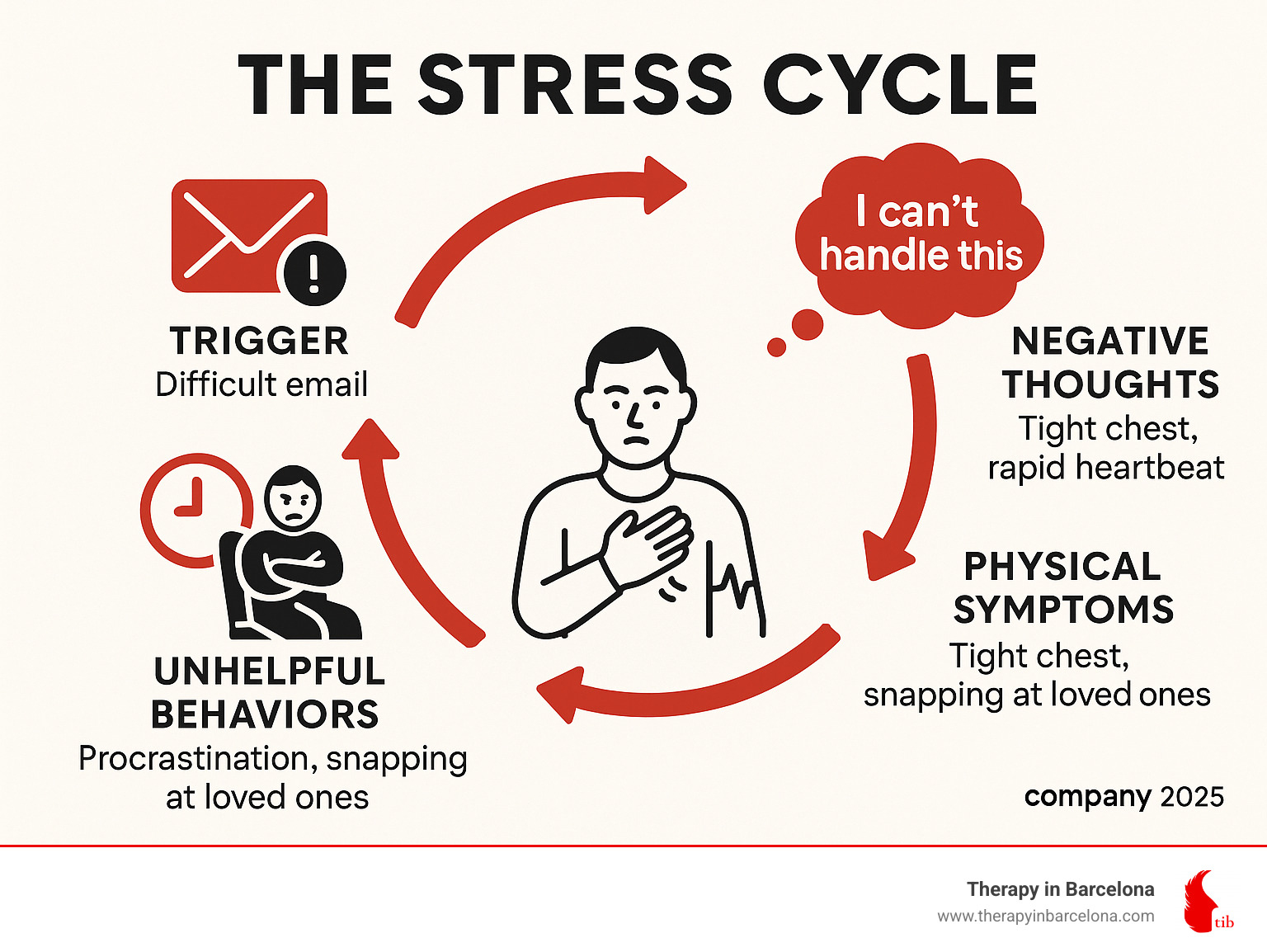
Understanding the Stress Cycle and How CBT Breaks It
Stress is your body’s natural alarm system, designed to keep you alert and performing at your best. A certain amount is essential for motivation. The problem arises when this alarm system never switches off, leading to chronic stress and issues like insomnia, anxiety, and depression. With nearly one in three people reporting extreme stress, it’s a pervasive modern problem.
At the heart of CBT therapy for stress management is the cognitive triangle, which shows the constant interaction between your thoughts, feelings, and behaviours. These three elements influence each other in a cycle: unhelpful thoughts trigger unpleasant feelings, which lead to unhelpful behaviours. These behaviours then reinforce the original negative thoughts, trapping you in stress.
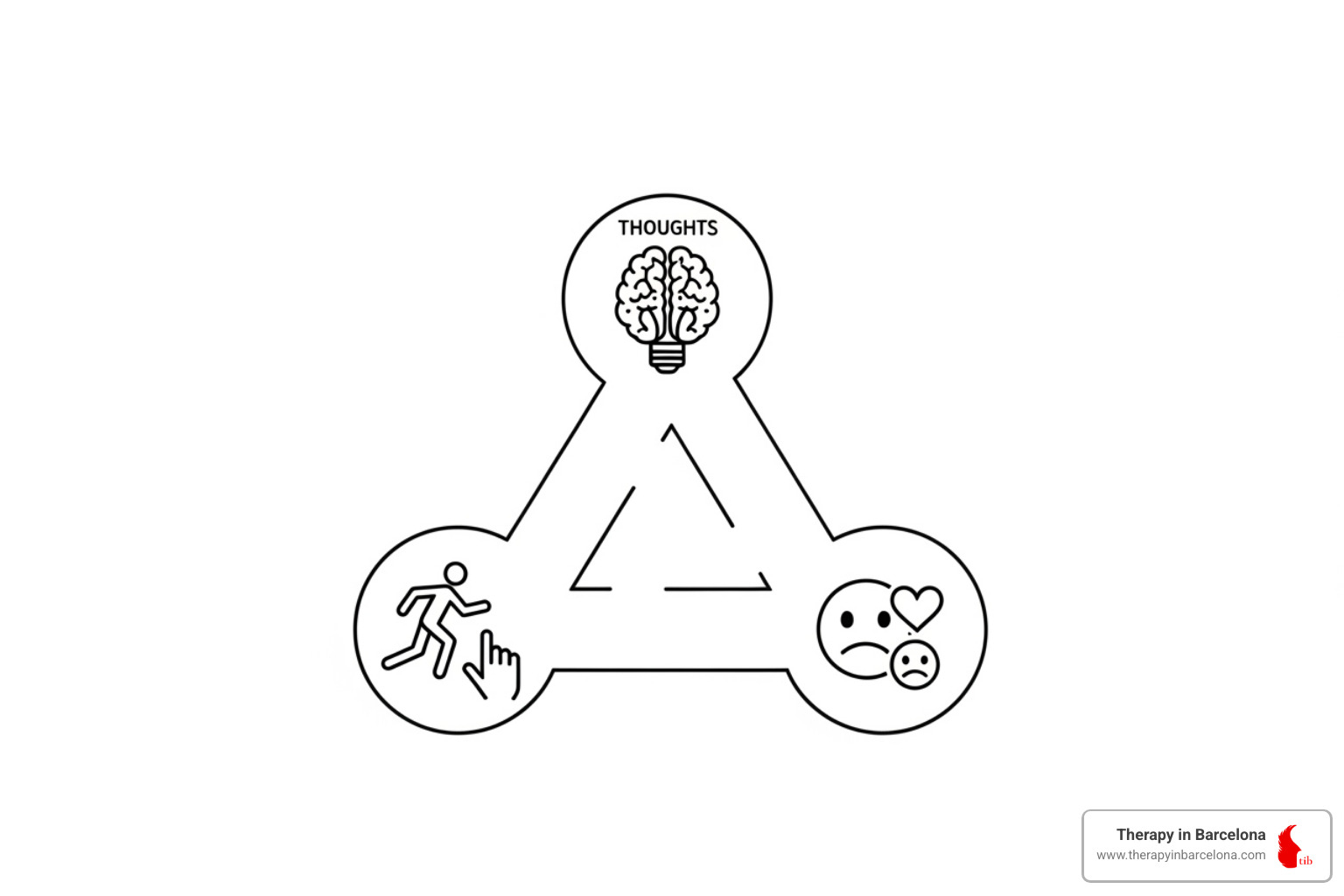
This pattern is especially relevant for expats. Imagine receiving a confusing letter from the Spanish tax office. Your thought might be, “I’m incompetent, I’ll never get this right.” This fuels anxiety, leading you to avoid the paperwork, which reinforces your belief that you can’t handle things. Leigh Matthews, the Australian psychologist who founded Therapy in Barcelona, recognised these unique expat challenges from her own experience, which is why our team is uniquely positioned to offer culturally sensitive support. For more help with these pressures, explore our stress management services.
What is Cognitive Behavioural Therapy (CBT)?
Cognitive Behavioural Therapy is about change—specifically, changing how you think (cognition) and act (behaviour) to cope more effectively. It’s a structured, goal-oriented approach focused on the “here and now.” You work collaboratively with your therapist to identify unhelpful patterns and develop new coping skills. This practical, skill-building approach is clinically effective for stress, anxiety, and low mood, making it ideal for expats facing immediate challenges.
How Your Thoughts Fuel the Fire of Stress
CBT reveals a fundamental truth: it’s rarely the event that causes distress, but your interpretation of it. Your thoughts act as a lens, and sometimes that lens becomes distorted, magnifying stress. CBT helps you identify these “cognitive distortions” or “thinking traps.”
- Catastrophising: Blowing things out of proportion (e.g., a small mistake at work means “I’m going to be fired”).
- Black-and-white thinking: Seeing things in extremes—if you’re not perfect, you’re a failure.
- Mind-reading: Assuming you know what others are thinking, usually negatively (e.g., “My colleagues think I’m stupid because I don’t get the joke”).
CBT teaches you to spot these traps and reframe your thoughts into more balanced, realistic perspectives, which is crucial for breaking the stress cycle. If you’re caught in such patterns, our resources on rumination can help.
The Vicious Cycle of Stress and Unhelpful Behaviours
When stressed, it’s natural to want to escape. However, avoidance often makes things worse. Procrastination on a stressful task or social withdrawal provides temporary relief but maintains stress long-term by preventing you from learning that you can cope.
Think of stress as water slowly filling a glass. Each minor stressor adds a few drops. Over time, the glass fills up, and a small event—like spilling coffee—can make it overflow, triggering an intense reaction. The coffee isn’t the problem; it’s the accumulated stress.
CBT therapy for stress management helps you reduce the water in your glass with better coping strategies and build a bigger glass to handle future challenges with greater resilience.
Your Practical Toolkit: CBT Therapy for Stress Management
The beauty of CBT therapy for stress management lies in its practical, actionable toolkit. These are techniques you can use immediately to manage stress and build resilience. Like learning a language, CBT works best when you apply what you learn to real-life situations between sessions.

Technique 1: Become the Detective of Your Own Mind
This technique, called cognitive restructuring, teaches you to examine your automatic thoughts with curiosity. When stress hits, your mind can jump to conclusions. A delayed residency application might trigger the thought, “They’re going to reject me.” But is this based on evidence or stress?
A thought record is your tool for investigation. You note the situation, your automatic thoughts, and your emotions. Then, you challenge these thoughts:
- What’s the evidence for and against this thought?
- Is there another way of looking at this situation?
- What’s the worst that could happen, and could I cope?
- What would I tell a friend who had this thought?
- Is this thought helpful or harmful?
By consistently asking these questions, you train your brain to think more flexibly and realistically.
Technique 2: Take Action to Reduce Stress
Sometimes, the best way to feel better is to do something different. Behavioural activation is about getting unstuck through action. When stress makes you want to withdraw, intentionally scheduling positive activities—even small ones—can lift your mood. Your mood often follows your actions.
Problem-solving skills are also key. CBT teaches you to break down overwhelming problems into manageable steps, brainstorm solutions, and take concrete action. For situations that consistently trigger stress, like speaking Spanish at the bank, gradual exposure can help. By facing these situations in a controlled way, you learn they are more manageable than you imagined.
Technique 3: Learn to Calm Your Body and Mind
Stress is physical: a racing heart, tight shoulders, shallow breathing. CBT includes techniques to manage these symptoms and activate your body’s relaxation response.
- Diaphragmatic breathing: Deep belly breathing sends a signal to your nervous system to relax.
- Progressive muscle relaxation: Tensing and releasing muscle groups helps you let go of physical tension.
- Grounding techniques: These anchor you in the present moment when your mind is racing. Focus on five things you can see, four you can touch, three you can hear, etc.
- Mindfulness: This teaches you to observe your thoughts and feelings without getting swept away by them.
Combining these cognitive, behavioural, and physical techniques allows you to address stress from all angles, creating lasting change.
Is CBT an Effective and Proven Method for Stress?
The short answer is yes, absolutely. CBT therapy for stress management is not a wellness trend; it’s a first-line treatment backed by decades of rigorous scientific research. An extensive body of evidence, including numerous systematic reviews and randomised controlled trials, demonstrates its proven track record in helping people manage stress effectively.
What the Science Says About CBT Therapy for Stress Management
Research consistently shows that CBT is as effective as—and often more effective than—other therapies or even medication for many conditions. It leads to significant improvements in quality of life and daily functioning. Its benefits extend beyond mental health to physical conditions like chronic pain and fibromyalgia.
Crucially, the effects are lasting. Evidence suggests that the anxiety-reducing benefits of CBT last for at least a year, and continued practice solidifies these gains. The skills you learn become lifelong tools. For those interested in the science, you can explore A review of CBT’s efficacy and A comprehensive scientific review of CBT.
Beyond Stress: How CBT Helps with Anxiety, Depression, and More
CBT has a “transdiagnostic” benefit, meaning the core skills you learn for stress are also effective for other challenges like anxiety and depression. The cognitive restructuring skills used for stress work just as well for the negative thought patterns of depression. Behavioural activation helps lift mood and combat isolation. By strengthening your emotional regulation, CBT equips you to handle the uncertainty of expat life, from bureaucracy to building new social circles.
CBT vs. Other Approaches: Finding What’s Right for You
While CBT is highly effective, the best approach depends on your needs. Here’s a quick comparison:
Core Principle
CBT (Cognitive Behavioural Therapy): The foundation here is changing unhelpful thoughts and behaviours to shift how you feel. It’s about breaking those negative cycles that keep anxiety spinning.
Mindfulness-Based Stress Reduction (MBSR): This approach focuses on cultivating present-moment awareness and non-judgmental acceptance. Rather than fighting anxiety, you learn to observe it without getting swept away.
Medication: The core principle targets physiological symptoms or chemical imbalances that fuel anxiety. It works directly on your brain chemistry to provide relief.
Key Techniques
CBT: You’ll work with cognitive restructuring to challenge those catastrophic thoughts, try behavioural experiments to test your fears, and develop practical problem-solving skills.
MBSR: Your toolkit includes meditation practices, body scan exercises, and mindful movement. These help you step back from anxious thoughts and reconnect with your body.
Medication: Common options include antidepressants like SSRIs (which also help anxiety) and anxiolytics for more immediate relief during panic or intense worry.
Best For
CBT: This works brilliantly for structured, goal-oriented people who want to actively challenge their negative patterns. If you like having specific tasks and seeing measurable progress, CBT might be your sweet spot.
MBSR: Perfect for those seeking to reduce their reactivity to stress and increase self-awareness. It’s particularly helpful if you tend to get caught up in worry spirals or feel disconnected from your body.
Medication: Most effective for rapid symptom reduction or when anxiety symptoms are severe. It’s often used alongside therapy rather than as a standalone solution.
Things to Consider
CBT: This approach requires active participation – you’ll have “homework” between sessions. The more you put in, the more you get out, but that means committing to practice outside the therapy room.
MBSR: Success depends on consistent practice. Like learning an instrument, the benefits come with regular meditation and mindfulness exercises, not just during formal sessions.
Medication: While it can provide quick relief, medication may have side effects and doesn’t teach you long-term coping skills. Many people find it most helpful when combined with therapy.
Many people find combining approaches works best. At Therapy in Barcelona, our personalised therapist matching by our experience Intake Coordinators helps you find the right fit for your unique situation.
Frequently Asked Questions about CBT for Stress
It’s natural to have questions when considering therapy. Here are answers to some common queries about CBT therapy for stress management.
How long does CBT take to work for stress?
CBT is a short-term therapy, typically ranging from 5 to 20 sessions. The exact duration depends on your individual needs and the severity of your symptoms. Many people feel significant improvement after just a few sessions. Your progress is greatly influenced by your commitment to practising the skills you learn between sessions, as this is where real-world change happens.
Can I do CBT on my own without a therapist?
You can apply CBT principles on your own using self-help books, apps, and online courses. These are a great starting point. However, a qualified therapist offers personalised support, an objective perspective, accountability, and expert guidance through complex issues. While self-help is valuable, professional support is highly recommended if your stress is persistent or significantly impacting your life.
What happens in a typical CBT therapy for stress management session?
A CBT session is a structured, collaborative meeting. You can generally expect to:
- Check-in: Briefly discuss your week and review any homework.
- Set an agenda: Collaboratively decide what to focus on in the session.
- Learn and practise skills: Your therapist will introduce new CBT techniques and help you apply them to your challenges.
- Plan for the week: Agree on new homework to practise before the next session.
- Summarise: End with a summary of the session and key takeaways.
This structured approach empowers you to take an active role in your healing journey. Learn more about the CBT process.
Conclusion: Take the First Step Towards a Calmer, More Resilient You
The journey through understanding CBT therapy for stress management brings us to an empowering realisation: you have far more control over your stress response than you might have imagined. By grasping the intricate dance between your thoughts, feelings, and behaviours, you’ve gained the keys to dismantling that vicious cycle of stress and building healthier ways of coping.
Taking that first step to ask for help requires courage. It’s a sign of strength, not weakness. Leigh Matthews, the Australian psychologist who founded Therapy in Barcelona, understood this when she moved here in 2011. As an immigrant herself, she experienced the unique stressors of living abroad and couldn’t find the culturally sensitive support she needed. This inspired her to create a practice specifically for the international community.
Our team of expat therapists doesn’t just understand your challenges—we’ve lived them. We know what it’s like to steer bureaucracy, miss home, and feel caught between cultures. This shared experience creates a foundation of genuine understanding.
We believe in personalised matching to ensure the best therapeutic fit, which significantly increases the chances of a positive outcome. We take the time to understand your needs before pairing you with the right therapist.
Whether you prefer face-to-face sessions at our welcoming office in Barcelona’s Eixample district or the convenience of online therapy (available to expats worldwide, except the USA and Canada), we are here to support you.
Your stress doesn’t have to dictate your life. With the right tools and support, you can build the resilience to thrive. That journey starts with a single step.
Ready to begin? Find how CBT therapy for stress management can transform your relationship with stress—and with yourself. Reach out to us today https://www.therapyinbarcelona.com/contact/
