


Accessing English Therapy Support in Spain

If you are living in Spain and want counselling in English, look for a psychology-trained therapist who is comfortable working with international clients and understands that relocation affects more than language. English therapy can give you a confidential space to discuss loneliness, relationship strain, work pressure, homesickness, identity changes, or the uncertainty of building a life abroad – without having to translate your feelings first.
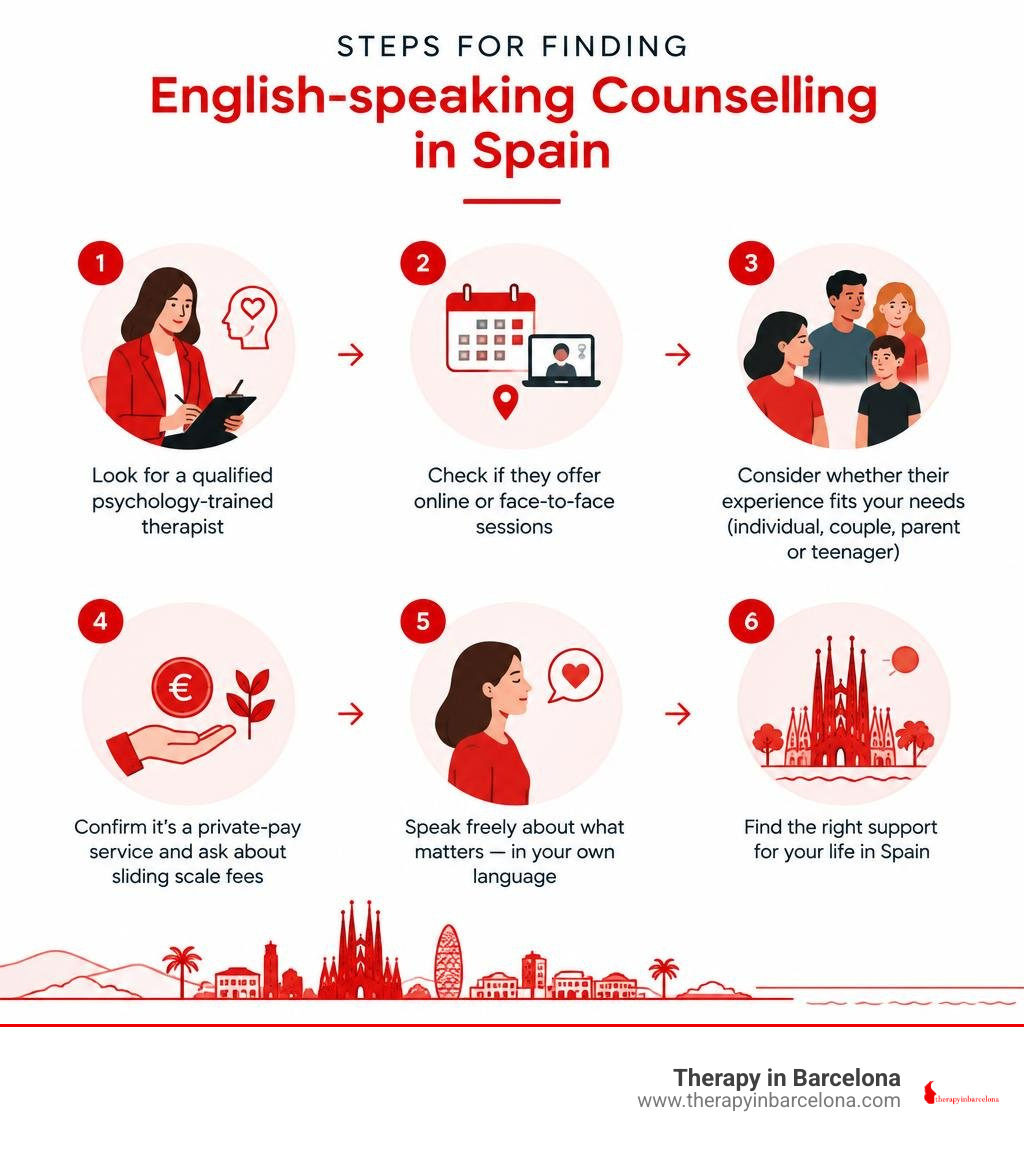
A good starting point is to check the therapist’s qualifications, ask whether they offer online or face-to-face sessions, and consider whether their experience fits your needs as an individual, couple, parent, or teenager. Therapy is a private-pay service, and some therapists offer sliding scale fees for financial need, so it is worth asking.
For many internationals, speaking English is not simply about convenience. It can make it easier to describe personal history, humour, conflict, and the parts of life abroad that feel difficult to explain. Therapy in Barcelona is a trusted psychology practice in Spain established since 2011. It offers personalised matching for adults, couples, teens, and families, with face-to-face sessions in Barcelona and online therapy worldwide.
Understanding English Therapy: Mental Health Support vs. Language Coaching

When people search for English therapy, the term can occasionally refer to two distinct areas: English language instruction, and evidence-based mental health counselling conducted in English. Understanding the distinction ensures you receive the exact form of care you need.
Language tutoring focuses on conversational fluency, grammar, or vocabulary. While language practice helps build speech confidence, psychological therapy provides clinical mental health care.
Key Differences Between Language Coaching and English Therapy
To distinguish between the two paths, consider how their objectives, methods, and outcomes differ:
- Functional fluency: Language instruction addresses grammar, pronunciation, and dialogue. In contrast, clinical counselling focuses on emotional processing, relational dynamics, and internal well-being.
- Emotional vulnerability: While language training stays within structured conversational boundaries, psychological therapy provides an ethical, confidential container to explore grief, trauma, anxiety, and interpersonal distress.
- Therapeutic rapport: An instructor evaluates speech patterns and provides corrections. A psychology-trained therapist builds an attuned, non-judgemental alliance designed to foster safety and self-understanding.
- Mindset shifts: Educational coaching often targets confidence for specific scenarios like public presentations. Psychological therapy addresses deep-seated core beliefs, attachment patterns, and somatic emotional regulation.
Why Native-Language Emotional Processing Matters
Expressing complex emotions in a non-native language creates cognitive load. When you are searching for vocabulary while describing an emotional crisis, your brain spends energy translating instead of feeling and processing.
Speaking in your native language—or a shared lingua franca in which you feel entirely natural—allows you to tap directly into somatic awareness and early emotional memories. Humour, sarcasm, cultural idioms, and subtle nuances of grief lose their meaning when filtered through mechanical translation. Psychological therapy in a language you speak fluently allows you to explore vulnerabilities without linguistic friction.
Why English Therapy Is Essential for Mental Well-Being Abroad
Living in Spain offers wonderful lifestyle benefits, but moving abroad disrupts your familiar support networks. Accessing dedicated expat mental health support in Spain gives internationals a grounded space to process the emotional impact of cultural relocation.
How English Therapy Bridges Cultural and Emotional Nuances
Relocating involves more than adapting to a new routine; it often triggers subtle identity shifts. Expatriates frequently experience acculturation stress, imposter syndrome in international workplaces, or relational friction within binational partnerships.
Consider the fictional composite profile of Marcus, a software engineer who relocated to Valencia. Outwardly thriving, Marcus found himself withdrawing socially, caught between the high expectations of his remote team and the isolation of living in an unfamiliar neighbourhood. Working with an English-speaking therapist allowed him to explore how unspoken cultural differences at work were triggering chronic fatigue and self-doubt, helping him establish healthy boundaries without second-guessing his communication.
Addressing Common Relocation Roadblocks
From bureaucratic administrative processes to the subtle grief of being far from family milestones, moving abroad can strain emotional resilience. Without a familiar social anchor, minor hurdles can quickly lead to burnout or isolation.
Receiving individual counselling support helps untangle situational stress from deeper personal patterns. A qualified practitioner provides practical coping strategies to manage social disconnection, process the loss of previous routines, and cultivate sustainable emotional stability in your new environment.
Core Modalities Used in English-Speaking Psychological Care

Qualified therapists working with internationals draw from a broad range of evidence-based psychological modalities, ensuring care is adapted to your unique goals and personal history.
Evidence-Based Approaches for Internationals
Experienced practitioners integrate several therapeutic frameworks:
- Cognitive Behavioural Therapy (CBT): Helps identify unhelpful cognitive distortions and provides structured behavioural experiments to reduce anxiety and stress.
- Acceptance and Commitment Therapy (ACT): Encourages psychological flexibility and helps you align daily actions with core personal values, particularly when managing unpredictable life changes.
- Internal Family Systems (IFS) & Schema Therapy: Explores protective internal parts, coping modes, and unmet childhood emotional needs.
- Psychodynamic & Relational Psychotherapy: Examines how past attachment dynamics influence current relationship patterns and emotional responses.
These modalities can be accessed face-to-face or via flexible online counselling options across Spain and internationally.
Support Across Diverse Expat Needs
The international community is diverse, and therapeutic needs vary significantly across different life stages:
- Digital Nomads & Remote Workers: Managing transient relationships, loneliness, and professional burnout.
- International Students: Adapting to academic pressures, identity formation, and social transitions far from home.
- Couples & Binational Partners: Addressing communication breakdowns, differing cultural values, and parenting philosophies through dedicated couples counselling.
- Families & Third Culture Kids: Supporting children and teens through relocation transitions, schooling adjustments, and family dynamics abroad.
Crisis Support Note: Private therapy practices do not provide emergency crisis intervention. If you or someone you know in Spain is experiencing an acute mental health crisis, please dial 061 (Health Emergencies) or 024 (National Suicide Prevention Helpline), or visit your nearest hospital emergency room (urgencias).
How to Find and Choose the Right English-Speaking Therapist in Spain
When looking for a practitioner, it helps to understand how different providers operate:
Provider Comparison for Expats in Spain
Public Healthcare System (CatSalut / Sistema Nacional de Salud)
- Session Language: Predominantly Spanish or regional languages (such as Catalan).
- Matching Process: Assigned based on geographic clinic catchment area.
- Session Flexibility: In-person at local primary clinics; public system wait times can be significant.
- Cost: Covered by public social security contributions.
Large Generic Matching Directories
- Session Language: Varies widely by clinician profile.
- Matching Process: Automated search filters or algorithm-based suggestions.
- Session Flexibility: Primarily automated online platforms.
- Cost: Private subscription plans or direct per-session fees.
Therapy in Barcelona
- Session Language: English (with selected therapists also offering sessions in German, French, Spanish, Afrikaans, Portuguese, Austrian-German, and Swiss-German).
- Matching Process: Bespoke clinical matching handled by experienced expat psychologists.
- Session Flexibility: Face-to-face sessions in Barcelona and secure online sessions worldwide.
- Cost: Private-pay practice; some therapists provide sliding scale fees for financial need. Strict data privacy with no selling of personal information.
In-Person vs. Online Sessions Across Spain
Whether you live in Madrid, coastal hubs like Málaga, Alicante, Marbella, Sevilla, or regional areas such as Gran Canaria or Zaragoza, accessible mental healthcare is vital.
Online video therapy provides continuity of care, allowing you to maintain regular sessions even when travelling for work or moving between cities. For those residing in Barcelona, face-to-face sessions at a dedicated clinic offer a quiet, grounded environment away from home and work routines.
The Value of Personalised Matching Over Generic Directories
Therapeutic success relies heavily on the quality of the therapeutic alliance. Rather than scrolling through hundreds of unvetted online listings, bespoke clinical matching pairs you with a professional whose training, clinical focus, and lived cultural experience align with your circumstances.
Working with our team of psychology-trained therapists ensures you collaborate with practitioners who have personal and clinical insight into the international experience, creating a collaborative and empathetic space from your first session.
Frequently Asked Questions About English Therapy
Does private health insurance in Spain cover English therapy sessions?
Coverage depends entirely on your specific private policy. While Therapy in Barcelona is a private-pay service, many international and Spanish private insurance policies offer outpatient psychological reimbursement provisions. You can request itemised clinical session invoices from your therapist to submit directly to your insurer for reimbursement according to your policy terms.
What should I look for when verifying an English-speaking therapist’s credentials in Spain?
Ensure your therapist holds a university psychology degree and appropriate professional registration or ethical accreditation. In Spain, health psychologists are registered as Psicólogo General Sanitario or hold equivalent accredited clinical standing from their country of training. Beyond credentials, confirm that the therapist has dedicated experience working with expatriates and cross-cultural dynamics.
Can I access English-speaking counselling if English is my second language?
Yes. Many internationals use English as a shared second language because they feel comfortable speaking it conversationally and professionally. In therapeutic settings, absolute grammatical perfection is never the goal. What matters is that you feel safe, understood, and able to express your thoughts without fear of judgement.
Conclusion
Building a fulfilling life abroad requires emotional grounding, intentional self-care, and reliable support when unexpected challenges arise.
Therapy in Barcelona is a trusted psychology practice in Spain established since 2011. The practice was founded by Leigh Matthews, an Australian Psychologist who has lived in Barcelona since 2011 and is highly experienced in supporting internationals. With face-to-face sessions at its central Barcelona office and online therapy available worldwide, the practice provides a supportive environment tailored to expatriates, couples, teens, and families.
If you’d like support, book a Free Discovery Call to find the right therapeutic match for your journey.
