


Intercultural conflict resolution is crucial in our interconnected world, where cultural differences often lead to misunderstandings and disputes. When navigating diverse cultural landscapes, particularly when living abroad in vibrant cities like Barcelona, it’s important to understand the root causes of these conflicts and explore effective ways to resolve them.
- What is intercultural conflict? It’s a struggle arising from differences in cultural values, norms, or communication styles.
- Why does it happen? Often due to misunderstandings based on cultural assumptions and differing worldviews.
- How can it be addressed? Through open communication, cultural awareness, and empathy.
For many people living abroad, these challenges are deeply familiar. Adapting to a new culture, navigating language barriers, and feeling out of step with local norms can create stress and misunderstanding. These everyday experiences show how intercultural conflict can develop and why practical, respectful ways of building connection across differences matter.
Addressing intercultural conflict isn’t just about resolving disputes; it’s about building connections that improve mutual understanding and respect. In this guide, we’ll explore these concepts, focusing on practical strategies to turn conflict into a meaningful connection.
Understanding Intercultural Conflict
Types of Intercultural Conflict
Intercultural conflict can be a complex puzzle, especially for those navigating life in a new country. It often arises from differences in cultural assumptions, cultural values, and communication styles. Let’s explore these concepts and see how they can lead to different types of conflicts, particularly for expats and internationals.
Cultural Assumptions and Values
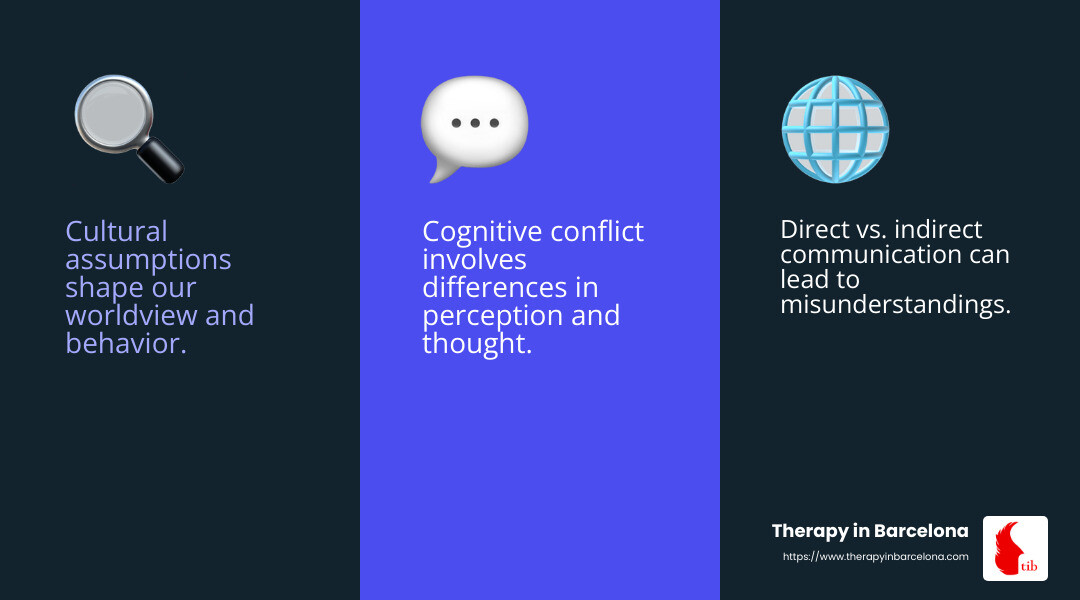
Cultural assumptions are the unspoken beliefs that guide our behaviour. They shape how we see the world and interact with others. For example, in some cultures, direct eye contact is seen as a sign of confidence, while in others, it might be considered rude. These assumptions can be particularly challenging for expats adjusting to a new cultural environment.
Cultural values are the core principles that guide what is important in a culture. These values can vary widely across cultures. For instance, while some cultures highly value individual achievement, others might prioritise community and family ties. When people from different cultures interact, these differing assumptions and values can lead to misunderstandings and conflict. For expats, understanding these differences is crucial for smoother interactions.
Communication Styles
Communication styles also play a big role in intercultural conflict. Some cultures prefer a direct communication style, where people say exactly what they mean. Others might use an indirect style, where messages are conveyed through hints or suggestions. Misunderstandings can arise when people from these different styles communicate, leading to frustration and conflict. Expats often find themselves navigating these differences in their daily interactions.
Types of Intercultural Conflict
There are several types of intercultural conflict, each stemming from different sources:
Affective Conflict: This occurs when emotions are at the forefront. Imagine a situation where one person expresses emotions openly, while another values emotional restraint. This mismatch can lead to tension and misunderstandings, especially for those adjusting to new cultural norms.
Value Conflict: This type of conflict arises when there are clashes in core values. For instance, if one person values punctuality and another prioritises flexibility, they might find themselves in conflict over time management. Expats often encounter these differences in workplace settings.
Cognitive Conflict: This involves differences in perception and thought processes. For example, one person might focus on details while another sees the big picture. These differing cognitive approaches can lead to disagreements on how to solve problems. For internationals, understanding these cognitive differences can aid in conflict resolution.
Understanding these types of conflicts is the first step in resolving them. By recognising the roots of intercultural conflict, such as cultural assumptions, values, and communication styles, we can pave the way for more effective and empathetic interactions. This understanding is particularly valuable for expats and internationals striving to build connections in their new environments.
In the next section, we’ll explore strategies for resolving these conflicts, focusing on practical steps and cultural awareness, which are essential for expats and internationals in Barcelona and beyond.
Strategies for Intercultural Conflict Resolution
Resolving intercultural conflicts requires a thoughtful approach, combining practical steps with a deep understanding of cultural nuances. Let’s explore some strategies that can help bridge these cultural divides.
Probing for Cultural Dimensions
When conflict arises, it’s crucial to probe for cultural dimensions. This means acknowledging that cultural factors might be at play. Here are some steps to guide you through this process:
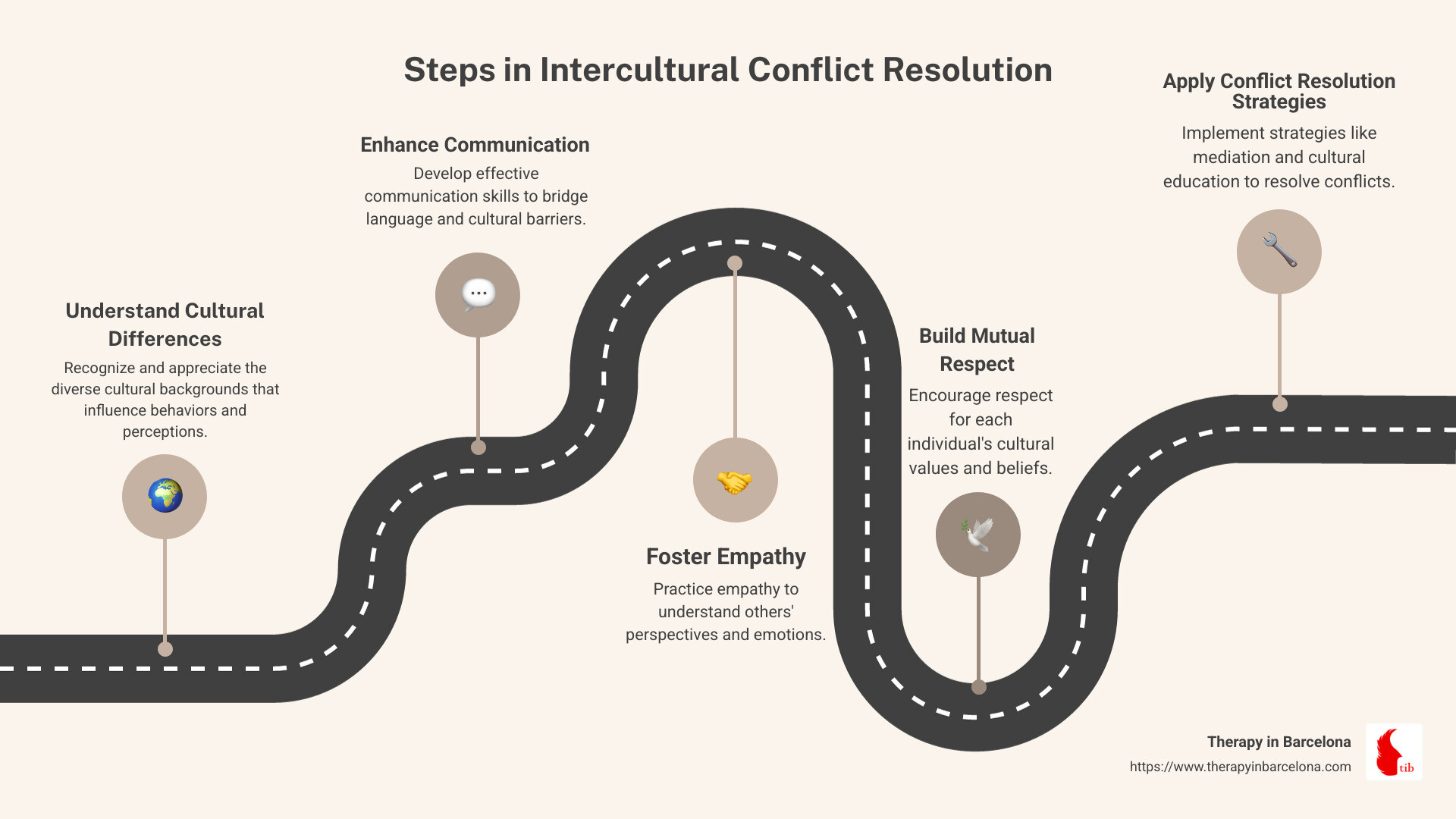
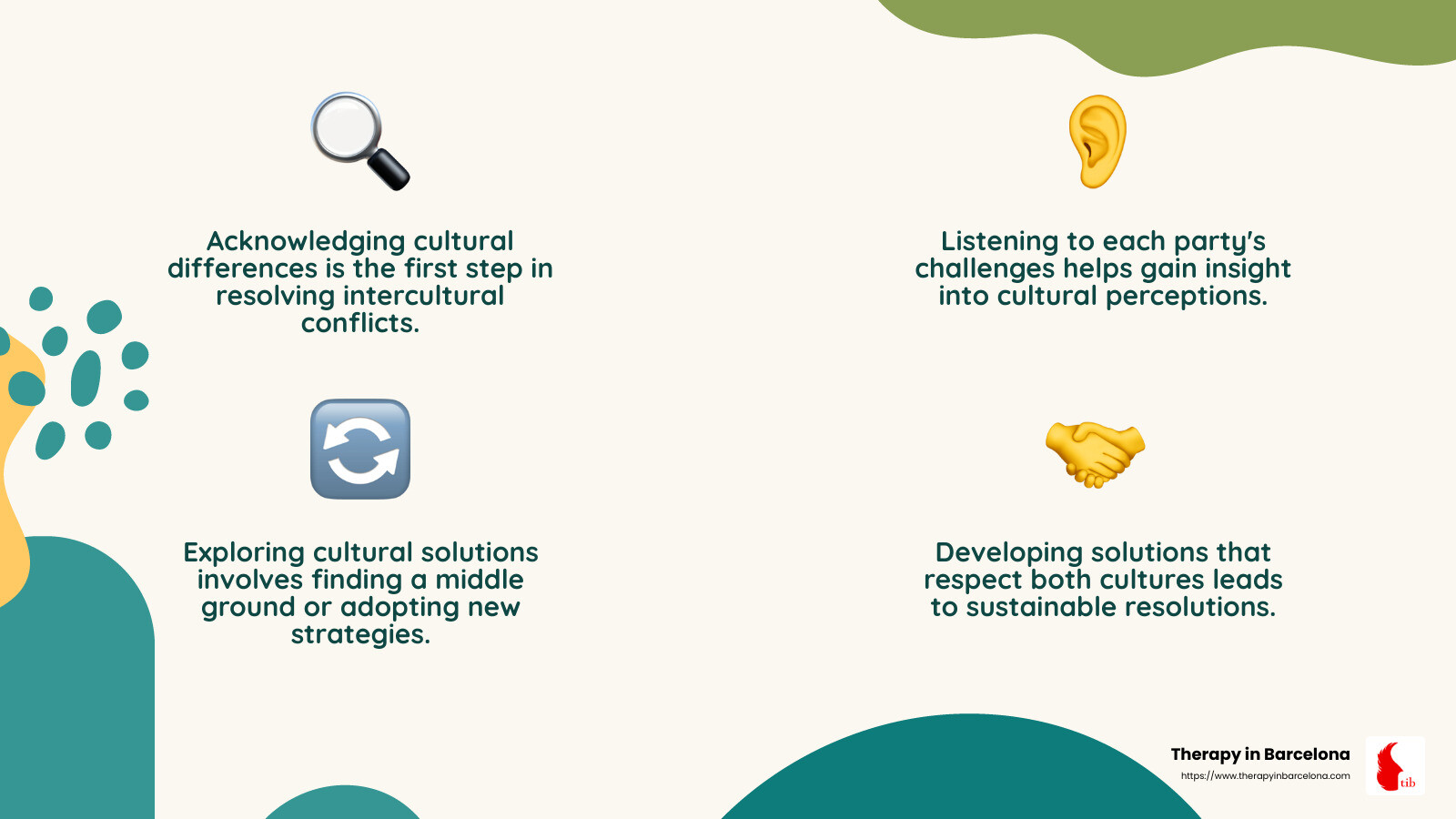
Acknowledge Cultural Differences: Start by recognising that the conflict might have a cultural dimension. This awareness can open the door to understanding.
Describe and Understand: Each party should describe what they find challenging in the other’s behaviour. This step is about listening and gaining insight into each other’s cultural perceptions.
Explore Cultural Solutions: Once you understand the cultural roots of the conflict, explore how the issue might be resolved within the cultural context of each party. This might involve adopting new strategies or finding a middle ground.
Develop Conflict Solutions: Finally, work together to develop solutions that respect and integrate both cultures. This might require creativity and compromise, but it can lead to more sustainable resolutions.
Learning About Other Cultures
Cultural education is a proactive way to prevent conflicts before they start. By learning about other cultures, we can build a foundation of cultural awareness that promotes understanding and empathy.
Engage in Training: Participate in cultural training programs. These can provide valuable insights into different cultural norms and values.
Read and Research: Books, articles, and online resources can deepen your understanding of various cultures. Aim to gain a broad knowledge of cultural beliefs and practices.
Communicate and Connect: Talk to people from different cultures. Listening to their experiences can offer insights and help dismantle stereotypes.
Reflect on Your Own Culture: Understanding your own cultural biases and assumptions is just as important. This self-awareness can help you approach intercultural interactions with an open mind.
By investing time in learning about other cultures, we not only reduce the likelihood of conflict but also improve our ability to connect with others on a deeper level.
In the next section, we’ll dig into different intercultural conflict styles and how understanding these styles can further aid in resolving conflicts.
Intercultural Conflict Styles
Navigating intercultural conflicts can be challenging, especially when communication styles differ. Understanding these styles is crucial for resolving disputes effectively. Let’s explore the Intercultural Conflict Style Inventory (ICS), a tool that can help bridge these differences.
The Intercultural Conflict Style Inventory (ICS)
Created by Dr. Mitchell R. Hammer, the ICS Inventory helps explain how people from different cultural backgrounds tend to handle conflict. It maps conflict styles across four quadrants using two key dimensions: direct vs. indirect communication and emotional expressiveness vs. emotional restraint.
Direct vs. Indirect Communication
Direct Communication: This style is straightforward, valuing clarity and explicitness. It’s common in many Western cultures, where saying exactly what you mean is appreciated.
Indirect Communication: More subtle, this style relies on context and non-verbal cues. It’s prevalent in many Asian cultures, where harmony and saving face are prioritized over directness.
Emotional Expressiveness vs. Emotional Restraint
Emotional Expressiveness: Emotions are openly displayed and considered essential in communication. Cultures that accept expressiveness often encourage sharing feelings to connect and resolve issues.
Emotional Restraint: Emotions are controlled and kept private. This approach values calmness and composure, often seen in cultures where public displays of emotion might be viewed as unprofessional.
The Four Conflict Styles
By combining these dimensions, the ICS model identifies four distinct conflict styles:
Discussion Style: Direct and emotionally restrained. This style focuses on logical arguments and facts, keeping emotions in check.
Engagement Style: Direct and emotionally expressive. Open discussions with emotions play a key role in conveying sincerity and passion.
Accommodation Style: Indirect and emotionally restrained. Individuals with this style prefer to avoid confrontation and use diplomacy to maintain harmony.
Dynamic Style: Indirect and emotionally expressive. This style relies on storytelling, metaphors, and emotional appeals to resolve conflicts.
The ICS Inventory is a powerful tool for improving intercultural conflict resolution. By understanding these styles, you can better navigate conflicts, whether you’re an expat in Barcelona or working in a multicultural team.
In our next section, we’ll answer some frequently asked questions about intercultural conflict resolution, providing more insights into how you can apply these concepts in real-life situations.
Frequently Asked Questions about Intercultural Conflict Resolution
What is intercultural conflict resolution?
Intercultural conflict resolution is the process of addressing and resolving disputes that arise from cultural differences. These conflicts often stem from misunderstandings related to cultural assumptions, values, and communication styles. Effective resolution requires a deep understanding of these cultural dimensions and how they influence interactions.
Intercultural conflict resolution involves recognising and navigating the unique challenges posed by cultural diversity. This includes being aware of one’s own cultural biases and assumptions, as well as those of others. By doing so, individuals can foster more meaningful and respectful dialogue, ultimately leading to more harmonious relationships.
What is the best way to solve intercultural conflict?
Solving intercultural conflict often requires a combination of mediation and effective communication. Mediation involves a neutral third party who helps facilitate discussions and find common ground. This approach can be particularly beneficial when cultural differences create significant barriers to understanding.
Communication is equally crucial. Being open and willing to listen mindfully is key. This means focusing on the speaker, asking clarifying questions, and reframing statements to ensure understanding. By doing so, individuals can bridge gaps in communication and work towards mutually acceptable solutions.
Another effective strategy is to improve cultural awareness through education. Learning about other cultures, their norms, and values can help prevent conflicts from arising in the first place. By appreciating diversity, individuals can approach interactions with empathy and respect.
What are the four intercultural conflict styles?
The Intercultural Conflict Style Inventory (ICS) identifies four main conflict styles based on two dimensions: direct vs. indirect communication and emotional expressiveness vs. emotional restraint. These styles help explain how different cultures approach conflict:
Discussion Style: Characterised by direct communication and emotional restraint. People using this style focus on facts and logical reasoning while keeping emotions in check.
Engagement Style: Combines direct communication with emotional expressiveness. This style values open discussions where emotions are expressed to convey sincerity and passion.
Accommodation Style: Involves indirect communication and emotional restraint. Individuals with this style prefer to avoid confrontation, using diplomacy to maintain harmony.
Dynamic Style: Features indirect communication and emotional expressiveness. This style relies on storytelling and emotional appeals to resolve conflicts.
Understanding these styles can greatly improve your ability to manage intercultural conflicts. By recognising your own style and that of others, you can adapt your approach to foster more effective and harmonious interactions.
Conclusion
Navigating the complexities of intercultural conflicts can be challenging, especially for expatriates adjusting to a new culture. However, with the right support, these challenges can transform into opportunities for growth and connection. Therapy in Barcelona offers culturally sensitive support tailored for the international community, helping individuals and couples bridge cultural divides and improve their personal and professional relationships.
Our team of multilingual therapists understands the unique challenges faced by expats. We provide a safe space where you can explore cultural differences and develop strategies for effective intercultural conflict resolution. By focusing on personalised therapist matching, we ensure that each client receives the support best suited to their needs, fostering an environment of empathy and understanding.
Whether you are dealing with cultural adjustment, language barriers, or relationship dynamics, Therapy in Barcelona is here to help you steer these challenges. Our approach is grounded in cultural awareness and effective communication, empowering you to build stronger connections with those around you.
For more information on how we can support you, contact us to learn more about our services and get guidance for thriving in a multicultural environment.
Embracing cultural diversity not only enriches your life but also strengthens your ability to connect with others on a deeper level. Let Therapy in Barcelona be your partner in this journey towards personal growth and intercultural harmony.
