


Why Finding the Right Mental Health Support Matters for Internationals

Therapy in Barcelona offers a lifeline for internationals who call this vibrant city home, yet find themselves struggling with challenges unique to expat life. Whether you’re in Barcelona, Valencia, or another Spanish hub, professional support can make all the difference.
Quick Guide to Finding Therapy in Barcelona:
- English-speaking options: Therapy in Barcelona works in English. Some therapists also speak German, French, Spanish, Afrikaans, Portuguese, Swedish, Austrian-German and Swiss-German.
- Types available: Individual, couples, family, and online sessions.
- Specialised support: Expat-focused practices understand cultural challenges.
- How we work: Online worldwide and in-person in our Barcelona office.
- Investment: Private-pay service; some therapists offer sliding scale fees.
- Getting started: Many practices offer Free Discovery Calls to help you find the right therapist.
Take Emily, a 34-year-old from the UK who moved to Barcelona for adventure and found unexpected loneliness instead. She’s fictional, but her story mirrors many expats’ experiences. The excitement of a new city can quickly give way to isolation when familiar support systems disappear.
Living abroad brings unique mental health challenges that locals may not fully grasp. From navigating bureaucracy in a foreign language to redefining your identity, these struggles are real and valid. The good news is that Barcelona’s international community has access to culturally sensitive mental health support designed for people like you.
Many expats report feeling more anxious or down than usual. Yet seeking help isn’t a sign of weakness—it’s a recognition that major life transitions deserve professional support.
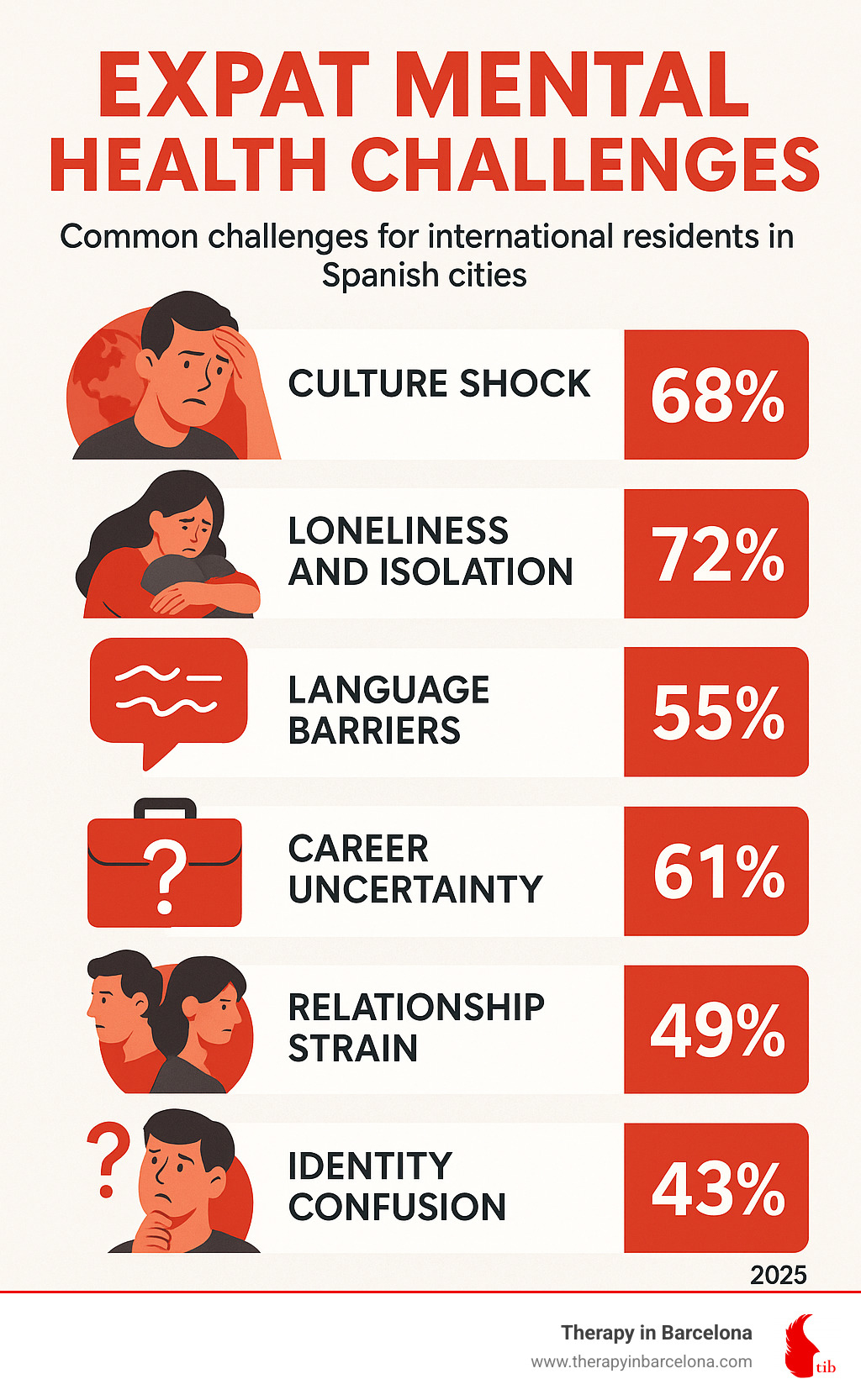
Why Many Expats Seek Therapy: Common Challenges in a New City
Instagram shows Barcelona’s sunshine, but not the 3am homesickness or the frustration of navigating bureaucracy with limited Spanish. Moving to a new country is an adventure, but it also brings a unique cocktail of challenges that can shake even the most resilient person.
Culture shock often arrives in waves. One moment you’re marvelling at the late dinner culture, the next you’re overwhelmed by how different everything feels. Loneliness can be jarring for people who’ve never struggled to make friends before. Back home, you had established social circles. Here, you’re starting from scratch.
Career pressures intensify when you’re proving yourself in a new country, whether in Barcelona’s tech scene or Madrid’s corporate world. The stakes feel higher because this move was supposed to improve your life.
Then there’s the grief that nobody warns you about—mourning the life you left behind, even when you chose to leave it. You might feel guilty for missing home when you’re living in one of Europe’s most vibrant cities.
Therapy in Barcelona was created for this reason. Since 2011, it has supported over 4,000 internationals. Their therapists aren’t just qualified—many are expats who have steered similar struggles.
Adjusting to Life in Barcelona
Living in Barcelona involves more than finding a flat in Gràcia. Language barriers can make simple tasks feel mountainous, like explaining medical symptoms in broken Spanish or understanding a rental contract.
Building community from zero requires energy you might not have after daily cultural navigation. Where do you start? The gym? Language exchanges? Each attempt feels like a small act of courage.
Spanish bureaucracy can be a significant source of stress. The endless paperwork and specific office hours can become all-consuming frustrations when trying to get your NIE or open a bank account.
Finding belonging takes time. You’re not quite a tourist, but not yet a local. You exist in an in-between space, watching locals steer social situations while you’re still figuring out cultural norms.
The Impact on Relationships and Identity
Moving abroad ripples through every relationship. Couples often find that stress brings out different coping mechanisms. One partner might throw themselves into learning Catalan while the other retreats, creating unexpected tension.
Intercultural relationships face added complexity. Your Spanish partner might not understand why you need to call your mum every Sunday, while you can’t grasp why family lunch extends to 6pm. Finding middle ground requires patience and often professional support.
For families, parenting abroad brings new questions about schools and cultural integration. Third Culture Kids—children raised in a culture different from their parents’—develop their own unique identity challenges.
Most surprisingly, you might find yourself redefining your identity. The confident professional you were in London might feel uncertain in Barcelona. This isn’t failure—it’s a natural part of growth.
Therapy in Barcelona provides a safe space to explore these shifts. Sometimes you need someone who understands that missing Marmite isn’t really about the spread—it’s about missing home.
What Support Can Look Like: Therapy Types and Specialisations at Therapy in Barcelona
When you’re struggling with expat life, understanding what Therapy in Barcelona can offer is crucial. A wide range of support is available, designed with the international community in mind. We’re a group practice of psychology-trained therapists who work with adults, couples, teens and families.

Most expats are drawn to individual therapy, a confidential space to explore personal challenges. For relationship difficulties, couples counselling helps partners steer the unique pressures of building a life together abroad.
Family therapy addresses the ripple effects on entire households, from children adapting to new schools to parents managing their own stress. You can explore these options further through Individual therapy and couples therapy
Many therapists also focus on specific concerns like support for distressing past events, difficulties with food and body image, grief, or major life transitions. A practice like Therapy in Barcelona can match you with a therapist who understands your cultural background and specific struggles.
Therapeutic Approaches for Expats
Different therapeutic approaches work for different people. When you’re an expat, having options is even more important.
Some approaches are practical and help you change thought patterns that keep you stuck, which is useful when feeling anxious or down about the move. Others help you learn to accept uncertainty—a constant in expat life—rather than fighting difficult emotions. Some therapy explores how past experiences influence your present reactions, helping you understand why certain aspects of expat life feel particularly challenging.
Other methods look at you within your relationships and social systems, which is valuable for navigating intercultural dynamics. Mindfulness-based approaches can also offer tools for staying grounded when everything feels overwhelming.
The therapists at Therapy in Barcelona use various other evidence-based methods, tailored to your needs. These may include approaches that focus on the mind-body connection, explore how past experiences influence the present, build practical skills for managing difficult thoughts and feelings, or use creative expression. For couples, therapists may use methods designed to improve communication and strengthen connection.
Online vs. In-Person Therapy at Therapy in Barcelona
Choosing between online and in-person therapy often comes down to lifestyle and comfort. Both are effective, and Therapy in Barcelona offers both.
Convenience
- Online therapy: Highly convenient and accessible from anywhere. Ideal for busy schedules.
- In-person therapy: Requires travel, creating a clear boundary between therapy and daily life.
Accessibility
- Online therapy: Great for those outside Barcelona, with mobility issues, or who prefer privacy. Available worldwide.
- In-person therapy: Offers a dedicated, distraction-free environment.
Therapeutic Space
- Online therapy: Familiar and comfortable, though home settings can bring distractions.
- In-person therapy: Purpose-built, confidential rooms designed specifically for therapy.
Non-Verbal Cues
- Online therapy: Some non-verbal cues may be missed on screen.
- In-person therapy: Full range of non-verbal communication is easier to notice.
Technology
- Online therapy: Relies on stable internet and devices; occasional technical issues may arise.
- In-person therapy: No tech required during sessions.
Confidentiality
- Online therapy: Uses secure platforms; clients should ensure a private space on their end.
- In-person therapy: Controlled, private setting in the therapist’s office.
Online therapy is popular among expats, particularly digital nomads or those who travel frequently. This flexibility ensures consistent support, even if you move. Research shows online therapy is as effective as in-person sessions for most concerns.
In-person therapy offers a dedicated space separate from your daily life. Some people find it easier to open up in a purpose-built therapeutic environment, deepening the connection.
Many clients at Therapy in Barcelona switch between formats or alternate depending on their circumstances. The important thing is finding what works for you.
Your Guide to Finding English-Speaking Therapy in Barcelona
Finding an English-speaking therapist in a foreign city can feel overwhelming, but Barcelona’s thriving international community means excellent support is available. The key is knowing where to look.

Barcelona has become a hub for English-speaking mental health professionals who understand the expat experience. Several platforms can connect you with therapists, from large online directories to specialised practices like Therapy in Barcelona, which has helped over 4,000 expats since 2011.
Specialised practices offer a personal touch. Instead of automated booking, they take time to understand your needs to ensure a good match from the start.
Comparing Your Options
When seeking therapy in Barcelona, you’ll find three main pathways.
The public healthcare system offers mental health services, but English-speaking support can be hard to access, with long waiting lists and services primarily in Spanish or Catalan.
Large online platforms provide convenience and choice, but the matching process can feel automated and may miss the cultural subtleties that matter to expats.
Specialised group practices like Therapy in Barcelona offer a different approach. It was founded by Leigh Matthews, an Australian Psychologist who has lived in Barcelona since 2011 and is experienced in supporting internationals. What makes these practices stand out is their bespoke therapist matching and expat-to-expat support. When your therapist has also steered visa applications or felt homesick, there’s an immediate, shared understanding. This translates into culturally sensitive care that goes beyond language, addressing the unique grief, identity shifts, and feelings of belonging that many expats face. Therapy in Barcelona is a group practice of highly qualified, psychology-trained therapists who collaborate to provide high quality care. We do not sell data; your information stays between you and your therapist.
As a private-pay service, these practices maintain high standards and confidentiality, focusing entirely on your therapeutic needs. When considering options, remember the therapeutic relationship is the strongest predictor of positive outcomes. The British Association for Counselling and Psychotherapy offers guidance on what to look for.
The Importance of Cultural Sensitivity in Expat Therapy
For expats, therapy must steer challenges through the lens of cultural transition. When your therapist understands expat life firsthand, you don’t need to explain why bureaucracy is stressful or why you feel guilty missing events back home. This shared understanding builds trust.
A culturally aware therapist helps you process these experiences without judgement, creating a space where you feel truly seen and heard, rather than having to constantly justify your expat experience.
How to Choose the Right Therapist for You
Finding the right match requires a thoughtful approach. The connection matters more than credentials alone.
Start by checking qualifications and specialisations. Ensure the therapist is registered and has expertise that aligns with your concerns.
Reading therapist profiles gives insight into their approach and personality.
Many practices offer a Free Discovery Call—a no-obligation chat to discuss your needs and see if it’s a good fit. This helps the practice match you with their most suitable professional.
Finally, trust your intuition. If a connection doesn’t feel right after a few sessions, it’s okay to explore other options. Good practices support clients in finding their ideal match.
Finding Therapy in Barcelona and Other Spanish Hubs
While Barcelona is a major hub, English-speaking support extends throughout Spain, often via online sessions.
Other major cities host thriving international communities. Valencia ranks highly for expat quality of life. Madrid, as the capital, offers a large selection of international therapists. Málaga has seen growth in tech and tourism, bringing more services for internationals. Alicante appeals to families and has therapists who understand relocation dynamics.
Other popular destinations include Marbella, Costa del Sol towns like Mijas and Torrevieja, the digital nomad hotspot of Gran Canaria, and culturally rich Sevilla. The growing availability of culturally sensitive, English-speaking therapy means support is increasingly within reach across Spain.
Understanding the Investment: Therapy Costs in Barcelona
When considering therapy in Barcelona, the financial side is a natural focus. Think of it as an investment in your wellbeing—one that can transform how you experience life as an expat.

Therapy in Barcelona is a private-pay service, meaning you cover costs directly. This allows for personalised care, shorter waits, and therapists who understand the expat experience. Costs for private therapy in Barcelona are generally comparable to those in other major Spanish cities like Madrid or Valencia.
Session costs vary depending on the therapist’s experience and specialisation, typically ranging from €80 to €95 per individual session.
Private health insurance can sometimes help, though coverage varies significantly. It’s worth checking the specifics with your insurer, as even partial coverage can make therapy more accessible.
For those with financial constraints, some therapists offer sliding scale fees based on income, making quality care more affordable. It’s worth asking about this during your initial enquiry.
During a Free Discovery Call, you can openly discuss the Fees and find an option that works for you. This ensures you can commit to your healing journey with clarity about costs.
Investing in your mental health pays dividends in other areas of life, like improved relationships and a greater sense of wellbeing in your new country.
Frequently Asked Questions about Therapy for Expats
Starting therapy in Barcelona as an expat often brings up practical questions. Here are some common concerns, with straightforward answers to help you take the first step.
Do I need to speak Spanish or Catalan for therapy?
Absolutely not. Many therapists working with the international community are fluent in English and other languages. At Therapy in Barcelona, all services are in English, and some therapists also speak German, French, Spanish, Afrikaans, Portuguese, Swedish, Austrian-German and Swiss-German.
Expressing complex emotions in your native language is crucial for effective therapy. It removes an unnecessary barrier to getting the support you need. As one client shared: “It was vital that she fully understands me.”
How long does therapy usually take?
The length of therapy varies. It depends on your goals, the issues you’re addressing, and your personal journey. Some people find relief in a relatively short time, perhaps 8-12 sessions, especially when focusing on specific, practical goals.
For deeper work—like support for distressing past events or navigating major life transitions—therapy often takes longer. The duration is always a collaborative decision between you and your therapist. You’re never locked into a specific timeframe and can adjust as your needs change.
Is online therapy as effective as in-person?
Yes, research consistently shows that for most concerns, online therapy is just as effective as in-person sessions. For expats, this flexibility is a huge benefit. You can maintain continuity with your therapist if you travel, move cities, or visit home.
The key factor isn’t the format but the quality of the therapeutic relationship. If you feel connected and understood by your therapist online, the medium becomes secondary. Many clients prefer the convenience and privacy of online sessions.
Therapy in Barcelona offers both options, allowing you to choose what feels right. You can access support from anywhere, whether you’re in Valencia, Madrid, or even back home visiting family. Personal preference matters, and there’s no wrong choice—just what works best for you.
Taking the first step towards therapy in Barcelona is a sign of strength and an investment in your wellbeing. Moving abroad brings incredible opportunities, but it also presents challenges that can test anyone. Whether you’re wrestling with culture shock, battling loneliness, or feeling untethered, you’re not alone.
The expat journey has ups and downs, and these experiences deserve compassionate, professional support.
Therapy in Barcelona exists because founder Leigh Matthews, an Australian psychologist who moved to Barcelona in 2011, understood this need firsthand. She created a practice where English-speaking therapists, who are also expats, provide understanding that comes from lived experience.
The support is different because of the personalised matching process. The team takes time to understand your concerns, background, and goals to find the right therapeutic fit from the start.
The international community in Barcelona—and across Spain—deserves mental health support that truly gets it. Whether you’re in Valencia, navigating Madrid’s corporate world, or settling into life in Alicante, culturally sensitive therapy can make all the difference.
Seeking therapy isn’t about admitting defeat; it’s about giving yourself the tools to not just survive your expat experience, but to thrive in it.
If you’d like support, out online therapy is available worldwide, including ensuring that wherever your journey takes you, support remains within reach.
