


Finding Your Mental Safe Harbour: Counselling for Expats in Barcelona

If you’re looking for counselling for expats in Barcelona, here’s what you need to know straight away:
- Qualified, English-speaking therapists are available in Barcelona, both in person and online
- Therapy can help with culture shock, loneliness, worry, relationship strain, and identity shifts triggered by life abroad
- Sessions are available in multiple languages, including English, French, German, Spanish, Portuguese, and more
- This is a private-pay service; some therapists offer sliding scale fees for those with financial need — you can enquire about this when you get in touch
- You can start with a Free Discovery Call to find the right therapist match before committing to sessions
Moving to Barcelona is supposed to feel like an adventure. And for many people, it does — at first. The light, the architecture, the food, the energy of the city. But somewhere between sorting out your NIE number, navigating a new workplace, and realising your closest friends are now a two-hour flight away, something quietly shifts.
You may feel anxious, lonely, or under pressure, even if everything looks fine from the outside. When people ask, you simply say, “It’s great.”
That gap between how you seem and how you feel is common among expats. Living abroad can remove familiar anchors like routine, language, and support networks, leaving life—and your sense of self—feeling less stable.
This guide is for anyone in that position — whether you arrived last month or have been here for years and still can’t quite put your finger on why something feels off. You’ll find honest, practical information about how therapy can help, what your options are in Barcelona, and how to take that first step towards feeling more like yourself again.
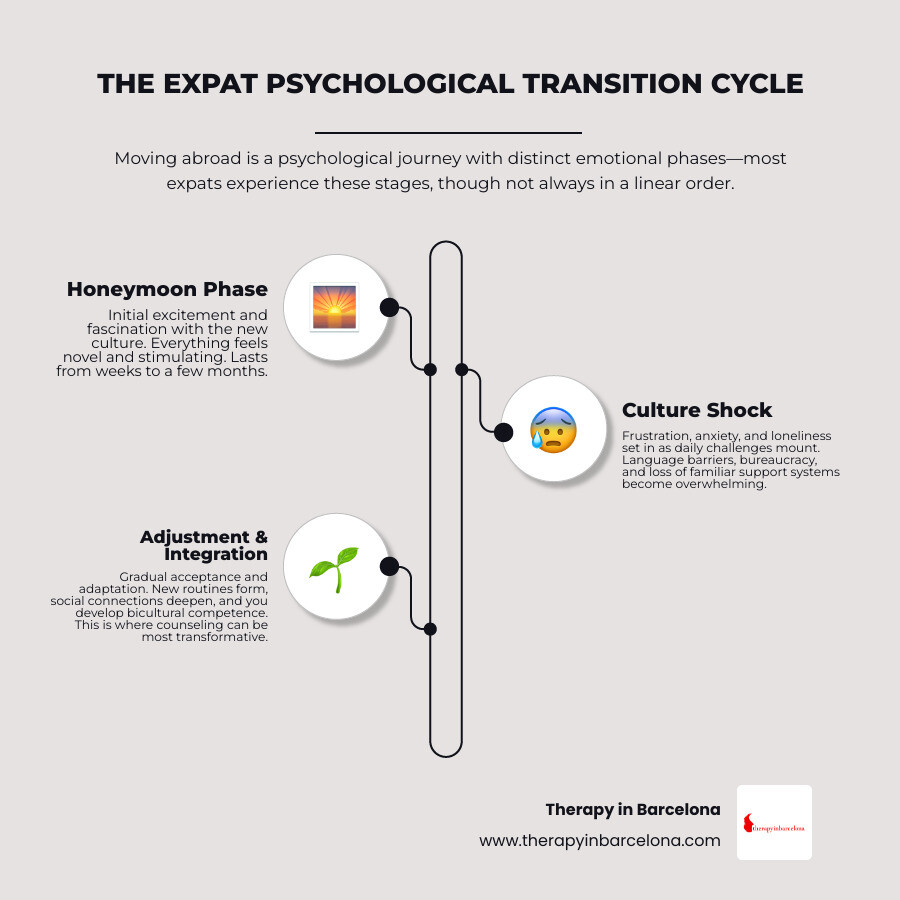
The Unique Mental Health Challenges of Life Abroad

Living outside your home country is highly romanticised. Social media feeds are filled with sunny afternoons on Barceloneta beach or weekend trips to the Costa Brava. But the psychological reality of relocation is far more complex. When you move, you don’t just change your postcode; you leave behind your entire support framework.
This sudden lack of local anchors often triggers what is commonly experienced as feeling persistently down, rootless, and exhausted after relocating. The daily mental energy required to navigate a foreign language, administrative systems, and different cultural norms can quickly lead to feeling completely overwhelmed.
Research on acculturative stress also shows that adapting to a new cultural environment can place real pressure on mental health and wellbeing.
Loneliness is another quiet hurdle. You can be surrounded by crowds in the heart of Gràcia or El Born and still feel completely isolated. Building deep, meaningful friendships takes time, and the transient nature of international hubs means that the social circles you do build can shift rapidly.
This stress frequently spills over into bicultural relationships. When one partner is local and the other is an expat, or when both are internationals navigating a new country together, the lack of an external support network puts immense pressure on the partnership.
Small misunderstandings can escalate because you have fewer outlets and fewer people who truly understand your day-to-day context.
Physical distance from your family of origin also introduces unique emotional challenges. Many expats carry a silent burden of guilt – guilt for missing birthdays, holidays, or milestones, and anxiety about managing ageing parents from afar.
Consider a fictional example: after moving abroad for a new job, the excitement fades and is replaced by anxiety, loneliness, relationship strain, and guilt for not enjoying the “dream life.”
These are exactly the kinds of challenges addressed in Expat Therapy. Whether you are based in Barcelona, Valencia, or Málaga, having a professional space to unpack these feelings is often the first step to reclaiming your sense of balance.
Why Specialised Counselling for Expats in Barcelona is Essential
When you decide to seek support, finding the right professional is crucial. While there are many excellent local psychologists in Spain, working with a specialist who understands the unique psychological footprint of the international experience makes a significant difference.
Overcoming Language Barriers with Counselling for Expats in Barcelona
Expressing complex emotional pain, past difficult experiences, or subtle relationship dynamics requires a deep level of comfort. Trying to translate your deepest vulnerabilities into a second language often leads to a phenomenon known as “translation loss.”
When you cannot find the precise words to describe what is happening inside your system, you might simplify your feelings just to get the point across. This can leave you feeling misunderstood or only partially heard. Working with English Speaking Therapists in Barcelona ensures that you have access to your full emotional vocabulary.
You can speak naturally, use slang, and share your thoughts without having to mentally translate them first. For more on how language impacts the therapeutic process, you can read about Finding English Speaking Therapists in Barcelona.
Finding Culturally Sensitive Counselling for Expats in Barcelona
Therapy is not just about language; it is also about shared context. An expat-focused therapist understands that your feelings of worry or unease might not be an individual struggle, but a completely normal response to systemic relocation stress.
Therapists who are expats themselves bring a deep, intuitive empathy to their work. They know what it feels like to navigate Spanish bureaucracy, build a life from scratch, and experience the subtle grief of leaving home behind.
This shared lived experience is invaluable. It means you do not have to spend half your session explaining why your bicultural marriage is strained or why being a Third Culture Kid makes you feel like you do not belong anywhere.
A specialised therapist can help you understand how your cultural background shapes your coping mechanisms and guide you through the process of rebuilding your identity in a new country.
This tailored approach is why finding specialised support can be so impactful; you can learn more about this journey in Why Expat Therapy in Barcelona Can Transform Your International Experience.
Therapeutic Modalities: Tailoring Support to Your Journey

At Therapy in Barcelona, we believe that mental health support should never be a one-size-fits-all model. Our international team of psychology-trained professionals utilises a wide range of evidence-based modalities, blending different approaches to match your unique personality, goals, and struggles.
- Cognitive Behavioural Therapy (CBT): This is a highly practical, goal-oriented approach that focuses on the “here and now.” It helps you identify negative thought patterns and develop concrete coping strategies to manage daily worry, stress, and feeling persistently down.
- Acceptance and Commitment Therapy (ACT): Instead of fighting or trying to eliminate uncomfortable thoughts and feelings, ACT teaches you to accept them, clarify your core values, and take committed action to build a meaningful life.
- Internal Family Systems (IFS): This gentle, transformative approach views the mind as made up of different “parts” (such as a perfectionist part, a self-critical part, or an anxious part). By understanding and healing these parts, you can access your core Self and find inner harmony.
- Person-Centred Therapy: A non-judgmental, empathetic approach that places you at the centre of the therapeutic process, fostering self-acceptance and personal growth in a safe environment.
- Evidence-Based Couples Therapy: Using models like the Gottman Method, couples therapy helps partners break destructive communication loops, rebuild trust, and develop active listening skills to navigate the unique pressures of international life together.
By integrating these diverse frameworks, we can support you through everything from immediate relocation stress to deep-seated childhood experiences that have resurfaced abroad.
To explore how these approaches can support your personal journey, read more about Therapy Without Borders in Barcelona: Expat Therapy You Can Trust.
Navigating Your Options: In-Person vs. Online Therapy and Local Alternatives
When seeking therapy in Spain, you have several paths to choose from. Understanding the differences between these options will help you make an informed decision for your mental well-being.
First, you can choose between in-person and online sessions. In-person therapy at our quiet, welcoming offices in the Eixample district of Barcelona offers a dedicated physical sanctuary away from your daily routine. It allows for a deep, embodied therapeutic connection.
On the other hand, online therapy offers unparalleled flexibility. It is ideal for digital nomads, busy professionals, or parents who struggle to find time for travel. Online sessions also ensure continuity of care; if you travel for work or decide to move from Barcelona to Alicante, Madrid, or Valencia, you can keep working with the same trusted therapist.
Comparing Your Mental Health Support Options in Spain
To help you navigate the local landscape, here is an honest, respectful comparison of the main avenues for mental health support in Spain.
The Public Healthcare System (CatSalut)
- What it is: The state-run medical system in Catalonia (and similar regional systems across Spain).
- The Pros: It is fully funded and free of charge if you are registered with public social security.
- The Cons: Waiting lists are often long, sessions are typically short and spaced far apart, and it is highly unlikely you will be able to choose a therapist who speaks fluent English or specialises in expat transitions.
Large Global Online Platforms
- What it is: Massive, international directory apps and text-based subscription platforms.
- The Pros: Fast sign-up processes and lower initial price points.
- The Cons: Many platforms rely on algorithm-based matching and may lack culturally informed support, local knowledge, and personalised care.
Therapy in Barcelona (Local Private Group Practice)
- What it is: A dedicated, trusted practice established in 2011, run by expats for expats.
- The Pros: We offer personalised therapist matching, culturally aware support in your preferred language, and strict privacy with no data selling.
- The Cons: As a private-pay service, it requires an out-of-pocket investment, though some of our therapists offer sliding scale fees based on financial need.
Frequently Asked Questions about Expat Therapy
What should I expect during my first session or discovery call?
Your journey starts with a simple step. When you get in touch, you will be invited to complete a confidential intake form or book a Free Discovery Call. This initial conversation is not a therapy session; it is a warm, informal chat to understand your current challenges, goals, and preferences.
Based on this information, we manually match you with the therapist on our team who is best suited to support you. In your first official therapy session, your therapist will focus on building a safe, trusting rapport. Together, you will explore what brought you to therapy, discuss your history, and begin setting collaborative goals for your path forward.
How much does expat therapy cost and is it covered by insurance?
Therapy in Barcelona is a private-pay service. While we do not publish a single flat rate because our team includes practitioners with different levels of experience and specialities, we believe in financial accessibility. Some of our therapists offer sliding scale fees for those with financial need, and you are welcome to enquire about this during your initial contact.
Regarding insurance, many private international health insurance policies or premium local policies offer reimbursement options for independent psychology providers. If your policy includes “free choice of specialist” (reembolso), you can often claim back a significant percentage of your session costs.
We recommend checking directly with your insurance provider to confirm their specific reimbursement policies and required therapist credentials.
How do I know if I need therapy or just time to adjust?
A short adjustment period after moving abroad is normal. But if worry, low mood, loneliness, or physical symptoms like poor sleep or panic persist, it may be time to seek support.
You do not need to wait until you hit rock bottom or reach a point of crisis to seek help. Therapy is an active form of self-care. It can help you make sense of your transition early on, preventing temporary adjustment stress from developing into deeper, long-term struggles with low mood or burnout.
Finding Your Footing in Barcelona
Life abroad is an incredible opportunity for growth, but it does not have to be navigated alone. Therapy in Barcelona was founded in 2011 by Leigh Matthews, an Australian Psychologist who moved to the city in 2011.
Having navigated the challenges of relocation, intercultural marriage, and raising a child abroad herself, Leigh recognised the profound need for a dedicated, high-quality mental health sanctuary for the international community.
Over the last fifteen years, Therapy in Barcelona has grown into a trusted hub of professional excellence, supporting thousands of expats in finding their footing in Spain. Whether you are living in Barcelona, Madrid, Valencia, or Málaga, our team of psychology-trained professionals is here to offer the warm, culturally sensitive care you deserve.
If you are ready to take the first step towards feeling more grounded, connected, and at home in your international life, we invite you to reach out.
If you’d like support, Book a Free Discovery Call today.
