


What Is Couple Intimacy Therapy — and Could It Help You?

Couple intimacy therapy is a specialised form of couples work that focuses on rebuilding both emotional and physical closeness between partners — and it’s one of the most effective ways to address disconnection before it becomes irreparable.
Here’s a quick overview of what it involves and who it’s for:
- What it is: A therapeutic process that addresses emotional distance, mismatched desire, communication breakdown, and physical intimacy — using evidence-based approaches like the Gottman Method, Emotionally Focused Therapy (EFT), and sensate focus techniques.
- Who it’s for: Couples feeling like roommates, partners dealing with mismatched libidos, those recovering from infidelity or trust breaks, and anyone who senses the connection they once had is slipping away.
- What happens in sessions: A trained therapist helps you identify unhelpful patterns, create emotional safety, and develop practical tools you can use between sessions.
- Does it work? Research suggests around 70% of couples who complete therapy stay together and report meaningful improvement in their relationship.
- Where to start: A free initial consultation with a specialist — not a general counsellor — is usually the best first step.
Somewhere between the daily routines, the to-do lists, and the weight of life abroad, intimacy can quietly disappear. It rarely happens all at once. More often, it fades — a little less touch here, a little more distance there — until one day you and your partner feel more like housemates than lovers.
This is one of the most common experiences couples bring to therapy. And it shows up across many kinds of relationships: long-term partners, newlyweds adjusting to a new country, intercultural couples navigating very different expectations, and expat couples who arrive in Barcelona full of hope, only to find that the stress of relocation quietly erodes their bond.
What makes couple intimacy therapy different from general relationship counselling is its direct focus on both emotional and physical closeness, not only communication skills or conflict management. It looks at patterns that often sit underneath intimacy problems, like feeling too distant, too fused, unseen, unsafe, pressured, or disconnected. These are the kinds of relational dynamics that specialised intimacy therapy is designed to explore and repair.
This guide walks you through everything you need to know — from what to expect in sessions, to how to choose the right therapist, to the practical techniques that actually make a difference.
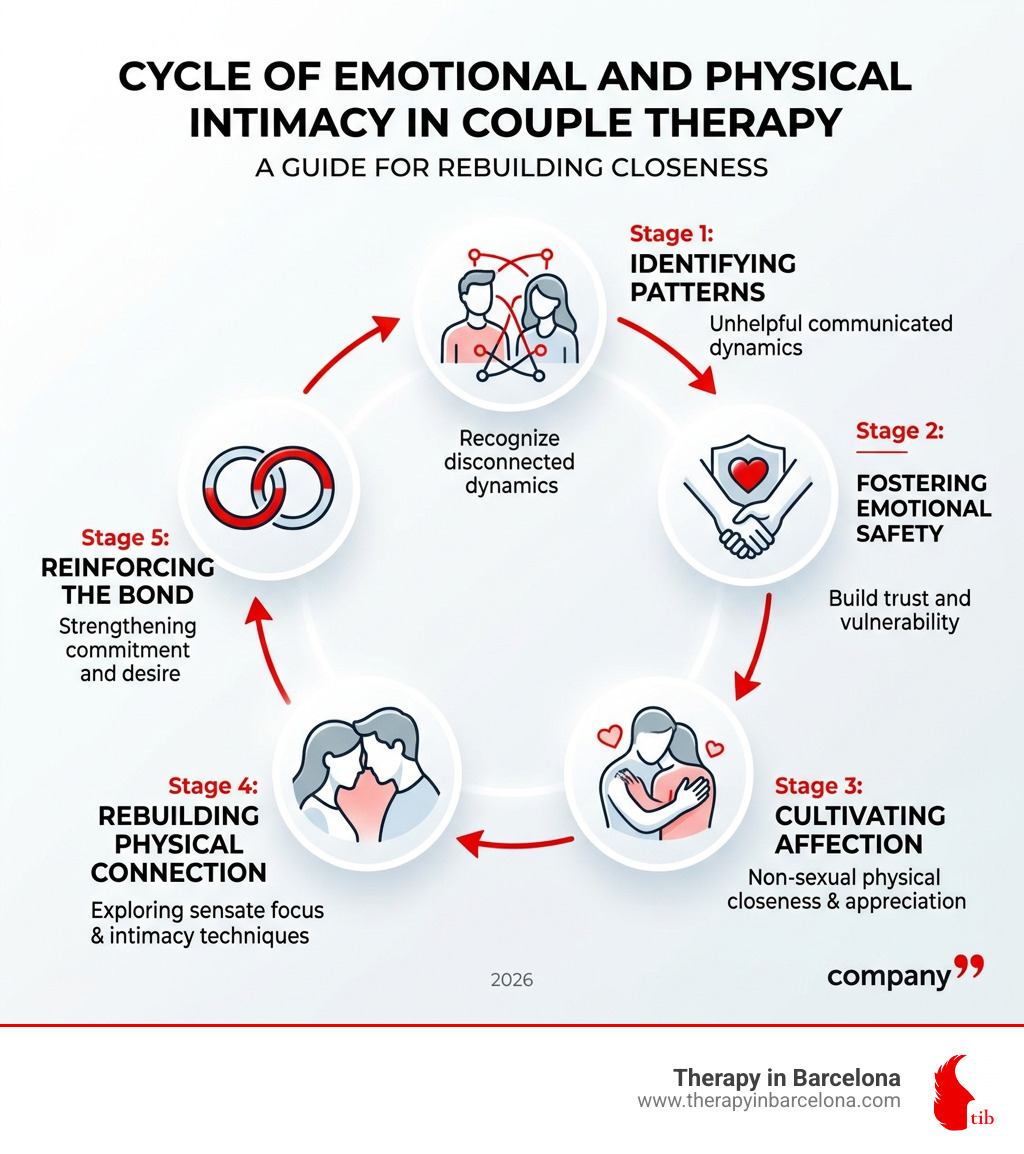
Why Couple Intimacy Therapy is Essential for Modern Relationships
In the vibrant, fast-moving life of an international resident in Spain, it is easy for the relationship to fall to the bottom of the priority list. Whether you are navigating the tech scene in Valencia or the bustling streets of Madrid, the unique stresses of expat life—such as “language fatigue,” lack of a local support network, and professional pressure—often manifest as a “dead bedroom” or deep emotional disconnection.
Common issues include mismatched libidos and “roommate syndrome,” where daily logistics replace affection. In many couples, emotional safety and closeness strongly shape sexual connection. When partners feel distant, physical intimacy is often harder to work through.

The difference between sex therapy and couple intimacy therapy
These approaches overlap, but they are not the same. General counselling often focuses on day-to-day relationship problems. Sex therapy usually targets sexual concerns like pain, arousal, desire, or performance. Couple intimacy therapy looks more broadly at the relationship itself, including trust, communication, vulnerability, and emotional closeness. In many cases, sexual problems and emotional disconnection are tightly linked. For a deeper look, see What is Sex Therapy?.
How emotional intimacy serves as a foundation
True intimacy is built on attunement—the ability to understand and respect your partner’s inner world. Without trust and vulnerability, physical touch can feel performative or even pressured. Therapy helps couples move past the surface-level “logistics” of life to rediscover Emotional Intimacy, creating a secure base where physical passion can naturally reignite.
Proven Frameworks: The Gottman Method and Beyond
At Therapy in Barcelona, our psychology-trained therapists often draw from the Gottman Method, a research-informed approach shaped by more than 50 years of studying over 40,000 couples. Dr John Gottman identified communication patterns that helped researchers predict a relationship’s future with up to 94% accuracy.
One of the cornerstone concepts is the Sound Relationship House, which includes nine levels of healthy bonding, from building “Love Maps” (knowing your partner’s world) to creating shared meaning. Understanding these levels helps couples see where the “foundation” of their intimacy has cracked. You can explore how these frameworks apply to your situation in our article on Unlocking Intimacy: Exploring the Benefits of Sex Therapy for Couples.
Using the Magic 5:1 Ratio in couple intimacy therapy
One of the most famous Gottman findings is the Magic 5:1 Ratio. In stable, happy relationships, there are at least five positive interactions for every one negative interaction during a conflict. If your ratio falls below this, it’s a strong indicator of future distress. Therapy focuses on increasing those “small things often”—the tiny moments of connection that buffer the relationship against the friction of daily life.
Addressing the pursue-withdraw cycle
Many couples get stuck in a “tug-of-war” known as the pursue-withdraw cycle. When one partner feels disconnected, they may “pursue” by pushing for conversation or sex. If the other partner feels overwhelmed or anxious, they “withdraw” to protect themselves. This creates a loop where the pursuer feels rejected and the withdrawer feels pressured. Breaking this cycle requires identifying the “brakes” and “accelerators” of desire for each person and creating a safe space to discuss needs without blame.
Practical Exercises Used in Couple Intimacy Therapy
Therapy isn’t just about talking; it involves “homework” designed to bridge the gap between the session and the bedroom. These exercises are behavioral strategies meant to lower anxiety and increase curiosity.
Rebuilding connection through daily rituals
A simple but powerful tool is the six-second kiss. Dr Gottman describes this as a “kiss with potential”—it’s long enough to feel like a moment of true connection rather than a transactional peck. Other rituals include daily check-ins where partners share one thing they appreciate about each other. These “micro-connections” are essential for Mindful Sex with Therapy in Barcelona’s Collaborating Sexologist.
Practical techniques often include:
- Sensate Focus: A series of exercises where couples engage in non-sexual touch to reduce performance anxiety and rediscover sensory pleasure.
- Scheduling Intimacy: While it sounds unromantic, scheduling time for closeness ensures it doesn’t get lost in the busyness of expat life.
- Vulnerability Sharing: Using structured prompts to discuss fantasies, fears, and desires in a non-judgmental environment. You can find more strategies in our Couples Compass: A Self-Help Guide to Sex Therapy.
Overcoming barriers like body image and postpartum changes
Intimacy struggles are often linked to internal factors. For many women, Why Every Woman Should Consider Sex Therapy becomes clear when navigating postpartum body changes or hormonal shifts like perimenopause. Resentment over “mental load” or parenting duties can also act as a major “brake” on desire. Therapy helps partners externalise these issues, so they can tackle the problem together rather than seeing each other as the problem.
Choosing the Right Path for Your Relationship
Finding a therapist is a deeply personal process, especially when discussing intimate matters. For expats in Spain, cultural nuances—such as different views on gender roles or family obligations—can significantly impact the therapeutic process. This is why we focus on bespoke matching for the international community.
Comparing Your Therapy Options in Spain
When seeking help for your relationship in Spain, it is important to understand the landscape of care.
Public Health System (CatSalut/Seguridad Social) The public system provides essential mental health support, but it is often stretched thin. You may face long waiting lists, and you rarely get to choose a specialist with specific training in couple intimacy therapy. Furthermore, services in English are not guaranteed, which can be a significant barrier for internationals.
Large Online Platforms Apps and large directories offer high accessibility and often lower costs. However, they frequently rely on automated algorithms for matching. For expats, this can lead to a lack of “cultural fit.” A therapist based in another country may not understand the specific isolation of moving to Málaga or the bureaucratic stress of living in Barcelona.
Specialised Private Practice Therapy in Barcelona offers a higher quality of care through a private-pay model. We don’t just assign you to the next available person; we take the time to ensure a bespoke match based on your specific needs. Our therapists are expats themselves, meaning they understand the unique challenges of bicultural relationships and the “messiness” of international life. We offer culturally sensitive support in English, as well as several other languages including French, German, and Spanish.
When to consider focused or intensive support
Sometimes, weekly sessions aren’t enough to break a long-standing deadlock. For couples in high distress or those who want to make rapid progress, intensive options like workshops or “sexual intensives” (one or two-day immersive sessions) can be transformative. These formats allow you to dive deep into the pursue-withdraw cycle without the interruptions of daily life.
Frequently Asked Questions about Intimacy Therapy
What is the success rate of intimacy therapy?
Success in intimacy therapy is best measured by the goals you and your partner set together. For some couples, success means rebuilding trust, improving communication, and restoring physical connection. For others, it may mean gaining clarity about the relationship and making thoughtful decisions with less conflict. Rather than focusing on a single number, it is more accurate to say that therapy can be highly effective when both partners engage honestly and consistently in the process.
How do we prepare for our first session?
The best preparation is an open conversation with your partner about what you hope to achieve. Logistics-wise, check if your private insurance offers reimbursement for private-pay psychological services. At Therapy in Barcelona, the journey begins with a Free Discovery Call to ensure we find the right specialist for your unique dynamic.
Can we attend therapy if only one partner is willing?
Absolutely. While it is ideal for both partners to attend, solo Sex Therapy can be incredibly effective. By changing your own patterns, reactions, and understanding of your desire, you inevitably shift the “dance” of the relationship.
Conclusion
Many couples in Barcelona find that the stress of relocation, a new baby, demanding work, and being far from their usual support network can slowly erode closeness. What once felt easy can start to feel strained, and physical touch may become a source of pressure instead of comfort.
Through specialised couple intimacy therapy, they learned to spot their “pursue-withdraw” pattern. One partner saw how pushing for closeness could feel like pressure, while the other understood how pulling away could trigger insecurity and distance. With tools like the six-second kiss and sensate focus, they slowly shifted from resentment toward reconnection.
Whether you are in Barcelona, Madrid, Valencia, or anywhere else in the world, you don’t have to navigate these challenges alone. Therapy in Barcelona was founded in 2011 by Leigh Matthews—an Australian Psychologist and expat who understands the unique hurdles of international life firsthand. Our team of psychology-trained therapists offers a compassionate sanctuary for expats, providing culturally sensitive care that respects your journey.
If you’d like support, book a Free Discovery Call.
