


Why In-Person Couples Therapy Creates Real Connection
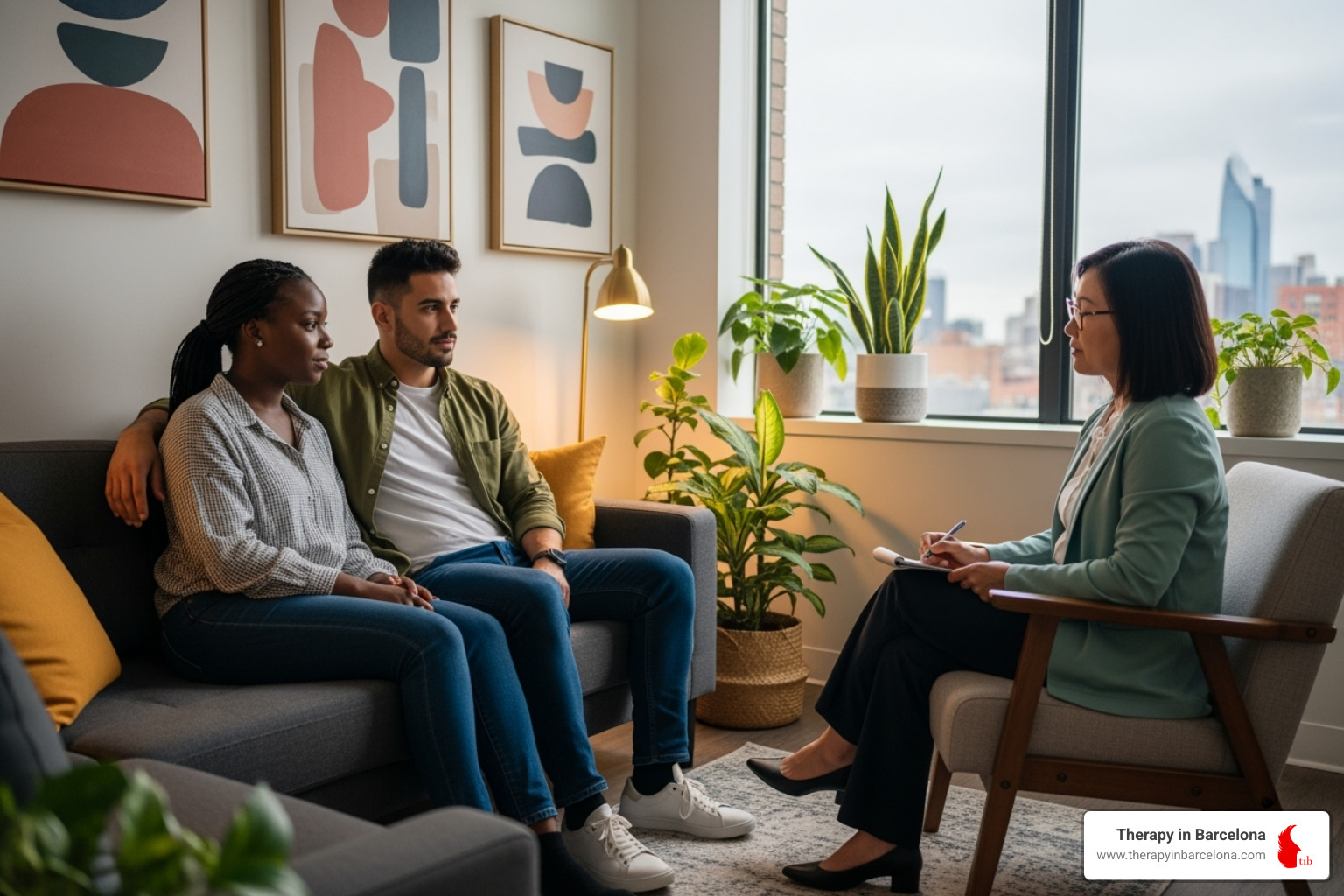
In-person couples therapy offers something a video call cannot: the power of being physically present in a safe, neutral space. For expats navigating relationship challenges while adapting to life abroad, this face-to-face connection can be transformative.
Quick Facts About In-Person Couples Therapy:
- Duration: Typically 12-24 sessions, 50-90 minutes each
- Focus: Communication skills, conflict resolution, emotional intimacy
- Approach: Licensed therapists facilitate discussions without taking sides
- Cost in Barcelona: €98-125 per session for couples therapy
- Success rate: About 70% of couples who attend counselling stay together
Moving abroad can put unique pressure on relationships. The stress of adapting to a new life often spills into the relationship, leading to more conflict and misunderstandings. Couples therapy can help partners reconnect and remember they are on the same team.
The physical presence in therapy matters. A therapist can observe subtle body language and non-verbal cues that reveal patterns partners may not have noticed. This commitment to showing up in the same room demonstrates a powerful investment in your relationship’s future.
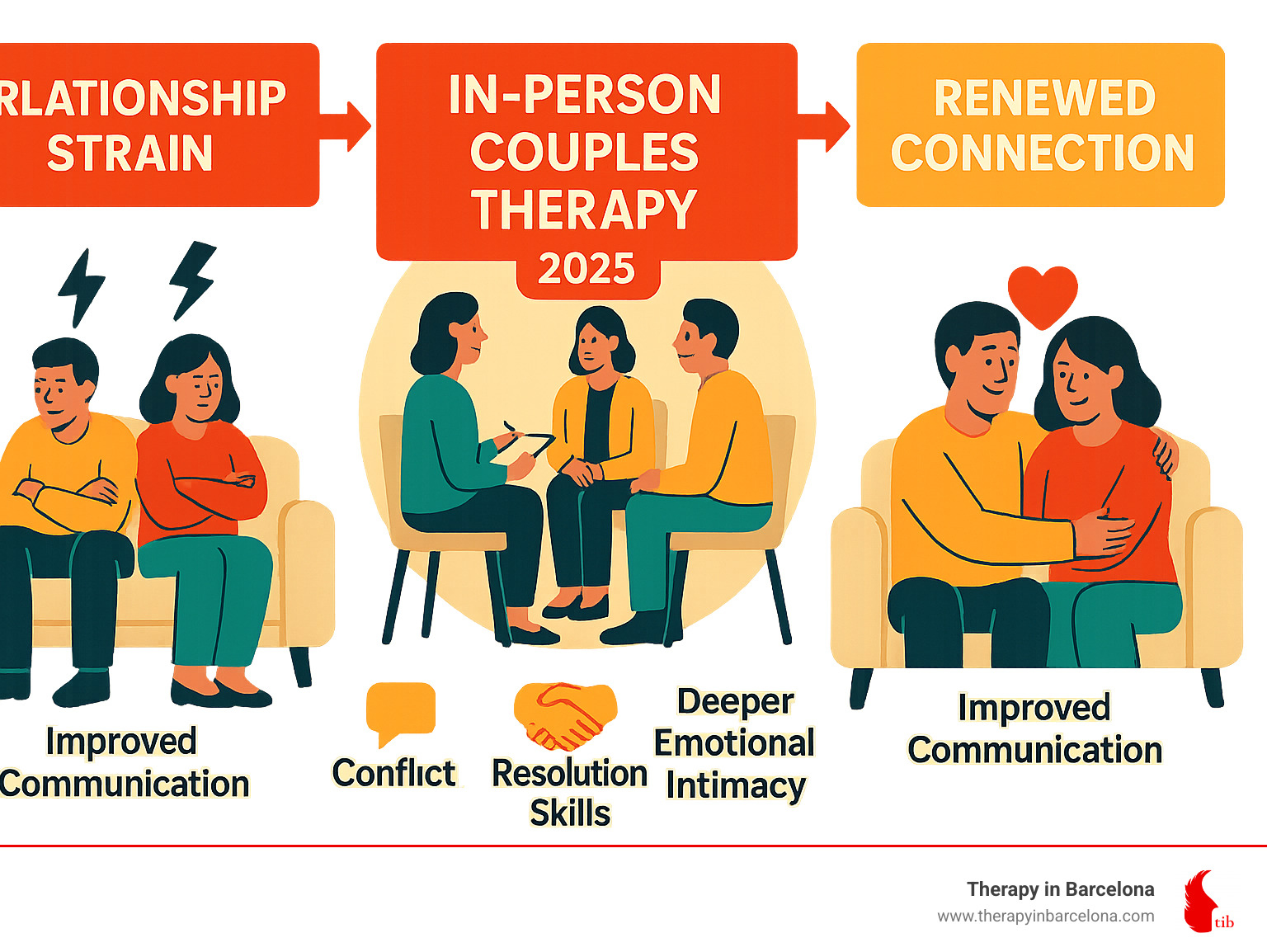
What is In-Person Couples Therapy and Why Does It Work?
In-person couples therapy gives you a dedicated space to understand each other better, improve communication, and navigate the unique challenges of expat life together. With the support of a therapist, you can rebuild connection and strengthen your relationship.
The process works by creating a safe, neutral space where both partners feel heard without judgment. Your therapist acts as a neutral facilitator, focusing on solutions over blame. This therapeutic alliance—the trust between you, your partner, and your therapist—is the foundation for change.
Therapy is often a short-term commitment, typically 12 to 24 sessions, where you’ll learn practical strategies for healthier interaction. Many therapists use evidence-based approaches like the Gottman Method, which focuses on friendship and conflict management. For more on this, The Art of Healing: How Couples Therapy Works offers deeper insights.
Understanding the Therapist’s Role
A couples therapist doesn’t play judge. They are a skilled facilitator who maintains an unbiased perspective, guiding conversations and ensuring both voices are heard. They act like a coach, focusing on how you communicate, not just what you argue about.
They teach practical skills like active listening and how to express your needs constructively, which is vital when expat life adds extra pressure. You can find examples of therapeutic questions in Essential Couples Counseling Questions.
The Core Goal: From Surviving to Thriving
The ultimate aim of in-person couples therapy is to help your relationship evolve. It’s about cultivating mutual respect, working towards shared goals, and rekindling emotional intimacy so you both feel seen and valued.
For expat couples, this means navigating unique challenges like cultural adjustment and homesickness with more grace and teamwork. The goal is to build a future where you both feel supported and joyful. To explore practical exercises, Reignite Your Relationship: 21 Couples Therapy Activities provides concrete examples.
The Unique Power of the Room: Why In-Person Matters
While online therapy has revolutionised accessibility, in-person couples therapy offers a unique intimacy that is hard to replicate through a screen. For expats, this physical connection can be transformative. Our welcoming office in Barcelona’s Eixample district is a sanctuary, a neutral space away from daily stressors where you can focus on your relationship.
The Tangible Benefits of In-Person Couples Therapy
Being physically present allows for communication on multiple levels. A therapist observes subtle shifts in body language and fleeting expressions that reveal more than words alone. This is difficult to capture on a video call. The focused environment of a therapy office is neutral territory, free from the distractions and emotional baggage of home. This dedicated space signals that you are there to do important work together.
The therapist’s physical presence creates a sense of security, making it easier to discuss vulnerable topics. This face-to-face connection also helps build rapport and trust more quickly.

When is Face-to-Face a Better Fit Than Online?
While online platforms offer convenience, certain challenges benefit more from in-person support.
- High-conflict couples find that a therapist’s physical presence helps manage emotional intensity and prevents conversations from escalating.
- Issues like Infidelity require profound emotional safety, which is more effectively created within the secure boundaries of a therapy room.
- For couples with severe communication breakdown, a therapist can physically guide interactions, encourage eye contact, and keep both partners engaged.
- In-person sessions offer a break from technology and guarantee confidentiality, which can be a concern in smaller apartments or homes with family. The office serves as neutral territory, free from triggers associated with your living space.
In-Person Couples Therapy
Benefits
- Greater ability for the therapist to observe body language, subtle facial expressions, and relationship dynamics.
- Private, distraction-free environment designed specifically for therapeutic work.
- Therapist’s physical presence can help contain and manage strong emotions during difficult conversations.
- Often facilitates a deeper sense of connection and rapport more quickly.
- Confidential setting with no concerns about being overheard by family members or housemates.
Considerations
- Requires travel time and coordinating schedules around office hours.
- Access may be limited by location, transportation, or mobility challenges.
Particularly helpful for
- High-conflict relationships.
- Severe communication difficulties.
- Complex trauma.
- Situations where close observation of interactions is important.
Online Couples Therapy
Benefits
- Attend sessions from anywhere with an internet connection.
- No commute, making it easier to fit therapy into busy schedules.
- Accessible for couples living in different locations, remote areas, or those with mobility limitations.
- Can be an effective option for improving communication and strengthening relationships.
Considerations
- Therapists have less access to non-verbal cues and physical dynamics.
- Home environments may include distractions or interruptions.
- Privacy depends on having a confidential space at home.
- Building rapport may require more intentional effort through a screen.
Particularly helpful for
- Communication tune-ups.
- Premarital counselling.
- Long-distance relationships.
- Couples seeking maximum flexibility and convenience.
Is In-Person Couples Therapy Right for Your Relationship?
Deciding to seek therapy can feel overwhelming, but it isn’t just for couples on the verge of breaking up. Many partners use it as a proactive relationship check-up or to steer life changes together. For expats in Barcelona, Madrid, or elsewhere in Spain, the stress of adapting to a new culture can strain even the strongest bonds.
Working with therapists who understand the expat experience means they see the whole picture—how cultural adjustment, homesickness, and isolation affect your relationship. If you’re wondering if it’s time, When It’s Time for Couples Counselling can help you recognise the signs.

Common Challenges We Help Couples Steer
Couples seek therapy for countless reasons. What brings you to therapy never defines your relationship’s strength. Common challenges include:
- Communication Breakdowns: Frustrating cycles of criticism, defensiveness, or shutting down.
- Financial and Life Stress: Disagreements over money or navigating major life transitions like moving abroad or changing careers.
- Parenting and Family Differences: Clashes over discipline, bicultural parenting, or blended family dynamics.
- Intimacy and Trust Issues: Difficulties with sexual desire, emotional distance, or rebuilding trust after infidelity. Our Guide to Cross-Cultural Marriage Counseling is a great resource for cultural clashes.
Who Should Consider Seeking In-Person Couples Therapy?
In-person therapy is beneficial for relationships at every stage:
- Couples at a crossroads, considering separation or major life changes. For those facing separation, understanding Expat Divorce in Spain can provide context.
- Engaged couples seeking premarital counselling to build a strong foundation.
- New parents or empty nesters navigating new family dynamics.
- Couples feeling distant who want to reconnect and rekindle their spark.
- Expat couples facing the unique stressors of living abroad. Our team, founded by an expat psychologist, specialises in Therapy for Expat Couples, offering culturally sensitive support.
The most important requirement is a shared commitment to the process. If you’re both willing to show up and be honest, therapy can be a profound investment in your future.
Your First Session and Beyond: Making Therapy Work for You
Stepping into couples therapy for the first time can feel nerve-wracking. It’s natural to feel a mix of hope and vulnerability. Therapy is not a quick fix but a collaborative investment in your relationship’s future. It requires patience, practice, and a willingness to find your rhythm together.
How to Prepare for Your First Appointment
Preparation isn’t about rehearsing arguments. It’s about setting the stage for honest dialogue.
- Come with curiosity, not certainty. Be open to finding new things about yourself, your partner, and your dynamic.
- Be honest. Withholding truths from your therapist can hinder progress. Honesty with yourself and your partner is just as crucial.
- Discuss your shared hopes. Talk with your partner about what you both want to achieve. This helps your therapist focus the sessions.
- Identify recurring patterns. Think about the arguments that happen on repeat. These patterns often hold the key to deeper understanding.
- Manage your expectations. Therapy is a process, not a magic wand. Approach it as a team working against the problems, not each other. For more guidance, see these Tips to Succeed in Couples Therapy.
What to Expect: From the First Meeting to Ongoing Growth
Your therapy journey will unfold in stages.
The first session is about getting to know each other. Your therapist will ask about your relationship’s history and your goals for therapy, creating a safe space without blame.
As you progress, you’ll explore deeper territory, such as family backgrounds and the recurring patterns that keep you stuck. Your therapist may suggest occasional individual sessions to address personal issues that impact the relationship.
Learning new skills is a central focus. You’ll be taught practical tools for better communication, conflict resolution, and intimacy, which you’ll practice in session.
Homework between sessions, like communication exercises, is crucial for integrating these new skills into your daily life.
The typical journey lasts 12 to 24 sessions, but every couple’s path is unique. Consistency is key to allowing new, healthier patterns to take root. For a look at potential topics, explore these Top 10 Discussion Topics for Couples Therapy Sessions. The goal is to actively build a more fulfilling relationship, one conversation at a time.
Frequently Asked Questions about In-Person Couples Therapy
It’s natural to have questions before starting in-person couples therapy. Here are answers to some of the most common concerns.
Does couples therapy mean our relationship is failing?
Absolutely not. Choosing therapy is a sign of commitment and strength. Many couples use it proactively as a relationship check-up to improve communication, navigate life transitions, and strengthen their connection before problems become overwhelming.
What if my partner is hesitant to go to therapy?
This is a very common and understandable concern. Approach the conversation gently.
- Use “I” statements to express your feelings without blame (e.g., “I feel disconnected and I miss our closeness”).
- Frame it as teamwork. Emphasise that you want to work together to strengthen your relationship.
- Focus on shared benefits, like less conflict and more joy for both of you.
- Suggest a single trial session to ease any fears about the process.
- Acknowledge their feelings and validate their apprehension.
Will the therapist take sides or tell us to break up?
A trained, ethical therapist will never take sides. Their role is to be a neutral facilitator, advocating for the health of the relationship itself. They are there to empower you and your partner to make your own informed decisions, not to tell you whether to stay together or break up. They provide tools and insights to help you gain clarity.
Even if a couple decides to separate, therapy can help make the process more amicable and respectful. For more on this, you can read about therapeutic boundaries.
Regarding fees, our therapists set their own prices. Once you’re matched, we’ll provide their specific fees. Generally, fees range from 85 to 95 Euros for individual sessions and from 98-115 Euros for couples therapy sessions.
Conclusion: An Investment in Your Relationship’s Future in Barcelona
Choosing in-person couples therapy is an investment in the relationship you want to build. The power of being physically present in a room, allowing a therapist to observe the subtle dynamics between you, creates opportunities for breakthroughs that a screen cannot replicate. For expats in Barcelona, this is especially true. The pressures of adapting to a new culture, from language barriers to bureaucracy, can strain any partnership.
This is where Therapy in Barcelona understands your journey. Our practice was founded by Leigh Matthews, an Australian psychologist who, as an expat herself, experienced the need for culturally sensitive mental health support in Barcelona. Our team of English-speaking therapists are also expats. We don’t just have the professional qualifications; we have the lived experience. We get it.
We offer a personalised matching process to connect you with the right therapist for your unique situation. Our welcoming office in Eixample provides a crucial neutral space to focus on your relationship. Don’t let relationship challenges add to your expat stress. Taking this step is a sign of strength and commitment to your shared future.
Your relationship deserves care, connection, and the chance to thrive. If you’re ready to strengthen your partnership, learn more about our Couples Counselling in Barcelona or book a free discovery call to find the therapist who’s the right fit for you. We’re here to help you build a stronger, healthier relationship—together.
