


Understanding Intercultural Marriage Counseling

Have you ever watched a loved one steer the beautiful yet complex journey of loving someone from a different culture? Perhaps you’re on this path yourself. When two worlds come together in marriage, the richness of shared experiences can be extraordinary—but so can the challenges.
Intercultural marriage counseling is a specialized form of therapy designed for couples from different cultural backgrounds. Unlike traditional couples therapy, it specifically addresses how cultural differences influence relationship dynamics, communication patterns, and life decisions.
Our increasingly connected world has made intercultural relationships more common than ever. According to Pew Research Center data, 17% of U.S. newlyweds in 2015 married someone of a different race or ethnicity—a dramatic increase from just 3% in 1967.
With this rise comes unique relationship challenges that standard couples therapy might not fully address:
Communication barriers that go deeper than typical misunderstandings. When one partner’s first language differs from the other’s, nuances, humor, and emotional expression can be lost in translation.
Family acceptance issues create significant stress, with 70% of intercultural couples reporting family-related tensions in therapy. As the saying goes, “When you date me, you are dating my family too”—and this becomes especially true across cultural boundaries.
Different cultural expectations about gender roles, finances, and daily routines can create friction in otherwise loving relationships.
Religious and traditional differences often surface around major life events and holidays, requiring thoughtful navigation.
Identity and belonging concerns affect both partners as they negotiate which aspects of their cultural heritage to maintain, adapt, or blend.
At Therapy in Barcelona, our therapists understand these dynamics profoundly—many are expats themselves, navigating intercultural relationships in their personal lives. This experience allows them to provide genuine empathy alongside professional expertise.
As one of our clients at Therapy in Barcelona shared:
[Our therapist] is a very kind, empathetic person and we felt very positive about the sessions we had with her. She tried to understand both of our perspectives and help us better understand each other. We highly recommend her.
While every couple’s journey is unique, having a guide who understands the intercultural terrain can make all the difference.
Rather than viewing cultural differences as obstacles to overcome, effective intercultural marriage counseling helps couples transform these differences into strengths—creating a relationship that’s more resilient, creative, and rich with shared meaning.

The process typically begins with a thorough assessment of both partners’ cultural backgrounds, values, and communication styles. From there, skilled therapists help couples explore cultural differences with curiosity rather than judgment, build communication skills that bridge cultural gaps, and integrate the best of both worlds into a shared vision for their relationship.
Through this journey, couples don’t just solve immediate problems—they develop a deeper appreciation for each other’s cultural heritage and create what therapists often call a “third culture” unique to their relationship.
What Is Intercultural Marriage Counseling?
Have you ever wondered how couples from different cultural backgrounds steer the unique challenges they face? Intercultural marriage counseling is the answer many are turning to—a specialized form of therapy that places cultural identity, values, and traditions at the heart of the approach, rather than treating them as secondary factors.
Unlike traditional couples therapy, intercultural marriage counseling recognizes that our cultural backgrounds shape our deepest beliefs about relationships, family dynamics, communication styles, and how we resolve conflicts. When partners bring different cultural frameworks into a marriage, these differences create both wonderful opportunities and significant challenges that require specialized support.
Intercultural Marriage Counseling vs Traditional Models
Think about it this way: traditional couples therapy is like using a general map to steer relationship terrain, while intercultural marriage counseling provides a specialized map that highlights cultural landmarks, boundaries, and pathways.
| Traditional Couples Therapy | Intercultural Marriage Counseling |
|---|---|
| Focuses on communication patterns | Addresses cultural influences on communication styles |
| Examines family of origin issues | Explores cultural family systems and expectations |
| Works on conflict resolution | Steers culturally-informed conflict styles |
| Addresses intimacy and connection | Considers cultural attitudes toward closeness and space |
| Emphasizes shared decision-making | Reconciles cultural approaches to decision authority |
As one of our therapists at Therapy in Barcelona often says, “All therapy is cross-cultural to some degree, but intercultural marriage counseling explicitly acknowledges how deeply culture shapes our expectations, communication styles, and relationship patterns.”
This specialized approach typically employs an acceptance-based framework. Rather than trying to eliminate differences (which would be both impossible and undesirable!), the goal is to help couples recognize and respect their cultural differences. The aim isn’t for one partner to adopt the other’s cultural lens, but to create a shared understanding and a “third culture” unique to their relationship—a beautiful blend of both worlds.
Why the Need Is Rising
The demand for intercultural marriage counseling has grown significantly in recent years, particularly in global melting pots like Barcelona where intercultural marriages are common. Several factors have contributed to this rising need:
Global mobility has increased dramatically, with work, education, and travel bringing people from different backgrounds together more frequently than ever before. Digital connectivity now allows people to form relationships across cultural and geographic boundaries that would have been impossible just a generation ago. Major cities host increasingly diverse populations, and younger generations show more openness to intercultural relationships.
Leigh Matthews, founder of Therapy in Barcelona and an Australian psychologist who moved to Barcelona in 2011, experienced this need firsthand: “When I arrived here with my Catalan partner, I experienced the challenges of navigating an intercultural relationship while adapting to a new country. I couldn’t find an English-speaking therapist who understood my situation, which revealed the critical need for culturally sensitive support for internationals.”
This personal experience directly informed the creation of Therapy in Barcelona, which now serves the growing international community facing similar challenges. As our increasingly connected world brings more people together across cultural boundaries, the need for specialized support continues to grow—and intercultural marriage counseling provides exactly the kind of nuanced, culturally-informed guidance these relationships need to thrive.
Challenges Intercultural Couples Commonly Face
When two people from different cultural backgrounds fall in love, they bring together not just their individual personalities, but entire worldviews, value systems, and sets of expectations. These differences can create a beautiful mix of shared experiences—but they can also present unique challenges that require specialized support.

Communication & Language Barriers in Intercultural Marriage Counseling
Even when both partners speak each other’s language fluently, communication challenges in intercultural relationships run much deeper than vocabulary.
The emotional dimension of language becomes particularly challenging. When you’re trying to express complex feelings in a non-native language, finding the right words can feel like searching for a needle in a haystack. Humor and cultural references often fall flat, creating misunderstandings where connection was intended.
Many intercultural couples also struggle with different communication styles—one partner might come from a culture that values direct communication, while the other’s background emphasizes indirect expression and saving face. These differences can lead to one partner feeling attacked while the other feels frustrated at not being understood.
Then there’s what therapists call “translation fatigue”—that mental exhaustion that comes from constantly operating in your second or third language. When emotions run high during an argument, many people instinctively retreat to their native language, creating further barriers.
In intercultural marriage counseling, we address these challenges by:
- Teaching couples to recognize when language is contributing to conflict
- Creating safe spaces for each partner to express themselves in their native language when needed
- Building awareness of different cultural communication patterns
- Developing strategies that honor both partners’ styles
Culture, Religion & Value Clashes
Some of the most profound challenges in intercultural marriages emerge from differences in core values and beliefs that partners may not even realize they hold until they’re tested.
“Couples often don’t realize how deeply culture shapes their expectations until they’re faced with decisions about whose holidays to celebrate, how to raise children, or how involved extended family should be in their lives,” notes one of our therapists at Therapy in Barcelona.
Religious differences can affect everything from daily routines to major life celebrations. Even couples who aren’t particularly religious may find themselves surprised by how important certain traditions become when living in a cross-cultural relationship.
Gender role expectations can be particularly thorny. One partner might come from a culture where household responsibilities are clearly divided along gender lines, while the other expects more fluid arrangements. These differences often surface during major life transitions—planning a wedding, having children, or navigating career changes.
Money management approaches also vary widely across cultures. Some societies emphasize saving and financial caution, while others value generosity and spending on family. One partner might view financial independence as essential, while the other expects shared resources.
Even something as seemingly simple as time orientation can create friction. Being “on time” means very different things in different cultures, and these differences can lead to recurring conflicts that are really about deeper values.
Family Dynamics & External Pressures
Intercultural couples don’t exist in isolation—they must steer relationships with extended family, friends, and broader society, which can create additional stressors.
A recent study found that 70% of intercultural couples in therapy identified family approval and involvement as a significant source of relationship stress. When family members express disapproval or resistance to the relationship, partners can feel torn between loyalty to their family of origin and commitment to their spouse.
Cultural stereotyping from others can also take a toll. Well-meaning friends might make assumptions about a partner based on their cultural background, or strangers might stare or make comments about the couple’s differences.
Many intercultural couples also report feeling a sense of social isolation—not quite fitting into either cultural community. This can be particularly challenging during holidays or important cultural celebrations.
For couples navigating immigration issues, there can be additional practical obstacles—visa requirements, work permits, or legal documentation challenges that add stress to the relationship.
At Therapy in Barcelona, we understand these external pressures are often crucial to address in intercultural marriage counseling. As one of our Therapy in Barcelona clients shared:
“Our therapist made the right questions to both of us and moderated our conversations, ending up in active listening and more understanding in our relationship.”
These challenges may seem daunting, but they also offer opportunities for growth, deeper understanding, and the creation of a unique relationship culture that honors both partners’ backgrounds while creating something new together.
Unique Rewards & Strengths of Cross-Cultural Love
While intercultural marriages bring their fair share of challenges, they also offer remarkable rewards that same-culture relationships might never experience. These unique strengths often become powerful building blocks for a resilient and vibrant partnership.

When partners from different cultures come together, they often develop extraordinary relationship skills through necessity. Improved communication becomes essential when navigating linguistic and cultural nuances. Greater flexibility and adaptability naturally emerges as couples regularly accommodate different perspectives and approaches to life. Many intercultural couples find themselves developing deeper self-awareness as they explain their own cultural norms and assumptions to their partner.
“The challenges we’ve faced have actually made our relationship stronger,” reflected one Therapy in Barcelona client. “We’ve had to talk about things most couples never discuss, and that’s created a deeper understanding between us.”
Living between two cultures also tends to foster an expanded worldview as partners gain intimate access to another culture’s values and perspectives. This cross-cultural exposure often builds increased empathy through regular perspective-taking and consideration of different cultural contexts. Many couples treasure the cultural richness that comes from sharing two sets of traditions, languages, foods, and celebrations.
Perhaps most importantly, successfully navigating cultural differences builds remarkable resilience in relationships. Having worked through complex cultural misunderstandings, these couples often develop confidence in their ability to handle whatever life throws their way.
Building a “Third Culture” Together
One of the most powerful concepts in intercultural marriage counseling is the development of what therapists call a “third culture” – a unique blend that honors both partners’ backgrounds while creating something entirely new together.
This third culture isn’t about abandoning individual cultural identities. Rather, it’s about intentionally crafting a shared life that respects both traditions while establishing values and practices specific to the couple.
Strong third cultures typically feature co-created rituals that thoughtfully blend elements from both backgrounds. These couples engage in ongoing conversations about negotiated values to explicitly align on core relationship principles. Many develop their own shared language with unique expressions and communication patterns that bridge their different worlds.
Successful intercultural couples often accept flexible celebrations that honor important occasions from both cultures, sometimes creating entirely new traditions that represent their unique partnership. Throughout this process, mutual respect remains essential – maintaining curiosity and appreciation for each other’s heritage even during challenging moments.
Leigh Matthews, founder of Therapy in Barcelona, notes: “Building this third culture requires intentional effort and ongoing conversation. It’s not something that happens automatically, but when couples succeed, they often create a rich, meaningful foundation that’s uniquely theirs.”
The third culture concept proves particularly valuable for intercultural couples raising children. Rather than forcing children to choose between competing cultural identities, it provides a coherent framework that accepts multiple heritages as part of a unified family identity.
At Therapy in Barcelona, we’ve seen how this intentional approach to building a shared culture can transform potential conflicts into opportunities for deeper connection and understanding. When couples commit to honoring both their differences and their shared vision, they often create relationships of extraordinary depth and resilience.
Navigating Differences Day-to-Day
Beyond the big-picture understanding of cultural differences, intercultural couples need practical strategies for navigating daily life together. These approaches can transform potential conflict points into opportunities for deeper connection.
Communication Tools for Cultural Harmony
Effective communication is the cornerstone of any successful relationship, but intercultural couples need specialized tools to bridge cultural differences:
1. Identify “stress languages” When under pressure, people often revert to communication patterns from their cultural background. Recognizing these patterns helps partners avoid misinterpreting stress reactions as personal attacks.
2. Practice cultural translation Beyond word-for-word translation, this involves explaining the cultural context and meaning behind statements or reactions.
3. Establish check-in rituals Regular conversations about cultural differences prevent misunderstandings from accumulating. Some couples set aside weekly “culture talks” to discuss any issues that have arisen.
4. Use the “describe, don’t interpret” approach When confused by a partner’s behavior, describe what you observe without assigning meaning based on your cultural framework.
5. Develop a shared vocabulary Create terms that acknowledge cultural differences without judgment, such as “That’s your British reserve talking” or “I’m having a Spanish moment.”
As one Therapy in Barcelona therapist explains: “These tools aren’t about eliminating cultural differences—they’re about creating a shared framework for understanding them. The goal is to move from seeing differences as problems to recognizing them as natural aspects of the relationship.”
Integrating Two Families & Social Circles
Managing relationships with extended family and friends presents particular challenges for intercultural couples:
1. Set clear boundaries together Decide as a couple what level of family involvement works for your relationship, recognizing that cultural expectations may differ significantly.
2. Create “family integration plans” Develop strategies for introducing partners to family traditions and helping them feel included despite language or cultural barriers.
3. Establish allies Identify supportive family members who can help bridge cultural gaps and advocate for the relationship.
4. Balance family time equitably Ensure both partners’ families receive attention and respect, even if geographic distance makes this challenging.
5. Prepare for challenging interactions Develop responses to insensitive questions or comments, and agree on how to support each other in difficult family situations.
“Family dynamics often represent the most emotionally charged aspect of intercultural relationships,” notes a Therapy in Barcelona counselor. “Intercultural marriage counseling provides a safe space to develop strategies that honor family connections without compromising the primary relationship.”
Parenting Across Cultures
For intercultural couples who become parents, raising children presents both challenges and opportunities:
1. Discuss parenting values early Before having children, explore how cultural backgrounds influence parenting philosophies and expectations.
2. Make language decisions intentionally Consider how to incorporate multiple languages, recognizing the cognitive benefits of bilingualism while ensuring no partner feels excluded.
3. Create inclusive traditions Develop family rituals that honor both cultural heritages and create a sense of belonging.
4. Address education choices thoughtfully Discuss schooling options that support multicultural identity development.
5. Prepare children for questions Help children develop confidence in explaining their multicultural background to others.
Research suggests five common patterns for raising children in intercultural families:
- Assimilated: One culture predominates
- Modified bi-cultural: Primary focus on one culture with elements of the other
- Bi-cultural: Equal emphasis on both cultures
- Secular: Focus on shared universal values rather than specific cultural traditions
- Transcendent: Emphasis on spiritual or philosophical principles that transcend cultural differences
“There’s no single right approach,” emphasizes Leigh Matthews of Therapy in Barcelona. “The key is making conscious choices that reflect your family’s unique values rather than defaulting to one partner’s cultural expectations.”
The Process of Intercultural Marriage Counseling
Intercultural marriage counseling follows a thoughtful, structured approach designed specifically for cross-cultural relationships. Understanding what happens during this journey can help couples feel more at ease and get the most from their therapy experience.

Phases: Assessment to Integration in Intercultural Marriage Counseling
When you begin intercultural marriage counseling, you’ll typically move through several meaningful phases, each building on the previous one.
Your journey usually starts with a cultural assessment and exploration period. During these early sessions, your therapist will conduct both individual and joint interviews to truly understand each partner’s cultural background. You might create what therapists call a “cultural genogram” – essentially a family tree that highlights cultural influences across generations. This visual map often reveals patterns and potential areas where differences might create friction.
“This exploration phase is so eye-opening for many couples,” shares one of our Therapy in Barcelona counselors. “Often partners find cultural influences they weren’t even aware were shaping their expectations.”
From there, you’ll move into an awareness and understanding phase. This is where you’ll gain insights about how your cultural backgrounds have shaped your expectations about everything from communication to family roles. Many couples experience “aha moments” during this phase as they recognize how seemingly personal preferences are actually rooted in cultural conditioning.
The skill building and negotiation phase equips you with practical tools to bridge your differences. You’ll practice communication techniques specifically designed for cross-cultural conversations and learn conflict resolution strategies that respect both partners’ cultural approaches. Your therapist will create a safe space to practice these difficult conversations, offering guidance when needed.
Finally, the integration and growth phase helps you create what many therapists call your “third culture” – a unique blend of both backgrounds that becomes the foundation of your shared life. You’ll develop resilience strategies for handling external challenges and plan for future transitions that might trigger cultural differences.
“The timeline varies significantly depending on the couple’s specific challenges and goals,” explains a Therapy in Barcelona counselor. “Some couples benefit from short-term, solution-focused work on specific issues, while others prefer a more exploratory process that addresses deeper patterns.”
Effective Therapeutic Approaches
Several evidence-based therapy models have proven particularly helpful for intercultural couples, and at Therapy in Barcelona, we often blend elements from multiple approaches based on your specific needs.
Integrative Behavioral Couple Therapy (IBCT) combines acceptance strategies with practical change techniques. What makes this approach especially valuable for intercultural relationships is its emphasis on understanding and accepting core differences rather than trying to eliminate them. In an intercultural marriage, some differences aren’t “problems to solve” but realities to accept with understanding.
Emotionally Focused Therapy (EFT) focuses on strengthening the emotional bond between partners by identifying negative interaction patterns. For intercultural couples, EFT helps address how cultural differences can trigger deep emotional reactions and attachment insecurities. It creates a safe haven where both partners can express vulnerable feelings without judgment.
Narrative Therapy helps couples examine and rewrite the stories they tell about their relationship. This can be particularly powerful for intercultural couples who may be battling problematic cultural narratives or stereotypes. Together, you create new, more empowering stories about your unique relationship journey.
Multicultural Therapy explicitly addresses power dynamics, privilege, and cultural identity within relationships. This framework helps couples recognize how broader social contexts influence their interactions and develop strategies for navigating external pressures together.
As one client shared: “Our therapist not only understands our cultural differences but helps us see them as strengths rather than obstacles. She’s teaching us to leverage our diverse perspectives rather than letting them divide us.”
Tracking Progress & Celebrating Wins
Measuring progress is an important aspect of intercultural marriage counseling. Without clear markers of improvement, the work can sometimes feel abstract or overwhelming.
At the beginning of therapy, you’ll work with your therapist to establish specific goals that reflect what you hope to achieve. These might include better communication during disagreements, more satisfying decision-making processes, or stronger connections with each other’s families.
Throughout your sessions, your therapist will check in regularly on your progress toward these goals, adjusting approaches as needed. Many couples find it helpful to celebrate small victories along the way – the first time you steer a cultural misunderstanding without an argument, or successfully blend traditions during a holiday celebration.
Some couples create tangible reminders of their journey, such as shared vision boards depicting their ideal relationship or timelines marking important milestones in their growth together. These visual tools can provide encouragement during challenging periods.
As formal therapy begins to wind down, you’ll develop maintenance strategies for sustaining your progress and handling future challenges. Many intercultural couples find that periodic “booster” sessions during major life transitions can help them apply their skills to new situations.
“One of the most rewarding aspects of this work is seeing couples transform cultural differences from sources of conflict to sources of strength,” notes Leigh Matthews of Therapy in Barcelona. “When partners develop the skills to steer these differences effectively, they often report deeper connection and greater resilience than before.”
The journey through intercultural marriage counseling isn’t always easy, but couples who commit to the process often find not just solutions to their immediate challenges, but a deeper appreciation for the rich mix their different backgrounds have woven together.
Finding a Culturally Competent Therapist
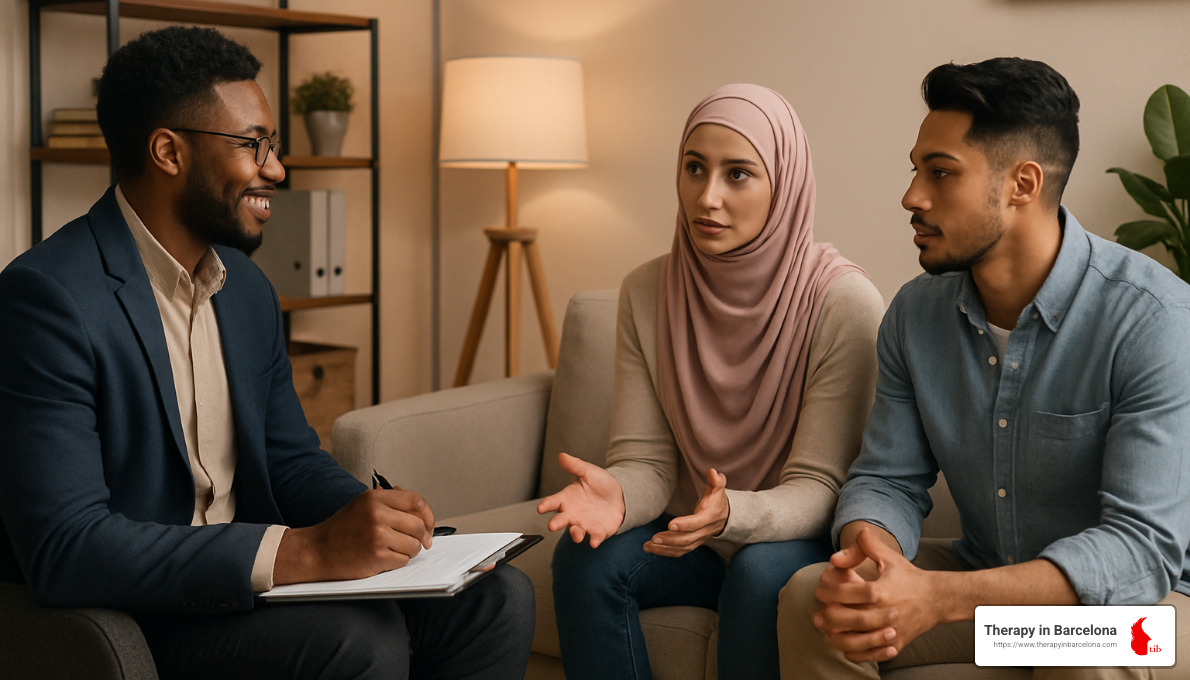
When it comes to intercultural marriage counseling, finding the right therapist can make all the difference between frustration and healing. The journey through cultural differences requires a guide who truly understands the terrain—someone who can steer the nuances with sensitivity and skill.
Where to Look for Intercultural Marriage Counseling Help
Finding a therapist who “gets it” might feel daunting at first, especially when you’re already dealing with relationship challenges. At Therapy in Barcelona, we’ve seen how transformative the right match can be.
Start by exploring specialized therapy practices that focus specifically on international clients. Services like ours have built expertise around the unique challenges faced by expatriates and cross-cultural couples. We’ve walked this path ourselves—many of our therapists are expats too, bringing both professional training and personal experience to their work.
Professional associations can be another excellent resource. Organizations like the International Association of Marriage and Family Counselors often maintain directories of therapists with specialized training in cross-cultural dynamics. These professionals have typically invested in additional education to better serve diverse couples.
Don’t overlook the power of expatriate networks either. Fellow internationals who have steerd similar challenges can offer invaluable recommendations. Online forums, Facebook groups, and community organizations often share the names of therapists who have helped other cross-cultural couples thrive.
One client at Therapy in Barcelona shared:
“I was very glad to have found a place that offered therapy in English, as it is more comfortable and also with therapists that are also foreigners in Spain, as cultural differences may be easier to understand.”
When evaluating potential therapists, don’t hesitate to ask direct questions during your initial consultation:
“What experience do you have working with intercultural couples?”
“How do you incorporate cultural awareness into your approach?”
“Have you lived abroad or navigated cross-cultural relationships yourself?”
These questions can help you gauge whether a therapist truly understands the complex interplay of culture, identity, and relationship dynamics that shape intercultural marriages.
Red Flags to Avoid
Not all therapists—even well-meaning ones—are equipped to provide effective intercultural marriage counseling. Being aware of warning signs can save you time, money, and emotional energy.
Be wary of cultural stereotyping. If a therapist makes broad generalisations about cultural groups (“All Mediterranean families are like this…” or “Asian cultures always prioritise…”), it suggests a lack of nuanced understanding that could hinder your progress.
Watch for signs of cultural bias. Even subtle favouritism toward one partner’s cultural framework can unbalance the therapeutic relationship. Effective intercultural counseling requires holding space for multiple worldviews simultaneously—not privileging one over another.
Some therapists might minimise cultural differences, suggesting that “we’re all just human” or “love is universal.” While well-intentioned, this approach fails to acknowledge how deeply culture shapes our expectations, communication styles, and relationship patterns.
Pay attention to the therapist’s self-awareness about their own cultural lens. The best intercultural therapists recognise and openly acknowledge their own cultural biases and how these might influence their work.
“Finding the right therapeutic match is particularly important for intercultural couples,” emphasises one of our counselors at Therapy in Barcelona. “The therapy relationship should feel balanced, with both partners feeling equally seen and understood.”
At Therapy in Barcelona, we take matching seriously. Our intake process includes detailed questions about cultural background, languages spoken, and relationship dynamics to ensure each couple is paired with a therapist who understands their specific cultural context. As one client noted:
“I think the intake service is great. I like how thorough the intake is. I feel that I have been placed really well with the right therapists.”
The journey through cultural differences in marriage isn’t always easy, but with the right guide, it can lead to profound growth and connection. A culturally competent therapist doesn’t just help you overcome challenges—they help you transform cultural differences from obstacles into strengths that enrich your relationship for years to come.
Frequently Asked Questions about Intercultural Marriage Counseling
When should we seek counseling?
Many couples wonder about the right timing for intercultural marriage counseling. While it’s common to wait until problems feel overwhelming, the truth is that earlier support often leads to better outcomes.
Think of counseling as relationship maintenance rather than emergency repair. The most successful couples we see at Therapy in Barcelona often come in proactively, before small cultural misunderstandings grow into entrenched patterns.
Ideal moments to consider counseling include before marriage or making a serious commitment, when you can explore potential cultural differences in a low-pressure environment. Major life transitions—like relocating to a new country, planning a wedding, considering parenthood, or changing careers—also present perfect opportunities for support, as these moments often intensify cultural differences.
“Prevention is always easier than repair,” notes Leigh Matthews of Therapy in Barcelona. “Many of our most successful clients are those who come in before crisis points, looking to strengthen their relationship rather than save it.”
Family conflicts with in-laws or extended family members can be particularly challenging for intercultural couples. If you’re experiencing tension in these relationships, early intervention can provide valuable strategies before patterns become established.
Research consistently shows that intercultural couples who participate in culturally sensitive counseling earlier in their relationship report greater satisfaction and resilience compared to those who wait until problems become severe.
Can counseling be effective online?
With the growth of digital therapy platforms, online intercultural marriage counseling has become increasingly popular—and for good reason, especially for international couples.
Online therapy offers several distinct advantages for intercultural couples. The geographic flexibility is particularly valuable for partners who may be living in different countries or traveling frequently. This format ensures both partners can attend sessions together regardless of location.
Digital platforms also expand access to specialists with specific cultural expertise that might not be available locally. For couples needing a therapist familiar with particular cultural dynamics, online therapy removes geographic limitations.
Many clients also appreciate the comfort of sessions in their own space, which can reduce anxiety and increase openness, especially when discussing sensitive cultural topics. As one Therapy in Barcelona client shared: “The availability of therapists working in different languages is incredibly helpful for foreigners living in Barcelona, and the online option made therapy accessible even when I was traveling.”
Of course, online therapy has its considerations too. Technical issues can occasionally disrupt sessions, and some subtle non-verbal communication might be harder to detect online. Finding a private space for confidential conversations can also be challenging in some living situations.
Therapy in Barcelona offers both in-person and online options, recognizing that flexibility is particularly important for our international clients. Research increasingly supports the effectiveness of online therapy, with studies showing comparable outcomes to in-person treatment for many relationship issues.
What if our families refuse to participate?
Family involvement can sometimes improve intercultural marriage counseling, but it’s certainly not required for effective therapy. Many couples worry when extended family members are reluctant to engage in the process, but there are many ways to steer these situations.
When families resist participation, the focus shifts to strengthening the couple as a unit first. Together, you can develop shared strategies for managing family dynamics, even without direct family involvement in therapy. This often includes setting clear boundaries that protect your relationship while still respecting important family connections.
“While family involvement can be valuable, the primary relationship is between the partners,” emphasizes a Therapy in Barcelona counselor. “Couples can develop effective strategies for navigating family dynamics even when families are reluctant to engage directly in the therapeutic process.”
In therapy, you might identify potential allies within your families—individuals who are more supportive and might help bridge cultural divides. Role-play techniques can also be invaluable, allowing you to practice difficult family conversations in the safety of therapy sessions before having them in real life.
Sometimes a gradual approach works best. Starting with less threatening interactions before addressing more challenging issues gives family members time to become more comfortable with cross-cultural communication. In some cases, separate individual or family sessions may be recommended to address specific cultural or family-of-origin issues before returning to joint couple work.
While family support is wonderful when available, the strength of your partnership doesn’t depend on it. Many intercultural couples build thriving relationships even when extended family approval is limited or evolving over time.
Conclusion
Intercultural marriage counseling offers a transformative journey for couples from diverse backgrounds, helping them turn potential challenges into unique strengths. When cultural differences are acknowledged and acceptd with professional support, these relationships can flourish in ways that might not otherwise be possible.

The path of an intercultural relationship isn’t always smooth sailing, but with the right guidance, it can be extraordinarily rewarding. As one of our clients beautifully expressed: “Each session was a relief and my therapist taught me and shared so many things that I know I will always remember and will help me to face any difficulties.”
At Therapy in Barcelona, we understand these challenges on a personal level. Our practice was founded by Leigh Matthews, an expatriate psychologist who experienced the complexities of intercultural relationships and couldn’t find appropriate support. This personal journey inspired the creation of a service specifically designed for the international community. Our team includes therapists who are themselves expatriates, bringing genuine understanding to their professional expertise.
“Being in an intercultural relationship myself, I know both the challenges and the incredible richness these unions can bring,” Leigh shares. “Our goal is to help couples steer the difficult moments while celebrating the unique strength that comes from bridging different worlds.”
Whether you’re just beginning your intercultural love story, planning a deeper commitment, or working through established patterns, specialized counseling provides valuable tools and perspectives. By addressing cultural differences with compassion and clarity, you can build a resilient relationship that draws strength from diversity rather than being divided by it.
If you’re navigating the beautiful but sometimes bumpy road of an intercultural relationship in Barcelona or beyond, we’re here to help. Our team offers both in-person sessions at our Barcelona office and online therapy for couples worldwide. We take care to match you with a therapist who truly understands your specific cultural dynamics and relationship needs.
Love across cultures is a remarkable journey—one filled with challenges, yes, but also with extraordinary opportunities for growth, understanding, and joy. It’s a journey that deserves thoughtful support and wholehearted celebration every step of the way.
