


Why Culture Shock Therapy Could Be Your Key to Thriving Abroad

Culture shock therapy is a specialised form of counselling that helps individuals steer the emotional and psychological challenges of adapting to a new cultural environment. Unlike general therapy, it combines traditional therapeutic techniques with culturally sensitive approaches to address the unique struggles of expatriates, international students, and immigrants.
What Culture Shock Therapy Addresses:
- Anxiety, depression, and homesickness from cultural adjustment
- Identity confusion and feeling caught between cultures
- Language barriers affecting daily functioning and self-confidence
- Social isolation and difficulty forming meaningful relationships
- Workplace or academic performance issues due to cultural stress
- Reverse culture shock when returning to your home country
Moving to a new country can feel like an emotional rollercoaster. As one expat therapist puts it: “Culture shock ‘keeps coming’ beyond an initial phase” – it’s not just a brief adjustment period, but an ongoing process that can resurface at unexpected moments.
Whether you’re like Emily (a composite representation of many clients we see), a 34-year-old from the UK struggling with loneliness in Barcelona, or David, a Canadian sales manager feeling overwhelmed by separation and work stress whilst navigating life abroad, you’re not alone. Approximately 70% of individuals experience some form of culture shock when adjusting to a new culture, and depression affects around 40% of expatriates during their first year abroad.
The good news? Culture shock therapy offers a roadmap not just to survive your international transition, but to truly thrive in your new environment.

What Is Culture Shock? Symptoms & The Classic Stages
Picture this: you land in Barcelona buzzing with excitement. Three months later, you feel defeated after a tricky supermarket run. That steep emotional drop is culture shock in action.
Coined by anthropologist Kalervo Oberg in 1958, culture shock refers to the anxiety and disorientation that arise when everyday cues — language, humour, social rules — suddenly change. The impact goes beyond mild awkwardness, often shaking your sense of self.
Common Signs You Might Recognise
- Intense homesickness and feeling “lost”
- Mood swings, irritability, or a dip in motivation
- Sleep and appetite changes
- Physical tension, headaches, or low energy
- Pulling back from social situations
- Idealising life back home and criticising the host culture
Oberg’s Four Stages (Anything but Linear)
- Honeymoon – novelty, adrenaline, and rose-tinted glasses.
- Negotiation/Frustration – differences feel irritating or confusing; doubts creep in.
- Adjustment – you develop routines, language skills, and coping strategies.
- Adaptation – switching between cultures feels more natural; you gain a bicultural identity.
In real life, people bounce between these stages. You might feel adapted at work yet frustrated with local bureaucracy. That fluidity is normal.
Culture Shock vs Transition Shock
Brief discomfort after a small cultural misstep is transition stress. Culture shock cuts deeper, disrupting day-to-day functioning or identity. If you feel like you no longer recognise yourself, that’s bigger than a simple hiccup.
Four, Five, or More Stages?
Some researchers add extra phases such as reverse culture shock (re-entry stress) or mastery. The exact number matters less than knowing adjustment is messy, cyclical, and unique to you.
More info about 5 key stages of culture shock and how psychotherapy can help
The Hidden Toll: Mental Health & Daily Functioning

Culture shock doesn’t just make ordering a coffee awkward. Continuous cultural navigation puts the brain on high alert, draining emotional and physical reserves.
How It Shows Up
- Persistent low mood or loss of interest in once-enjoyed activities
- Social anxiety about making mistakes
- Insomnia or, conversely, excessive sleeping as an escape
- Comfort eating or loss of appetite
- Brain fog, poor concentration, decision paralysis
- Unexplained headaches, digestive upsets, or frequent colds
Relationships often take a hit when partners or friends adapt at different speeds. Work or study performance can drop as mental energy gets rerouted to cultural decoding.
Why 92% Feel the Strain
Everyday tasks become complex puzzles: reading non-verbal cues, switching languages, re-building a support network, and renegotiating identity. International students juggle academic pressure; professionals face unfamiliar workplace norms. No wonder statistics like those from 2024 Global Expatriate Survey by Crown Relocations show roughly 92 % grapple with culture shock and about 65 % rate the adjustment as extremely or very difficult.
When to Reach Out for Help
Seek professional support if you notice any of the following:
- Thoughts of self-harm or substance misuse
- Panic attacks interfering with daily life
- Isolation lasting more than a few weeks
- Ongoing inability to work, study, or maintain relationships
- Physical symptoms with no medical explanation
Scientific research on social isolation confirms prolonged loneliness harms health, so early intervention matters.
Culture Shock Therapy: Personalised Roadmap to Resilience
Culture shock therapy is counselling designed for life between cultures. It blends evidence-based methods with cultural insight so you don’t just cope — you grow.
| General Therapy | Culture Shock Therapy |
|---|---|
| Focus on universal principles | Adds cultural context |
| May overlook identity conflict | Targets bicultural identity |
| Generic techniques | Culturally adapted interventions |
| Therapist may lack expat insight | Therapist has lived it |
Why It Feels So Different
- Normalisation – you learn your reactions are typical, not a personal failure.
- Bicultural competence – therapy aims beyond symptom relief toward thriving in two worlds.
- Shared experience – at Therapy in Barcelona, many therapists are expats themselves, creating rapid rapport.
What Works Best?
- Culturally adapted CBT reframes unhelpful thoughts linked to cultural assumptions.
- ACT (Acceptance & Commitment Therapy) helps you accept discomfort while acting on values.
- Mindfulness lowers the constant background stress of cultural decoding.
Scientific research on culturally adapted CBT shows higher success rates than one-size-fits-all care.
When to Start
Don’t wait for crisis. Some people begin sessions before moving; others reach out at the three-month dip. Early support prevents isolation from settling in.
Beyond the Therapy Room: Practical Coping & Community Support
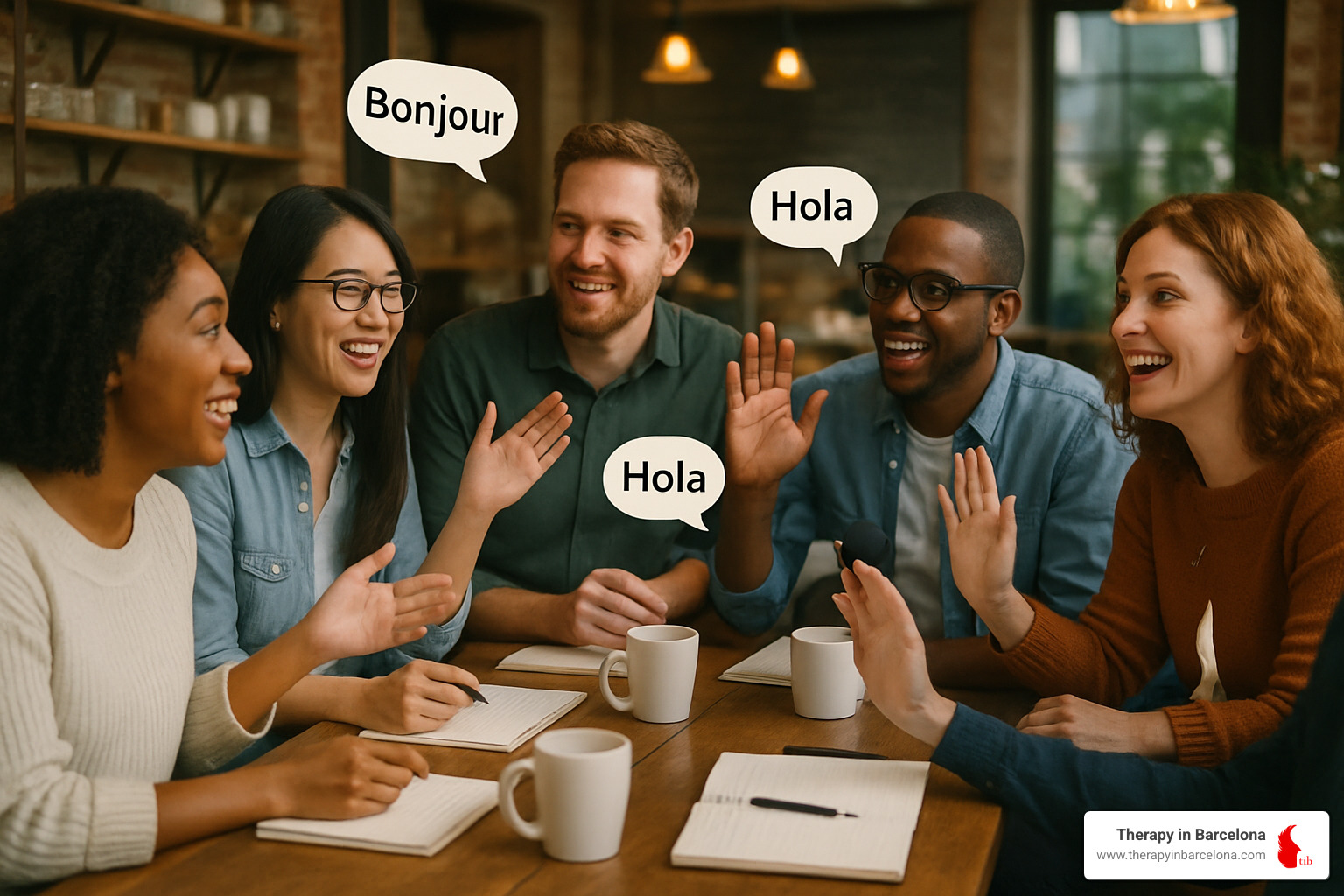
Therapy equips you with tools; daily life is where you strengthen them. A few strategies make a big difference:
Everyday Skills
- Curiosity over judgement – treat surprises as learning moments.
- Frame-switching – consciously choose which cultural lens fits the situation.
- Ritual preservation – keep small routines from home to ground you.
- Language investment – join classes, meet-ups or cooking workshops; culture hides between the lines.
Building Your Support Web
- Mix local and expat friendships for balanced perspective.
- Universities and city councils often host international meet-ups or peer-mentoring schemes.
- Digital nomad hubs across Spain (Barcelona, Madrid, Valencia) run networking events and mental-health talks.
More info about expat mental health
Watch for Reverse Culture Shock
Coming home can feel stranger than leaving. Psychologists Gullahorn and Gullahorn identified this pattern as far back as 1963, calling it the W-curve: the dip of re-entry often mirrors the dip of arrival in a new country. It is well-documented enough that the U.S. State Department’s Foreign Service Institute addresses it directly in guidance for returning diplomatic staff. You may grieve the community you built abroad, feel like a stranger in familiar places, and find that friends have little interest in the life you left. These feelings are normal. Therapy can help you integrate both versions of yourself rather than feeling you have to choose between them.
Integrate, Don’t Erase
Mindful identity work helps you decide which values to keep, adapt, or blend. Some expats create new traditions — Christmas paella, anyone? The aim is an expanded, authentic you.
Frequently Asked Questions about Culture Shock Therapy
What happens in a typical culture shock therapy session?
Walking into your first culture shock therapy session can feel daunting, but the process is designed to put you at ease from the moment you sit down. Your therapist will begin by exploring where you are right now – what cultural challenges are weighing on you today, and how they’re affecting your emotional wellbeing.
Unlike general therapy sessions, these conversations dive deep into the intersection of your personal history and your current cultural environment. Your therapist might ask about specific moments that triggered distress – perhaps that awkward interaction at work, or the overwhelming feeling you had whilst trying to steer bureaucracy in a foreign language.
Cultural formulation becomes the foundation of your work together. This means understanding how your background, values, and experiences interact with your new environment to create your current struggles. It’s not about changing who you are, but about building bridges between different parts of your identity.
Each session typically includes skill building custom to your specific cultural challenges. You might learn techniques for managing the anxiety that comes with constant cultural navigation, or practice cognitive restructuring to challenge thoughts like “I’ll never belong here” or “I should be handling this better by now.”
The beauty of culture shock therapy lies in its collaborative approach. You’re not just receiving treatment – you’re actively developing a toolkit for cultural navigation that will serve you throughout your international journey. Your therapist acts as both guide and fellow traveller, helping you find strengths you didn’t know you had.
Can therapy really prevent reverse culture shock?
This question comes up frequently, especially from expats who are planning their eventual return home. The honest answer is that whilst culture shock therapy can’t entirely eliminate reverse culture shock, it can dramatically reduce its intensity and help you steer it with greater resilience.
Many people are blindsided by reverse culture shock because they expect coming home to feel like slipping into a comfortable pair of shoes. In reality, you’ve changed, grown, and developed new perspectives during your time abroad. Your home country, meanwhile, has continued evolving without you.
Culture shock therapy helps by preparing you mentally for the identity conflicts you might face. You’ll develop realistic expectations about repatriation, understanding that feeling like a stranger in your own country is normal, not a sign that something’s wrong with you.
Perhaps most importantly, therapy helps you build skills for maintaining your expanded identity when you return home. You’ll learn strategies for staying connected to your international experiences whilst reconnecting with your roots. Many clients find that processing their expat journey before returning home makes the transition far smoother than they expected.
How long does it take to feel better?
The timeline for feeling better through culture shock therapy varies significantly from person to person, but most clients notice positive changes much sooner than they expect. Understanding these typical patterns can help set realistic expectations for your own journey.
Initial relief often comes surprisingly quickly. Many clients report feeling significantly better after just their first few sessions. This isn’t because all their problems are solved, but because of the powerful effect of normalisation and validation. Simply hearing that your struggles are a normal response to an abnormal situation can lift an enormous weight from your shoulders.
Skill development typically takes longer to solidify. Learning practical coping strategies for cultural stress usually requires 4-8 sessions of consistent practice. You might start noticing that you’re less anxious about social situations, or that you’re able to bounce back more quickly from cultural misunderstandings.
The deeper work of identity integration – developing a sophisticated understanding of your multicultural self – often takes 3-6 months of regular sessions. This is where the most profound changes happen. You begin to see yourself not as someone struggling to fit in, but as someone with a unique and valuable multicultural perspective.
The goal isn’t just temporary relief from cultural stress. Culture shock therapy aims to equip you with lasting skills for thriving in multicultural environments – skills that will serve you throughout your life, wherever that journey takes you.
Conclusion: Your Next Step Toward Thriving Abroad
Your journey through culture shock doesn’t have to be a solo expedition filled with confusion and frustration. What many people don’t realise is that culture shock therapy can transform what feels like an overwhelming challenge into a powerful catalyst for personal growth, expanded worldview, and genuine resilience.
Think of it this way: every successful expat you’ve ever met has had moments of doubt, homesickness, and cultural confusion. The difference isn’t that they avoided these feelings – it’s that they developed the tools and support systems to steer them effectively.
The research backs this up. A meta-analysis by Griner and Smith (2006) across 76 studies found that culturally adapted interventions were four times more effective than therapy delivered to mixed-background groups. A separate meta-analysis published in 2016 found they were 4.68 times more likely to produce remission from psychological symptoms than standard approaches. Whether you are in the thick of initial adjustment, wrestling with questions about who you are becoming in this new culture, or preparing for the surprisingly hard journey of eventual repatriation, specialised support makes a measurable difference.
At Therapy in Barcelona, this understanding runs deeper than professional knowledge – it’s personal. Founded by Leigh Matthews, an Australian psychologist who experienced her own cultural adjustment journey when she moved to Barcelona in 2011, the practice was born from recognising a crucial gap in mental health services for internationals. As an expat herself, Leigh understood the unique challenges of navigating intercultural relationships, adapting to Spanish family obligations, experiencing pregnancy in a foreign country, and raising a Third Culture Kid – all whilst building a new life in a different culture.
Leigh didn’t just study culture shock – she lived it. When she couldn’t find the culturally sensitive, English-speaking therapy she needed, she created it. Today, the team at Therapy in Barcelona includes therapists who are themselves expatriates, collectively speaking 10 languages and serving international clients from over 80 countries. They offer both in-person sessions in Barcelona and online support worldwide, bringing that essential combination of professional expertise and lived experience to every therapeutic relationship.
What makes this approach different is the deep understanding that seeking support isn’t a sign of weakness – it’s actually a sign of wisdom. It’s recognising that thriving in a multicultural environment requires specific skills that most of us were never taught. It’s understanding that your international journey doesn’t have to be about merely surviving the difficult moments, but about learning to flourish in the beautiful complexity of cross-cultural living.
Your story abroad can be one of growth, connection, and genuine thriving. With the right support, what feels overwhelming today can become the foundation for a richer, more resilient version of yourself tomorrow.

