


Understanding FWB Meaning in Chat and Text Messaging

When people talk about the fwb in chat, they are referring to the widely used acronym for “friends with benefits.” In the world of digital communication, abbreviations save time, reduce awkwardness, and allow individuals to communicate their relationship intentions clearly without writing long paragraphs.
In text messaging, using “FWB” allows someone to signal that they want casual physical intimacy anchored by a friendly rapport, rather than a traditional dating dynamic.
The Dictionary.com entry for friend with benefits defines the term as a relationship between friends who engage in sexual activity without romantic commitment.
The term relies heavily on context. Depending on where it appears—whether in an instant message, a social media caption, or a dating app profile—the acronym can carry slightly different tones ranging from playful teasing to explicit boundary setting.
Decoding FWB Meaning in Chat Across Social Media Platforms
Understanding the fwb meaning in chat often depends on the specific app or digital space where you see it. Different platforms encourage different styles of communication:
- Tinder, Bumble, and Dating Apps: Here, seeing “FWB” or “Looking for FWB” in a bio is a direct boundary statement. Users include it to filter out matches seeking long-term romance, ensuring both parties align on casual expectations before swiping right. For a deeper look at modern app dynamics, read about Tapas, Tinder, and True Love: Barcelona’s Best Dating Apps.
- Snapchat and WhatsApp: On direct messaging platforms, “FWB” often appears when discussing relationship statuses privately. On Snapchat, terms like “FWB OPS” (private stories shared only with a casual partner) occasionally crop up in digital youth culture. To learn more about how acronyms function in digital environments, check out WikiHow’s guide on what FWB means across text and social platforms.
- TikTok and Instagram: On video and image platforms, “FWB” frequently features in captions, memes, or “storytime” videos. It is often used humorously to describe modern dating mishaps or relatable situations where casual boundaries get blurry.
Real-Life Conversation Examples of FWB Meaning in Chat
Seeing how the acronym works in real text exchanges can clarify its tone and intent. Here are a few typical scenarios showing how people use or reply to “FWB” in modern texting:
Example 1: Setting Expectations Early
Alex: I’ve really enjoyed hanging out lately! Just to be open, I’m not really looking for a serious relationship right now.
Jordan: Thanks for telling me! I’m on the same page. Down for something casual like an FWB setup if you are?
Example 2: Clarifying Current Relationship Status
Sam: Are you and Taylor officially dating now?
Morgan: No, we’re not dating. It’s more of an FWB situation—we hang out and keep things relaxed.
Example 3: Responding Politely When You Want Something Different
Chris: Hey, had a great time last night. Would you be open to keeping things casual as FWB?
Pat: I had fun too! But I’m actually looking to date someone with potential for a long-term connection, so an FWB dynamic isn’t right for me. Wish you the best though!
FWB vs Other Casual Relationship Terms
Modern casual dating comes with a broad vocabulary. People often confuse FWB with other terms, but each label carries distinct social and emotional expectations.
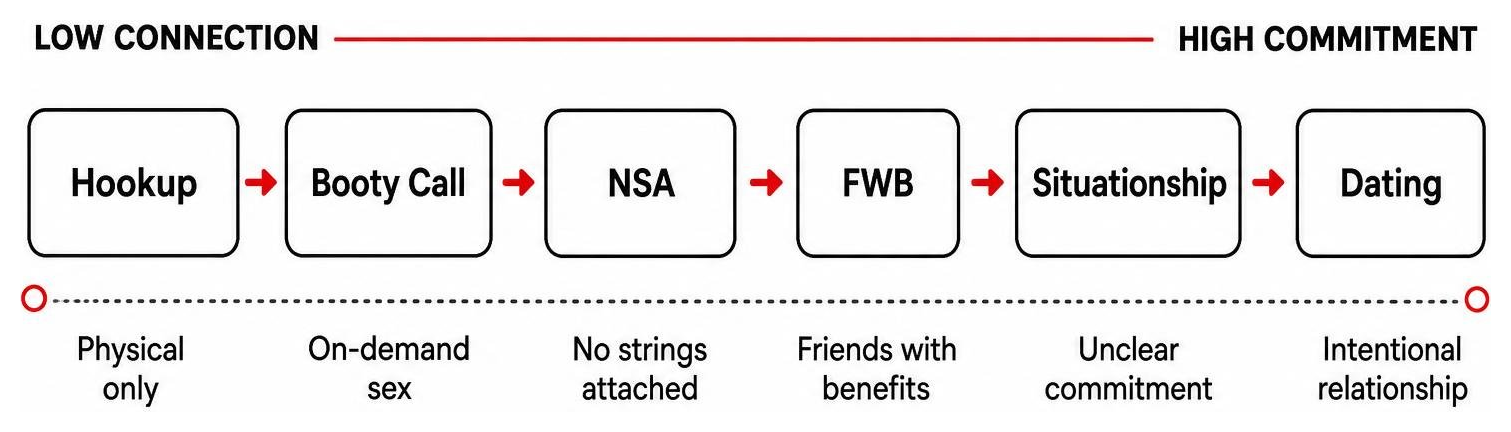
Here is a breakdown comparing common casual relationship terms to help keep their differences clear:
Connection Type: FWB (Friends With Benefits)
- Primary Focus: Shared friendship combined with consensual physical intimacy.
- Emotional Bond: Medium. An underlying friendship and social connection exist.
- Ongoing Interaction: Yes, includes regular non-sexual social activities alongside physical intimacy.
- Expectation of Romance: Low to none; explicitly non-romantic.
Connection Type: NSA (No Strings Attached)
- Primary Focus: Purely physical connection with zero emotional obligations.
- Emotional Bond: Very low; emotional involvement is actively avoided.
- Ongoing Interaction: Can be repeated, but usually limited to physical encounters.
- Expectation of Romance: None.
Connection Type: Booty Call / Hookup
- Primary Focus: Spontaneous or late-night physical encounters.
- Emotional Bond: Low to none; often opportunistic or transactional.
- Ongoing Interaction: Sporadic or one-off; rarely involves daytime social activity.
- Expectation of Romance: None.
Connection Type: Situationship
- Primary Focus: An undefined romantic and physical dynamic.
- Emotional Bond: High, but confused or unclarified.
- Ongoing Interaction: Behaves like dating, but lacks explicit labels, status, or long-term alignment.
- Expectation of Romance: Ambiguous; one or both partners often wish for official dating.
How FWB Differs From Booty Calls and Hookups
The primary factor that sets a friends with benefits dynamic apart from a hookup or a booty call is the word friend.
A hookup or booty call typically centres strictly on physical convenience. Communication usually happens late at night or strictly when physical intimacy is desired. There is rarely an expectation to share meals, meet friends, or offer emotional support.
In contrast, a genuine FWB dynamic involves two people who like each other as social companions. They share trust, converse during the day, and respect one another’s well-being outside the bedroom. People choose an FWB arrangement for various reasons—including relationship simplicity, physical intimacy, and shared social connection—highlighting that friendship remains a core pillar.
Establishing Boundaries, Expectations, and Communication
While an FWB arrangement can sound simple, mixing friendship with physical intimacy can get complicated. Clear ground rules help reduce mixed signals and hurt feelings.

If you are considering or currently in an FWB dynamic, it helps to discuss:
- Communication Etiquette: How often will you text? Is daytime messaging welcome, or are texts mainly for planning hangouts?
- Exclusivity and Sexual Health: Are you seeing or sleeping with other people? Agreeing on condom use, sexual safety, and STI testing keeps both partners safer and informed.
- Public Displays and Social Circles: How do you act around mutual friends? Do people in your group know about the arrangement, or is it kept private?
- The “Exit Strategy”: What happens if one person starts dating someone else, or if the arrangement stops feeling comfortable?
For a deeper exploration of the pros, cons, and emotional mechanics of casual setups, read our article on Friends with Benefits: The Good, The Bad, and The Beneficiary.
What to Do When Emotional Complications Arise
Human emotions rarely follow neat rules. People may enter FWB dynamics with different hopes or assumptions. One person may want something casual and self-contained, while the other may quietly hope the connection becomes closer over time.
When feelings change, pretending they have not can make things harder. Jealousy, confusion, or anxiety around texting patterns are often signs that the arrangement needs a check-in.
If you notice feelings developing or shifting:
- Be Honest With Yourself: Ask whether you are still comfortable with a casual dynamic, or whether you are hoping for more.
- Initiate a Direct Check-In: Use plain, non-accusatory language. A text like, “Hey, I’ve noticed my feelings shifting lately and wanted to be transparent. Can we talk about how we’re both feeling about our arrangement?” opens the door for clarity.
- Respect the Outcome: If your partner does not return those romantic feelings, continuing the same physical dynamic may hurt. Pausing intimacy can protect both your self-respect and the friendship.
Psychological Impact and Expat Dating Dynamics
Understanding casual relationship language like the fwb meaning in chat can present distinct challenges for international residents, digital nomads, and university students living abroad.

When living in international hubs like Barcelona, Madrid, Valencia, or Málaga, life can feel dynamic yet untethered. Expats often face social isolation, language barriers, and cultural adjustment stress.
In these environments, casual arrangements like FWBs can offer warmth, physical touch, and companionship without the weight of long-term commitment—especially if one or both partners know their time in Spain is temporary.
However, relying on casual chats and low-commitment dynamics can sometimes hide deeper feelings of loneliness. International students and young professionals adjusting to new social scenes may find themselves accepting casual terms they aren’t entirely comfortable with simply to feel connected.
To understand these academic and social environments better, explore The Global Campus: Unpacking Dating Dynamics for International Students.
When casual text chats leave you feeling anxious or unfulfilled, it can help to look at what you really want from your connections. If you find yourself struggling with social isolation abroad, our guide on How to Stop Feeling Lonely and Depressed and Start Reconnecting offers grounded, practical insights.
Relational and Mental Health Support Options
When casual dating dynamics become confusing or emotionally draining, support can help you slow down and make sense of what you want. You have several options, and the right fit depends on your needs, budget, language, and location.
Public system clinicians in Spain: Public healthcare can be a helpful route for many people. Access, waiting times, language options, and continuity of care can vary depending on where you live.
Large online therapy platforms: These can offer convenience and broad availability. Some people like the flexibility, while others prefer a more personal matching process and clearer privacy boundaries.
Local private practices: Local therapists and clinics may offer in-person support in Barcelona, Madrid, Valencia, Málaga, Alicante and other parts of Spain. Fit matters, especially if you are working through relationship stress, cultural adjustment, or feeling isolated abroad.
Relational Support with Therapy in Barcelona
- Personalised Therapist Matching: We do not use a one-size-fits-all approach. Our team carefully matches you with a therapist based on your needs, background, language preferences, and goals.
- Culturally Sensitive Expat Care: Our psychology-trained therapists offer therapy services in Spain and understand the emotional realities of living abroad. We speak English, and some of our therapists also speak languages such as German, French, Spanish, Afrikaans, Portuguese, Austrian-German and Swiss-German.
- Online and In-Person Therapy: We offer online therapy worldwide, including for clients in the USA and Canada, and face-to-face therapy sessions in our office in Barcelona.
- Collaborative Private-Pay Care: We are a trusted group practice in Spain, established since 2011, supporting adults, couples, teens and families. Our service is private-pay, carefully matched, and designed with strict privacy in mind. We do not sell client data.
- Relationship-Focused Support: Depending on your needs, therapy may draw on approaches such as CBT, ACT, Psychodynamic Therapy, Mindfulness-Based approaches, or couples therapy.
Frequently Asked Questions About FWB
What does FWB mean in texting?
In texting, FWB stands for “Friends With Benefits.” It describes two people who maintain a friendship while consensually sharing physical or sexual intimacy, explicitly without romantic commitment or official dating status.
Can a friends with benefits dynamic turn into a committed relationship?
While it is possible for an FWB dynamic to transition into a romantic relationship, it is relatively uncommon in practice. Most FWB arrangements are established specifically to avoid commitment. Transitioning successfully requires clear, honest communication about shifting motivations from both partners.
How do you politely propose or respond to an FWB text?
To propose an FWB dynamic, be direct about your intentions without placing pressure on the other person: “I really enjoy spending time with you, but I’m only in a space for something casual like an FWB setup right now. How do you feel about that?”
To politely decline an FWB text, state your boundaries clearly: “Thanks for being upfront! I’m looking for a relationship with romantic potential, so an FWB dynamic won’t work for me, but I wish you the best.”
Emotional Clarity in Modern Dating
Understanding text slang like the fwb meaning in chat is about more than decoding three letters. It is about understanding consent, boundaries, expectations, and the difference between what someone says and what you need.
Casual arrangements can offer flexibility and companionship, but they work best when both people stay honest with themselves and each other. If a chat leaves you feeling anxious, unseen, or unsure of where you stand, that feeling is worth listening to.
At Therapy in Barcelona, founded by Australian Psychologist Leigh Matthews, who has been in Barcelona since 2011 and has extensive experience supporting internationals, our group practice of psychology-trained therapists offers support for adults, couples, teens, and families. We work with people in Barcelona, Madrid, Valencia, Málaga, Alicante and beyond, as well as online worldwide.
If you would like to explore how casual dynamics affect your emotional well-being, read our detailed article on FWB Uncovered: What Friends With Benefits Means for You.
If you’d like support, book a Free Discovery Call and we will help match you with the right therapist for your needs.
