


When Your Culture Travels With You: Finding Therapy That Truly Gets It

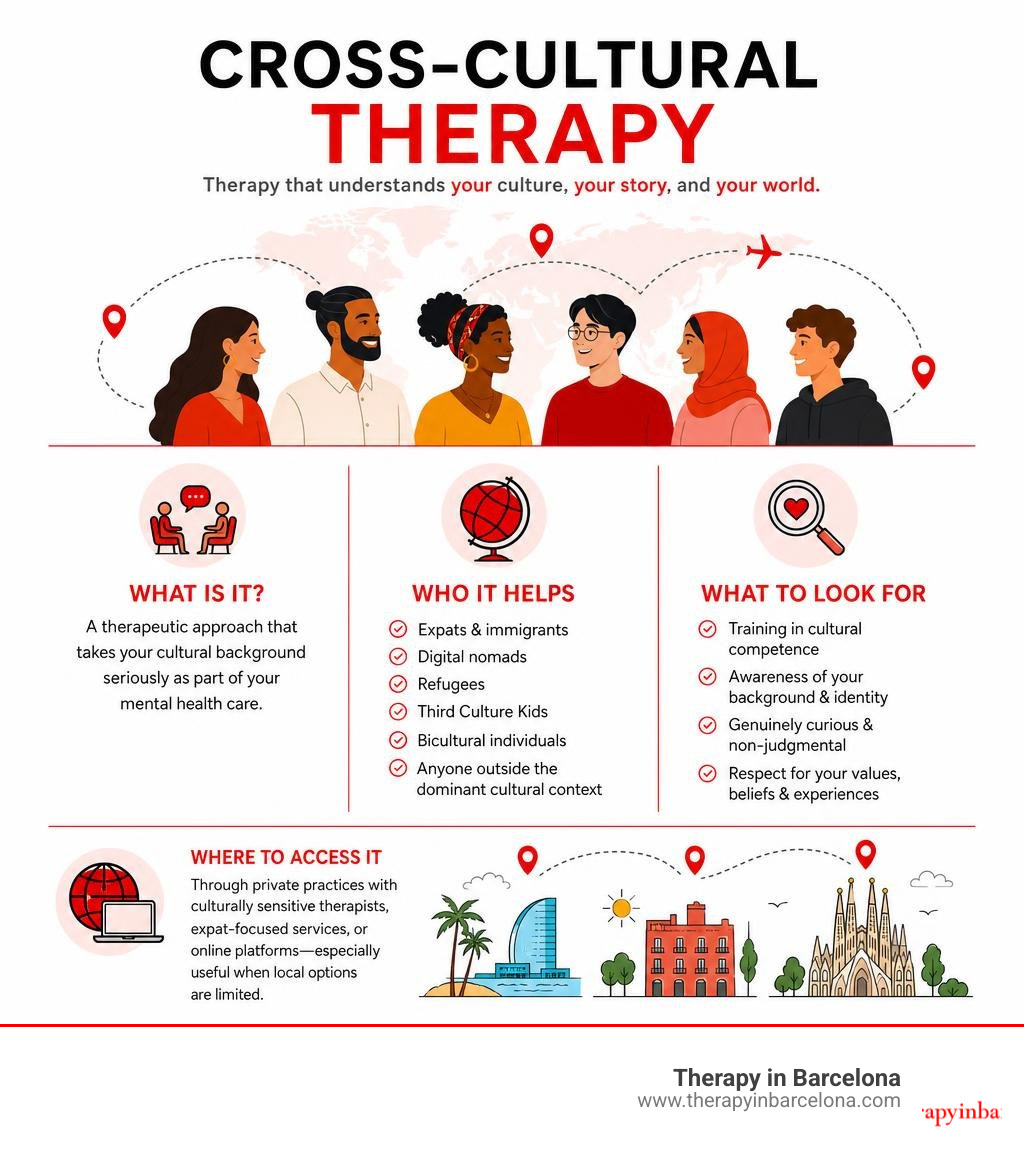
Cross-cultural therapy — also called multicultural therapy or culturally competent therapy — is a form of psychotherapy that takes your cultural background seriously as part of your mental health care. Rather than applying a one-size-fits-all approach, it adapts to who you are: where you come from, what you believe, and how you experience the world.
If you’re looking for a quick answer, here’s what you need to know:
- What it is: A therapeutic approach that accounts for cultural factors like race, ethnicity, religion, gender identity, sexual orientation, and socio-economic background in the healing process.
- Who it’s for: Expats, immigrants, digital nomads, refugees, Third Culture Kids, bicultural individuals, and anyone whose identity sits outside the dominant cultural context of where they live.
- Why it matters: Standard psychotherapy was largely developed within Western, individualistic frameworks — which don’t always fit people living across cultures or between them.
- What to look for: A therapist with specific training in cultural competence, awareness of your particular background, and a genuinely curious, non-judgmental stance.
- Where to access it: Through private practices with culturally sensitive therapists, expat-focused services, or online platforms — particularly useful when local options are limited.
Think about what it feels like to explain yourself in a second language — not just linguistically, but culturally. You’re not just translating words; you’re translating your entire frame of reference. For many people living abroad, that’s exactly what walking into a therapist’s office can feel like.
Whether you’re a digital nomad hopping between cities, an expat settled in Barcelona or Valencia, or someone building a life in a country that still feels foreign after years of trying — your mental health doesn’t exist in a cultural vacuum.
Research consistently shows that therapy is more effective when it aligns with who the client actually is. A meta-analysis of 99 studies involving over 13,000 participants found a meaningful effect in favour of culturally adapted treatments, with language matching, cultural metaphors, and values-based goals producing some of the strongest results.
And yet, the mental health field has historically been dominated by approaches that do not fully account for cultural differences. This historical bias can make it harder for people from diverse backgrounds to feel genuinely understood.
That gap matters. It’s one reason why cross-cultural therapy exists — and why finding the right therapeutic fit can make such a profound difference for those of us living between worlds.
What is Cross-Cultural Therapy and Why Does It Matter for Nomads?
Living as a digital nomad or expat means constantly changing your surroundings. Whether you’re in Málaga, Gran Canaria, or Madrid, the freedom of this lifestyle often comes at the cost of leaving behind familiar support systems. When emotional challenges arise, finding help in a new country can feel overwhelming.
This is where cross-cultural therapy becomes essential. It is not simply a set of therapeutic tools or a checklist of facts about different countries.
Instead, as explored in Frontiers | Culturally sensitive psychotherapy—technique or attitude? , it is a professional attitude and a relational stance. It is an ongoing commitment to understanding how a client’s cultural background, migration journey, and daily environment shape their inner world.
For a location-independent soul, your culture is the invisible luggage you carry everywhere. It influences how you define success, how you express sadness, and how you view relationships. If a therapist does not understand this, they might misinterpret your lifestyle choices or miss the root cause of your distress.
Working with a professional who understands these dynamics helps you feel seen. You can explore these concepts further in Beyond Borders: A Guide to Culturally Sensitive Therapy and The Heart of Healing: Exploring Culturally Informed Approaches.

Traditional Psychotherapy vs. Cross-Cultural Therapy
Traditional Western psychotherapy was largely built on the assumption that both the client and the therapist share a similar worldview. These traditional models often carry an individualistic bias, focusing heavily on self-reliance, personal autonomy, and individual achievement.
However, many people come from collectivist cultures where family and community shape identity. What may seem like unhealthy dependence to a traditional therapist can be a normal, healthy cultural value to a cross-cultural therapist.
Furthermore, traditional Western classification systems sometimes fail to capture how emotional distress is experienced in non-Western contexts. Cross-cultural therapy bridges these gaps by moving away from rigid, universal assumptions and centring the client’s unique cultural context.
You can read more about how this approach improves mental health outcomes in Bridging Divides: How Cross-Cultural Therapy Enhances Mental Health and the comprehensive review A Knowledge Synthesis of Cross-Cultural… : Journal of Cross-Cultural Psychology .
How Cultural Factors Shape the Therapeutic Journey
Our identities are multi-layered. They are shaped by a combination of race, ethnicity, religion, gender identity, sexual orientation, and socio-economic status. In cross-cultural therapy, these factors are not treated as secondary details; they are recognised as core elements of the therapeutic journey.
For instance, a client who identifies as a gender minority may face unique challenges when trying to reconcile their identity with the traditional religious views of their family of origin. Similarly, an expat’s socio-economic background can influence how they view financial security, career success, and their ability to sustain a location-independent lifestyle.
A culturally sensitive therapist actively considers these intersecting layers of identity. They pay close attention to how historical power dynamics, systemic privilege, and experiences of marginalisation affect a client’s mental health and their comfort level in therapy. For a deeper look into how therapists navigate these factors, see Understanding Cultural Sensitivity: A Guide for Therapists.
Navigating the Challenges of Life on the Move
To understand how these challenges play out in real life, consider this fictional composite example representing common expat experiences: a 29-year-old software engineer from Colombia who recently moved to Valencia to work as a digital nomad.
On paper, life seems ideal: a flexible job, a home near the beach, and an enjoyable local lifestyle. But behind the scenes, loneliness, anxiety, and a sense of disconnection from both home and the new environment begin to take hold. There is also guilt for feeling unhappy when life appears so perfect online.
When they try to talk to family back home, their struggles are often misunderstood. From their family’s perspective, they have “made it.” This disconnect can leave people feeling isolated and experiencing acculturative stress—the psychological strain of adapting to a new culture.
You can read more about these transitions in Beyond Borders: Your Guide to Understanding and Adapting to New Cultures and how therapists can help clients navigate bicultural identities in Clinician as Bicultural Coach: Integrating Bicultural Identity & B… .
Individualism, Collectivism, and Acculturative Stress
For digital nomads and expats, acculturative stress is often compounded by the tension between individualism and collectivism. Many nomads come from highly individualistic societies where self-reliance is celebrated. However, when they travel, they often realise how much they miss the natural safety nets of collectivist environments, where community care and group orientation are the norm.
This tension can lead to an identity crisis, sometimes described as “cultural adolescence.” This is a phase where your old values are questioned, but you have not yet fully integrated into your new environment.
To cope, bicultural individuals often engage in cultural frame shifting — moving between different cultural worldviews depending on their context. While this ability shows great cognitive flexibility, it can also be exhausting and lead to a sense of rootlessness.
Culturally responsive therapy helps clients make sense of these complex feelings, as discussed in The Cultural Compass: Navigating Therapy for Diverse Backgrounds.
Overcoming Language Barriers and Cultural Biases
Language is much more than a tool for sharing information; it is deeply tied to our emotional processing and how we access memories. When you speak in your native language, you can express subtle nuances of emotion that are hard to capture in a second language.
Different cultures also express emotional distress in different ways. Someone might describe having a “tight heart” or say their “insides are burning” to express sadness or anxiety. A cross-cultural therapist recognises these as culturally meaningful expressions rather than taking them literally or misinterpreting them.
Therapists must also be careful to avoid the outgroup homogeneity effect — the tendency to assume that everyone from a certain cultural group thinks and behaves in the exact same way. Effective cross-cultural communication requires the therapist to remain open, curious, and attentive to the client’s individual story, as outlined in The Intercultural Compass: Navigating Relationships and Communication in Therapy.
Building Trust and Adapting Evidence-Based Care
The foundation of any successful therapy is the therapeutic alliance — the bond of trust and collaboration between you and your therapist. When you are working across cultural lines, building this alliance requires extra care, intentionality, and specific professional training.
Establishing a Strong Alliance in Cross-Cultural Therapy
In cross-cultural therapy, therapists must be highly aware of power dynamics. Historically, the therapeutic relationship has had an inherent power imbalance, which can be amplified when the therapist belongs to the dominant culture and the client belongs to a marginalised group.
To build genuine trust, therapists must engage in ongoing self-reflection to identify their own cultural biases and blind spots. Rather than assuming they know what is best, they work collaboratively with the client, validating the client’s lived experiences and treating their cultural worldview with deep respect.
You can find guidelines for building these collaborative relationships in the theoretical model (PDF) Toward an integrative model for cross-cultural counseling and psychotherapy and explore practical strategies in Conflict to Connection: Strategies for Intercultural Resolution.
Adapting Evidence-Based Treatments for Diverse Souls
Evidence-based treatments like Cognitive Behavioural Therapy (CBT) and Acceptance and Commitment Therapy (ACT) are highly effective, but they often need to be adapted to fit different cultural contexts.
In standard CBT, therapists often challenge unhelpful thoughts. In cross-cultural therapy, however, those same thoughts may reflect adaptive coping strategies shaped by the client’s culture. Rather than changing them, the therapist explores their cultural context and helps the client find a balance that fits their current life.
These adaptations make therapy feel relevant and practical, especially when navigating intercultural relationships or family dynamics, as explained in When Cultures Collide and Hearts Unite: Cross-Cultural Couples Therapy Explained and Asking the Right Questions: Culturally Adapted Therapy Insights.
Choosing Your Path: Online vs. In-Person Support
As a digital nomad or expat, you have several options when it comes to taking care of your mental health. You can seek in-person therapy in your current city, use large global platforms, or choose specialised online therapy designed for the international community.
For many location-independent individuals, online therapy is the most practical option. It offers the flexibility to stay with the same therapist even when moving between cities, providing continuity and support wherever you are.
Specialised expat-focused practices help bridge this gap, making it easier to access high-quality, culturally sensitive care wherever you are in the world.
Comparing Your Mental Health Support Options
To help you decide which path is right for you, here is a breakdown of the common mental health support options available to internationals in Spain:
Public Health Systems
- How it works: Accessing mental health services through the local public healthcare system in Spain.
- Pros: Free or very low cost; integrated with local medical care.
- Cons: Long waiting times; very limited choice of therapists; services are rarely available in English or other foreign languages; lack of specialised understanding of expat transitions.
Large Global Online Platforms
- How it works: Using massive directory apps or subscription-based platforms that match you with a therapist from a large global database.
- Pros: Highly convenient; easy-to-use apps; lower immediate cost per session.
- Cons: High therapist turnover; matching is often automated rather than bespoke; therapists may lack specific expertise in expat life in Spain; serious concerns around data privacy, including the potential selling or sharing of personal information.
Local General Practices
- How it works: Visiting a traditional local therapy clinic in your city (e.g., in Madrid or Valencia).
- Pros: In-person sessions; face-to-face connection.
- Cons: Therapists may not speak fluent English or understand the unique psychological impact of living between cultures; standard Western approaches may be applied without cultural adaptation.
Specialised Expat Practices (Like Therapy in Barcelona)
- How it works: Working with a dedicated team of international, psychology-trained therapists who are expats themselves and specialise in supporting the global community.
- Pros: Hand-matched therapists, strict confidentiality with no data selling, culturally sensitive support in your native language, expertise in expat and digital nomad life, and sessions available in English and multiple languages.
- Cons: Private-pay service (though some therapists offer sliding scale options based on financial need).
Common Questions About Culturally Sensitive Care
What is the difference between cultural competence and cultural humility?
While these terms are often used interchangeably, they represent different approaches to diversity.
Cultural competence is often viewed as an educational goal. It involves gaining specific knowledge about different cultures, their histories, values, and customs. It is about building the skills needed to provide effective care, as detailed in the International Handbook of Cross-Cultural Counseling | SAGE Publications Ltd .
Cultural humility is the lifelong practice of recognising that no one can fully understand another person’s culture. Rather than claiming expertise, the therapist approaches clients with curiosity, acknowledges power differences, and treats them as the expert on their own experiences.
How do I know if a therapist is truly culturally sensitive?
A culturally sensitive therapist will demonstrate certain qualities from your very first interaction:
- They practise active listening and ask open, thoughtful questions about your background without making assumptions.
- They show a genuine, non-judgmental curiosity about your values, beliefs, and lifestyle.
- They do not pathologise culturally normative behaviours or try to force your experience into a rigid Western framework.
- They are willing to discuss how cultural differences between the two of you might affect your work together.
Can online therapy be as effective as in-person sessions?
Yes. Numerous research studies have shown that online therapy is highly effective for a wide range of concerns, including feelings of anxiety, low mood, and life transitions. For digital nomads and expats, the convenience and ability to maintain a consistent therapeutic relationship across different locations often make online therapy the most effective and sustainable option.
Finding Your Sanctuary Abroad
If you are navigating the ups and downs of life abroad, you do not have to do it alone. At Therapy in Barcelona, we understand how challenging, messy, and beautiful the international journey can be.
Founded in 2011 by Australian psychologist and expat Leigh Matthews, the practice was created to provide high-quality, English-speaking mental health support for internationals after her own experience adapting to life abroad.
Today, we are a team of qualified, multilingual therapists—many of whom are expats themselves—offering online therapy worldwide and in-person sessions in central Barcelona for adults, couples, teens, and families.
We believe that therapy is not one-size-fits-all. That is why we take the time to run a thorough, personalised matching process, connecting you with the therapist who best fits your unique personality, background, and goals.
Please note that our services are private-pay. However, we believe mental health support should be accessible, and some of our therapists offer sliding scale fees for those with financial need. If you are experiencing a mental health emergency, please contact your local emergency services, as we do not provide crisis care.
If you are ready to find a supportive, understanding space tailored to your unique journey, Book your Free Discovery Call today. Let us help you feel at home, wherever you are in the world.
