


Why Finding the Right Psychotherapy Support Matters

When you search for psychotherapy near me, you’re likely looking for professional mental health support that’s accessible, effective, and culturally understanding. Here’s what you need to know right away:
Quick Steps to Find Psychotherapy Near You:
- Identify your needs – anxiety, depression, relationship issues, or expat adjustment challenges
- Search strategically – use therapist directories, referrals, or platforms like Therapy in Barcelona
- Check credentials – look for licensed psychologists, counsellors, or social workers
- Consider format – in-person sessions, online therapy, or hybrid options
- Verify practical details – language preferences, fees (typically €80-95 for individuals), and availability
According to research from the World Health Organization, 1 in 5 people will experience mental health challenges in any given year. For expats and internationals living abroad, these numbers can be even higher due to cultural adjustment stress, language barriers, and social isolation.
“Your reasons for starting this search for psychotherapy may relate to a specific problem, or you may just feel that things do not feel right without knowing why,” notes one Barcelona-based therapist with nearly 30 years of experience supporting the international community.
Whether you’re dealing with anxiety about adapting to a new culture, relationship tensions amplified by relocation stress, or simply feeling lost in your new environment, finding the right therapeutic support can be transformative. The key is knowing how to search effectively and what to look for in a therapist who truly understands your unique situation as an international.
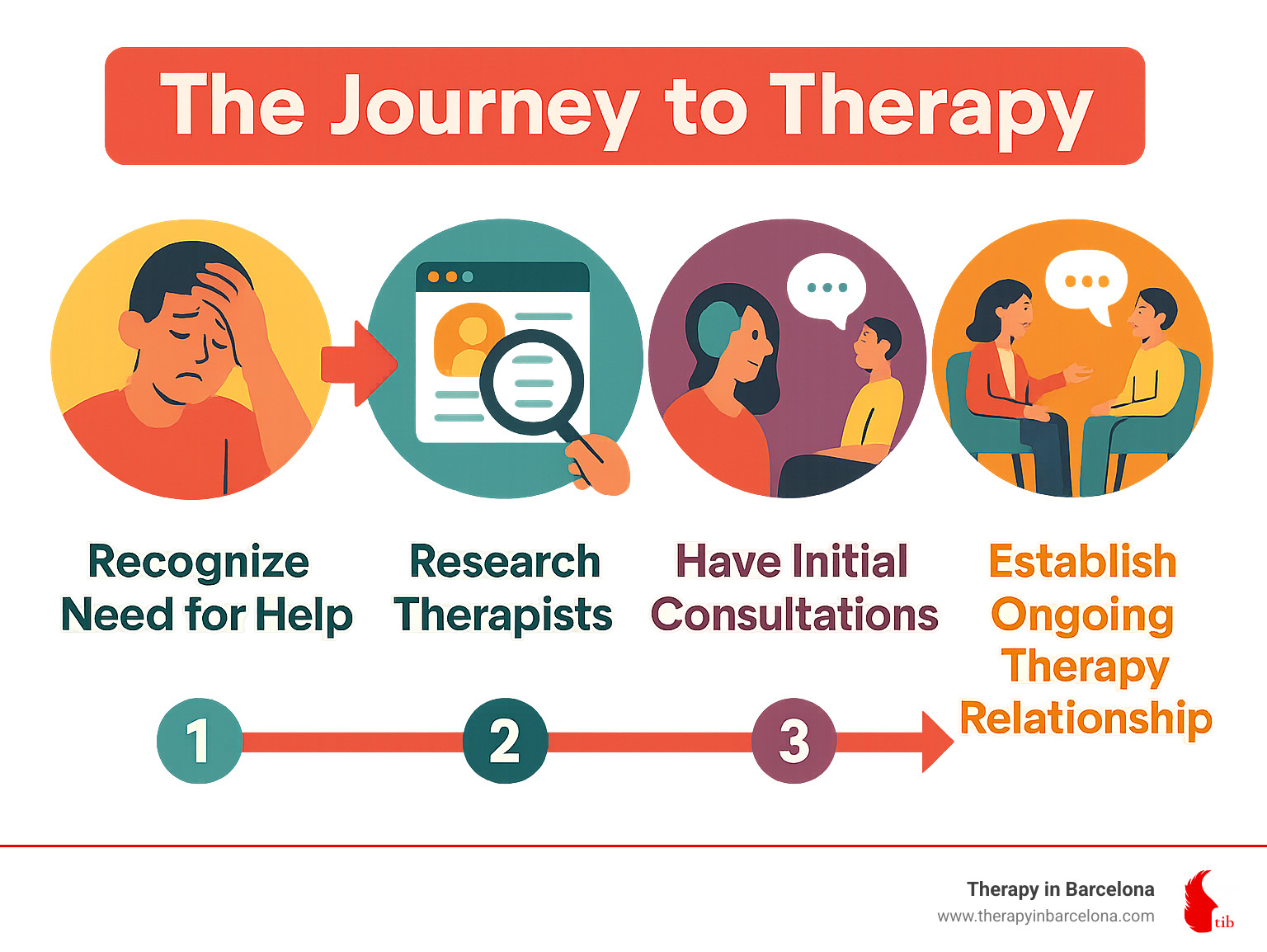
1. Recognise When You Might Need Help
Moving abroad can feel like stepping into a beautiful new chapter of your life—until the unexpected challenges start surfacing. Perhaps you relocated to Barcelona with dreams of weekend trips to the Costa Brava, only to find yourself spending Saturdays alone, scrolling through social media and feeling more isolated than ever. Maybe you’re a digital nomad who once thrived on trip, but now struggle to find motivation for projects that used to excite you.
These experiences aren’t just “part of the adjustment process”—they’re genuine signals that your mental health deserves attention. Living as an international amplifies everyday stresses in ways that can catch you completely off guard.
Recognising when you might benefit from professional support isn’t about admitting defeat—it’s about being proactive with your wellbeing. Many internationals push through difficult periods, thinking they should be grateful for their “privileged” expat lifestyle. But struggling with persistent anxiety that makes even simple tasks feel impossible, or experiencing low mood that lingers for weeks without lifting, are clear indicators that therapy could help.
Sleep disturbances often serve as early warning signs—perhaps you’re lying awake at 2 AM, your mind racing with worries about work, relationships, or whether you’ve made the right choice moving abroad. Changes in appetite, whether you’re barely eating or finding comfort in food more than usual, can also signal that your mental health needs support.
Relationship conflicts take on new dimensions when you’re living abroad. Arguments with your partner might follow the same patterns repeatedly, often intensified by the stress of cultural adaptation. You might find yourself feeling overwhelmed by differences that locals steer effortlessly—from understanding social cues to managing bureaucratic processes.
For many internationals, identity confusion becomes a significant struggle. You might catch yourself wondering who you are in this new context, especially if you’ve always defined yourself through your career, social circle, or cultural background.
Signs You Might Search “Psychotherapy Near Me” Right Now
Sometimes the need for support feels more urgent. If you’re experiencing certain symptoms, reaching out for help sooner rather than later can make a significant difference to your wellbeing and adjustment process.
Sleep issues that persist for more than two weeks often indicate that your nervous system is struggling to regulate itself. When combined with a complete loss of motivation for activities you usually enjoy, these signs suggest your mental health needs professional attention.
Frequent worry that feels uncontrollable is another clear indicator. This isn’t the normal concern about adapting to a new country; it’s persistent anxiety that interferes with your daily life.
Emotional numbness can be particularly concerning. If you find yourself feeling disconnected from your emotions, going through the motions of daily life without really feeling present, this often indicates that your mind is protecting itself from overwhelming stress.
You don’t need to be in crisis to benefit from therapy. Many of our clients at Therapy in Barcelona find that working with a therapist during relatively stable periods helps them build resilience and develop coping strategies for future challenges.
2. Psychotherapy Near Me: How to Search & Shortlist Therapists
Once you’ve recognised that therapy might be helpful, the next step is finding the right professional. The good news is that there are more options than ever before, especially for English-speaking internationals in cities like Barcelona, Madrid, and Valencia.
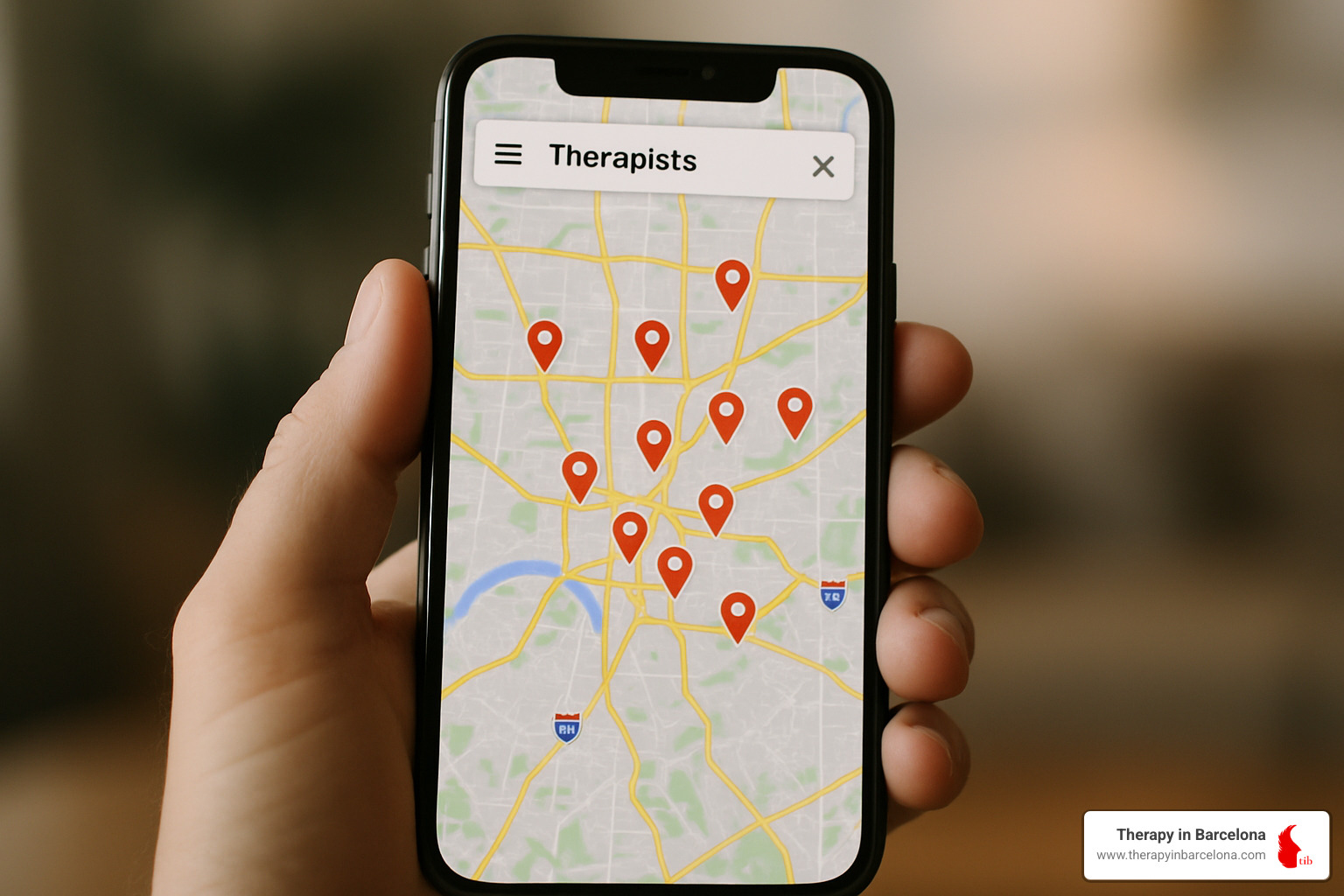
Your search for psychotherapy near me doesn’t have to feel overwhelming. Think of it as detective work—you’re gathering clues to find the person who’ll best understand your unique situation as an international living abroad.
Online directories are often your best starting point. Platforms like Psychology Today and GoodTherapy let you filter by location, language, and specialty. For those in Barcelona specifically, services like Therapy in Barcelona offer detailed therapist profiles with photos, backgrounds, and areas of expertise.
Personal referrals can be gold, especially from other expats who truly get what you’re going through. That colleague who moved from London last year? The friend from your international meetup group? They might have exactly the recommendation you need.
Insurance panels might feel limiting, but they’re worth checking if budget is a concern. Contact your insurance provider to understand your mental health coverage. Some international insurance plans offer surprisingly good therapy benefits.
Multilingual services matter more than you might think. Even if your English is excellent, there’s something powerful about working with a therapist who understands the nuances of living between languages and cultures.
More info about finding counsellors
Quick Filters for an Effective “Psychotherapy Near Me” Search
To avoid getting lost in endless therapist profiles, use these practical filters to narrow your search effectively.
Location considerations matter more than you might expect. Set a realistic travel radius—usually 30 to 45 minutes maximum. Consider Barcelona’s metro lines or Madrid’s transport links. Will you be coming straight from work? Is there parking near the office?
Specialty matching is where you can really fine-tune your search. Look for therapists who specifically mention expat experience or international clients. Someone who’s worked with accompanying spouses will understand your situation differently than a therapist who primarily sees local clients.
Practical requirements can make or break your therapy experience. Language preferences go beyond just fluency—do you want a native English speaker, or are you comfortable with someone who speaks English as a second language? Session availability that actually matches your schedule is crucial.
Finding “Psychotherapy Near Me” When You Prefer Online Sessions
The pandemic changed everything about how we think about therapy, and many people now prefer the flexibility of online sessions. This can be particularly beneficial for internationals who travel frequently or live in smaller Spanish cities with limited English-speaking therapist options.
Online therapy offers unique benefits for expats. You can access therapists from your home country who understand your cultural background intimately. There’s flexibility for different time zones if you’re frequently travelling for work. You get the comfort of attending sessions from your own space—no rushing across Barcelona traffic or finding parking.
When looking for online therapy platforms, prioritise encrypted, HIPAA- and GDPR-compliant video technology. Make sure there are clear policies about crisis intervention and emergency protocols. Check that therapists are licensed.
The choice between online and in-person really comes down to personal preference and your specific needs. Online therapy can be highly effective—research shows it’s just as beneficial as face-to-face sessions for many concerns.
3. Compare Professional Titles & Therapy Approaches
When you’re searching for “psychotherapy near me”, you’ll quickly find a confusing array of professional titles and therapeutic approaches. Don’t worry—this variety is actually good news because it means you can find someone who’s perfectly suited to your specific needs and situation.
Understanding who’s who in the mental health world can feel overwhelming, especially when you’re already dealing with stress or anxiety. The landscape in Spain might be quite different from what you’re used to back home, so let’s break it down in simple terms.
Psychologists are your go-to professionals for comprehensive therapy services. In Spain, they’re called “psicólogos” and must be registered with the official college of psychologists. They hold advanced degrees in psychology and can provide both therapy and psychological assessments.
Counsellors and Therapists bring a different flavour to the therapeutic relationship. Their educational backgrounds vary, but they specialise in creating those meaningful therapeutic conversations that help you work through challenges. Many have highly specialised training and belong to professional counselling associations.
Social workers offer a unique perspective because they understand how your social environment affects your mental health. They’re particularly valuable if you’re dealing with practical challenges alongside emotional ones—like navigating Spanish bureaucracy while managing anxiety.
Psychiatrists are the medical doctors of mental health. They can prescribe medication and provide therapy, making them essential if you think you might benefit from antidepressants or other psychiatric medications alongside talking therapy.
Now, let’s talk about therapy approaches—because this is where things get really interesting. Cognitive Behavioural Therapy (CBT) is probably the approach you’ve heard most about. It’s like having a detective for your thoughts, helping you identify and change unhelpful thinking patterns and behaviours. CBT tends to be structured and shorter-term, making it particularly effective for anxiety and depression.
Acceptance and Commitment Therapy (ACT) takes a different approach entirely. Instead of trying to eliminate difficult emotions, ACT helps you accept them while committing to actions that align with your values. This can be incredibly powerful for expats struggling with identity questions or feeling disconnected from their sense of purpose in a new country.
If you’ve experienced trauma—whether recent or from your past—Eye Movement Desensitisation and Reprocessing (EMDR) might be exactly what you need. It’s specifically designed for trauma processing and can seem almost magical in how effectively it helps people move through difficult experiences.
Psychodynamic therapy is the approach that explores how your past experiences influence your current behaviour and relationships. It tends to be longer-term and more exploratory, perfect if you’re curious about deeper patterns in your life.
For couples navigating the stress of relocation together, couples therapy can be a relationship-saver. Moving abroad puts enormous pressure on partnerships, and having a skilled therapist help you improve communication and resolve conflicts can strengthen your bond rather than let the stress tear you apart.
How Different Professionals Collaborate for Your Care
Here’s something many people don’t realise: you don’t have to choose just one professional. Sometimes the most effective approach involves a team of people working together to support your wellbeing.
You might work with a psychologist for weekly therapy sessions while also seeing a psychiatrist every few months for medication management. This combination can be particularly powerful if you’re dealing with anxiety or depression that benefits from both talking therapy and medication support.
Some people find that individual therapy combined with couples therapy from different specialists gives them the best of both worlds. You get space to work on your personal challenges while also strengthening your relationship with professional guidance.
The key to successful collaborative care is ensuring all your providers communicate effectively and work towards shared goals for your wellbeing. At Therapy in Barcelona, we often coordinate with other professionals to ensure you’re getting comprehensive support that addresses all aspects of your mental health needs.
4. Prepare for Your First Session & Build a Great Fit
Starting therapy can feel like stepping into the unknown, especially when you’re already navigating life in a foreign country. The good news is that first sessions are designed to be gentle introductions rather than deep dives. Think of it as a careful conversation where both you and your therapist are figuring out whether you’re a good match.

Before your appointment, take some time to gather your thoughts about what brought you to search for psychotherapy near me in the first place. Was it the sleepless nights after your move to Barcelona? The constant worry about whether you made the right decision? You don’t need a perfectly crafted story, but having a few key points in mind helps you make the most of your time together.
Consider what success looks like for you. Maybe it’s sleeping through the night again, feeling confident in social situations, or simply having someone who understands the unique challenges of expat life. These goals might evolve as you progress, but starting with some direction gives both you and your therapist a roadmap.
The practical side matters too. Gather your insurance information if you have coverage, think about payment methods, and make sure you know how to find the office or access the online platform. For in-person sessions in Barcelona, Therapy in Barcelona’s office is located in the heart of Eixample at Calle Paris 162-164, making it easily accessible by public transport.
Plan for the emotional side of your first session. It’s completely normal to feel nervous, and many people find that talking about their struggles brings up unexpected emotions. Consider scheduling some quiet time afterwards and having a supportive friend or partner available if you need to debrief.
More info about right therapist fit
Questions to Ask During the First “Psychotherapy Near Me” Appointment
Don’t hesitate to ask questions during your first session. A skilled therapist will welcome your curiosity and want you to feel fully informed about the process ahead.
Start with the basics about their experience. Ask directly: “What’s your experience working with expats and internationals?” This matters because living abroad creates unique stressors that not all therapists fully understand.
Understand their approach by asking how they typically work with concerns like yours. Some therapists are very structured and goal-oriented, while others prefer a more exploratory, conversational style.
Clarify the practical details that will affect your ongoing relationship. How often will you meet? What should you expect in terms of session frequency and duration? How will you know if therapy is working?
For expat-specific concerns, dig deeper into their cultural competence. Have they worked with people from your cultural background before? Do they understand the visa and residency pressures you might be facing?
What to Do if the Fit Isn’t Right
Sometimes, despite everyone’s best intentions, the therapeutic relationship doesn’t feel right. This happens more often than you might think, and it’s nobody’s fault.
Signs that the fit might not be working include consistently feeling misunderstood or judged, finding that the therapist’s approach doesn’t resonate with your learning style, or feeling like you’re not making progress after several sessions.
Cultural or language barriers can also create problems. While your therapist might speak excellent English, subtle cultural nuances can sometimes get lost, leaving you feeling like you’re constantly having to explain context rather than focusing on your actual concerns.
If you’re experiencing these issues, start with an open conversation with your therapist about your concerns. Be specific about what’s not working for you. A good therapist will listen without defensiveness and might be able to adjust their approach.
However, if adjustments don’t help, don’t hesitate to request a referral to someone else. Professional therapy practices like Therapy in Barcelona are experienced in helping clients find better matches when needed.
5. Fees, Insurance, and Sliding-Scale Options
Let’s talk about money—because therapy is an investment in yourself, and you deserve to understand exactly what that investment looks like. The financial side of psychotherapy near me searches can feel overwhelming, especially when you’re already dealing with the stress that brought you to therapy in the first place.
The reality is that therapy costs vary quite a bit depending on where you are, who you’re seeing, and how you’re receiving care. At Therapy in Barcelona, our collaborators set their own prices, and fees range from 80 to 95 Euros for an individual therapy session and from 90-115 Euros for a couples therapy session.
Online sessions often cost slightly less than in-person appointments—typically about 10-20% lower. This can make therapy more accessible, especially if you’re managing the financial pressures that often come with expat life.

Insurance can be your friend—or a puzzle to solve. Many international health insurance plans include mental health coverage, but the details vary dramatically. Some plans require you to get a referral from your GP first. Others have annual limits on the number of sessions they’ll cover.
Before you start your psychotherapy near me search, it’s worth spending a few minutes understanding what your insurance actually covers. Ask about co-pays, deductibles, and whether you need pre-authorisation.
Employee assistance programmes (EAPs) are often overlooked goldmines. Many international companies offer free short-term counselling—typically 3-8 sessions—as part of their benefits package.
Budget-Friendly Tips Without Compromising Quality
Here’s the thing about therapy costs: yes, it’s an investment, but it shouldn’t be financially devastating. There are several ways to access quality mental health care without breaking the bank.
Sliding scale fees are more common than you might think. Many therapists offer reduced rates based on your income or circumstances. When you’re discussing fees, be honest about your financial situation—most therapists would rather work with you at a reduced rate than not work with you at all.
Group therapy can be both cost-effective and surprisingly powerful. There’s something uniquely healing about realising you’re not alone in your struggles. Many practices offer expat support groups, anxiety management groups, or couples workshops that cost significantly less than individual sessions.
Training clinics and university programmes often provide excellent care at reduced rates. Therapists-in-training work under close supervision from experienced professionals, and they’re often highly motivated to provide excellent care.
Community mental health centres exist in many Spanish cities and sometimes offer services in English. These might have waiting lists, but they can provide quality care at significantly reduced costs.
The most expensive therapy is the therapy that doesn’t work for you. Sometimes paying a bit more for the right therapist is actually more cost-effective than cycling through cheaper options that don’t provide the support you need.
When you’re budgeting for therapy, think about it as a monthly investment rather than focusing on individual session costs. Most people attend weekly or bi-weekly sessions, so you’re looking at roughly 280-380 Euros per month for weekly individual therapy, or 180-240 Euros for bi-weekly sessions.
Frequently Asked Questions about Psychotherapy Near You
How long will therapy take and how often will I go?
There is no single timetable. Generally:
- Crisis stabilisation: 3–6 weekly sessions focused on immediate coping.
- Targeted work on anxiety, low mood, or relationship stress: 8–20 sessions, usually weekly at first, then bi-weekly as you feel steadier.
- Maintenance or personal growth: monthly check-ins once goals are met.
You and your therapist will review progress regularly and decide together when to space out or finish sessions.
Will my insurance or employee benefits pay for therapy?
Many international health policies include mental-health care, but the small print matters. Before booking, ask your insurer:
- Do you reimburse sessions with psychologists in Spain?
- Do I need a GP referral or pre-authorisation?
- What is the yearly session or euro limit?
- What paperwork is required for claims?
If cover is limited, check whether your employer’s EAP offers 3–8 free sessions to get you started.
What else, besides anxiety or depression, can therapy help with?
Talking therapy supports far more than the “big two”. Common themes we see at Therapy in Barcelona include:
- Cultural adjustment, homesickness, and identity questions.
- Relationship strain with partners, family, or colleagues.
- Grief, trauma, and major life transitions such as job change or parenthood.
- Sleep problems, burnout, perfectionism, and chronic stress.
- Self-confidence, assertiveness, creativity blocks, or finding purpose.
In short, if a thought, feeling, or behaviour is limiting your life abroad, therapy can give you tools, insight, and support to move forward.
Conclusion
Taking that first step to search for psychotherapy near me can feel overwhelming, but it’s often the beginning of a profound journey towards better mental health and personal growth. Whether you’re an expat struggling with cultural adjustment, feeling isolated in a new city, or simply recognising that you need professional support during a challenging time, the right therapeutic relationship can truly transform your experience of living abroad.
Finding the perfect therapist isn’t something that happens overnight—it’s a process that requires patience and self-advocacy. You might meet with several professionals before finding that magical therapeutic fit, and that’s completely normal. The time and energy you invest in this search is an investment in your future wellbeing, your relationships, and your overall quality of life in your new home.
For internationals living in Spain, services like Therapy in Barcelona understand the unique challenges you face in ways that go beyond language barriers. From the stress of visa renewals to the identity confusion that comes with living between cultures, from the loneliness of starting over to the relationship strains that relocation can bring—working with therapists who truly understand the expat experience can make all the difference.
Since 2011, Therapy in Barcelona has been providing culturally sensitive support to the international community, recognising that your mental health needs are as unique as your journey abroad. Their personalised therapist matching process ensures you’re not just paired with the next available professional, but with someone who genuinely understands your specific situation and cultural background.
Your mental health matters, and seeking support isn’t a sign of weakness—it’s an act of courage and self-care. You deserve to thrive in your new environment, not just survive it. Whether that first step involves researching therapists online, calling your insurance provider to understand your coverage, or booking that initial consultation you’ve been putting off, your future self will thank you for prioritising your wellbeing.
More info about Therapy Near Me services
You’re not alone in this journey. Thousands of expats have walked this path before you, and with the right support, you can steer whatever challenges you’re facing while building a fulfilling life abroad.
