


Why This Book Matters for Couples Living Abroad

The book how to improve your marriage without talking about it by Dr. Patricia Love and Dr. Steven Stosny offers a radical idea: sometimes, the best way to fix your marriage is to stop trying to talk it through. For couples living abroad—whether you’re building a life in Barcelona, Valencia, Madrid, or beyond—this message can feel both liberating and controversial.
Here’s what you need to know about this book:
- Core premise: Connection matters more than communication. Talking about your relationship can sometimes push you further apart.
- Main insight: Women often fear disconnection, while men often fear failure. These underlying emotions drive most conflicts.
- Key strategies: Focus on non-verbal actions like touch, shared activities, sex, and daily rituals instead of lengthy discussions.
- Target audience: Couples stuck in nagging/stonewalling patterns, or where one partner dreads “the talk.”
- Limitations: The book generalises gender differences and may not address deeper issues like infidelity, trauma, or cultural adjustment.
Emily, a 34-year-old UK expat in Barcelona, grew frustrated with her partner, Tom. When she tried to discuss her loneliness or stress about adapting, he shut down. She felt unheard; he felt criticised. Their talks became tense standoffs, leaving them more disconnected. Emily is fictional, but her story mirrors the relationship strain many internationals face when living far from home.
The book argues that actions, gestures, and understanding emotional vulnerabilities can rebuild intimacy when words fail. For expat couples dealing with cultural adjustment, language barriers, and isolation, this approach offers a different path.
In this review, we’ll explore the book’s core ideas, its practical strategies, where it succeeds, and where it falls short. We’ll also consider when self-help alone isn’t enough—and when professional support might be the better option.
The Core Premise: Why Talking Isn’t Always the Answer
The book how to improve your marriage without talking about it makes a surprising claim: sometimes, talking about relationship problems makes things worse. Drs. Patricia Love and Steven Stosny argue that endless emotional discussions can push partners apart, especially considering how differently people respond to them.
Think about the last time your partner said, “We need to talk.” That feeling of dread isn’t random. The authors say these talks often trigger a “cortisol hangover”—a stress response that leaves both partners anxious and disconnected. The talk meant to bring you closer leaves you feeling worse.
The book challenges communication myths—the belief that verbalising every feeling is the only path to intimacy. They suggest these myths ignore how differently people process emotional conversations. Following this advice without understanding can lead to exhaustion, frustration, and what the authors call “relationship talk fatigue.”
For expat couples dealing with the stress of living abroad, this pattern can be especially destructive. You can find the book here: How To Improve Your Marriage Without Talking About It: Finding Love Beyond Words.
The Problem with “The Talk”
You’ve probably seen this pattern. One partner (often the woman) tries to discuss feelings. The other (often the man) withdraws or gets defensive. She feels ignored; he feels attacked. The cycle repeats, leaving both more isolated.
The book explains this isn’t about right or wrong. When one partner expresses hurt, the other may hear it as criticism or failure. This triggers shame, leading to withdrawal. That withdrawal makes the first partner more anxious, so they push harder to talk. The conversation meant to create closeness becomes a source of conflict.
This is the classic “pursue-withdraw” pattern, a common source of relationship distress. The talk backfires by activating core vulnerabilities without offering safety, leaving both partners feeling misunderstood and distant.
Connection Before Communication
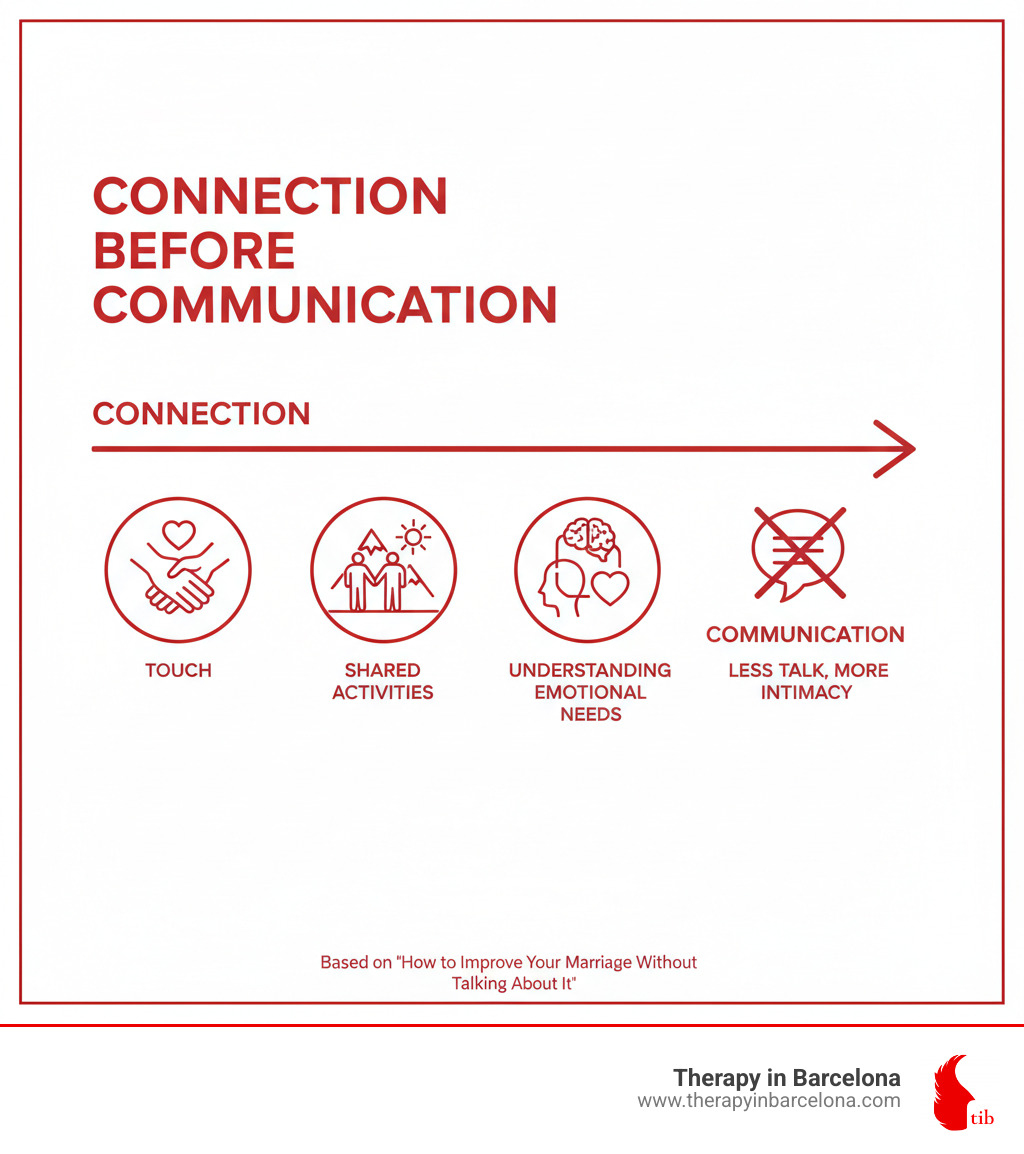
If talking isn’t the answer, what is? The book’s radical suggestion is to focus on connection before communication. Build emotional safety through actions, not words. When that foundation is solid, conversations become easier.
This means prioritising non-verbal intimacy: a hug, sitting close on the sofa, making their coffee, or initiating sex. These small gestures rebuild what John Gottman calls the “emotional bank account”—the goodwill that helps couples through difficult moments.
When partners feel connected and valued, they are more open to listening with empathy. Words then flow from a place of closeness, not as an attempt to create it. The conversation becomes an extension of your connection.
This approach can be especially helpful for couples facing the unique stresses of expat life. When dealing with cultural adjustment or homesickness in a new city, what you often need most is to feel close to your partner again. As we explore at Therapy in Barcelona, the strain of moving abroad on relationships can intensify these dynamics, making non-verbal connection vital for internationals.
Fear vs. Shame: The Hidden Emotional Drivers in Your Marriage
One of the most powerful insights from the book how to improve your marriage without talking about it is its focus on fear and shame—two emotions that quietly drive most relationship conflicts. The authors suggest these feelings often operate differently in men and women, shaping their responses to stress. While not universal, these patterns offer a useful lens for understanding why couples miss each other emotionally.
For expat couples, these dynamics are often more intense. Building a life in Barcelona, Valencia, or Madrid involves stressors like language barriers and distance from family, which amplify fear and shame. When your partner is your main anchor and that connection feels shaky, the emotional stakes are higher.
Her Fear of Disconnection
The book argues that women are often more attuned to threats of disconnection, linked to an evolutionary need for close relationships for safety. When a woman senses emotional distance, her anxiety rises. She wants to talk and reconnect to ensure the bond is intact. This is what psychologists call the “tend and befriend” response—a drive to repair when stressed.
For an expat woman, this fear can be acute. In a new city, without fluent language skills or old friends nearby, your partner is your main comfort. If that relationship feels unstable, the isolation can be overwhelming. You might push to talk things through, seeking reassurance that you’re not alone in a foreign place.
This strain is real and common. Many internationals find that moving abroad puts unexpected pressure on their relationships. You can read more about how relocation affects couples here: The Strain of Moving Abroad on Relationships: Why Couples Therapy Can Be Your Lifeline.
His Fear of Failure (Shame)
Men, according to the book, are more sensitive to shame and inadequacy. Many are taught to hide vulnerability and prove their competence. When a man feels he’s falling short as a partner or provider, shame kicks in. His instinct might be to fight or flight: become defensive, shut down, or withdraw. He’s trying to protect himself from feeling not good enough.
When a woman tries to talk about relationship problems, a man might hear it as criticism—that he’s failing to make her happy. This triggers his core shame, so he pulls back. Emotional withdrawal becomes a shield, not indifference.

This is especially painful for expat couples. If a man is already struggling to adapt—perhaps with his career or social life—his sense of failure is heightened. His partner’s need to talk can feel like another failure, causing him to withdraw and leaving both partners feeling misunderstood and alone.
A Deep Dive into the Book “How to Improve Your Marriage Without Talking About It”
The book how to improve your marriage without talking about it doesn’t ask you to stop communicating. It offers a radical shift: replace unproductive talk with intentional actions that build genuine connection. For many couples, especially those facing the challenges of expat life in Barcelona, Valencia, or Madrid, this reframing can be a relief.
The authors, Dr. Patricia Love and Dr. Steven Stosny, know that both partners want a close, loving marriage. The friction comes from how differently we often express emotion. The book provides practical tools for building empathy through behaviour, not just words.
The key is to see beyond the surface of what your partner says or does. When you understand the underlying fears and shames driving their reactions, you can respond with compassion instead of defensiveness. This shift alone can transform a relationship.

Key Strategies: The “How-To” of Loving More with Fewer Words
The book lays out concrete strategies for strengthening your marriage without “the talk.” These are small, consistent actions that communicate care more effectively than words.
Touch is one of the simplest tools. A hand on your partner’s arm, a hug that lasts a few seconds longer, or holding hands while watching television—these moments of non-sexual physical contact convey affection and bypass our defensive filters.
Sexual intimacy is another vital form of connection. For many, physical closeness can express love and commitment more directly than any conversation. When words feel loaded, sex can be a way to reconnect.
Shared routines create stability. Having coffee together each morning, taking an evening walk through your Barcelona neighbourhood, or cooking dinner side-by-side builds positive associations and reinforces the “we” in your relationship.
Shared activities go beyond routine. Exploring Valencia’s City of Arts and Sciences, taking a Spanish cooking class, or hiking near Málaga creates positive memories and strengthens your connection through enjoyment, not analysis.
Gestures of appreciation replace criticism with recognition. Instead of pointing out what your partner forgot, acknowledge what they did. A simple “Thanks for picking that up” reinforces positive behaviour and makes your partner feel valued.
Small daily rituals are intentional moments of connection. A lingering kiss before work, a quick text during lunch, or a specific greeting when you come home consistently shows your partner they matter.
The Power of Connection and ‘Binocular Vision’
The book argues that love is about connection—feeling seen, understood, and cherished. This sense of safety allows a relationship to weather storms, especially for expat couples dealing with cultural adjustment, language barriers, and distance from family.
The authors introduce a concept they call “binocular vision.” Just as two eyes create depth perception, understanding both your own and your partner’s emotional reality creates a fuller picture of your relationship. This means stepping outside your perspective to consider what might be driving your partner’s behaviour.
When your partner withdraws, binocular vision asks you to consider: might they feel ashamed rather than indifferent? When your partner seems anxious, might they fear disconnection rather than trying to control you? This empathetic understanding transforms how you respond.
This deep understanding is a central goal in couples therapy, where partners learn to see each other beyond defensive patterns. You can learn more about this process here: The Art of Healing: How Couples Therapy Works.
Applying the ‘Power Love Formula’ from the Book
The “Power Love Formula” is the book’s framework for putting these principles into daily practice. It’s about small, intentional actions that consistently show your partner they are important.
The formula encourages finding daily moments for connection. Perhaps you set aside ten minutes each evening for positive interaction—not to discuss problems, but simply to be together. Maybe you listen to your partner’s day without offering advice, just your presence. Or you create a moment of physical closeness before bed, holding each other without pressure.
These consistent, positive interactions build an emotional bank account. They create a reserve of goodwill that can absorb the stresses of life—job pressures, financial worries, and the challenges of building a life abroad. When that foundation is strong, conflicts become more manageable.
For expat couples, these daily rituals can be anchors when everything feels uncertain. When you are far from family, adjusting to a new culture, or feeling isolated, this steady connection with your partner becomes vital.
A Balanced View: Strengths, Criticisms, and When to Talk
The book how to improve your marriage without talking about it has resonated with many readers, earning a respectable 3.94 out of 5 stars on Goodreads from nearly 2,000 ratings. Around 70% of readers gave it 4 or 5 stars, suggesting its approach has genuinely helped people. But like any book that challenges conventional wisdom, it also attracts criticism and isn’t right for everyone.

What the Book Does Well
The book offers real relief for couples who feel stuck. It empowers action by giving concrete steps you can take today, without waiting for the perfect conversation. For partners who dread “the talk,” this can feel like a lifeline.
It also offers hope for talk-averse partners—particularly men who find traditional emotional discussions overwhelming. Many readers say the book validated their experience of feeling constantly misunderstood or criticised, which can be transformative.
The practical tools are another strength. The focus on touch, shared activities, and small rituals provides tangible ways to rebuild connection. These are actions you can implement immediately.
By explaining the fear-shame dynamic, the book helps couples break negative cycles. Understanding why your partner withdraws or becomes anxious can shift the entire tone of a relationship. Instead of blaming, couples can see the underlying vulnerabilities, interrupting long-standing patterns of nagging and stonewalling.
Perhaps most importantly, the book helps couples understand each other. It encourages empathy by offering insights into the different emotional vulnerabilities men and women often experience. When you understand that your partner’s withdrawal isn’t indifference but shame, or her need to talk isn’t nagging but fear, compassion becomes easier.
Is the Book “How to Improve Your Marriage Without Talking About It” a Substitute for Therapy?
Here’s the honest answer: no. While the book offers valuable insights, it has clear limitations. It’s a self-help resource and can’t adapt to your unique situation, past traumas, or specific relationship dynamics.
Self-help books provide general guidance. They can’t ask follow-up questions, notice what you’re not saying, or help you manage the emotional intensity of deep-seated resentment or infidelity. For expat couples, the challenges are often layered—cultural adjustment, language barriers, and the stress of being far from home can deepen underlying fears.
If your relationship is struggling with profound distance, betrayal, or patterns that feel impossible to shift, a book may not be enough. Professional couples therapy provides a safe, structured environment to explore these issues with a trained guide. You can read more about whether marriage counselling can save your relationship here: The Truth About Marriage Counseling: Can It Save Your Relationship?
When considering support, it’s worth understanding your options. Public system clinicians often have long waiting lists and may not specialise in couples therapy or expat issues. Large online platforms can be convenient but may lack the personalised matching and cultural sensitivity many expats need.
At Therapy in Barcelona, our approach is different. We offer a private-pay service focused on bespoke therapist matching. We ensure you’re paired with a qualified, psychology-trained therapist who understands the unique challenges of expat life. Our therapists, many of whom are expats themselves, bring cultural and linguistic sensitivity to their work, offering support in English and other languages including German, French, Spanish, Portuguese, and Swedish. We prioritise your privacy—we don’t sell your data—and deliver high-quality, evidence-based care custom to your needs, whether you’re in Barcelona, Madrid, Valencia, Málaga, or elsewhere in Spain. We also work online with clients worldwide, including the USA and Canada. While some of our therapists offer sliding scale fees for those with financial need, prospective clients can inquire about this during their initial contact or Free Discovery Call.
Frequently Asked Questions about This Approach
What if my partner and I actually enjoy talking?
Then keep talking. Seriously. The book how to improve your marriage without talking about it isn’t suggesting all conversation is harmful. The authors are addressing ineffective relationship talk—the kind that spirals into blame, defensiveness, or frustration. If your deep conversations bring you closer, create understanding, and leave you both feeling heard, then they’re working beautifully.
This book is really for couples who find that their attempts to “work things through” verbally often end in arguments, withdrawal, or both partners feeling more alone than before. If that’s not you, consider yourself lucky. The strategies in the book can still add value—small gestures of affection and shared activities strengthen any relationship—but you don’t need to abandon what’s already working.
Can this method work for issues like infidelity or financial stress?
Honestly? Not on its own. While the book’s emphasis on building connection through non-verbal actions can help create a safer emotional foundation, it’s not designed to address severe or complex issues. Infidelity, substance misuse, significant financial conflict, or deep-seated resentment typically require direct, sometimes difficult conversations—and often the guidance of a trained therapist.
Think of the book’s strategies as a supportive layer. They can help reduce defensiveness and rebuild trust, making space for harder discussions. But they shouldn’t replace accountability, transparency, or professional support when the stakes are high. For expat couples, these challenges can be even more complicated, layered with financial strain from relocation, cultural differences around money, or the isolation that makes betrayal feel even more devastating.
What if only one person is willing to try these non-verbal actions?
It’s not ideal, but it’s not hopeless either. The authors suggest that even when only one partner actively engages with the book’s principles, positive change is possible. Small, consistent gestures—a touch on the shoulder, initiating a shared activity, expressing appreciation without expecting anything back—can subtly shift the dynamic of a relationship.
By leading with positive actions, one partner can sometimes inspire the other to respond in kind, even if they haven’t read the book how to improve your marriage without talking about it or aren’t consciously trying. It’s about focusing on what you can control: your own behaviour, your own gestures of connection. That said, lasting change usually requires both partners to participate eventually. If one person continues to resist or withdraw, it might be time to explore whether there are deeper issues at play—and whether professional support could help.
Your Next Step Towards a Stronger Connection
The book how to improve your marriage without talking about it suggests that understanding each other’s vulnerabilities and taking action—through touch, shared experiences, and daily rituals—can rebuild intimacy when words fail. For couples stuck in cycles of nagging and withdrawal, this approach has offered real relief, and its strong Goodreads ratings reflect this.
For expat couples, the book’s insights are especially relevant. When you’re dealing with cultural adjustment, isolation, and the stress of building a new life in Barcelona, Madrid, or Valencia, words can feel inadequate. Focusing on connection through action can be a powerful alternative.
But a book has its limits. It can’t adapt to your unique history or the specific challenges you face as an international couple. If you’re dealing with deeper issues like persistent conflict, infidelity, or the compounded stress of expat life, professional support can make a real difference.
At Therapy in Barcelona, we understand the journey of international couples. Our team of psychology-trained therapists, many of whom are expats, offers culturally sensitive support in English and other languages like German, French, Spanish, Portuguese, and Swedish. We work online with clients worldwide (including the USA and Canada) and offer face-to-face sessions in our Barcelona office.
What sets us apart is our personalised therapist matching. We take time to understand your needs and match you with a therapist who gets your situation—whether you’re in Barcelona, Valencia, Madrid, or beyond. We are a private-pay service, and some therapists offer sliding scale fees. You can inquire about this when you reach out.
If you’d like support strengthening your connection, understanding your partner better, or working through the unique dynamics of an expat relationship, we’re here to help. Book a Free Discovery Call with us to explore how custom couples counselling can support you.
