


What the Research Really Says About the Psychological Impact of Biculturalism
The psychological impact of biculturalism evidence and theory points to a complex, nuanced picture — one where living between two cultures brings both genuine strengths and real challenges.
Here is a quick summary of what the research shows:
- Positive effects: Higher cognitive flexibility, greater creativity, improved perspective-taking, and stronger intercultural communication skills
- Identity benefits: Biculturals who integrate both cultural identities (known as high Bicultural Identity Integration, or BII) tend to show greater self-consistency and psychological well-being
- Cognitive advantages: Exposure to two cultural frameworks fosters what researchers call “integrative complexity” — the ability to hold and reconcile multiple viewpoints
- Mental health considerations: Cultural identity conflict, isolation, and the stress of navigating two worlds can increase vulnerability to anxiety and low mood
- Key moderating factors: Age, generation status, gender, and the degree of harmony between one’s two cultural identities all shape how biculturalism is experienced psychologically
If you are living between cultures — whether you moved from London to Barcelona, grew up with one foot in two worlds, or are raising children across cultural lines — you are part of a group that now numbers in the hundreds of millions worldwide. And the science of what that does to the mind is far richer than most people realise.
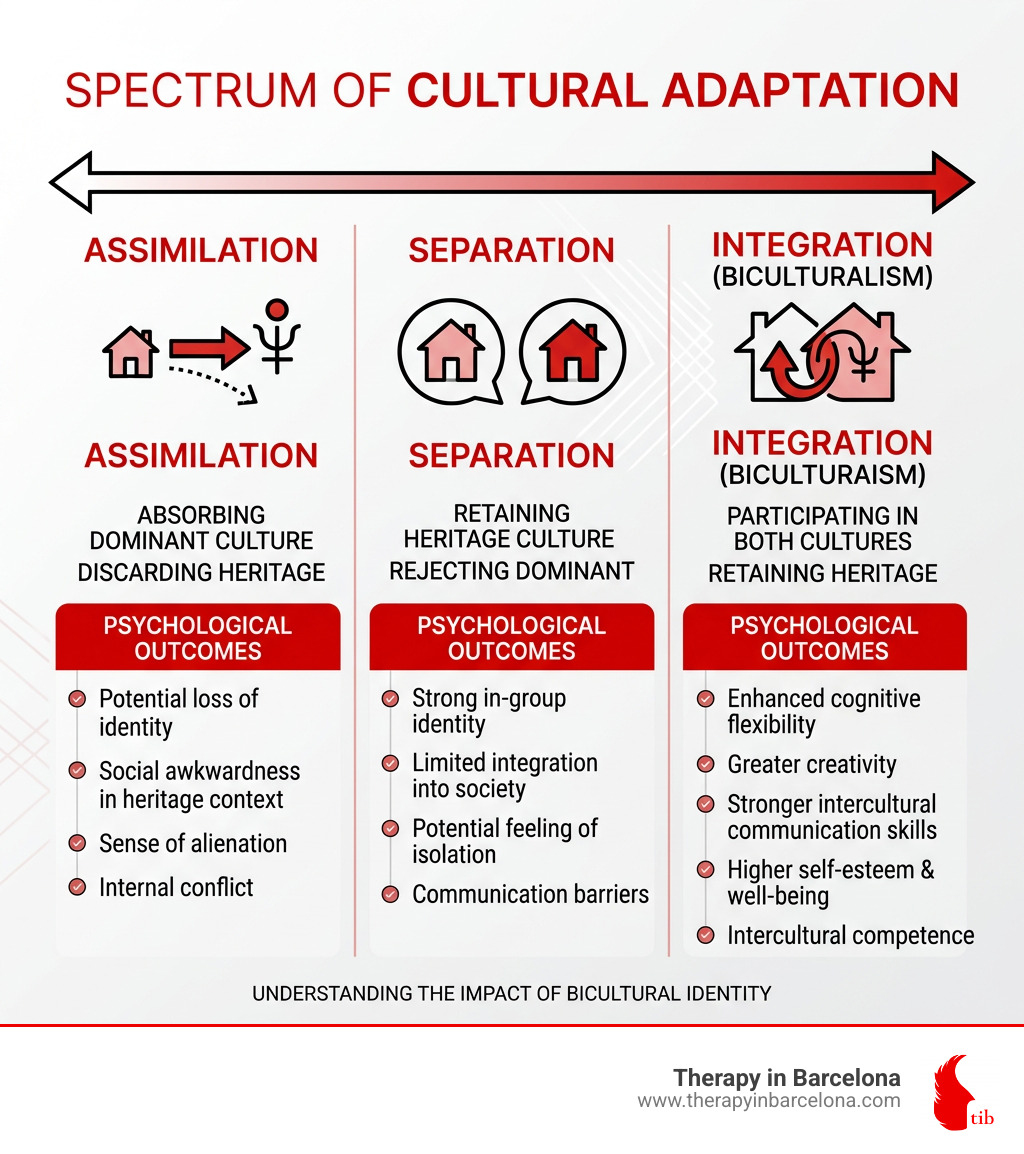
For many years, psychology framed assimilation as the ideal: adapt to the dominant culture and gradually let go of your heritage culture. Bicultural theory pushed back on that assumption. Research, including the influential review by LaFromboise and colleagues on bicultural competence and adaptation, suggests that people can participate effectively in two cultures without losing either one. That shift changed how psychologists understand identity, adjustment, and well-being.
This article takes a deep look at what the evidence actually tells us — from the theoretical models that frame biculturalism, to the empirical findings on self-concept, mental health, and cognitive complexity, to what all of this means practically for expats, immigrants, and their families navigating life in multicultural cities across Spain and beyond.
Defining the Bicultural Experience
To understand the psychological impact of biculturalism evidence and theory, we first need to define what it means to be bicultural. In simple terms, biculturalism involves the process of identifying with and being proficient in two different cultures. This isn’t just about where you were born; it’s about how you navigate the values, traditions, and social cues of both your heritage culture and the dominant culture where you currently live.
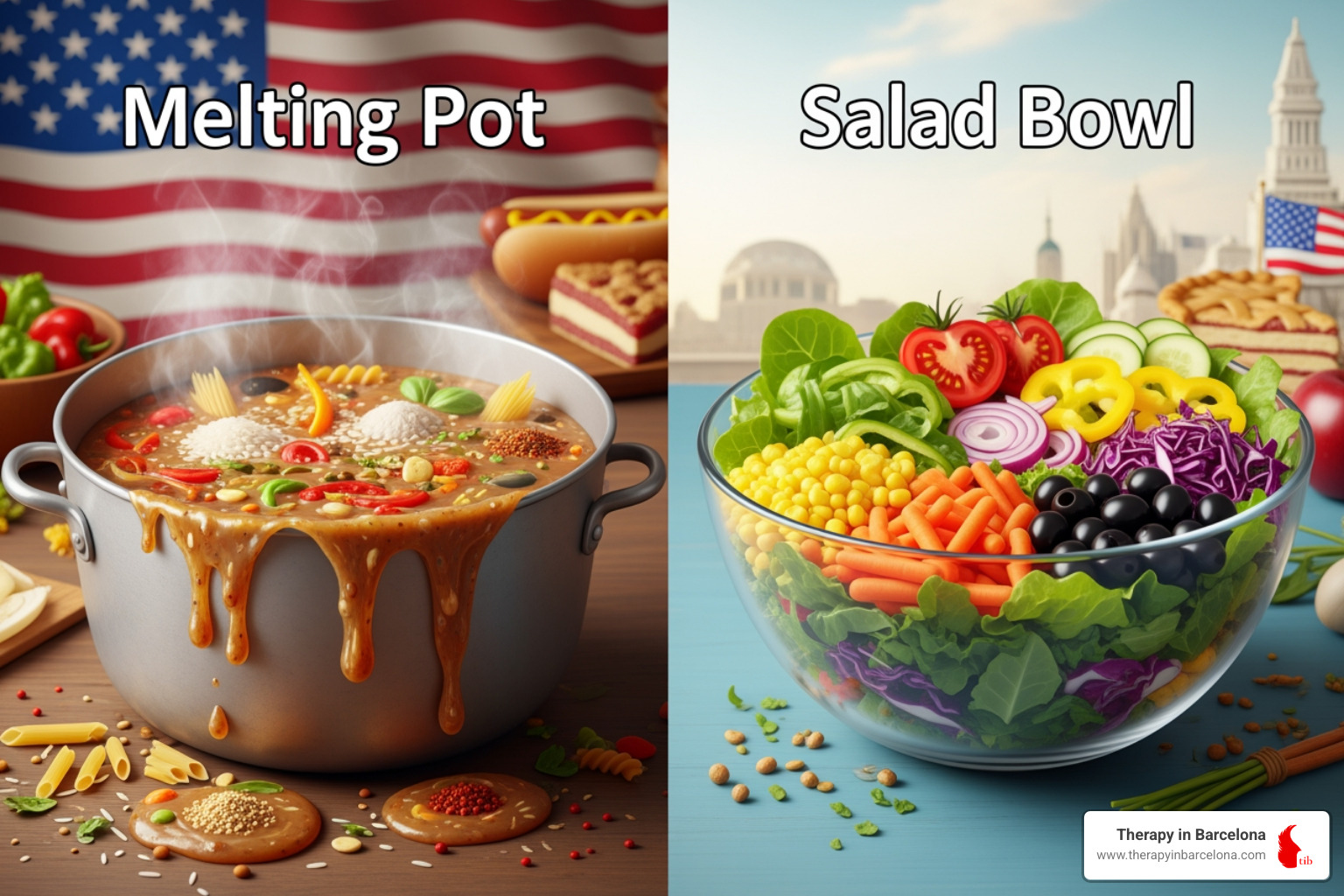
Historically, society viewed cultural adaptation through the lens of the “melting pot.” This concept of assimilation suggested that to succeed, a person must shed their original cultural skin and fully adopt the new one. However, modern psychology prefers the “salad bowl” analogy. In a salad bowl, each ingredient—the lettuce, the tomatoes, the cucumbers—retains its distinct flavour and texture while contributing to a delicious whole.
Distinguishing Biculturalism from Assimilation
The difference between biculturalism and assimilation is fundamental. Assimilation is a linear, one-way street where the heritage culture is eventually lost. Biculturalism, however, is a two-way process. It allows an individual to maintain their heritage roots while simultaneously branching out into the dominant culture.
Research shows that forcing assimilation can lead to significant psychological stress. Conversely, biculturalism allows for a more flexible identity. It acknowledges that you can be “both/and” rather than “either/or.” For an expat in Valencia or a digital nomad in Madrid, this means you don’t have to stop being British, American, or German to become a functional and happy part of Spanish society.
Theoretical Frameworks: Exploring the Psychological Impact of Biculturalism Evidence and Theory
Psychologists use several models to explain how we handle dual identities. The most prominent include:
- The Alternation Model: This is often considered the most promising framework. It suggests that individuals can gain competence in two cultures and switch between them depending on the context—much like a bilingual person switches languages—without losing their primary identity.
- The Fusion Model: This suggests that cultures intermingle to form a new, unique hybrid culture.
- The Multicultural Model: This views society as a collection of distinct cultural groups that interact while maintaining their boundaries.
The Scientific research on bicultural theory by LaFromboise et al. (1993) highlights that the alternation model leads to the best psychological outcomes because it avoids the “cultural choice” stress that other models might impose.
The Psychological Impact of Biculturalism Evidence and Theory: A Comprehensive Overview
Living as a bicultural person literally changes how your brain works. When a bicultural person switches between languages or cultural contexts, they are engaging in “cultural frame switching.” This requires high levels of executive function—the brain’s command centre responsible for focus, switching tasks, and ignoring distractions.
Bicultural Identity Integration (BII) and Self-Consistency
One of the most important concepts in this field is Bicultural Identity Integration (BII). This measures how much a person feels their two identities are compatible and “blended” versus oppositional and “distant.”
- High BII (Harmony/Hybridity): These individuals see their two cultures as complementary. They might call themselves “Chinese Canadian” or “Mexican Spanish” with ease.
- Low BII (Conflict/Distance): These individuals feel caught between two worlds. They may feel that they have to choose one over the other or that the two cultures are in constant battle.
Research on self-consistency in biculturals shows that those with higher BII tend to have more consistent self-concepts across different roles. For example, a study of Chinese Canadians found that those who felt their identities were “hybrid” showed a strong correlation (r=0.31) with cross-role consistency. They felt like the same person whether they were with their Chinese family or their Canadian friends.
Empirical Findings: The Psychological Impact of Biculturalism Evidence and Theory in Practice
The evidence for the benefits of biculturalism is robust. When over 232 million people are international migrants, understanding these impacts is vital.
- Cognitive Flexibility: Biculturals often show higher “integrative complexity.” Because they have to navigate two sets of rules, they become experts at seeing multiple perspectives.
- Creativity: Studies on Latino and East Asian Canadians suggest that biculturalism is a driver of creative success. The ability to “think outside the box” comes naturally when you live in two different boxes simultaneously.
- Social Effectiveness: Research involving 493 university students using the Multicultural Personality Questionnaire (MPQ) found that bicultural students scored significantly higher in intercultural effectiveness than their monocultural peers.
In highly diverse cities like Toronto, where ethnic minorities account for 47% of the population, or Barcelona, which is a hub for internationals, these bicultural skills are not just psychological perks—they are essential tools for daily life.
Developing Bicultural Competence
Being bicultural isn’t just something you are; it’s something you do. Researchers have identified specific dimensions of “bicultural competence”—the skills required to navigate two cultures successfully without losing your sense of self.
The Six Dimensions of Cultural Competence
According to the hypothetical model proposed by LaFromboise and colleagues, there are six key areas:
- Knowledge of Cultural Beliefs and Values: Understanding the basic history, institutions, and “unwritten rules” of both cultures.
- Positive Attitudes Toward Both Groups: Being able to see the strengths in both your heritage and your host culture.
- Bicultural Efficacy: The confidence that you can live effectively in both cultures without losing your identity.
- Communication Ability: Proficiency in the languages of both cultures, including the non-verbal cues.
- Role Repertoire: The ability to behave appropriately in different cultural situations (e.g., knowing how to act at a Spanish sobremesa versus a formal business meeting in London).
- Groundedness: Having a stable social support system in both cultures.
Naïve Dialecticism and Cognitive Flexibility
An interesting finding in the psychological impact of biculturalism evidence and theory is the role of “naïve dialecticism.” This is a cognitive style common in East Asian philosophies that embraces contradiction, change, and holism.
Some bicultural people, especially East Asian biculturals, may seem less consistent across different situations than Latino or European Canadian groups. That does not automatically mean confusion or poor adjustment. Often, it reflects a more flexible, context-sensitive view of the self. In practice, biculturalism can make it easier to adapt to different settings without feeling inauthentic. For more, see this study on self-consistency in biculturals.
Navigating Mental Health as a Bicultural Expat
While the strengths are many, the path isn’t always smooth. Expats in Spain often face a unique cocktail of challenges: cultural adjustment, language barriers, isolation, and the resurgence of past traumas. When you add the complexity of a bicultural identity, it’s common to feel “lost in transition.”
Choosing the Right Support: A Comparison of Services
When seeking help, internationals have several options. Here is how they generally compare:
Public Health Clinicians
- Pros: High accessibility and usually free or low-cost.
- Cons: Significant language barriers are common. They often use a generalist approach and can have very long wait times.
Large Online Platforms
- Pros: Access to a high volume of therapists quickly.
- Cons: Quality can be hit-or-miss. There are often concerns about data privacy, and these platforms may lack the specific nuance of the expat experience in Spain.
Specialised Expat Practices (like Therapy in Barcelona)
- Pros: We provide bespoke therapist matching to ensure you connect with the right person from the start. Our therapists are all psychology-trained and, crucially, are expats themselves. This means we share your “lived experience” and offer culturally sensitive care with strict privacy protocols.
- Cons: This is a private-pay service, though some of our therapists offer sliding scale fees for those in financial need.
The Role of Culturally Sensitive Therapy
At Therapy in Barcelona, we believe therapy for bicultural people should reflect the complexity of their lived experience. That is why we draw on evidence-based approaches such as Cognitive Behavioural Therapy (CBT), Acceptance and Commitment Therapy (ACT), and Internal Family Systems (IFS) to support identity, stress, and emotional balance.
Whether you are a Third Culture Kid trying to find where “home” is, or an accompanying spouse struggling with a loss of professional identity in Málaga, we tailor our support to your specific journey. We understand that your “messy” expat life is also full of incredible strengths.
Frequently Asked Questions about Biculturalism
Does being bicultural cause identity confusion?
It can, but it doesn’t have to. Identity conflict usually happens when a person feels their two cultures are in opposition (low BII). Through therapy and self-reflection, many people move toward “integration,” where they view their dual identity as a unified, harmonious strength rather than a source of confusion.
What are the main cognitive advantages of biculturalism?
The biggest advantages are “integrative complexity” and “divergent thinking.” Biculturals are often better at creative performance because they can access two different “toolkits” of cultural knowledge. They are also generally better at problem-solving in social situations because they are used to reading different sets of social cues.
How does biculturalism affect long-term well-being?
Research shows that biculturalism is the most successful acculturation strategy. People who maintain their heritage culture while adapting to a new one generally report higher life satisfaction, better psychological adjustment, and lower levels of anxiety and depression compared to those who either fully assimilate or remain entirely isolated.
Conclusion
The psychological impact of biculturalism evidence and theory teaches us that living between cultures is a powerful cognitive and emotional asset. While the journey involves navigating identity conflicts and adaptation stress, the result is often a more resilient, creative, and flexible mind.
Many expats feel like “cultural chameleons” at first, especially when they notice themselves acting differently across languages or social settings. That can feel fake, but bicultural theory suggests something else is happening: they are building a broader role repertoire. With culturally sensitive support, people often begin to see that adapting to a new culture does not mean losing who they are. It means adding new ways of relating, communicating, and belonging. The goal is not to choose one self over another, but to grow into a fuller one.
If you are navigating your own bicultural journey, your dual perspective is a superpower.
Leigh Matthews, an Australian Psychologist and the founder of Therapy in Barcelona, has lived this journey herself. Since moving to Barcelona in 2011, she has dedicated her career to supporting internationals through the unique challenges of life abroad.
If you’d like support navigating your own cultural identity or the stresses of expat life, we are here to help. We offer sessions at our offices in Barcelona, Calle Paris 162-164, and ONLINE to expats worldwide.
Actionable Step: Today, take five minutes to reflect on one strength your heritage culture gives you and one strength your host culture has added to your life. How do these two “ingredients” make your personal “salad bowl” unique?
If you’re ready to take the next step in your well-being, book a Free Discovery Call today. We will help match you with a therapist who truly understands your world.
