


Why EMDR Therapy Matters for Expats Living Abroad

EMDR therapy for expats offers a path to healing that doesn’t require you to relive every painful detail of your story. If you’re an international living abroad and struggling with the emotional weight of relocation, cultural adjustment, or past trauma resurfacing in new ways, this guide explains how EMDR works, why it suits expat life, and how to access it—whether you’re in Barcelona, Valencia, or anywhere else in the world.
Quick answers for expats seeking EMDR:
- What it is: Eye Movement Desensitization and Reprocessing, or EMDR, is a therapy that uses bilateral stimulation, such as guided eye movements or tapping, to help the brain process distressing memories without needing to explain every detail out loud
- Why it helps expats: It can be especially useful when therapy happens in a second language, reduces the pressure to retell painful experiences, can address relocation stress and culture shock, often takes around 8-20 sessions, and can work well online
- Success rate: Research has found strong results for EMDR, including one often-cited study where 77% of people with multiple traumas no longer met PTSD criteria after treatment, making it one of the best-supported trauma therapies available. Scientific research on EMDR effectiveness
- Where to access it: Available online worldwide, including USA and Canada, and in person in Spanish cities like Barcelona, with English-speaking therapists familiar with expat life
- Cost approach: Usually offered as a private-pay service; some therapists may provide sliding scale fees based on financial need, so it is worth asking directly
Living between two worlds can stir up more than homesickness. Research shows expats face increased risk for anxiety, depression, sleep disturbances, and even PTSD symptoms. The simple act of navigating bureaucracy in a foreign language or feeling like an outsider at a café can exhaust your nervous system in ways you didn’t expect. Sometimes, memories you thought you’d left behind resurface with surprising intensity when you’re far from home.
EMDR was developed in 1987 by Dr. Francine Shapiro as a trauma treatment, and today it is recognised by major bodies including the World Health Organization, the American Psychiatric Association, and the United Nations High Commissioner for Refugees for PTSD care. For expats, one reason it can feel especially accessible is that it often involves less talking than traditional therapy, which can be a real relief when you’re already navigating different languages, cultures, and ways of expressing emotion.
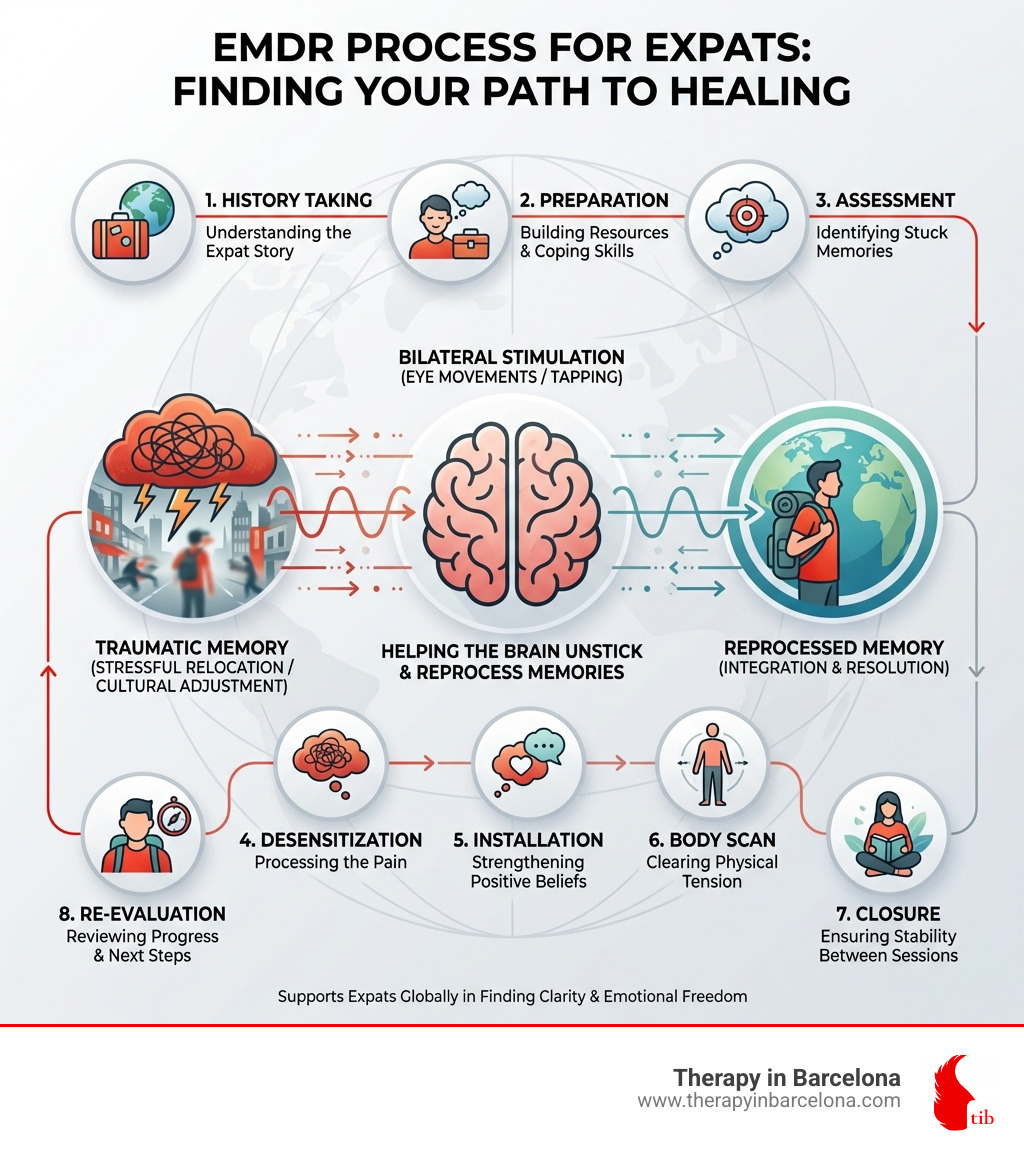
The therapy mimics the brain’s natural processing mechanisms, similar to what happens during REM sleep. Through guided bilateral stimulation—typically eye movements, but also taps or sounds—EMDR helps “unstick” memories that feel frozen in time. This means you can process a frightening arrival experience or a moment of profound loneliness without having to recount every detail out loud. For expats juggling time zones, work demands, and cultural adjustment, this efficiency matters.
At Therapy in Barcelona, we help internationals find culturally sensitive, psychology-led support. Our team offers personalised therapist matching, care in English and other languages, and both online sessions worldwide and in-person therapy in Barcelona. Compared with large platforms, the focus is on thoughtful matching, privacy, and support that understands expat life.
This guide walks you through what EMDR is, how the eight-phase process unfolds, why it suits expat life, and how to find the right support—whether you’re in Valencia, Málaga, Madrid, or halfway across the globe.
What is EMDR Therapy? A Simple Guide for Expats

If you have ever felt “stuck” in a memory, you are not alone. For many internationals, a difficult move or a frightening event back home can feel like it is happening all over again whenever they are stressed. Eye Movement Desensitisation and Reprocessing (EMDR) is a structured therapy designed to help the brain finish processing these “stuck” experiences.
EMDR is based on the idea that our minds have a natural ability to heal from psychological trauma, much like the body heals from a physical wound. But when a highly stressful event occurs, the brain’s information processing system can get overwhelmed. The memory gets stored in its “raw” form—complete with the original sights, sounds, and distressing emotions.
In an EMDR session, a therapist uses bilateral stimulation—usually guided eye movements, but sometimes rhythmic tapping or auditory tones—while you focus briefly on the distressing memory. This process helps the brain move the memory from a place of high emotional distress to a more functional, “resolved” state. You don’t lose the memory, but the “sting” is taken out of it.
One of the biggest perks for expats is that EMDR is a low-verbal therapy. You don’t have to spend hours explaining the cultural nuances of your hometown or the specific frustrations of the Spanish healthcare system if you don’t want to. As Bessel van der Kolk explains in The Body Keeps the Score: trauma in the body, trauma lives in the nervous system, not just in our stories. EMDR targets that physical storage.
Learn more about EMDR therapy what it is, how it works, and why it matters.
How EMDR Works in the Brain
The technical term for how EMDR works is Adaptive Information Processing (AIP). Think of your brain like a giant filing cabinet. Normally, new experiences are filed away neatly. But a traumatic event is like a file that is too big or too messy to fit; it just sits on the desk, causing clutter and stress. Bilateral stimulation helps the brain “resize” and file that memory.
Research suggests that the side-to-side movement mimics the natural processing that happens during REM (Rapid Eye Movement) sleep. This allows for memory reconsolidation—the brain actually updates the memory with new, safer information. This is why many people report rapid results and significant improvements after just a few sessions. For an expat who might only be in a city like Valencia or Madrid for a year or two, this efficiency is a huge advantage.
Why Traditional Talk Therapy Can Be Tough for Expats
Talk therapy is wonderful, but it has its limits for the international community. When you are living in a foreign country, you are often already suffering from “language fatigue.” Trying to find the exact English words to describe a complex trauma can be exhausting.
Furthermore, traditional talk therapy often requires you to recount the trauma over and over. For some, this can be re-traumatising. EMDR offers a different path. It allows you to process the experience internally while the therapist guides the bilateral stimulation. This reduces emotional fatigue and helps with untangling the past without getting lost in the retelling.
Why EMDR Suits the International Community
Expat life is often framed as a series of exciting adventures, but the reality is more complex. Moving countries is a major life stressor that can act as a “drip-feed” of pressure on your nervous system. Whether you are a digital nomad in the Canary Islands or a professional in Madrid, the constant need to adapt can reawaken old wounds.
The World Health Organization (WHO) and the UNHCR have both identified EMDR as a top-tier evidence-based treatment for stress-related conditions in displaced populations. While most expats move voluntarily, the psychological impact of “uprooting” your life shares many similarities with other forms of displacement. You lose your bearings, your support network, and often, a piece of your identity.
Facing Relocation Stress and Culture Shock
Culture shock is not just about being confused by local meal times in Seville or the bureaucracy in Barcelona. It is a physiological state of hypervigilance. When your environment is unfamiliar, your brain stays on “high alert.” This state makes it much harder to cope with past traumas or new stressors.
Common signs that relocation stress is overwhelming you include:
- Feeling constantly irritable or on edge.
- Difficulty sleeping or frequent nightmares.
- Feeling a sense of “unrealness” or disconnection from your new home.
- Intense anxiety when performing everyday tasks, like going to the supermarket.
EMDR can help settle this hypervigilance by processing the “shocks” of the move, helping you move beyond panic and anxiety into a state of genuine adjustment.
EMDR Benefits for Expats
The benefits of EMDR therapy for expats are practical and supported by research:
- Often faster than expected: EMDR has strong evidence behind it for trauma treatment. Some people notice meaningful change within 8 to 20 sessions, though this depends on your history and goals. You can explore one overview of the research here.
- Less pressure to explain everything perfectly: EMDR does not rely only on talking. That can be especially helpful for expats dealing with language barriers, emotional exhaustion, or memories that feel hard to put into words.
- Works well across borders: Because EMDR is structured, it can adapt well to online therapy, which matters if you travel often or move between countries.
- Broader benefits: Alongside trauma processing, many people also notice the surprising perks of healing, like better sleep, more confidence, and a greater sense of calm.
The 8-Phase EMDR Journey: What to Expect
EMDR is not just about waving fingers in front of someone’s eyes. It is a highly structured 8-phase process. Here is what the journey looks like:
- History Taking: Your therapist learns about your background and identifies “target” memories.
- Preparation: This is crucial. You learn grounding tools and coping skills to handle any emotional waves.
- Assessment: You identify the specific image, negative belief (e.g., “I am not safe”), and physical sensations associated with the memory.
- Desensitisation: The “eye movement” part. You focus on the memory while following the therapist’s lead with bilateral stimulation.
- Installation: We strengthen a positive belief (e.g., “I am safe now”) to replace the old negative one.
- Body Scan: You check for any remaining tension in your body.
- Closure: Each session ends with you feeling grounded and safe.
- Re-evaluation: At the start of the next session, we check the progress.
For a deeper dive, see our guide to EMDR for post-traumatic stress.
Building Your Internal Resource Kit (Phase 2)
We never jump straight into the “heavy” stuff. Phase 2 is about making sure you have a solid “Safe Place” or “Internal Sanctuary.” This is a mental resource you can use whenever you feel overwhelmed. For expats, this might be a memory of a favourite park back home or a quiet beach in the Costa del Sol.
This phase ensures that you are in control of the process. Your therapist will help you decide if EMDR is right for you at this specific moment in your expat journey.
Processing Memories Without Getting Stuck
During the processing phases, we use “dual awareness.” This means you have one foot in the past memory and one foot in the present, safe therapy room. If you get stuck, the therapist uses “cognitive interweaves”—small prompts to help your brain keep the processing moving. It is a collaborative effort to demystify the trauma and find relief.
Online EMDR: Support Wherever You Are
One of the best things about modern EMDR is its accessibility. You do not need to be in the same room as your therapist for it to be effective. In fact, a study on online EMDR for displaced populations showed that remote therapy is highly effective for reducing PTSD, depression, and anxiety.
For expats in remote parts of Spain, or digital nomads moving between countries, online therapy can make EMDR far easier to access. It offers the consistency and flexibility that often matter most when you are trying to heal while living abroad.
How to Access Online EMDR as an Expat
Online sessions use secure video platforms. Instead of following a therapist’s hand, you might follow a light on your screen or use “butterfly taps” on your own shoulders. It offers:
- Privacy: No sitting in a waiting room where you might bump into a colleague.
- Comfort: You can process difficult emotions from the safety of your own sofa.
- Flexibility: Easier to fit around busy international work schedules.
The Washington Post has highlighted how this accessibility is changing the landscape for those dealing with anxiety and depression.
Overcoming Distance: English-Speaking EMDR in Spain and Beyond
Finding a therapist who truly “gets” the expat experience can be hard. While you might find local therapists in cities like Alicante or Zaragoza, they may not have the specific training or English fluency you need.
Therapy in Barcelona provides English-speaking, psychology-trained therapists who are expats themselves. We offer sessions online worldwide and in-person at our central Barcelona office.
Comparing Your Options: EMDR and Other Support Routes
When you’re looking for support, it’s important to know what’s out there. Here is how different options usually compare for expats in Spain.
Public Health System (CatSalut/SNS)
The public system is a vital resource, but for expats, it can be a challenge. Wait times for psychological support are often very long. Most importantly, you are unlikely to be matched with an English-speaking specialist, and the generalist approach may not include specific trauma tools like EMDR.
Large Online Platforms
You’ve likely seen the ads for massive therapy apps. While convenient, they often have high therapist turnover and may sell user data. They rarely offer a personalised matching service, meaning you might end up with a therapist who doesn’t understand the specific cultural challenges of living in Spain.
Local Spanish Practices
There are many excellent local psychologists. However, unless they specifically cater to internationals, you may face a language barrier. Even if their English is good, they may not fully grasp the unique “identity-stripping” experience of being an expat.
Therapy in Barcelona’s Bespoke Approach
We offer a private-pay service that focuses on quality and fit. Our founder, Leigh Matthews, has been an expat in Barcelona since 2011 and has built a team of trusted professionals.
- Bespoke Matching: We don’t just give you the next person on the list. We take the time to match your personality and needs to the right therapist.
- Expat-Led: Our therapists have lived the journey. We know the stress of the NIE, the loneliness of the first year, and the complexity of bicultural relationships.
- Strict Privacy: We never sell your data.
- Multilingual: We offer care in English, French, German, and more.
Frequently Asked Questions about EMDR for Expats
How many sessions will I need?
There is no “one size fits all” answer, but most people see significant progress within 8 to 20 sessions. If you are dealing with a single event (like a car accident), it might be fewer. If you are working through complex trauma or childhood issues, it may take longer.
Is EMDR effective online?
Yes. Research and client testimonials consistently show that online EMDR is just as effective as in-person sessions. The key is using a secure platform and having a therapist who is trained in remote bilateral stimulation. The Guardian has covered the rise of EMDR as a versatile tool for modern life.
What qualifications should I look for?
Ensure your therapist is psychology-trained and has completed accredited EMDRIA (or equivalent) training. It is also helpful to find someone who understands the expat experience.
Conclusion
Healing is possible, even when you are thousands of miles from where your story began. Moving to a new country shouldn’t mean moving your problems—it can be the catalyst for finally resolving them. Whether you are in the heart of Barcelona or the quiet hills of Marbella, you deserve support that understands your world.
At Therapy in Barcelona, we are committed to being the therapists we would want to work with. We offer a compassionate sanctuary where your expat strengths are recognised and your challenges are met with expertise.
If you’d like support, book a Free Discovery Call today. We offer online therapy worldwide (including USA and Canada) and in-person sessions in Barcelona. Let’s find your path to healing together.
