


Why Emotionally Focused Therapy Works So Well for Intercultural Couples

Emotionally focused therapy effective with intercultural couples has become a hot topic as more partners steer love across cultural boundaries. The short answer? EFT works brilliantly because it focuses on universal human needs for connection and security—needs that transcend cultural differences.
Here’s what makes EFT so effective for intercultural couples:
- 86-90% success rate – Studies show couples experience significant relationship improvements
- Attachment-based approach – Targets universal needs for safety and connection
- Cultural adaptability – Successfully adapted for Chinese, Spanish-speaking, Iranian, and other diverse couples
- Addresses core issues – Helps partners move past cultural misunderstandings to underlying emotions
As one doctoral researcher found: “With increased globalisation, immigration, and technological advances worldwide, the number of intercultural couples is growing rapidly” – and this trend is happening across Europe, including Barcelona.
The magic of EFT lies in its recognition that whilst cultures shape how we express love, the fundamental human need for secure attachment remains constant. Whether you’re navigating different communication styles, family expectations, or religious traditions, EFT helps couples create a safe emotional space where cultural differences become bridges rather than barriers.

Attachment at the Core: What Is Emotionally Focused Therapy?
Picture this: you’re in love with someone whose cultural background is worlds apart from yours. When conflict arises, they might retreat into silence whilst you’re practically bursting to talk it through. This is where emotionally focused therapy, effective with intercultural couples, truly shines—by understanding that beneath these cultural differences lie universal human needs for connection and security.
Emotionally Focused Therapy emerged from Dr. Sue Johnson’s groundbreaking work in the 1980s, firmly rooted in adult attachment theory. Johnson recognised something profound: our deepest need for secure emotional bonds doesn’t vanish when we fall in love across cultural lines.
The beauty of EFT lies in how it maps out the negative cycles that keep couples spinning their wheels. You know the dance—one partner pursues connection whilst the other withdraws to find breathing space. For intercultural couples, these patterns can become particularly tangled when cultural norms around emotional expression clash dramatically.
Think about a passionate Italian partner paired with someone from a reserved Nordic background. What looks like “caring intensity” to one feels like “overwhelming pressure” to the other. EFT therapists help couples see past these surface behaviours to access their primary emotions—the vulnerable feelings underneath reactive responses.
The real magic happens during “change events”—those powerful moments when partners truly see and respond to each other’s emotional needs. These bonding moments transcend cultural differences because they tap into something beautifully universal: our shared human experiences of fear, love, and longing for connection.
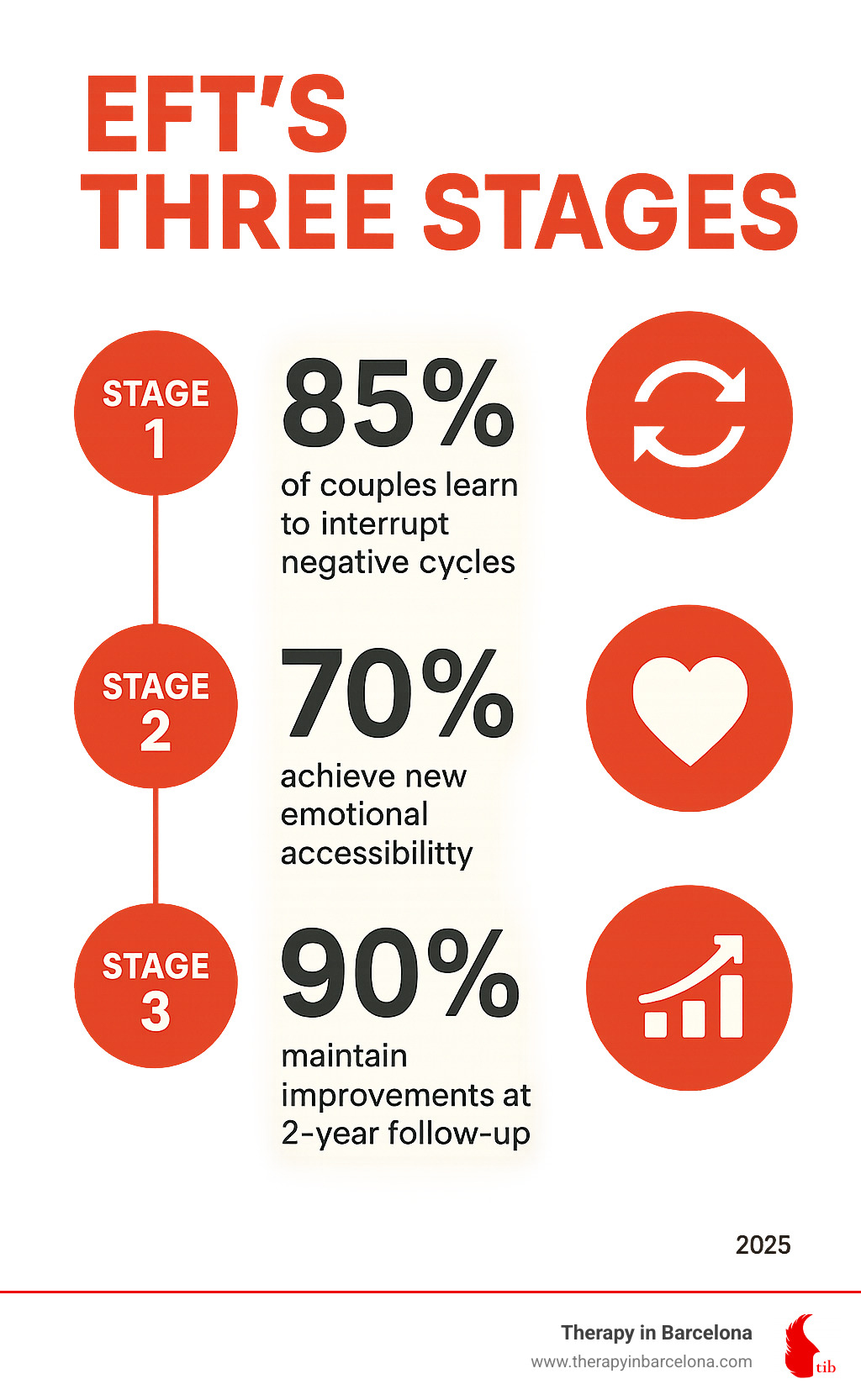
Three Stages of EFT in a Nutshell
Stage 1: De-escalation is all about mapping your couple’s unique negative cycle and helping both partners understand how cultural backgrounds influence your responses. A skilled therapist might help you see how one partner’s “directness” (highly valued in their culture) lands as “aggression” for someone from a more indirect communication culture.
Stage 2: Restructuring bonds dives deeper into accessing and expressing those underlying attachment needs we all carry. Partners learn to share their vulnerabilities in ways that honour both cultural backgrounds. This might involve adapting traditional EFT exercises to account for different comfort levels with emotional expression.
Stage 3: Consolidation helps couples integrate these new patterns and create shared rituals that celebrate both cultures. Partners develop their own unique relationship culture—drawing from both backgrounds whilst meeting those core attachment needs.
The scientific research on EFT effectiveness consistently shows remarkable results across different cultural contexts, proving that whilst love may speak many languages, the heart’s need for secure connection remains beautifully universal.
Why EFT Is So Effective for Couples in General
When you look at the research on couples therapy, one approach consistently stands out. Emotionally Focused Therapy achieves remarkable success rates of 70-90% for couples experiencing significant increases in relationship satisfaction. What makes these numbers even more impressive is their staying power—follow-up studies reveal that couples maintain or continue improving their connection over two years after completing therapy.
The secret behind EFT’s effectiveness lies in its focus on creating what researchers call a “secure emotional base” between partners. Rather than teaching couples communication scripts, EFT helps partners develop the emotional safety that authentic connection requires. Think of it as building a foundation rather than decorating the house—when partners feel securely attached, they naturally communicate with more openness.
The approach works through “emotion coaching”—helping partners recognise, understand, and respond to each other’s emotional signals with care and curiosity. This creates positive cycles where emotional accessibility leads to responsiveness, which in turn deepens engagement.
One of EFT’s most transformative interventions involves “blamer-softening”—helping the partner who typically pursues connection access and share their underlying fears and needs. When someone moves from “You never listen to me!” to “I feel scared that I don’t matter to you,” something magical happens. The partner who usually withdraws often finds their defences melting away, replaced by a natural desire to comfort and connect.

Common Mechanisms of Change
EFT creates lasting change through several interconnected pathways. Emotional accessibility develops when partners learn to identify and share their deeper feelings rather than staying stuck in reactive emotions. Responsiveness emerges as partners find how to truly hear and validate each other’s emotional experiences. Engagement deepens as both partners become more emotionally present and invested in the relationship. Repair dialogues become possible when couples develop the skills to acknowledge hurts and work through them together.
Cultural Crossroads: Unique Challenges Intercultural Couples Face
Living and loving across cultures creates a beautiful mix of shared experiences, but it also weaves in some complex challenges that same-culture couples rarely face. When emotionally focused therapy effective with intercultural couples research examines these relationships, several key stress points emerge.
Acculturation gaps often catch couples off guard. Picture this: one partner accepts their new country’s customs with enthusiasm, whilst the other clings to familiar traditions from home. This difference in adaptation speeds can create an unexpected wedge.
The dance of communication styles becomes particularly intricate when cultures collide. What feels like refreshing honesty to someone from a direct communication culture might land like a harsh blow to someone raised with indirect, high-context communication norms. A Dutch partner’s straightforward feedback could leave their Japanese partner feeling criticised and hurt, even when no criticism was intended.
Family approval and involvement can transform from a background concern into a front-and-centre relationship challenge. Extended family expectations don’t disappear when someone moves abroad—they often intensify. Whether it’s negotiating how much say parents have in major decisions or managing different holiday traditions, couples must steer not just their own preferences but also family and community expectations from multiple cultures.
Gender roles create another layer of complexity. A Swedish woman accustomed to egalitarian partnerships might struggle when her partner’s family expects her to take on traditional domestic responsibilities. These differences aren’t just about personal preferences—they’re about deeply ingrained cultural values around work, childcare, and decision-making authority.
Even when both partners speak excellent English, language barriers can create unexpected intimacy challenges. The subtle poetry of one’s native language often carries emotional nuances that get lost in translation. Many people find it easier to express vulnerability, anger, or deep love in their mother tongue, leaving their partner feeling somewhat shut out during emotional moments.
For expats navigating these waters in Barcelona, the challenges multiply. How to conquer these intercultural relationship challenges becomes not just a relationship question but a survival skill for building a life together in a new country.
How Culture Shapes Attachment & Conflict
Culture doesn’t just influence what we argue about—it shapes how we connect, how we fight, and even how we make up. Expressivity norms vary dramatically across cultures, creating misunderstandings that can feel deeply personal. In Mediterranean cultures, animated discussions with raised voices might signal passionate engagement, whilst in Nordic cultures, the same volume could feel aggressive or out of control.
The concept of saving face takes different forms across cultures, affecting how couples handle disagreements. Some cultures prioritise individual dignity, whilst others focus on family honour or community standing. Power distance variations influence everything from daily decision-making to conflict resolution styles. Conflict-avoidant scripts clash dramatically with conflict-engaging styles.
These cultural patterns run deep, often below conscious awareness. That’s why cultural harmony in intercultural marriage counselling requires therapists who understand not just relationship dynamics but also the cultural contexts that shape them.
Emotionally Focused Therapy with Intercultural Couples – The Evidence & Adaptations
Here’s where things get really exciting. Research consistently shows that emotionally focused therapy effective with intercultural couples works beautifully across diverse cultural contexts. Studies have successfully adapted EFT for Chinese couples navigating East-West differences, Iranian families balancing traditional and modern values, Spanish-speaking partners bridging language gaps, and countless other cultural combinations.
The key finding that gives us hope? Whilst specific techniques might need tweaking for different cultures, EFT’s core focus on universal attachment needs remains powerfully effective across all backgrounds. What makes this approach so adaptable is its inherent flexibility. Therapists can modify interventions whilst staying true to EFT’s core principles.
The numbers tell an encouraging story too. Couples who participate in EFT experience a 70% improvement in relationship satisfaction, and this success rate climbs even higher when cultural identity is actively integrated into the therapy process. This suggests that explicitly addressing cultural differences doesn’t complicate EFT’s effectiveness—it actually improves it.

Expert Roundup: What Leading Clinicians Say
Leading EFT experts consistently emphasise that successful intercultural couple therapy requires both cultural humility and therapeutic skill.
Dr. Sue Johnson, EFT’s founder, captures this beautifully: “Attachment needs are universal, but the way we express and meet these needs is culturally shaped. Good EFT therapists learn to honour both the universal and the particular.”
Dr. Carmen Knudson-Martin notes that “successful intercultural couple therapy requires therapists to actively explore power dynamics and cultural differences rather than assuming a colour-blind approach.”
Leigh Matthews, founder of Therapy in Barcelona, brings unique insight as both an Australian psychologist and an immigrant who has lived in Barcelona since 2011. Having steered her own intercultural marriage whilst supporting hundreds of international couples, she notes: “The universal need for secure attachment transcends cultural boundaries, but the path to achieving it must be culturally informed. My experience, and some of our couples therapists’ experiences as immigrants, helps us to understand the unique stressors intercultural couples face.”
Key takeaways from these leading experts: Cultural humility and ongoing education are essential. Attachment needs remain universal, but their expression varies significantly across cultures. Successful adaptation requires flexibility within EFT’s core framework whilst explicitly addressing cultural differences.
Practical Adaptations in Session
When it comes to actual therapy sessions, successful EFT with intercultural couples requires thoughtful adaptations. Cultural genograms become invaluable tools for helping couples map their cultural influences. Naming values becomes crucial when cultural backgrounds create different priorities. Language considerations require sensitivity even when couples share a common language. Pacing emotional expression requires cultural attunement—some cultures encourage immediate emotional sharing whilst others need more time and privacy.
For more insights into how cultural adaptation works in practice, explore our comprehensive guide to intercultural marriage counselling.
Therapist & Couple Tips to Maximise Success
When it comes to making emotionally focused therapy effective with intercultural couples, success depends on both therapist expertise and couple engagement. The journey requires patience, cultural sensitivity, and a willingness to accept the beautiful complexity of cross-cultural love.
Cultural competence forms the bedrock of effective intercultural EFT. Therapists must continuously examine their own cultural biases whilst developing genuine understanding of their clients’ backgrounds. The curiosity stance becomes absolutely essential—rather than making assumptions based on nationality, effective therapists remain genuinely curious about each couple’s unique cultural blend.
Homework rituals can be beautifully adapted to incorporate cultural elements that honour both partners’ backgrounds. One couple might create a weekly tradition of cooking dishes from alternating cultures whilst sharing appreciation. Another might develop a practice of expressing gratitude in both their native languages.
Protective narration helps couples reframe their cultural differences as relationship strengths rather than obstacles to overcome. When a therapist helps a couple see how one partner’s directness complements the other’s diplomatic approach, cultural differences transform from sources of friction into sources of richness.

Building Your Own Cultural Love Map
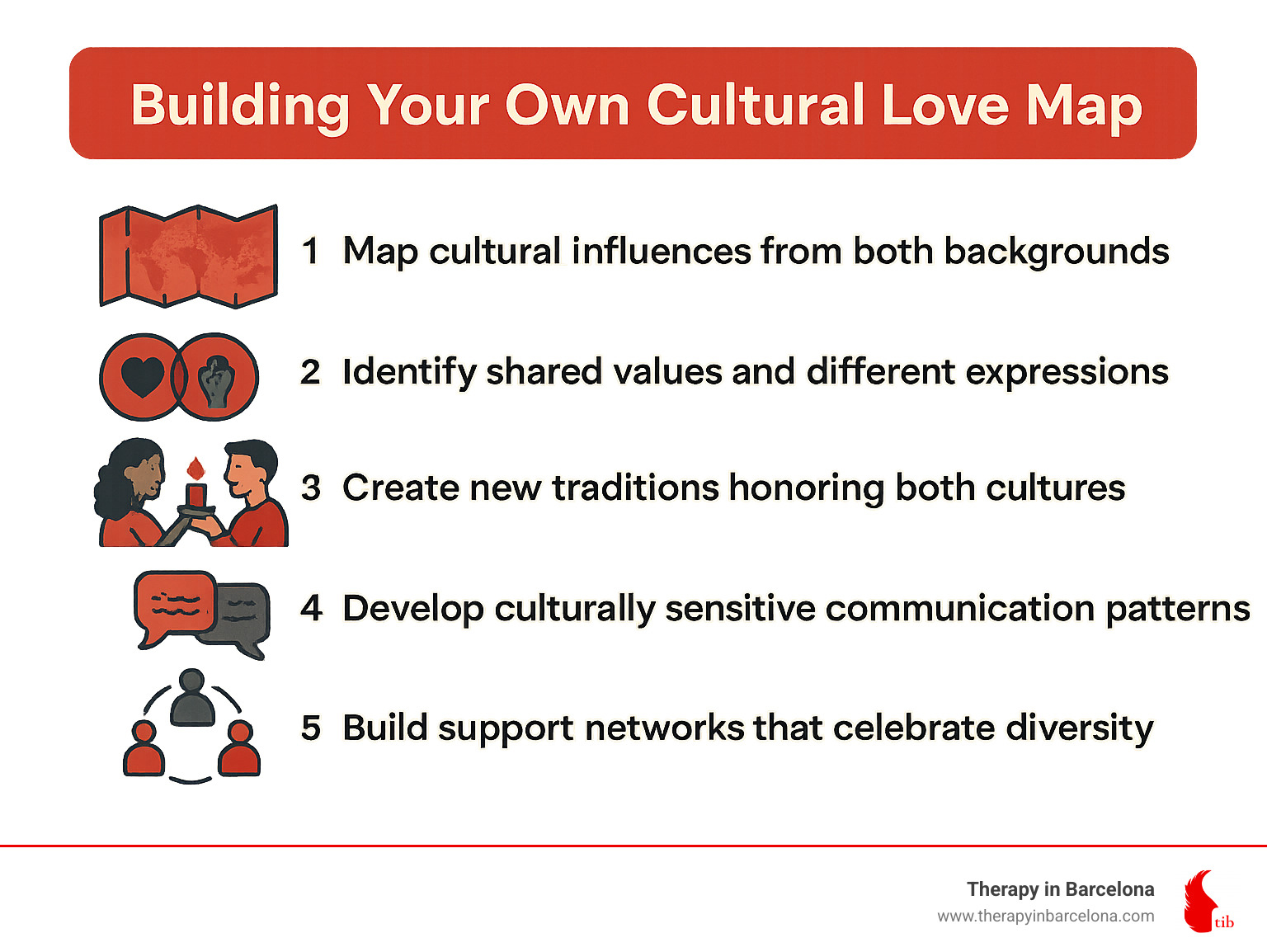
Creating a “cultural love map” offers intercultural couples a practical framework for navigating their unique relationship terrain. This process involves identifying shared traditions that honour both backgrounds whilst creating entirely new ones that reflect their combined heritage.
Holiday negotiation often requires creative problem-solving and genuine compromise. Some couples alternate between different cultural celebrations each year, whilst others create fusion traditions that blend elements from both cultures.
Understanding each partner’s language of apology prevents countless misunderstandings. Some cultures emphasise verbal acknowledgment of wrongdoing, whilst others focus on changed behaviour as the primary form of repair.
Conflict resolution styles can be negotiated to create approaches that work for both partners. Rather than one partner always adapting to the other’s style, successful couples develop hybrid approaches that combine direct and indirect communication.
Limits, Alternatives & Future Research
Whilst emotionally focused therapy effective with intercultural couples shows remarkable promise, we’d be remiss not to acknowledge where gaps remain. Most EFT research has emerged from Western contexts, creating a potential Western bias that may not fully capture the experiences of couples from non-Western backgrounds.
Access issues present another significant hurdle. Finding therapists who combine solid EFT training with genuine cultural competence can feel like searching for a needle in a haystack, particularly in smaller communities.
The rise of online delivery has created interesting possibilities and challenges. Whilst teletherapy has opened doors for couples who might never have accessed culturally sensitive EFT otherwise, it can limit therapists’ ability to pick up on subtle cultural cues.
Future research should cast a wider net, including more diverse samples, longer follow-up periods, and investigation of how different cultural combinations affect treatment outcomes.
Alternative support options do exist, including public system clinicians and large online platforms. However, these often lack the cultural specificity that intercultural couples genuinely need. Many online platforms, whilst convenient, can’t provide the nuanced understanding of expat life that makes such a difference in therapy outcomes.
This is where Therapy in Barcelona’s unique approach truly shines. Our expat-matched, culturally sensitive support addresses the particular challenges of international relationships head-on. Our team of psychology-trained therapists, who are themselves expats, brings both professional expertise and lived experience of navigating cultural differences.
Frequently Asked Questions about Emotionally Focused Therapy with Intercultural Couples
Does EFT work if partners have very different ways of expressing emotion?
Absolutely—and this is precisely where emotionally focused therapy effective with intercultural couples truly shines. The beauty of EFT lies not in forcing partners to express emotions the same way, but in helping each person understand the attachment needs behind their partner’s unique cultural patterns.
When one partner comes from a culture that values emotional restraint whilst the other grew up in a family where feelings were expressed openly, misunderstandings are inevitable. EFT helps couples decode these cultural differences and create space for both styles to coexist.
How many sessions does culturally adapted EFT usually take?
Research suggests that culturally adapted EFT typically requires 12-20 sessions, which may be slightly longer than standard EFT. The additional time allows for the careful exploration of cultural influences that shape your relationship patterns.
The first few sessions often focus heavily on understanding each partner’s cultural background. Most couples report significant improvements within the first 8-12 sessions, even as they continue working through more complex cultural negotiations.
Can EFT be combined with individual support for immigration stress?
Yes, and this combination often proves highly effective for intercultural couples. Many partners benefit from individual therapy to address personal challenges like immigration stress, cultural adjustment difficulties, or identity issues alongside their couples work.
At Therapy in Barcelona, our personalised matching process connects couples with therapists who understand both relationship dynamics and expat experiences. Our team of psychology-trained professionals—who are themselves expats—brings both clinical expertise and lived understanding of the cultural navigation process.
Conclusion
Emotionally focused therapy effective with intercultural couples offers genuine hope for partners navigating love across cultural boundaries. The evidence is clear: whilst cultures beautifully shape how we express love and handle conflict, our fundamental human need for secure attachment remains universal.
What truly matters is finding therapists who understand this delicate balance—professionals who honour both universal attachment needs and respect the rich mix of cultural differences that make each relationship unique.
At Therapy in Barcelona, we’ve witnessed this change countless times. As a practice founded by an expat for expats, we understand the particular challenges of intercultural relationships from lived experience. Our team of psychology-trained therapists, who are themselves internationals, brings both professional expertise and the deep understanding that comes from navigating cultural differences in their own lives.
Leigh Matthews, our founder and an Australian psychologist who has lived in Barcelona since 2011, knows the complexities of intercultural love. Her own journey—adapting to Spanish family obligations, Catalan culture, and raising a Third Culture Kid—informs our approach to supporting couples who are writing their own intercultural love stories.
Our personalised matching process ensures that couples work with therapists who truly understand their specific cultural contexts. Whether you’re navigating British-Spanish dynamics, Asian-European differences, or any other intercultural combination, we connect you with professionals who appreciate the nuances of your unique situation.
The beauty of culturally adapted EFT is that it doesn’t ask couples to abandon their cultural identities. Instead, it celebrates them within a framework of mutual understanding and secure attachment. Your different approaches to family, communication, conflict, and celebration become strengths rather than obstacles when viewed through the lens of attachment science.
For intercultural couples across Spain—whether in Barcelona, Madrid, Valencia, or beyond—the path forward is bright. Love that transcends boundaries isn’t just possible; it’s powerful. When partners have access to therapy that honours both their universal human needs and their unique cultural gifts, they can create relationships that are stronger than the sum of their parts.
For more information about couples therapy abroad, explore how our specialised support can help strengthen your intercultural relationship and celebrate the unique love story you’re creating together.
