


Is Employment in Spain for English Speakers Actually Possible in 2026?

Employment in Spain for English speakers is genuinely available — but it helps to know where to look before you book your flight.
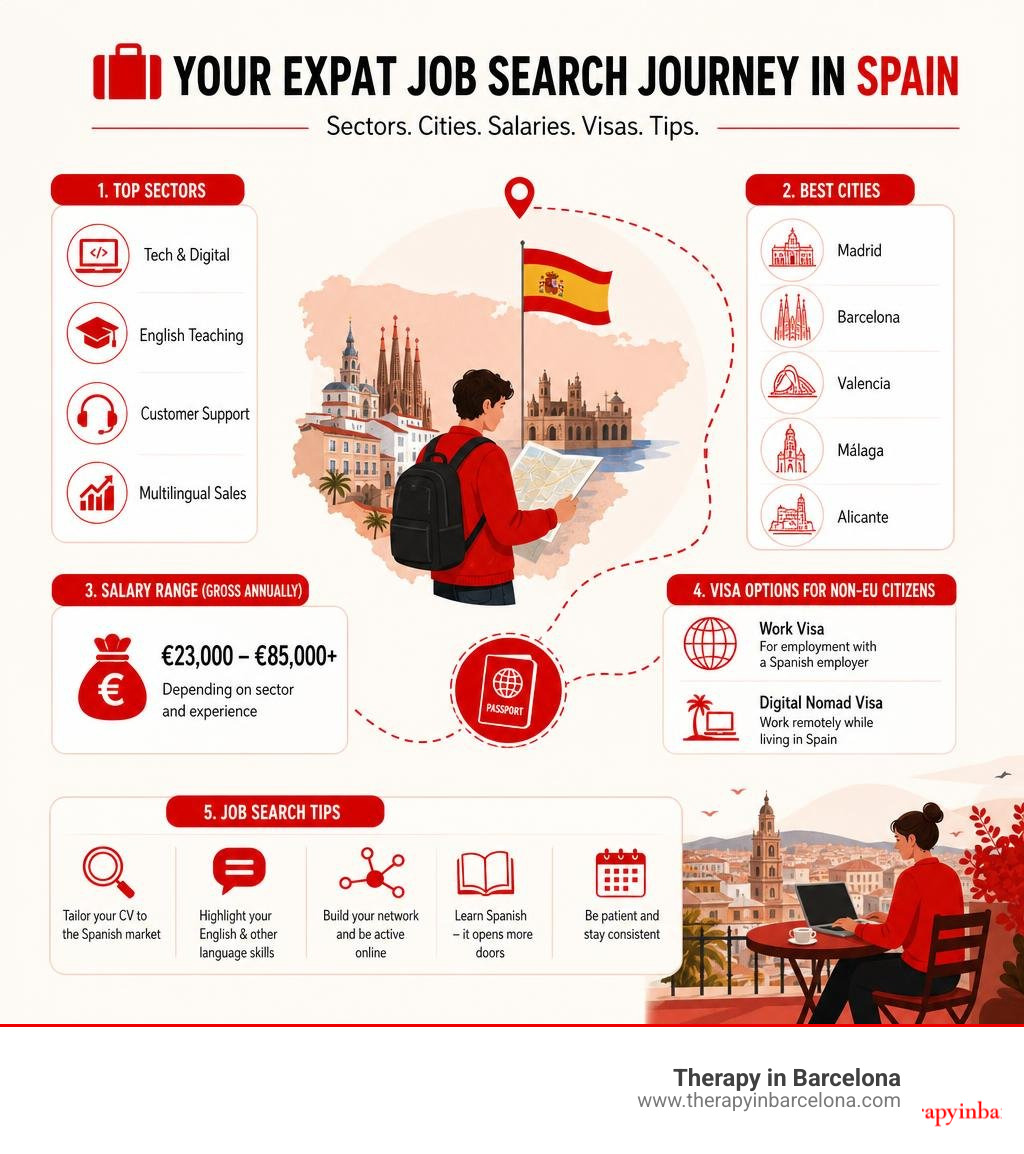
Here is a quick overview of what the market looks like right now:
- Best sectors: Tech and digital, English teaching, customer support, multilingual sales
- Best cities: Madrid, Barcelona, Valencia, Málaga, and Alicante
- Salary range: Roughly €23,000 to €85,000+ gross annually, depending on sector and experience
- Do you need Spanish?: Not always at first, but it helps significantly for long-term stability
- Non-EU workers: A work visa is required; the digital nomad visa is a popular newer option
- Where to search: LinkedIn, specialised English-language job boards, and company career pages
For many people, the idea of living and working in Spain feels like the answer to everything — sunshine, good food, a slower pace, and a fresh start. But when reality sets in, the questions start piling up. Can you actually build a career there if English is your main language? Will you be able to pay rent on a teaching salary? And what even is a TIE?
The honest answer is that Spain is not a simple place to crack professionally. According to market data reported by Euro Weekly News, the country’s unemployment rate sits around 12%, which is one of the highest in Europe, meaning employers generally prefer local or EU candidates when they can get them.
The same Euro Weekly News analysis notes that over 12% of job postings in Barcelona and Madrid list English as a required or preferred language, which is promising — but that still leaves a lot of competition.
What makes the difference is preparation. Knowing which sectors are genuinely hiring, which cities offer the most realistic opportunities, and what the visa process actually involves puts you in a very different position from someone who just hopes it will work out when they land.
This guide lays all of that out clearly, from job sectors and salary expectations to visa pathways and the psychological realities of building a working life in a new country.
1. The Reality of Employment in Spain for English Speakers in 2026
Moving to Spain for work is a thrilling prospect, but finding your way in the job market requires a healthy dose of realism. The Spanish employment landscape has its own unique rules, and the language barrier is often the first major hurdle expats face. While it is entirely possible to work in Spain without speaking fluent Spanish, your options will be highly concentrated in specific bubbles.
Without local language skills, you will primarily look at international companies, tech startups, shared service centres, and educational institutions. Outside these environments, Spanish quickly becomes essential for daily business operations and long-term career progression.
To illustrate this transition, consider this fictional composite example, which represents common expat experiences and is not based on a real client. A 34-year-old marketing professional from the UK moved to Barcelona seeking adventure but soon discovered that many local marketing agencies required native Spanish and Catalan.
Feeling isolated and overwhelmed by the competitive job market, she eventually shifted her focus to multinational companies and tech startups hiring English-speaking professionals. That change in approach helped her find her footing.
According to a detailed analysis of English-Speaking Jobs in Spain 2026 « Euro Weekly News , the market in 2026 rewards highly specialised skills rather than general experience. If you want to build a sustainable life here, you must understand where your specific skills fit. You can read more about mapping out your professional journey in our guide on English-speaking jobs in Spain: The ultimate guide to landing your dream role.
2. Top Sectors for English-Speaking Professionals
If you do not speak Spanish, your job search should be targeted. Trying to find a standard administrative or administrative-support role in a local Spanish company without knowing the language is incredibly difficult. Instead, focus your energy on the sectors that actively value English as an asset.

Tech, Startups, and Digital Roles
Spain’s tech hubs are booming, with Barcelona and Madrid leading the way, closely followed by Málaga and Valencia. In these ecosystems, English is the default working language. Startups and established international tech firms regularly recruit software engineers, product managers, data analysts, and digital marketing specialists.
Because tech talent is in high demand globally, companies in these hubs are often willing to sponsor visas for highly skilled non-EU professionals. If you are aiming for these roles, platforms like Jobs in Barcelona – Spain – for English Speaking Professionals are excellent places to start.
For a deeper understanding of how to position yourself for these competitive positions, check out our resource on Your path to English-speaking jobs in Barcelona.
English Teaching and Education
Teaching English remains the largest employment sector for native English speakers in Spain. The country has a massive appetite for English education, driven by a desire for global business integration.
According to industry placement data from Meddeas, there are over 45,000 TEFL-qualified English teachers employed across Spain’s language schools, and the country boasts over 1,000 private language schools and nearly 200 international schools.
If you are looking for structured programs, you can explore opportunities to Teach English in Spain as a Language Assistant | Meddeas , which is a popular route for recent graduates.
For certified educators, international schools offer more stable, long-term careers with higher salaries, such as roles like an Early Years to Year 1 teacher, Spain – Tes Jobs . Even regional academies, such as those offering a 1 Full-Time Teaching Position in Seville (Course 2026/2027) – Spainwise , provide excellent entry points for those wanting to experience southern Spanish culture while earning a living.
Customer Support and Multilingual Sales
For those with strong communication skills, shared service centres and international customer support hubs are major employers. Companies establish their European customer support and sales operations in cities like Barcelona, Valencia, and Málaga due to the high quality of life and lower operational costs compared to northern Europe.
These roles often involve managing accounts, handling customer inquiries, or driving business development for foreign markets. While the basic requirement is native-level English, having a second European language (like German, French, or Dutch) can significantly boost your salary and job prospects.
You can explore these customer-centric opportunities using resources like English Jobs in Spain | Find Opportunities with Faruse and read our practical tips on From English to employment: Job listings in Barcelona.
3. Best Cities for English-Speaking Jobs
Where you choose to live in Spain will dictate the types of jobs available to you. While rural Spain is beautiful, English-speaking professional opportunities are heavily concentrated in major metropolitan and coastal hubs.

Madrid and Barcelona: The Economic Powerhouses
Madrid, the capital, and Barcelona, the coastal cosmopolitan hub, are the primary destinations for expats. According to market research published by Euro Weekly News, over 12% of job postings in Barcelona and Madrid list English as a required or preferred language, reflecting their status as international business centres.
Madrid is home to major financial institutions, multinational headquarters, and large-scale corporate operations. You can browse active vacancies via English-speaking jobs in Madrid . Barcelona, on the other hand, is a magnet for digital nomads, creative agencies, and tech startups. If you want to explore the Catalan capital’s job market, read our guide on how to Unlock your career: English-speaking jobs in Barcelona.
Valencia, Málaga, and Alicante: Coastal Hubs
If you are looking for a balance between career opportunities and a relaxed coastal lifestyle, Spain’s mid-sized coastal cities are excellent choices. Valencia has grown rapidly as a tech and startup hub, offering a lower cost of living than Madrid or Barcelona. You can search for roles here through English-speaking jobs in Valencia .
Málaga has established itself as the “Silicon Valley of Southern Spain,” attracting major tech giants and remote workers. If you are looking for flexible setups, you can check out Remote jobs in Málaga – LinkedIn . Meanwhile, Alicante remains a favourite for tourism, hospitality, and customer service roles, with listings available at English-speaking jobs in Alicante .
Secondary Hubs: Sevilla, Marbella, and the Canary Islands
For a more traditional Spanish experience or specialised resort-based work, secondary hubs offer unique opportunities. Sevilla offers cultural immersion, though the English-speaking job market is smaller and mostly focused on education, as seen on English-speaking jobs in Seville .
Marbella and the wider Costa del Sol cater to luxury tourism, real estate, and hospitality, making English-speaking jobs in Marbella highly active during the warmer months. Finally, the Canary Islands have become a massive hub for digital nomads and remote professionals who want year-round warmth, with opportunities tracked on English-speaking jobs in Canary Islands .
To explore how to choose the right region for your lifestyle, read Spain calling: Uncover your next career move.
4. Visas, Salaries, and the Practicalities of Moving
Moving to Spain is not just about finding a job; it is about securing the legal right to work and understanding how your earnings will translate to daily life.
Visa Pathways for Non-EU English Speakers
For citizens of EU/EEA countries, moving to Spain is relatively straightforward. However, for non-EU citizens (including British, American, and Canadian nationals), visa pathways require careful planning:
- Digital Nomad Visa: This popular option allows individuals to live in Spain while working remotely for companies based outside the country. It offers attractive tax benefits and a relatively smooth application process.
- Student Visa: Many expats enter Spain on a student visa, often through language assistant programs. This visa typically allows you to work part-time (up to 30 hours per week) while completing your studies. If you are considering this route, read our guide on Navigating career choices abroad: A guide for international students.
- Employer Sponsorship: This is the most traditional route but also the most difficult. To hire a non-EU citizen, a Spanish company must prove that no qualified Spanish or EU citizen was available to fill the position, which usually limits sponsorship to highly specialised or senior roles.
Salary Expectations vs. Cost of Living
Salaries in Spain are generally lower than in northern Europe or North America. However, this is balanced by a lower cost of living, affordable public transport, and access to excellent public services.
When evaluating a job offer, look closely at your net income (after tax) rather than the gross figure, and compare it against local rental prices in your chosen city. For example, market reports from Euro Weekly News show that a one-bedroom flat in the centre of Madrid or Barcelona can easily cost €1,000 to €1,200 per month, whereas the same budget goes much further in Valencia or Sevilla.
Mobile-Friendly Salary Comparison by Sector
To help you budget, here is what you can expect to earn across the primary English-speaking sectors in Spain’s major hubs, based on salary data compiled by Euro Weekly News:
Tech & AI Roles
- Average Gross Salary: €45,000 to €85,000+ annually
- Key Hubs: Barcelona, Madrid, Málaga
- Demand Level: High
- Notes: Highly competitive; often includes remote or hybrid working options and visa sponsorship.
Business & Sales
- Average Gross Salary: €35,000 to €55,000 annually
- Key Hubs: Madrid, Barcelona, Valencia
- Demand Level: Medium-High
- Notes: Often requires bilingual capabilities (English plus another European language) and offers performance-based bonuses.
Multilingual Support
- Average Gross Salary: €24,000 to €32,000 annually
- Key Hubs: Barcelona, Valencia, Málaga
- Demand Level: High
- Notes: Great entry-level roles for expats; highly social environments but lower long-term salary progression.
Education & Teaching
- Average Gross Salary: €23,000 to €42,000 annually
- Key Hubs: Madrid, Sevilla, Zaragoza, Valencia
- Demand Level: Steady
- Notes: International schools pay on the higher end (€2,000–€2,500/month). Private language academies typically pay €1,000 to €1,500 monthly for part-time or hourly contracts.
5. Your Job Search Journey
Securing a job in Spain requires a proactive, localised approach. You cannot rely solely on sending cold applications from abroad.
Practical Steps to Secure Employment in Spain for English Speakers
- Tailor Your CV: Keep your CV concise (one to two pages). Clearly state your visa status or residency rights at the top. If you have conversational Spanish, list it using the CEFR framework (e.g., “A2 Spanish”) rather than vague terms like “conversational.”
- Leverage LinkedIn: LinkedIn is incredibly active in Spain. Ensure your profile is fully updated, set your location to your target Spanish city, and connect with recruiters working in your industry.
- Use Local Job Boards: Beyond global sites, use targeted platforms. You can find excellent advice on where to look in our guide Find a job in Barcelona: Best websites.
Overcoming Challenges in Employment in Spain for English Speakers
The process of relocating, job hunting, and adapting to a new culture can take a toll on your mental well-being. It is common to feel exhausted, isolated, or to struggle with your identity when your professional status changes in a new country.
If you are struggling with this transition, you are not alone. Many expats benefit from professional guidance to manage these emotional hurdles. Working with a coach can help you align your professional goals, which we discuss in Navigating your international career with expert coaching.
Sometimes, a career transition is a sign of a deeper need for self-exploration. If you are feeling stuck, you might find it helpful to explore Why career change therapy might be your missing piece. If you want to start reflecting on your path independently, try using these Jumpstart your client’s career exploration with these powerful questions.
Frequently Asked Questions about Employment in Spain
Can I work in Spain if I only speak English?
Yes, but your options will be limited to international companies, tech startups, multilingual customer support hubs, and English teaching roles. While you can survive and work in these bubbles, learning Spanish is highly recommended for long-term career progression and daily integration into Spanish society.
What are the most in-demand jobs for English speakers in Spain?
The most in-demand roles are in software engineering, AI development, multilingual sales, customer success management, and qualified international school teaching.
How long does it take to get a Spanish work visa?
The timeline varies significantly depending on the visa type. A Digital Nomad Visa can be processed in a few weeks if applied for within Spain, while a traditional employer-sponsored work visa can take anywhere from three to eight months due to bureaucratic checks and consulate appointments.
Final Thoughts on Your Spanish Career Journey
Building a working life in Spain is a deeply rewarding adventure, but it is rarely a straight line. Dealing with a competitive job market, adjusting to a new work culture, and managing the administrative hurdles of relocation can feel overwhelming.
During these times of transition, taking care of your mental well-being is just as important as updating your CV.
Therapy in Barcelona was founded in 2011 by Leigh Matthews, an Australian Psychologist and expat who understood the unique challenges of adapting to a new culture, navigating bicultural relationships, and building a career abroad.
While you could look into public health system clinicians (which often have long waiting lists and language barriers), large online directory platforms, or local Spanish practices, Therapy in Barcelona offers a highly specialised alternative.
Unlike large online platforms, they guarantee strict privacy with absolutely no data selling. They provide bespoke therapist matching to pair you with a psychology-trained professional who matches your unique situation, offering culturally sensitive support in your native language.
Their international team of therapists are expats themselves, providing a safe, confidential space to help you settle into your new life. They work with adults, couples, teens, and families both in-person at their central Barcelona office and online for clients across Spain (including Madrid, Valencia, Málaga, Alicante, Sevilla, Marbella, and Gran Canaria) and worldwide.
If you are dealing with the challenges of expat life and want a supportive, professional space to process the journey, help is available.
