


What Are the Best Therapeutic Questions for Teenagers?

Therapeutic questions for teenagers are open-ended prompts designed to help young people explore their emotions, identity, relationships, and goals in a safe, non-judgemental way. Here are some of the most effective ones:
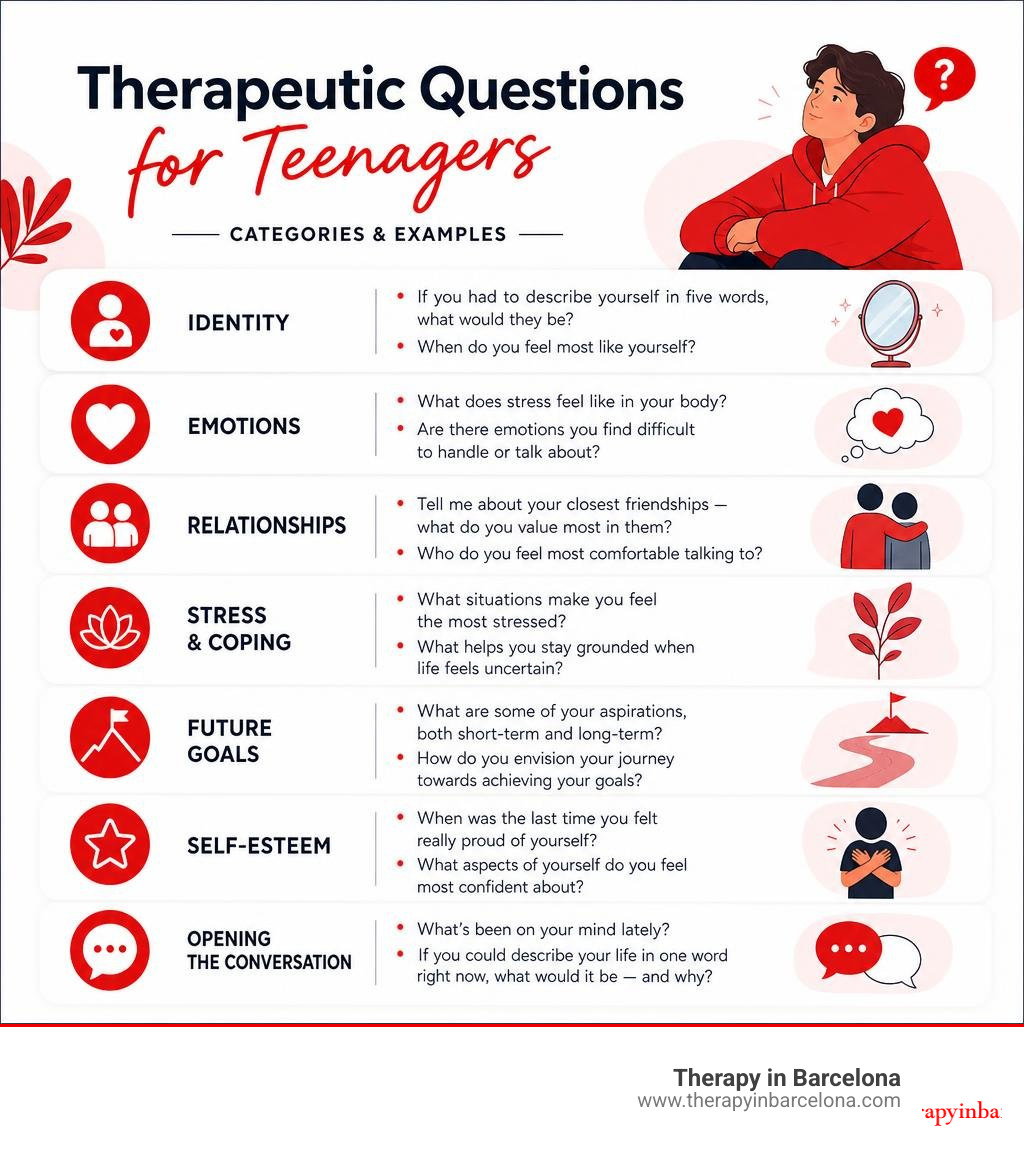
By category:
- Identity: “If you had to describe yourself in five words, what would they be?” / “When do you feel most like yourself?”
- Emotions: “What does stress feel like in your body?” / “Are there emotions you find difficult to handle or talk about?”
- Relationships: “Tell me about your closest friendships — what do you value most in them?” / “Who do you feel most comfortable talking to?”
- Stress and coping: “What situations make you feel the most stressed?” / “What helps you stay grounded when life feels uncertain?”
- Future goals: “What are some of your aspirations, both short-term and long-term?” / “How do you envision your journey towards achieving your goals?”
- Self-esteem: “When was the last time you felt really proud of yourself?” / “What aspects of yourself do you feel most confident about?”
- Opening the conversation: “What’s been on your mind lately?” / “If you could describe your life in one word right now, what would it be — and why?”
You ask how school was. They say “fine.” You ask what’s wrong. They say “nothing.”
If that exchange sounds familiar, you are not alone. Talking to a teenager can feel like trying to open a locked door without a key. But here is the thing: most teens are not trying to shut you out. They are simply still learning how to name what they feel — and often, no one has given them the right questions to work with.
That is exactly where therapeutic questions come in. Unlike typical conversation starters, these prompts are designed to invite genuine reflection rather than a one-word deflection. They create space for a teenager to think, feel, and speak on their own terms. And when used well, they can shift an awkward silence into a real connection.
The stakes are worth taking seriously. According to the World Health Organisation, approximately 13% of adolescents worldwide experience mental health challenges.
In the United States, the Pew Research Center reports that 61% of teens feel strong pressure to get good grades, and over 20% of students aged 12 to 18 experienced bullying in 2019 according to the National Center for Education Statistics. For teens dealing with all of this — especially those adjusting to a new country, a new school, or a new language — the pressure can be quietly overwhelming.
This guide is for parents, carers, and therapists who want practical tools to open those doors. Whether you are supporting a teenager at home in Barcelona, Valencia, or anywhere else in the world, the questions in this article can help you move from surface-level chat to something that actually matters.
Why the Right Therapeutic Questions for Teenagers Matter Under Pressure
Adolescence is a time of rapid neurological development. While the emotional centers of the brain are highly active, the prefrontal cortex — which handles decision-making, planning, and emotional regulation — is still developing. When you add the unique pressures of the modern world, it is easy to see why teenagers can become overwhelmed and retreat into silence.
For international families, these challenges often have an extra layer of complexity. Expat teenagers frequently grapple with a loss of their familiar support networks, the stress of adapting to a new school system, and the confusion of building a multicultural identity.
Whether a family has recently relocated to a bustling hub like Madrid or a coastal city like Alicante, the emotional toll of moving countries can make a young person feel highly isolated. To understand this dynamic better, it helps to explore Why Expat Teens Mental Health Matters More Than You Think.
Imagine a 15-year-old whose family has recently relocated from London to Málaga. On the surface, they seem to be adapting well. Underneath, they may be carrying pressure to achieve top marks while feeling disconnected from peers. When parents ask, “Are you making friends?” the teen may feel defensive and shut down. The question can sound like an evaluation rather than an invitation to share.

This kind of experience is far from unique. Many teenagers are carrying pressure that is hard to explain out loud:
- They may feel constant pressure to perform well at school.
- They may be dealing with bullying, exclusion, or social tension.
- They may feel lonely, even when they seem connected online or surrounded by people.
When we ask the right therapeutic questions, we stop testing them and start collaborating with them. Instead of asking if they are making friends, a parent might ask: “How do you feel about the relationships in your life right now?” This simple shift gives a teen more control to talk about loneliness without feeling like they have failed to meet an expectation.
Open-Ended vs. Closed-Ended Therapeutic Questions for Teenagers
To understand why therapeutic questions are so effective, we have to look at how they are structured. The most important distinction is between closed-ended and open-ended questions.
A closed-ended question invites a single, definitive answer — usually “yes,” “no,” or a simple fact. An open-ended question, on the other hand, requires the teenager to look inward, organise their thoughts, and explain their perspective in their own words.
To make this distinction clear, let us compare the two approaches using a mobile-friendly vertical format.
Closed-Ended Approach: The Interrogation
- The Question: “Did you have a good day at school?”
- The Likely Answer: “Yes.” or “No.”
- The Result: The conversation ends immediately. The adult is left guessing, and the teenager feels monitored rather than supported.
Open-Ended Approach: The Invitation
- The Question: “What was the most memorable part of your day, and how did it make you feel?”
- The Likely Answer: “Well, lunch was weird because…”
- The Result: The teenager is prompted to reflect on their experiences and share a narrative, keeping the lines of communication open.
Closed-Ended Approach: The Direct Emotion Check
- The Question: “Are you feeling anxious about your exams?”
- The Likely Answer: “I’m fine.”
- The Result: The teenager may feel defensive or self-conscious about admitting to anxiety, leading to a protective shutdown.
Open-Ended Approach: The Externalised Exploration
- The Question: “If your anxiety had a voice, what would it be trying to tell you right now?”
- The Likely Answer: “It’s telling me that I’m going to fail no matter how much I study.”
- The Result: This externalises the anxiety, making it safer to discuss. It allows the teen to look at their feelings objectively.
By choosing open-ended prompts, you change the dynamic of the conversation entirely. For a deeper look at how this shift transforms communication, read our guide on From Awkward to Awesome: Therapy Questions for Teens and Young Adults.
Key Categories of Therapeutic Questions for Teenagers
To help teenagers explore their inner worlds, it is useful to categorise therapeutic questions. This ensures we cover different aspects of their lives — such as identity, relationships, stress, and goals — without making any single conversation feel too heavy.
Identity and Self-Perception
Adolescence is primarily a journey of answering the question: Who am I? Questions in this category help teenagers reflect on their values, strengths, and self-image.
- “If you had to describe yourself in five words, what would they be?”
- “When do you feel most like yourself, and what are you doing in those moments?”
- “What is something you wish people understood about you that they often get wrong?”
Relationships and Social Dynamics
Peer relationships are incredibly important during the teenage years. These prompts encourage reflection on boundaries, safety, and connection.
- “Tell me about your closest friendships. What do you value most in them?”
- “How do you handle peer pressure while still keeping hold of who you are?”
- “Who in your life do you feel most comfortable talking to when things get difficult?”
Stress, Pressure, and Coping
With academic demands and social expectations, teenagers need healthy ways to process stress. These questions help identify triggers and evaluate coping mechanisms.
- “What does stress actually feel like in your body? Where do you notice it first?”
- “How do you usually handle difficult emotions, and do you feel like that strategy is working for you?”
- “What is one routine or habit that brings you a sense of peace when everything else feels chaotic?”
Future Goals and Existential Questions
As teenagers prepare for independence, they often experience a mix of excitement and dread. Structured screening tools like the Confidential Adolescent Questionnaire (11-14yr) can help identify practical health and social needs. For deeper, meaning-focused conversations, resources like the Teenagers Existential Therapy Session Questions Workbook offer excellent frameworks for exploring choice, responsibility, and purpose.
- “If you could design a perfect day for your future self five years from now, what would it look like?”
- “What are some of your biggest hopes for the future, and what feels like the biggest obstacle standing in your way?”
- “What does ‘success’ mean to you, and how does that compare to what your family or school expects?”
Adapting Therapeutic Questions for Teenagers by Age Group
A thirteen-year-old and an eighteen-year-old are in very different developmental stages. When using therapeutic questions, it is vital to adapt your approach to their cognitive and emotional maturity.
Younger Teens (Ages 11-14)
Younger adolescents are often concrete thinkers. They can struggle with highly abstract questions about the future or complex emotional states.
- The Strategy: Use creative, visual, or externalised prompts. Ask about specific situations rather than broad concepts.
- Example: Instead of asking, “How is your self-esteem?” try: “Which emoji best describes your mood today, and what makes that emoji fit?” or “If your mood was a colour today, what colour would it be?”
Older Teens (Ages 15-18)
Older adolescents are developing the capacity for abstract thought and deep self-reflection. They are highly focused on identity, independence, and existential questions.
- The Strategy: Offer questions that respect their autonomy, challenge their assumptions, and invite them to explore their values.
- Example: “How do you decide what is worth caring about when your friends, family, and social media are all telling you different things?”
Practical Examples of Therapeutic Questions for Teenagers Facing Modern Stressors
To help you put these concepts into practice, here are specific therapeutic questions tailored to the exact challenges today’s teenagers face.
| The Stressor | The Therapeutic Question to Try | The Therapeutic Goal |
|---|---|---|
| Social Media Pressure | “What would you do with your time if you couldn’t use social media for an entire week?” | Encourages reflection on digital habits and highlights hidden sources of anxiety. |
| Low Self-Esteem | “When was the last time you felt genuinely proud of yourself, even for something small?” | Shifts focus toward personal strengths and builds self-recognition. |
| Academic | “What situations or expectations make you feel the most pressured right now?” | Pinpoints specific academic triggers to help develop targeted coping plans. |
| Relocation / Expat Stress | “What is the hardest part of living in a new city, and what do you miss most about home?” | Validates the grief of relocation while opening space to discuss adaptation. |
Overcoming Resistance: How to Handle One-Word Answers
It is bound to happen. You ask a beautifully crafted, open-ended therapeutic question, and your teenager shrugs and says, “I don’t know.”
First, take a breath. Resistance is not a sign of failure; it is a normal way for a teenager to test whether a space is truly safe. If you respond with frustration, you confirm their suspicion that the conversation is actually an interrogation.
Here is how to handle those moments with patience and skill:
- Respect the Silence: You do not need to fill every pause immediately. Sometimes, a teenager needs thirty seconds of quiet to gather the courage to speak. Let the silence sit warmly.
- Change the Environment: Sitting eye-to-eye across a table can feel incredibly intense. Try asking questions while side-by-side — such as during a walk through Eixample, while driving, or while cooking together.
- Use Low-Pressure Tools: If words feel too difficult, try using structured prompts. Many families find that keeping a physical copy of a Conversation Starters Guide on the kitchen counter allows teens to pick a question when they feel ready.
- Validate the Difficulty: If they refuse to engage, validate their choice. You might say: “That’s okay. Talking about this stuff is really hard, and we don’t have to do it right now. I’m just glad to be here with you.”
If you are noticing persistent communication barriers at home, exploring the resources in Teen Troubles in Barcelona: Therapy in Barcelona to the Rescue can provide practical strategies for rebuilding trust.
Therapeutic Questions in Group Therapy and Clinical Settings
While parents and carers can use therapeutic questions to build connection at home, these prompts serve a highly structured purpose in professional and clinical settings.
In group therapy, for example, questions are designed to foster peer validation. When a teenager hears a peer answer a question like, “When do you feel most lonely?” they quickly realise they are not alone in their struggles. This peer connection is one of the most powerful aspects of adolescent recovery. To learn more about how these dynamics work, you can read about From Angst to Awesome: 9 Effective Therapy Options for Teenagers.
If you are considering professional support for your teenager, it is helpful to understand the different options available. Here is how our services compare to other common pathways:
Public Health System
- The Approach: Standardised, clinic-led mental health care provided through national health systems.
- The Limitations: Often involves very long waiting lists, limited session allocations, and a lack of choice regarding your therapist. Language barriers can make this option highly challenging for expat families.
Large Online Platforms
- The Approach: Automated matching with therapists via global digital apps.
- The Limitations: High therapist turnover, limited local context, and serious concerns regarding data privacy, including the potential selling of personal data. These platforms rarely offer the deep, culturally sensitive support in the client’s native language required by expat youth.
Local Private Practices
- The Approach: Independent local therapists working within the city.
- The Limitations: While often high-quality, it can be difficult to find a qualified therapist who speaks fluent English and truly understands the unique psychological journey of relocation and international life.
Therapy in Barcelona
- The Approach: A dedicated group practice specialising in English-speaking mental health care for the international community.
- The Advantage: We offer bespoke therapist matching based on your teen’s unique personality and goals, rather than simply assigning the next available professional. We guarantee strict privacy with absolutely no data selling. Our expat-focused, psychology-trained therapists understand the realities of international life firsthand, providing culturally sensitive support in the client’s native language. We operate on a private-pay basis to ensure complete confidentiality, with sliding scale fees available for those with financial need.
To explore how our team can support your family, visit our dedicated page on Adolescent Therapy Barcelona.
Frequently Asked Questions about Therapeutic Questions
What makes a question therapeutic for a teenager?
A question is therapeutic when it is open-ended, non-judgemental, and focused on self-exploration. Rather than looking for a “correct” answer, it invites the teenager to explore their own thoughts, emotions, and bodily sensations, helping them build deeper self-awareness.
How do I ask therapeutic questions without sounding like an interrogator?
Timing and tone are everything. Avoid firing off multiple questions in a row. Instead, weave a single prompt naturally into a shared activity, like walking, driving, or preparing a meal. Most importantly, listen deeply to their response without immediately trying to “fix” their problems or offer advice.
When should we transition from asking questions at home to professional therapy?
While open communication at home is incredibly valuable, professional support is recommended if your teenager’s distress persists for several weeks, begins to impact their schoolwork or friendships, or leads to significant withdrawal, changes in sleep and eating habits, or self-harming behaviours.
Next Steps for Your Family
Asking the right questions is not about finding quick fixes; it is about building a bridge of trust that lets your teenager know they do not have to carry their burdens alone.
Founded in 2011 by Australian Psychologist Leigh Matthews, Therapy in Barcelona offers culturally sensitive, English-speaking support for internationals through in-person sessions in Barcelona and online therapy worldwide.
If you would like to support your teenager’s mental health and help them manage the challenges of growing up abroad, we are here to help.
If you’d like support, Book a Free Discovery Call with our team today.
