


Exploring Your Inner World: The Power of Therapy Questions

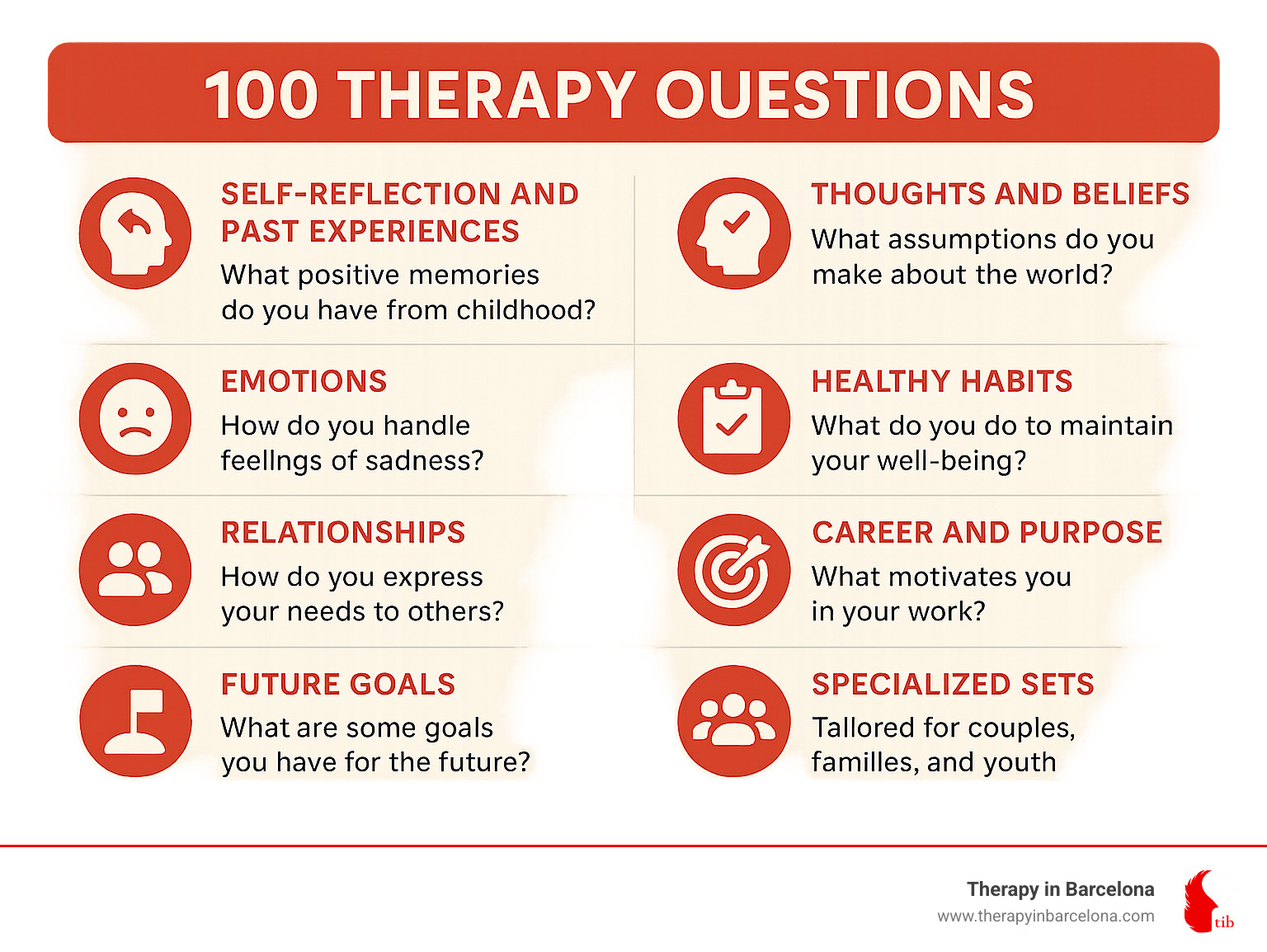
If you’re looking for 100 therapy questions to aid self-reflection or improve therapy sessions, here are the key categories these questions typically cover:
- Self-reflection and past experiences – Questions about childhood, pivotal moments, and patterns
- Thoughts and beliefs – Questions examining cognitive patterns and core beliefs
- Emotions – Questions exploring feelings, triggers, and emotional regulation
- Healthy habits – Questions about lifestyle, self-care, and wellness routines
- Relationships – Questions addressing connection, boundaries, and communication
- Career and purpose – Questions exploring work satisfaction and balance
- Future goals – Questions about aspirations, values, and life direction
- Specialized sets – Questions adapted for couples, families, and young people
Therapy questions are powerful tools for self-findy and healing. Whether you’re sitting across from a therapist or journaling on your own, thoughtfully crafted questions can open up insights that might otherwise remain hidden. As psychotherapist Irvin Yalom noted, “The act of revealing oneself to another and experiencing acceptance is itself a healing mechanism.”
For internationals navigating life abroad, therapy questions can be particularly valuable. Living in a new country often prompts deep reflection about identity, belonging, and purpose—questions that might have seemed settled in your home country suddenly resurface in a new cultural context.
The right questions create a safe space for exploration, helping to bridge cultural gaps and process the unique challenges of expat life. Research shows that open-ended questions increase client engagement and disclosure by up to 60% compared to closed questions, making them essential tools for meaningful therapy work.
Why Ask Therapy Questions?
Therapy questions serve as doorways to deeper understanding. They’re not just about gathering information—they’re about creating opportunities for insight and change.
Research indicates that structured therapy question frameworks, like the “100 Therapy Questions” approach, can improve the efficiency of initial assessment sessions by 30%, leading to faster rapport building and goal setting. For expats in Barcelona or anywhere in the world, this efficiency is particularly valuable when seeking support in a new environment.
The power of questions lies in their ability to:
- Create psychological safety – Thoughtful questions signal genuine interest and build trust
- Facilitate self-findy – They help clients access insights they already possess but haven’t articulated
- Provide structure – Questions guide exploration in productive directions
- Improve therapeutic alliance – Good questions demonstrate empathy and understanding
A survey of therapists found that 85% regularly use curated question lists to guide sessions, with 72% reporting improved client insight and self-reflection. For internationals navigating cross-cultural challenges, these structured approaches can be especially helpful in bridging cultural differences in communication styles.
Solution-focused therapy, which often uses structured question sets, has demonstrated a 65% client satisfaction rate in brief therapy interventions. This approach focuses on building solutions rather than analyzing problems—particularly helpful for expats seeking practical strategies for adjustment challenges.
Learning to ask open-ended questions is a valuable skill not just for therapists but for anyone seeking deeper connections and understanding in their relationships.
The Ultimate List: 100 Therapy Questions
Welcome to our comprehensive collection of 100 therapy questions designed to spark meaningful self-reflection and growth. Whether you’re a therapist looking to enrich your sessions, an individual seeking deeper self-understanding, or a couple wanting to strengthen your connection, these questions can be powerful tools for exploration and healing.
For internationals living in Barcelona or anywhere abroad, these questions are particularly valuable. They create space to process the unique dimensions of expat life – from cultural adaptation challenges to identity shifts and building new support networks in unfamiliar surroundings.
| Open-Ended Questions | Closed Questions | Why Open Questions Work Better |
|---|---|---|
| “What was that experience like for you?” | “Was that experience difficult?” | Invites detailed reflection rather than yes/no response |
| “How did that situation affect you?” | “Did that upset you?” | Allows the person to define their own emotional response |
| “What thoughts come up when you consider that?” | “Are you worried about that?” | Explores the full range of thoughts without suggestion |
| “How would you describe your relationship with them?” | “Do you get along with them?” | Encourages nuanced description of complex dynamics |
| “What would an ideal outcome look like?” | “Do you want this to work out?” | Helps visualize specific desired results |
Self-Reflection – Questions About Your Past
Our past experiences shape who we are today in countless subtle and profound ways. These questions gently open doors to childhood memories, pivotal life moments, and recurring patterns that continue to influence your thoughts, emotions, and behaviors.
- “What childhood memories bring you the most joy when you recall them?”
- “Can you identify a moment when your perspective or values significantly shifted?”
- “How do past events still echo in your present life?”
- “What family traditions or rituals do you cherish most from your early years?”
- “What patterns or themes do you notice repeating throughout your life story?”
- “How does nostalgia affect your current emotional state?”
- “Are there unresolved issues from your past that might be limiting your happiness now?”
- “How have your early experiences shaped your current decision-making process?”
- “In what ways did your early relationships influence your ability to trust others?”
- “How has living across different cultures shaped your sense of identity?”
- “What aspects of cultural transition have been most challenging for you?”
- “How has your concept of ‘home’ evolved throughout your life journey?”
For expats in Barcelona, these reflection questions can be particularly illuminating, helping process the complex emotions that arise when leaving your home country and establishing a new life in a different cultural context.
Thoughts & Beliefs – Questions to Reframe Mindsets
Our thoughts and beliefs create the lens through which we view the world and ourselves. These questions help identify and examine cognitive patterns, core beliefs, and potential distortions that might be limiting your growth or contributing to distress.
- “What thoughts tend to dominate your mind on a typical day?”
- “Which negative thought patterns would you like to explore further?”
- “How do you typically respond to self-critical thoughts?”
- “What factors might be coloring your perception of reality right now?”
- “How much of your current thinking is influenced by past experiences?”
- “In what situations do you notice intrusive or anxious thoughts arising?”
- “What does your decision-making process look like, and what beliefs might be interfering?”
- “Which automatic beliefs tend to intensify your stress levels?”
- “How do your thought patterns impact your ability to set and achieve goals?”
- “What thinking patterns might be creating challenges in your relationships?”
- “How does your self-talk affect your motivation and perseverance?”
- “What strategies help when you find yourself overthinking?”
- “How have your cultural beliefs shifted since moving to a new country?”
These questions align beautifully with Cognitive Behavioral Therapy (CBT) principles, which focus on identifying and challenging unhelpful thoughts. For internationals in Barcelona, exploring how cultural differences influence thinking patterns can be especially illuminating.
Emotions in Focus
Emotional awareness forms the foundation of psychological wellbeing. These questions help you identify, express, and regulate emotions in healthier ways.

- “If you had to describe your current emotional state in three words, what would they be?”
- “What situations or experiences reliably bring you joy?”
- “What strategies help you manage intense emotions day-to-day?”
- “Is there a particular memory that still evokes strong emotions when you recall it?”
- “How do your core beliefs influence your emotional responses and behaviors?”
- “What does healthy anger expression look like for you?”
- “Are there certain emotions you tend to suppress? What’s behind that?”
- “How do your emotions impact your interactions with others?”
- “Which self-care practices best support your emotional wellbeing?”
- “Can you identify your emotional triggers for stress or anxiety?”
- “How do you distinguish between authentic emotions and those influenced by external factors?”
- “How comfortable are you with vulnerability in your emotional life?”
- “In what ways has self-reflection helped you recognize and manage your emotions?”
For expats, emotional regulation can be particularly challenging during cultural adjustment. The stress of navigating unfamiliar systems, potential language barriers, and building new support networks in Barcelona can intensify emotional responses.
Healthy Habits & Lifestyle
Physical and mental wellbeing are deeply interconnected. These questions explore daily habits, self-care practices, and lifestyle choices that impact your overall health and resilience.
- “How do your current healthy habits contribute to your overall wellbeing?”
- “What daily rituals or routines support your mental and physical health?”
- “How well do your food choices align with your overall health goals?”
- “Are there any habits that might be undermining your health and wellbeing?”
- “How do you prioritize sleep in your life?”
- “What helps you stay motivated to remain physically active?”
- “What specific techniques do you use to manage stress in different areas of your life?”
- “How do you maintain healthy hydration throughout your day?”
- “What role do mindfulness or meditation practices play in your daily life?”
- “What strategies help you maintain work-life balance?”
- “How do you manage your relationship with technology and screen time?”
- “How do you respond when you face setbacks in maintaining healthy habits?”
- “How have your health routines evolved since moving to a new country?”
For internationals in Barcelona, adapting health routines to Mediterranean lifestyle patterns—including later mealtimes and different food options—can present both challenges and opportunities for positive change.
Relationships & Social Connections
Our connections with others profoundly influence our wellbeing. These questions explore relationship patterns, communication styles, boundaries, and social support networks.
- “How do your past relationships influence your current approach to connecting with others?”
- “What values matter most to you in relationships?”
- “Do you notice any patterns in your relationships that you’d like to change?”
- “What strategies help you maintain healthy communication in your relationships?”
- “How do you typically handle conflict in relationships?”
- “How do you balance priorities between friendships, family relationships, and romantic partnerships?”
- “What helps you build and maintain trust with others?”
- “What would you like to change about how you give and receive love?”
- “Are there any fears that might be interfering with your ability to form meaningful connections?”
- “How do you establish and communicate boundaries in your relationships?”
- “How has relocating to a new country affected your relationships with people back home?”
- “What challenges have you faced in building a social network in your new location?”
- “How do cultural differences impact your relationships with locals?”
For expats in Barcelona, building new social connections while maintaining relationships across distance presents unique challenges that these questions can help address.
Career & Work-Life Balance
Work occupies a significant portion of our lives and can be a source of both fulfillment and stress. These questions explore career satisfaction, professional identity, and work-life balance.
- “Do you notice any patterns in how you make career decisions?”
- “What strategies help you manage work-related pressure and stress?”
- “How does your current career contribute to your sense of purpose and fulfillment?”
- “What might be holding you back professionally, and how might you address it?”
- “How do you balance passion and practicality in your career choices?”
- “What role does work-life balance play in your overall job satisfaction?”
- “How do you ensure your health and wellbeing remain priorities in your work life?”
- “How do your career decisions align with your long-term financial goals?”
- “How would you define success in your career, and has this definition evolved over time?”
- “How has being an international professional affected your career path?”
- “What workplace cultural differences have you noticed, and how have you adapted to them?”
- “How has remote work or digital nomad life impacted your sense of professional identity?”
For internationals, navigating career transitions across countries often involves reconciling different work cultures, professional recognition challenges, and sometimes language barriers.
Future Goals & Values Alignment
Our vision for the future guides our present actions. These questions help clarify aspirations, values, and concrete steps toward desired outcomes.
- “How would you describe your ideal future?”
- “What concerns do you have about your future?”
- “How well do your current goals align with your long-term vision?”
- “Do you tend to prioritize short-term or long-term goals, and why?”
- “How do your core values influence your future plans?”
- “How do you respond to unexpected changes to your long-term plans?”
- “How do you balance career and personal goals?”
- “Are there any self-limiting beliefs that might be holding you back from pursuing your goals?”
- “How do you handle uncertainty about the future?”
- “How do you ensure your future plans contribute to your sense of fulfillment?”
- “How has living internationally influenced your life goals and priorities?”
- “What legacy would you like to leave behind?”
- “If you could travel back in time, what advice would you give to your younger self?”
The “miracle question” from Solution-Focused Brief Therapy is particularly powerful here: “Imagine that tonight while you sleep, a miracle happens and all the problems that brought you here are solved. When you wake up tomorrow, how will you know a miracle has happened? What will be different?”
Adapted Sets for Couples, Families, and Young People
Different relationship contexts require custom approaches. These questions are specifically designed for couples, families, and younger clients.

For Couples:
- “What does intimacy mean to you, and how does it show up in practice?”
- “Where does intimacy rank in your relationship priorities?”
- “What might be preventing deeper connection between you?”
- “Do you and your partner share the same core values?”
- “What does commitment mean to you, and how does it manifest?”
For Families:
- “Who do you feel closest to in your family?”
- “How does your family typically resolve disagreements?”
- “Do you feel safe expressing your feelings within your family? Why or why not?”
- “What makes your family unique or special?”
For Young People:
- “What feels most challenging in your life right now?”
- “What helps you feel better when you’re upset or stressed?”
For international families in Barcelona, these questions can help steer the complexities of raising third culture kids and maintaining family cohesion across cultural transitions.
At Therapy in Barcelona, we use these 100 therapy questions and many more to support our international clients through life’s challenges. Whether you’re seeking support for cultural adjustment, relationship issues, or personal growth, our team of experienced therapists understands the unique aspects of expat life and is here to help.
Adapting Questions for Different Clients
The beauty of therapy lies in its flexibility. While our 100 therapy questions provide an excellent starting point, the true art comes in tailoring these questions to fit each person’s unique circumstances and needs.
Children and Teens
Working with younger clients requires a thoughtful approach. When using therapy questions with children or adolescents, consider:
Instead of asking “How do you process difficult emotions?” try “If your feelings were colors, what color are you feeling today?” This makes abstract concepts more concrete and engaging for younger minds.
For international or third culture kids, questions about belonging take on special significance. A teen who’s moved between countries might respond more deeply to “Where do you feel most like yourself?” than standard questions about home.
Children often express themselves better through creative means than direct conversation. Drawing, storytelling, or using metaphors can open up insights that words alone cannot reach.
Couples
Relationship work benefits from questions that explore patterns rather than assign blame. For intercultural couples, understanding how cultural backgrounds shape expectations becomes especially important.
Consider how attachment styles influence relationship dynamics. A question like “When you feel disconnected from your partner, what’s your first instinct?” can reveal important patterns about how each person seeks connection or distance during conflict.
For expat couples, relationship stress often intensifies during cultural transitions. Questions that address how cultural differences affect communication, intimacy expectations, and family roles can be particularly illuminating.
Families
Family therapy questions should explore the system as a whole rather than focusing solely on individuals. In international families, questions about maintaining cultural traditions take on added importance.
Family alliances and unspoken rules often become more complex when navigating multiple cultures. Questions like “What family traditions feel most important to preserve in your new country?” can reveal different priorities among family members.
For families raising third culture kids, questions about language choices, educational systems, and cultural identity help address the unique challenges of parenting across cultures.
Trauma-Informed Approaches
When working with trauma, safety must always come first. Before asking deeper questions, establish grounding techniques that clients can use if they become overwhelmed.
For expats who’ve experienced difficult transitions or migration-related trauma, questions should be offered with particular sensitivity. Always prioritize choice and control, allowing clients to decide which questions feel safe to explore.
Simple adjustments like “Would you be comfortable sharing about…” rather than direct questions give clients agency in the therapeutic process. This trauma-informed approach is especially important when working with refugees or those who’ve experienced forced migration.
The team at Therapy in Barcelona brings specialized training in trauma-informed care, solution-focused approaches, and culturally sensitive therapy techniques. This allows us to adapt these questions thoughtfully for each client’s unique circumstances and cultural background.
Best Practices for Using Therapy Questions
The power of 100 therapy questions lies not just in what you ask, but how you ask it. When these questions are used thoughtfully, they become doorways to deeper understanding and meaningful change.

Open-Ended Language
Think about the difference between these two approaches:
“Do you feel anxious about that?” limits your client to a yes or no.
“How does thinking about that situation affect you?” opens up a world of possible responses.
Open questions invite exploration and allow clients to define their own experience rather than simply confirming what you already suspect. This is especially valuable when working with internationals, who may have cultural frameworks that differ from your own.
Non-Judgment and Curiosity
The way we phrase questions reveals our underlying attitudes. Compare:
“Why would you do something so risky?” (carries judgment)
“What was going through your mind when you made that decision?” (shows genuine curiosity)
For expats navigating life in Barcelona, non-judgmental curiosity about cultural differences builds trust and creates safety. When clients feel their experiences are met with openness rather than evaluation, they’re more likely to explore vulnerable territory.
Cultural Awareness
At Therapy in Barcelona, we know that cultural context shapes everything about the therapeutic conversation. When using therapy questions, remember that:
Cultural values around disclosure and privacy vary widely. What feels appropriate to share differs across cultures.
Key concepts like “family,” “success,” or “health” may carry different meanings depending on cultural background.
Communication styles vary – some cultures value directness while others prefer indirect communication.
Taking time to understand your client’s cultural framework allows you to adapt questions to reflect cultural relevance and build stronger rapport.
Pacing and Timing
The therapeutic relationship unfolds gradually. Trust your instincts about when to deepen exploration:
Begin gently with less emotionally charged questions that help establish comfort and connection.
Watch for cues that indicate readiness or hesitation – a change in body language, tone, or eye contact often tells you more than words.
Allow silence after asking important questions. Many clients need time to process before responding, especially when speaking in a non-native language.
Deepen gradually as trust builds and the therapeutic relationship strengthens.
Journaling Between Sessions
Research shows that therapy clients who engage with self-reflection questions outside of sessions report a 40% increase in perceived progress toward their goals. Journaling can be particularly valuable for expats processing cross-cultural experiences and identity shifts.
Simple prompts might include:
- “What insights from our session stood out to you?”
- “What feelings or thoughts have come up since we last met?”
- “What patterns have you noticed in your daily life this week?”
At Therapy in Barcelona, we’ve found that clients who engage in regular journaling often make connections between sessions that accelerate their growth. For more information about how we approach the therapeutic process, visit our therapy process page.
The most effective questions emerge from genuine connection and respect for each person’s unique journey. When you approach questioning as an art rather than a technique, the conversation becomes a pathway to deeper understanding and meaningful change.
Frequently Asked Questions about Therapy Questions
What makes a “good” therapy question?
The most effective therapy questions open doors to meaningful exploration rather than closing them with simple answers. A truly good question comes from genuine curiosity about someone’s experience, not from a place of judgment or assumption.
When I’m working with clients, I find that timing matters enormously. A powerful question asked too early in the therapeutic relationship might feel invasive, while the same question later could lead to a breakthrough. The best questions align naturally with the client’s goals and create space for thoughtful reflection rather than demanding an immediate response.
For our international clients, cultural sensitivity is particularly important. A question that feels appropriate in one cultural context might feel uncomfortable or confusing in another. At Therapy in Barcelona, we’re mindful of how cultural backgrounds influence both how questions are asked and how they’re received.
How many questions should I use in one session?
Quality always trumps quantity when it comes to therapeutic questions. One thoughtfully timed question that leads to meaningful exploration is infinitely more valuable than a rapid-fire series of superficial ones.
I’ve found that paying attention to a client’s non-verbal cues helps guide the pacing of questions. When you notice someone becoming emotionally overwhelmed, it’s time to slow down and create space for processing. Similarly, when a conversation has reached significant depth on one topic, it’s often best to stay there rather than moving to a new question.
Natural closure on a theme is another indicator that it might be time to shift focus or simply sit with what’s been finded. And of course, being mindful of the session time helps ensure there’s space to properly close the conversation rather than opening up something profound in the final minutes.
Can I use these questions for self-help outside therapy?
Absolutely! These 100 therapy questions can be wonderful tools for self-reflection outside a formal therapy context. Many of our expat clients use them as journaling prompts between sessions to deepen their self-understanding.
If you’re using these questions for self-reflection, I recommend:
Setting aside dedicated time when you won’t be interrupted, perhaps with a cup of tea and your favorite journal. Writing your responses often leads to deeper insights than just thinking about them.
Revisiting questions periodically can be illuminating—you might be surprised how your answers change over time, especially during the dynamic experience of living abroad when perspectives often shift rapidly.
Most importantly, be gentle with yourself if difficult emotions arise. These questions are designed to promote insight, but that process isn’t always comfortable. If you find yourself feeling overwhelmed, take a break and consider reaching out for professional support.
For our international community, connecting with culturally sensitive support is particularly important when deeper issues emerge. Living abroad can amplify emotional responses, as you’re navigating challenges without your usual support systems. At Therapy in Barcelona, we understand these unique expatriate experiences firsthand, as we’re internationals ourselves.
Conclusion: Your Journey to Self-Findy Through Therapy Questions
Asking the right questions can open doors to profound self-findy and healing. The 100 therapy questions we’ve explored offer valuable pathways to better understand yourself, whether you’re working with a therapist or engaging in personal reflection.
For internationals navigating life abroad, these questions take on special significance. When you’re building a life in a new country, you’re not just managing everyday challenges—you’re also processing cultural transitions, identity shifts, and the unique experience of creating home in an unfamiliar place.
At Therapy in Barcelona, we deeply understand this journey because we’ve lived it ourselves. Our team of international therapists brings both professional expertise and personal understanding to their work with the expat community. We’ve walked similar paths and faced similar crossroads.
What makes our approach unique is our personalized therapist matching process. We take time to understand your specific needs and concerns, connecting you with a professional who truly gets your situation. Whether you’re working through cultural adjustment struggles, relationship challenges, or seeking personal growth, our culturally sensitive approach creates a foundation for meaningful exploration.
The beauty of therapy questions is that they continue working long after your session ends. Many clients tell us they find themselves reflecting on a particularly insightful question days later, uncovering new layers of understanding as they go about their daily lives. This ongoing reflection is where much of the healing happens.
If you’re ready to explore your inner world with a therapist who understands the expat experience firsthand, we invite you to reach out. Our free findy call helps us find your perfect therapist match—someone who can support you in navigating both your inner and outer worlds with greater clarity and confidence.
Learn more about our couples counselling services or explore what the therapy process looks like when you work with us.
Asking questions is where healing begins. Your journey to greater self-understanding and well-being might start with just one powerful question that opens the door to change.
