


Why the Right Questions Transform Family Therapy

Counselling questions to ask clients are useful tools for therapists working with families, especially those navigating the added pressures of expat life. Whether you’re a therapist planning a session or a family wanting to know what to expect, understanding the kinds of questions used in therapy can help make each session more focused, productive, and supportive.
Quick Answer: Essential Counselling Questions for Family Therapy
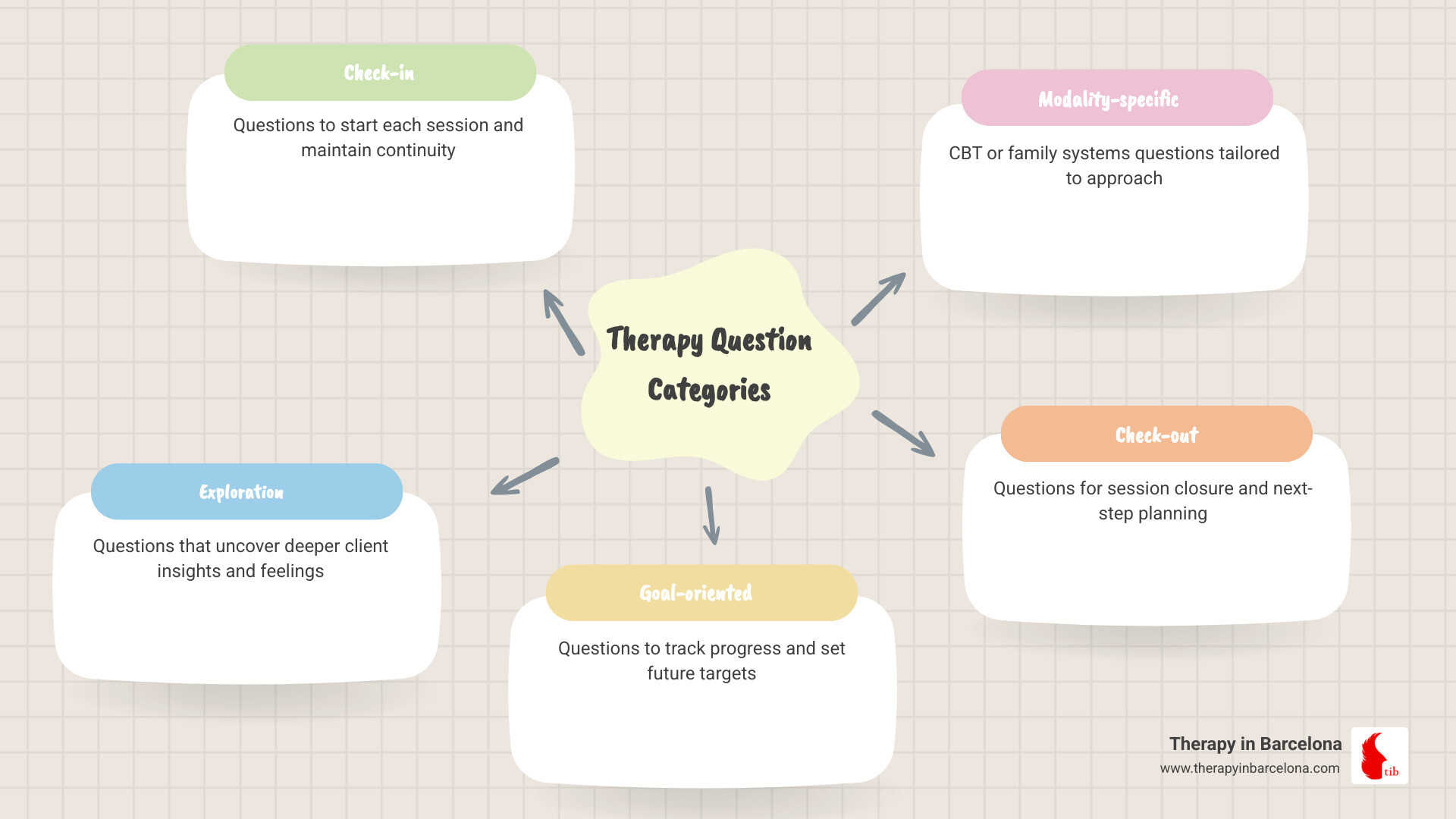
- Check-in questions – “How has your week been?” or “What’s been on your mind since we last met?”
- Scaling questions – “On a scale of 1-10, how would you rate family communication this week?”
- Goal-oriented questions – “What would you like to work on today?” or “What does progress look like for your family?”
- Exploration questions – “Can you tell me more about that situation?” or “What happened next?”
- Check-out questions – “What are you taking away from today?” or “How do you feel about what we discussed?”
The questions therapists ask aren’t random. Research shows that the therapeutic alliance—the bond between therapist and client—is the strongest predictor of successful outcomes . Open-ended questions, in particular, lead to more detailed understanding and help families feel heard and understood.
For international families in Barcelona, Valencia, Madrid, or Málaga, therapy questions serve an even more vital role. They help untangle the layered challenges of cultural adjustment, language barriers, family role shifts, and the emotional weight of living far from home. When a therapist asks the right question at the right moment, it can open up insights that have been stuck for months or even years.
This article breaks down the categories of questions therapists use, from initial phone consultations to closing rituals, and explains how these questions adapt to different family situations and therapeutic approaches. You’ll find practical examples, downloadable resources, and guidance on what makes certain questions so powerful in creating change.
Laying the Groundwork: First Questions in Therapy
This section explores the first questions therapists use to build rapport, understand family dynamics, and set a collaborative tone. These initial inquiries are crucial for establishing a safe space, especially for expats who might be starting therapy in a new cultural context.
Questions for the Initial Phone Consultation
The very first interaction with a potential client often happens over the phone. This isn’t just about scheduling; it’s a vital opportunity for both the client and the therapist to assess their fit. For international families, this initial conversation helps gauge whether the therapist understands the unique challenges of expat life.
Here are some key questions often asked during an initial phone consultation:
- “What made you decide to reach out today?”
- “Have you worked with a therapist before? If so, what was that experience like?”
- “What are you looking for in a counsellor or therapist?”
- “Do you have any questions for me?”
- “Are there any specific scheduling preferences or limitations I should know about?”
At Therapy in Barcelona, the first conversation helps us understand your family’s needs, background, and goals for therapy. That way, we can match you with a psychology-trained therapist who fits your situation and understands expat life. You can get started by booking a Free Discovery Call.
Questions for the First Therapy Session

The first in-person or online therapy session is primarily about information gathering and building trust. It’s where the therapist begins to paint a comprehensive picture of the family’s situation, their history, and their hopes for the future. For expats, this might include discussing the impact of cultural adjustment or feelings of isolation.
Therapists might ask questions such as:
- “Why are you seeking therapy now, and what do you hope to accomplish?”
- “How have you been coping with the problems that led you to seek counselling?”
- “Can you tell me about your family relationships and how they function?”
- “What are some of your family’s strengths?”
- “Is coming to therapy a personal decision for everyone involved, or did someone encourage you to come?”
These questions help the therapist understand the family’s unique context, including any challenges related to living abroad, such as those faced by internationals in Madrid or Valencia.
You can learn more about the therapeutic journey in What Does the Therapy Process Look Like? and explore common first-session concerns in Starting Therapy: 10 Honest Questions You Might Be Asking and Deserve Straight Answers To. In early sessions, therapists usually follow a clear, thoughtful structure so they can understand what is happening, build trust, and focus on what matters most to you.
The Role of Check-In Questions
Check-in questions are not just formalities; they are the compass that guides each therapy session. They help transition clients from their busy lives into the therapeutic space, setting a baseline for their current emotional state.
At the beginning of a session, a therapist might ask:
- “How have things been for you since our last session?”
- “Did anything we talked about last time stick with you or come up during the week?”
- “What’s one thing that feels different—even slightly—this week?”
- “On a scale of one to ten, how would you rate your overall mood this week?”
These questions help maintain continuity, connecting the current session to previous discussions and allowing for reflection on progress or new challenges. They prompt self-disclosure and allow the therapist to tailor their approach for that specific day.
Check-in questions can transform a session from a disconnected appointment into a continuous narrative. If you’re keen to explore more, you can access a resource with 50 Check-In Ideas as a PDF Download.
Your Toolkit: Counselling Questions to Ask Clients
A downloadable list and breakdown of effective questions therapists use at different stages, designed to help families and individuals gain insight and move forward. Mastering these tools is a basic counselling and therapy skill, enabling deeper understanding and more effective interventions.
Open-Ended vs. Closed-Ended Questions
The type of question a therapist asks significantly impacts the quality of the response.
Closed-Ended Questions: These typically elicit a ‘yes’ or ‘no’ answer, or a very specific piece of information. They are useful for gathering facts quickly.
- Example: “Are you feeling better today?”
Open-Ended Questions: These invite elaboration, encouraging clients to share more detailed thoughts, feelings, and experiences. They are crucial for fostering a constructive conversation and gaining a deeper understanding.
- Example: “How are you feeling today?”
Research indicates that open-ended questions are positively associated with a more detailed understanding of clients. They shift the control of the conversation to the client, empowering them to explore their inner world. For a broader exploration of therapeutic inquiries, explore Explore Your Inner World with 100 Therapy Questions.
Scaling, Goal-Oriented, and Reflective Questions
These types of questions offer unique ways to track progress, set future directions, and connect with past insights.
- Scaling Questions: These help quantify subjective experiences, making them easier to track over time.
- “On a scale of one to ten, how would you rate your overall mood this week, where one is the worst and ten is the best?”
- “How confident do you feel about managing the challenges we discussed last time, on a scale of one to ten?”
- Goal-Oriented Questions: These focus clients on their aspirations and the steps needed to achieve them. They are particularly effective in Solution Focused Brief Therapy (SFBT), an approach used by some therapists at Therapy in Barcelona.
- “What are some goals you have for yourself in the coming weeks or months?”
- “What do you hope to accomplish in therapy?”
- The ‘Miracle Question’: A powerful SFBT technique. “Imagine that one night a miracle occurs, and the problem that brought you to therapy is solved! When you wake up in the morning: How do you know that this miracle has truly happened? What’s different in how you feel? What’s different about your life? What will others notice about your new self?” This helps clients visualise a problem-free future and identify concrete steps towards it.
- Reflective Questions: These build on previous sessions, encouraging clients to consider how past discussions have resonated or influenced their week.
- “Is there a particular topic from our last session that you’ve found yourself thinking about more this week?”
- “Were there any insights from our last meeting that you felt particularly resonated with or challenged you?”
For more practical examples, consider these 10 Useful Questions for Counsellors to Ask.
Modality-Specific Counselling Questions to Ask Clients

Different therapeutic modalities use different questioning styles, each shaped by its core theory. Common examples include Cognitive Behavioural Therapy (CBT), Gestalt therapy, and Family Systems therapy, all of which guide clients toward insight in different ways.
- Cognitive Behavioural Therapy (CBT) Questions: CBT aims to help clients identify and challenge unhelpful thought patterns and behaviours. A key technique involves “Three Rational Questions” clients can ask themselves:
- “Is the thought I’m having based on fact?”
- “Does that thought help me achieve my goals?”
- “Does that thought help me feel the way I want to feel?” If the answer is ‘No’ to at least two, the thought is considered irrational and can be challenged.
- Gestalt Therapy Questions: Gestalt therapy focuses on the present moment, helping clients gain awareness of their current experiences. Gestalt questions often begin with ‘what’ and ‘how’, rather than ‘why’.
- “How are you feeling now?”
- “What are you thinking right now?”
- “How does your body feel at the present moment?”
- “What mood is evoked now?”
- Family Systems (Circular Questioning): This approach is particularly useful in family therapy, focusing on the relationships and interactions within a family rather than individual symptoms. Circular questions ask one family member about another’s perspective or reaction.
- “When your mother gets angry, how does your father usually react?”
- “Who in the family is most concerned about [the problem]?”
- “If [the problem] were to disappear, what would be different in your family’s interactions?”
Adapting to Family Needs: Tailoring Your Questions
Therapy is most effective when questions fit the family’s unique situation, whether facing adjustment, conflict, or communication challenges. This is especially true for the diverse international community in cities like Barcelona, Málaga, or Alicante.
Questions for Families Facing Adjustment or Conflict
Expat families often face unique stressors, including cultural adjustment, language barriers, and the absence of established support networks. These can exacerbate existing family conflicts or create new ones. Effective questions address these layers of complexity.
- “What changes have you noticed in your family since moving to [city, e.g., Barcelona]?”
- “How has living in a new culture impacted your family’s routines or traditions?”
- “Who in the family feels most supported, and who feels most isolated?”
- “What coping mechanisms do you use individually and as a family when stress arises?”
- “How do you resolve disagreements, and does everyone feel heard during conflict?”
It also helps to notice mental health concerns that may be adding to family stress. Low mood, anxiety, burnout, grief, or substance use can affect communication, coping, and connection. In these moments, therapists ask clear, compassionate questions to understand what is happening underneath. If depression may be present, they often explore sleep, energy, motivation, hopelessness, and, when needed, safety around self-harm or suicidal thoughts.
Questions for Resistant or Ambivalent Family Members
It’s completely natural for some family members to feel resistant or ambivalent about therapy. Sometimes, ‘resistance’ isn’t about unwillingness, but rather about fear, discomfort, or a feeling that the therapy isn’t addressing their needs. It’s widely suggested that resistance can often be an indication of therapist conduct rather than a client characteristic.
Instead of direct, probing questions, therapists use validating statements and motivational interviewing techniques to build rapport and encourage openness.
- “It sounds like this is really hard to talk about, and that’s perfectly understandable.”
- “What feels safest to start with today? We don’t have to go there right now, I’m here whenever you’re ready.”
- “I can see how much effort you’re putting into being here today. You’re in control of what we talk about.”
- “What part of you wants to make a change, and what part is unsure?”
- “When things were going better, what was different?”
These approaches, considered basic counselling and therapy skills, create emotional safety and allow resistant clients to explore their own motivations for change without feeling judged.
Family, Group, and Couples Counselling Questions to Ask Clients
Effective counselling adapts to each family, couple, or group, with questions tailored to their specific dynamics.
Family Therapy: Focuses on the dynamics, communication patterns, and roles within the family unit.
- “What changes do you want to see within your family?”
- “How does your family typically resolve fights or disagreements?”
- “Do you feel safe voicing your opinions or feelings in your family?”
- “What activities do you do as a family that bring you closer?”
Group Therapy: Encourages shared experiences, mutual support, and learning from others. Questions foster interaction and self-reflection within the group context.
- “What do you like best about our group therapy sessions?”
- “What coping strategies are you using to manage your triggers, and what have you learned from others here?”
- “Discuss three goals you want to achieve in group therapy.”
- Couples Counselling: Concentrates on improving communication, understanding, and shared goals between partners.
- “What makes it difficult for you to communicate with each other?”
- “Do you and your partner share the same values, and how do you steer differences?”
- “What does intimacy mean to each of you, and are you comfortable being intimate with your partner?”
- “How do you think you can rebuild trust or strengthen your relationship?”
Wrapping Up: Ending Sessions and Finding the Right Support
The way a session ends matters. This section covers check-out questions and how to find a therapist who fits your family’s needs, especially for expats.
The Value of Check-Out Questions and Rituals
Just as check-in questions open a session, check-out questions bring it to a thoughtful close. They provide closure, encourage reflection, and help consolidate the insights gained during the session.
- “What is one key insight or takeaway you are bringing with you from today’s meeting?”
- “How do you feel about the discussions and decisions we made today?”
- “Is there anything you want to do differently between now and next time?”
- “What would you like to focus on when we meet again?”
Check-out questions help therapists gather helpful feedback, spot misunderstandings, and notice tension in the therapeutic relationship. Ending a session with a brief, consistent ritual can support reflection, emotional grounding, and a smoother transition out of the room. Simple closing questions such as “What stands out from today?” or “What feels important to carry into the week?” can strengthen continuity and help clients leave with clarity.
Finding the Right Therapist for Your Family
Finding the right therapist for your family is a deeply personal journey, especially for expats seeking support in Barcelona, Valencia, Madrid, or Málaga. The most crucial factor is the “match,” also known as the therapeutic alliance. This bond, characterised by mutual trust, good communication, and agreement on goals, is the strongest predictor of successful therapy outcomes.
When searching, consider:
- Your preferences: Do you have a preference for the therapist’s age, gender, cultural background, or language? Therapy in Barcelona prides itself on its multilingual team, offering English, German, French, Spanish, Afrikaans, Portuguese, Austrian-German, and Swiss-German therapy, amongst others.
- Therapeutic approach: Are you looking for a tool-based approach like CBT or ACT, or a deeper exploration with psychodynamic therapy? Therapy in Barcelona‘s psychology-trained therapists are trained in a wide array of evidence-based modalities.
- Expat-specific understanding: For internationals, cultural sensitivity is paramount. Our therapists are often expats themselves, bringing a unique understanding of challenges like cultural adjustment, isolation, and living in Spain.
- Logistics: Consider location (in-person in Barcelona or online worldwide), availability, and cost. While we are a private service, some of our therapists offer sliding scale fees for those with financial need, and prospective clients can inquire about this.
For more help, see The Art of Choosing a Therapist: What You Need to Know and How to Choose the Right Therapist for Your Needs as an Expatriate. These guides explain what to look for, including cultural fit, language, and the therapist-client match.
Comparing Your Therapy Options: What to Consider
When seeking therapy, especially as an expat in Spain, you’ll encounter several options. Understanding their differences can help you make an informed choice.
Public Healthcare System
- Pros: Generally accessible and low-cost.
- Cons: Often involves long wait times, limited choice of therapist, and less personalised care. Language barriers can also be an issue for non-Spanish speakers.
Large Online Platforms
- Pros: Convenient, wide selection of therapists, often lower cost.
- Cons: May lack local expertise and expat-specific focus. Privacy policies can vary, and data selling might be a concern. The connection with a therapist might feel less personal.
Local Private Practices
- Pros: Highly personalised care, often with psychology-trained therapists. Strict privacy and confidentiality. Can offer a deeper, more consistent therapeutic relationship.
- Cons: Can be more expensive than public options or large platforms. Availability might be limited depending on the practice.
- Pros: Personalised therapist matching, strong cultural sensitivity for expats, psychology-trained therapists, and strict privacy. Offers in-person sessions in Barcelona and online therapy worldwide, in English and other languages.
- Cons: Private therapy can cost more, though some therapists may offer sliding scale fees.
Your Next Step: Support for Families in Spain and Beyond
The right questions help families connect, understand, and grow together. Whether you’re a therapist or a family seeking support, knowing what to ask—and what’s being asked—can make all the difference.
For internationals in Barcelona, Valencia, Madrid, Málaga, and across Spain, Therapy in Barcelona offers psychology-trained, culturally sensitive therapists who understand expat family life.
We believe in empowering you to strengthen family connections and build a more fulfilling life abroad. If you’re ready to explore how tailored support can benefit your family, we invite you to learn more about Our Services or to Book Your Free Discovery Call.
