


Understanding Expat Family Therapy

Expat family therapy is specialised counselling designed to help international families steer the unique challenges of living abroad together. Unlike traditional family therapy, it focuses on culture shock, identity shifts, language barriers, and the emotional ripple effects that impact every family member during global transitions.
Key aspects of expat family therapy include:
- Cultural adaptation support – helping families adjust to new social norms and expectations
- Third Culture Kid guidance – supporting children who grow up between cultures
- Trailing spouse assistance – addressing identity loss and relationship changes
- Communication strategies – rebuilding connection across generational and cultural divides
- Online accessibility – flexible sessions that work across time zones and locations
- Multilingual options – therapy in the family’s preferred language(s)
Moving abroad as a family brings excitement, but it also creates unexpected stress. What starts as an trip can quickly become overwhelming when parents face visa uncertainty, children struggle at new schools, and everyone misses their support network back home.
Research shows that expatriate families often deal with homesickness, loneliness, and relationship tensions that didn’t exist before the move. Children may become withdrawn or act out, whilst parents find themselves arguing more frequently about decisions they used to make easily together.
Without usual coping methods and comforts, expats may quickly become overwhelmed. This is especially true for families, where one person’s adjustment struggles can affect everyone else’s emotional wellbeing.
That’s where specialised support makes all the difference. Expat family therapy provides a safe space to work through these challenges together, using approaches that understand both family dynamics and the unique pressures of international living.
Why Expat Families Need Specialised Support
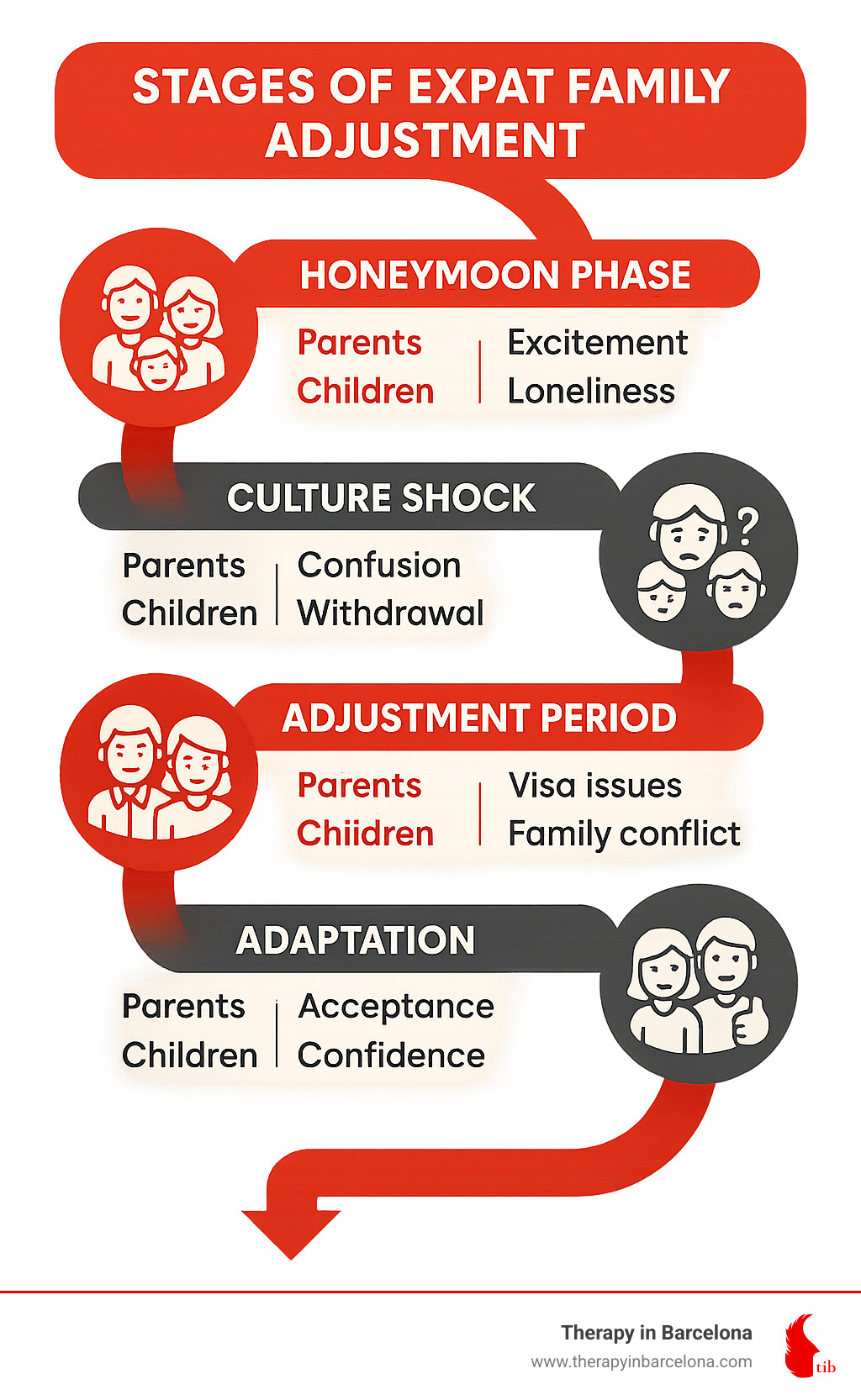
Moving abroad as a family can turn excitement into emotional land-mines once the honeymoon phase fades. Everyday routines—school drop-offs, grocery shopping, or making friends—suddenly feel complicated and unfamiliar.
Culture shock ripples through the whole family. Parents juggle new workplace norms while helping children decode foreign school rules. Home becomes both sanctuary and pressure-cooker, where everyone’s stress collides.
Homesickness hits each person differently. Children mourn friends, while parents miss professional identity and the easy support of relatives. Celebrations without grandparents or familiar faces highlight the distance.
The trailing-spouse dynamic often breeds loneliness or resentment when one partner’s career drives the move. Children absorb these tensions even when parents try to hide them.
Third Culture Kids grapple with questions like “Where do I belong?” Visa stress adds an undercurrent of uncertainty that blocks long-term planning and fuels anxiety.
Finally, multilingual households face communication shifts. Kids pick up the local language faster and may become family translators, changing traditional roles.
More info about relocation challenges
Unique Pressures of Life Abroad
- Uncertain timelines driven by visas and contracts
- Loss of extended support networks during crises
- Continuous school changes that affect learning and friendships
Common Emotional Ripples Across Generations
- Heightened parenting stress and self-doubt
- Couple conflict when partners adapt at different speeds
- Shifts in child behaviour—clinginess, anger, or a drop in grades
From Culture Shock to Relationship Rock: Couples Counseling for Expats
Expat family therapy recognises these intertwined challenges and offers tools that traditional counselling often overlooks, helping families build resilience together.
What Happens in Expat Family Therapy?
Expat family therapy starts with a simple idea: every person’s reaction to a move abroad affects everyone else. When your teen slams the door after school, your stress about visas may surge—and vice-versa.
Most families attend 5–20 sessions. Some resolve urgent issues quickly; others appreciate longer support through multiple relocations. Every conversation is filtered through a cultural lens: homesickness is framed as grief for routines and community, not just missing a house.
Sessions usually take place online via secure, HIPAA-compliant platforms, so travelling partners or university-aged children can still join. From the beginning, you and the therapist agree on clear goals—fewer evening arguments, smoother bedtimes, or helping kids honour their heritage while blending in.
A Walk-Through of the First Three Sessions
- Session one: map your move story and feelings, noticing who speaks, who stays quiet, and why.
- Session two: explore communication patterns and try short listening or emotion-labelling exercises.
- Session three: set concrete objectives so everyone knows what “better” looks like.
Typical Tools & Techniques Used
- Role-plays to rehearse tricky talks—telling kids about another move, negotiating chores.
- Communication drills that swap blame for “I” statements and active listening.
- Emotion coaching so each person feels heard before solutions are suggested.
- Homework such as weekly family check-ins or exploring local cultural activities.
With younger children, therapists weave in drawing, stories, and play to bypass language limits.
How Online Expat Family Therapy Keeps You Connected
Screen-sharing enables interactive exercises, while flexible scheduling respects different time zones. Encrypted platforms guard privacy and—with consent—sessions can be recorded so absent members stay in the loop.
Effective Approaches for Global Families
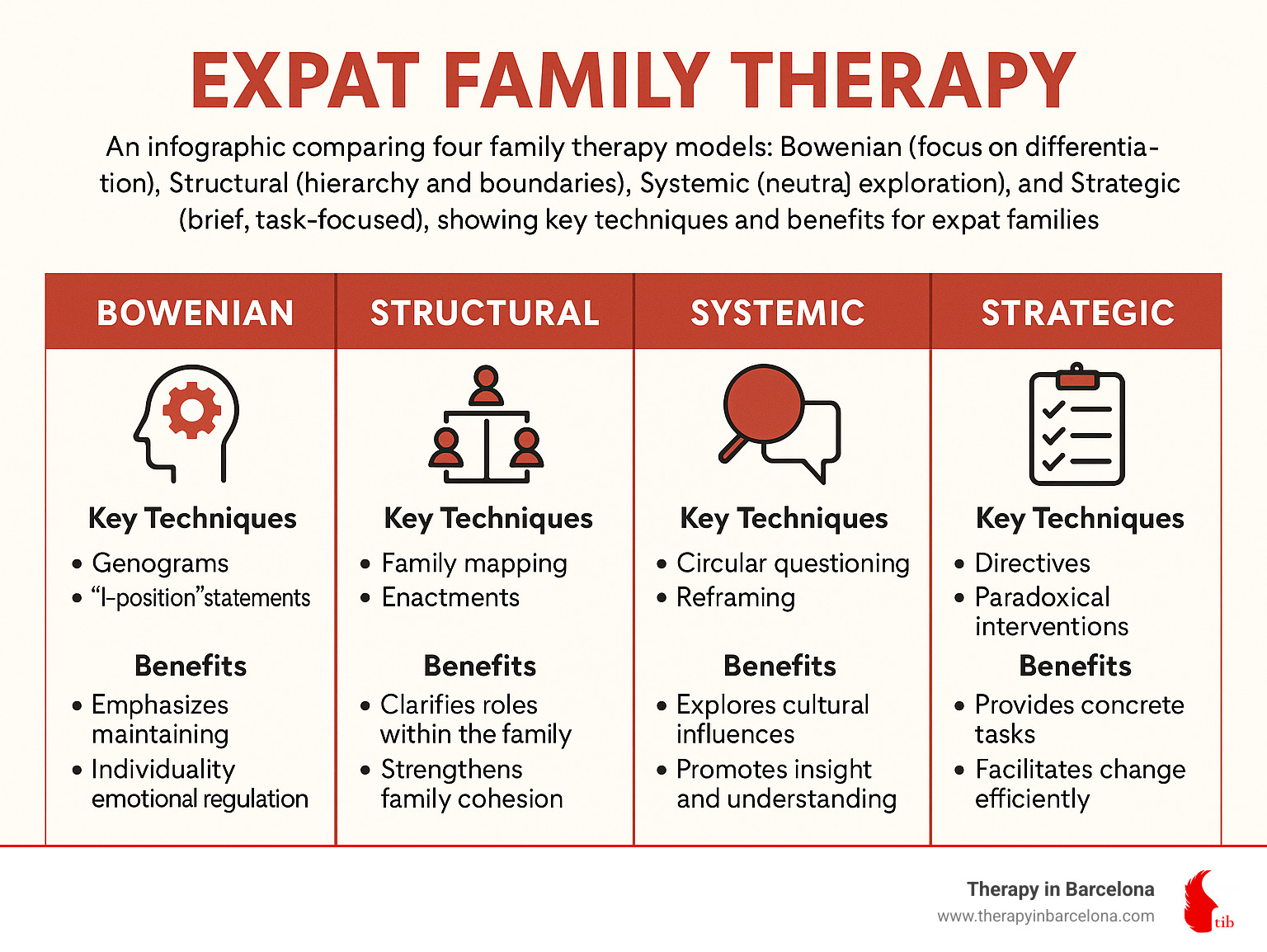
When it comes to helping expat families, different therapeutic approaches offer unique benefits that address the complex layers of international living. Bowenian Family Therapy focuses on differentiation – helping family members maintain their individual identity whilst staying connected to the family unit. This approach proves particularly valuable for families navigating cultural identity questions, especially when children feel torn between their parents’ culture and their new environment.
Structural Family Therapy examines family hierarchies and boundaries, which often shift dramatically during international moves. Therapists help families establish clear roles and expectations that work in their new cultural context. This approach addresses common expat challenges like children becoming cultural interpreters for parents, or spouses losing their traditional roles when one partner’s career drives the move.
Systemic Family Therapy takes a neutral stance, exploring the underlying meanings behind family behaviours without judgment. This approach helps families understand how their cultural backgrounds influence their reactions to expat challenges. Rather than labelling behaviours as right or wrong, it explores what these patterns mean for the family system.
Strategic Family Therapy offers brief, homework-focused interventions that busy expat families often appreciate. Therapists assign specific tasks to reframe family problems and create positive change. This approach works particularly well for families juggling multiple time zones, international school schedules, and work demands.
Cognitive Behavioural Therapy (CBT) techniques help families identify and change negative thought patterns about their expat experience. Parents might learn to challenge catastrophic thinking about visa renewals, whilst children develop coping strategies for social anxiety at new schools.
Acceptance and Commitment Therapy (ACT) helps families accept uncertainty whilst committing to their values. This approach proves particularly relevant for expat families dealing with ongoing uncertainty about their future – whether they’ll stay in their current country, how long visa renewals will take, or when they might see extended family again.
For younger family members, play therapy and sand tray therapy work beautifully. These approaches allow children to express complex emotions about moving and cultural adjustment through creative means rather than words alone.
Narrative therapy helps families rewrite their expat story from one of loss and struggle to one of trip and growth. This approach recognises that how we tell our story shapes how we experience it.
Child Therapy Barcelona offers specialised approaches for younger family members struggling with international transitions.
Tailoring Modalities to Age & Culture
The beauty of expat family therapy lies in adapting approaches to match both developmental stages and cultural backgrounds. Storytelling approaches work particularly well with younger children who might struggle to express their feelings directly. Therapists might create narratives about brave children who move to new countries, helping young clients process their own experiences through metaphor and imagination.
Mindfulness techniques benefit teenagers dealing with identity questions that are particularly complex for expat youth. Adolescents learn to observe their thoughts and emotions without judgment, developing self-awareness that helps them steer cultural conflicts and peer pressure.
Solution-focused tasks appeal to busy parents who want practical outcomes and measurable progress. Therapists help parents identify what’s already working in their family system and build on those strengths rather than focusing exclusively on problems.
Cultural considerations significantly influence therapeutic effectiveness. Families from more hierarchical cultures might need different communication strategies than those from egalitarian backgrounds. Therapists adapt their interventions to match family cultural values whilst still promoting healthy functioning.
Making Therapy Work Across Borders

Finding the right therapist for expat family therapy across international boundaries requires more thoughtful consideration than simply booking with the nearest available professional. The complexity of working with families scattered across time zones, speaking different languages, and navigating various cultural backgrounds means that careful matching becomes crucial for therapeutic success.
Language matching forms the foundation of effective cross-border therapy. Families need therapists who don’t just speak their preferred language fluently, but who understand the subtle cultural nuances that affect how emotions are expressed and problems are discussed. When a family switches between languages during emotional moments, or when children prefer expressing themselves in their adopted language whilst parents feel more comfortable in their native tongue, skilled therapists know how to work with these linguistic preferences rather than against them.
Cultural competence extends far beyond language skills. Effective expat family therapists understand how different cultural backgrounds influence family hierarchies, communication styles, and approaches to problem-solving. They recognise that what might appear as dysfunction through one cultural lens could be perfectly normal behaviour in another context.
The practical logistics of international therapy require careful coordination. Time-zone planning becomes an art form when family members are scattered across different countries. Some therapists extend their working hours specifically to accommodate international clients, understanding that a 2 PM session in Barcelona might be the only time that works for a family with members in Asia and Europe.
Emergency planning takes on new complexity when working across borders. Families need clear protocols for crisis situations, including local emergency contacts and procedures for accessing immediate help when their primary therapist isn’t available.
In which language should one speak with their therapist? explores the nuanced considerations that multilingual families face when choosing therapeutic languages.
Research shows that platforms specialising in international therapy now feature thousands of mental health professionals from dozens of countries, offering counselling in nearly 100 languages. This diversity ensures that families can find culturally and linguistically appropriate support, rather than settling for whatever happens to be locally available.
Expat Therapy Barcelona offers specialised matching services that understand these complex international requirements.
Finding and Vetting the Right Professional
Licensure verification requires extra diligence when working across international boundaries. Families should confirm that their chosen therapist holds valid qualifications.
Cross-cultural experience matters significantly more than general therapy training. Therapists who have lived abroad themselves bring personal understanding to their professional skills. They recognise the emotional complexity of visa uncertainty, the grief of leaving extended family behind, and the identity questions that arise from cultural adaptation.
Platform reviews provide valuable insights, but families should look specifically for feedback from other expat clients. Comments about cultural sensitivity, communication effectiveness across time zones, and practical results with international families offer more relevant information than general therapeutic reviews.
Consultation calls before committing to ongoing therapy allow families to assess fit and discuss practical logistics. Most experienced international therapists offer these preliminary conversations to explore family needs, explain their therapeutic approaches, and work out time-zone scheduling.
Preparing Your Family for the First Session
Setting clear expectations helps reduce anxiety about the therapeutic process, especially for children who might be nervous about video calls with strangers. Parents should explain what therapy involves using age-appropriate language, why the family is seeking support, and how online sessions will work.
Technical preparation prevents frustrating interruptions during emotional conversations. Families should test their internet connection, video quality, and audio clarity well before their first appointment. They need to identify a private space where all family members can participate comfortably without interruptions.
Privacy discussions ensure that all family members understand confidentiality rules, recording policies, and how their personal information will be protected across international boundaries.
| Comparison | In-Person Sessions | Online Sessions |
|---|---|---|
| Accessibility | Limited by location | Available worldwide |
| Scheduling | Fixed office hours | Flexible time zones |
| Family Participation | All must travel together | Members can join from different locations |
| Privacy | Office confidentiality | Home environment control |
| Technical Requirements | None | Stable internet, quiet space |
| Emergency Support | Immediate local resources | Pre-planned crisis protocols |
Frequently Asked Questions about Expat Family Therapy
How is expat family therapy different from traditional family counselling?
Traditional therapy can improve communication, but it rarely considers visa deadlines, culture shock, or shifting identities. Expat-focused therapists weave these realities into every intervention and offer online access so relatives in different countries can still attend.
Can family members join sessions from different countries?
Yes. Secure video platforms allow real-time or recorded participation. Therapists skilled in time-zone juggling usually offer slots that suit everyone.
What if our children prefer another language?
Many therapists at Therapy in Barcelona are multilingual and comfortable code-switching mid-session. They may also use drawing, music, or play when words feel awkward, ensuring every voice is heard.
Conclusion
The journey of expat family therapy reflects a deeper truth about international living: while moving abroad as a family brings incredible opportunities, it also creates emotional complexities that require specialised understanding and support.
Throughout this exploration, we’ve seen how expatriate families face unique pressures that domestic families rarely encounter. Research consistently shows that culture shock, visa uncertainties, language barriers, and the loss of extended support networks create a perfect storm of challenges. Yet these same challenges, when addressed with proper support, become catalysts for remarkable family growth and resilience.
What makes expat family therapy so effective isn’t just the therapeutic techniques – though approaches like systemic therapy, CBT, and culturally sensitive interventions prove invaluable. The real difference lies in working with professionals who understand the expatriate experience firsthand. When therapists have steerd their own cultural transitions, they bring both professional expertise and personal insight to the therapeutic relationship.
The families who thrive abroad aren’t necessarily those who avoid difficulties – they’re the ones who develop global resilience through improved communication and a shared coping toolkit. They learn to see homesickness not as weakness but as a natural part of loving multiple places. They find that identity questions strengthen rather than threaten family bonds when explored together.
Online therapy platforms have revolutionised access to culturally competent support. Families scattered across continents can now participate in sessions together. Parents living in Barcelona can access specialists who understand both their cultural background and their new Spanish context. Children can work with therapists who speak their emotional language, whether that’s English, Spanish, or the unique blend that third culture kids often develop.
Therapy in Barcelona recognises these intricate dynamics because founder Leigh Matthews lived them herself. As an Australian psychologist who moved to Barcelona in 2011, she experienced the isolation of seeking English-speaking mental health support that didn’t exist. Her journey from struggling expat to founding Barcelona’s premier English-speaking therapy practice reflects the change that proper support can create.
The therapists at Therapy in Barcelona aren’t just professionally qualified – they’re fellow internationals who understand that seeking support isn’t about failure, it’s about wisdom. They recognise that the strongest expat families are often those who invest in their emotional wellbeing before crisis hits.
Every family’s global journey looks different. Some struggle with teenage identity questions in international schools. Others steer trailing spouse depression or couple conflicts over future plans. Many face the ongoing uncertainty that defines expat life: “Will we stay? Should we go? How do we decide what’s best for everyone?”
These questions don’t have simple answers, but they become manageable when families develop the communication skills and emotional resilience that expat family therapy provides. The investment in professional support often pays dividends for years beyond the initial therapeutic relationship.
More info about family therapy services can help your family build the connections and coping strategies needed to not just survive international living, but to truly thrive anywhere your global trip takes you.
