


Why Finding the Right Therapist Is Harder Than It Should Be

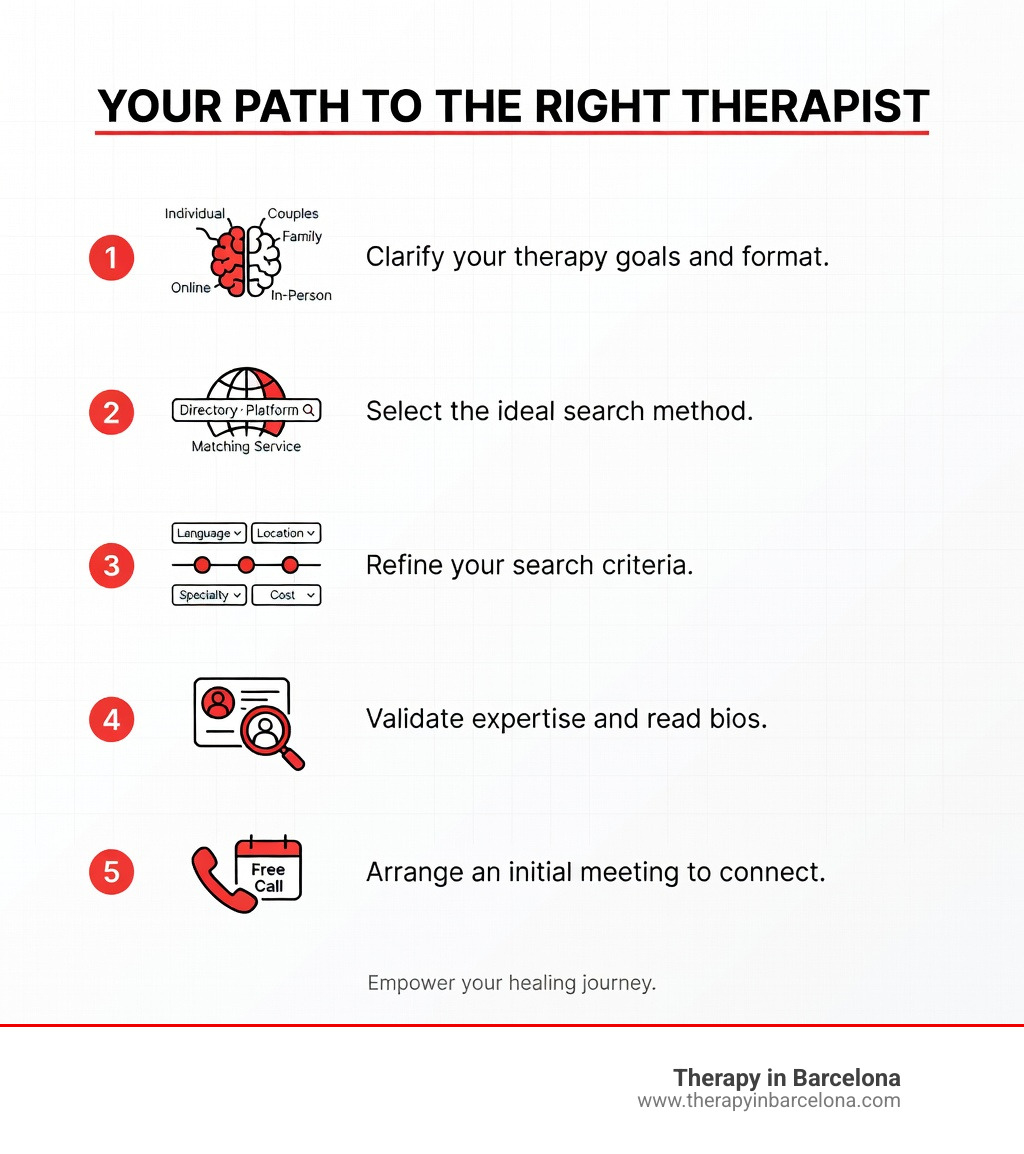
Find therapy that actually fits your life — not just your postcode — and you’re already ahead of most people. Here’s a quick overview of how to do it:
- Define what you need – individual, couples, family, or group therapy; in-person or online
- Choose your search tool – directories like Psychology Today, specialist platforms, or a personalised matching service
- Filter by what matters – language, cultural fit, speciality, and availability
- Check credentials and fit – look for licensed, psychology-trained therapists with experience in your concerns
- Book a first session or discovery call – an initial consultation can help you decide if the therapist feels like the right match
If you’ve ever opened a browser tab to look for a therapist and ended up more confused than when you started, you’re not alone. The search process can feel overwhelming — dozens of directories, vague profiles, unclear pricing, and no obvious way to know who’s actually right for you.
That challenge gets even harder when you’re living abroad. Whether you’re an expat in Barcelona, settling into life in Valencia, or navigating a new job in Madrid, finding someone who speaks your language — literally and culturally — adds a whole extra layer of difficulty. You might be dealing with anxiety, loneliness, relationship stress, or simply the quiet disorientation of building a life somewhere new.
The good news is that the right tools can cut through the noise. This guide rounds up the most useful therapy finders available today, so you can stop scrolling and start healing.
Understanding Your Options to Find Therapy
When you begin your search to find therapy, the first hurdle is often the terminology. You’ll encounter psychologists, counsellors, and social workers, and it isn’t always clear who does what.
Generally, psychologists hold doctoral or advanced degrees and often focus on long-term clinical work. Counsellors and therapists typically offer focused support for specific life challenges, while social workers often look at an individual within the context of their social environment. If you require medication, you would typically see a psychiatrist.

The format of therapy is just as varied. You can choose from:
- Individual sessions: 1-on-1 focus on personal growth.
- Couples therapy: Navigating relationship dynamics or choosing a therapist together.
- Family or Child therapy: Supporting children (usually aged five and up) or the family unit.
- Group therapy: Led by one or more therapists with 5 to 15 participants, often focusing on shared issues like depression or substance use.
Most modern therapists use evidence-based approaches. This means the methods have been scientifically tested. Common styles include Cognitive Behavioural Therapy (CBT), which targets thought patterns, and Acceptance and Commitment Therapy (ACT), which focuses on psychological flexibility. Research on online therapy effectiveness suggests that digital sessions are just as effective as sitting in a room together for concerns like anxiety and PTSD.
How Therapy in Barcelona Helps You Find Therapy
At Therapy in Barcelona, we believe that the “human” element is the most important part of the process. We aren’t a giant directory where you have to do all the heavy lifting yourself. Instead, we offer a personalised matching service.
We specialise in the international community. Our team is made up of psychology-trained therapists who are expats themselves. We understand the specific “messiness” of moving to a new country—the isolation, the cultural shock, and the strain on relationships.
We provide:
- Multilingual care: While we are the primary provider of English therapy, our team also speaks German, French, Spanish, Afrikaans, Portuguese, and various dialects of Swiss and Austrian-German.
- Specialised support: We work with adults, couples, teens, and families.
- Global reach: We offer face-to-face sessions in our Barcelona office and online therapy worldwide, including the USA and Canada.
- A collaborative approach: We are a group practice, meaning our therapists share knowledge and maintain high ethical standards.
Alternatives: Public, Platform, and Local Options
It’s important to know that there are several ways to find therapy, and the right choice depends on your budget and needs.
Public Health System In Spain, the public system is accessible and free at the point of use. However, it often comes with very long waiting lists. You rarely get to choose your therapist, and sessions may be brief or focused only on acute crises.
Large Online Platforms Big apps use algorithms to match you with a provider. These can be convenient and often operate on a subscription model. However, there can be concerns regarding data privacy and the consistency of the therapist’s experience.
Local Private Practices Boutique practices offer a middle ground. You get the high quality and strict privacy of a private service, but with a more human, tailored touch than a large app. This is often where you’ll find the best therapists near you who truly understand the local expat experience.
Navigating Costs, Insurance, and Regional Resources
One of the biggest stressors in looking for help is the cost. In Spain, private therapy sessions typically range between €80 and €120.
Many people use private or international health insurance to cover their sessions. It is always worth checking if your provider allows for “out-of-network” reimbursement. If you are a student, check your university resources.
If you are on a tight budget, look for therapists who offer “sliding scale” fees. This means they adjust their rate based on your income. At Therapy in Barcelona, we are a private-pay service, but some of our therapists do offer sliding scales for those in financial need—just ask during your initial inquiry.
While our home base is Barcelona, we support internationals across Spain’s major hubs, including Valencia, Madrid, Málaga, and Alicante. Each of these cities has growing international communities with specific mental health needs.
Choosing the Right Match and Comparing Options
The first session can feel intimidating. Think of it as a “test drive.” You are checking to see if you feel heard and safe. A good therapist won’t judge you; they will work with you to set clear goals.
Building trust takes time, but it’s easier when your therapist understands your background. If you are an expat professional or a digital nomad, having a therapist who knows the “relocation blues” is a game-changer. Whether you are looking for how to find a good therapist in Barcelona or support in a smaller hub like Sevilla or Marbella, the goal is the same: a connection that feels real.
Comparing Your Options: What to Consider
To help you decide, we’ve broken down the main differences between the paths you can take.
Public Health System
- Pros: Free or very low cost.
- Cons: Long waiting lists; limited choice of therapist; often short-term or crisis-focused.
Large Online Platforms
- Pros: Convenient mobile apps; easy to start.
- Cons: Subscription models can be tricky; algorithmic matching lacks a human touch; variable therapist experience; data privacy concerns.
Boutique Private Practices (like Therapy in Barcelona)
- Pros: Personalised matching by humans; expat-specific cultural sensitivity; multilingual care; higher quality, psychology-trained therapists; strict privacy with no data selling.
- Cons: Private-pay (though insurance may reimburse).
Frequently Asked Questions
How much does therapy typically cost?
In Spain, expect to pay between €80 and €120 per session. In the US, the average is around $150. Most sessions last about 50 minutes. While many private practices are private-pay, you can often use international insurance, and some providers offer sliding scale options.
Is online therapy as effective as in-person?
Yes. 80% of therapists now offer both, and research shows that online sessions are highly effective for depression, anxiety, and PTSD. It’s a great option for digital nomads or those living in more remote areas like Gran Canaria or Zaragoza. Just ensure the platform used is GDPR compliant to protect your privacy.
How do I know if a therapist is a good fit?
It usually takes 1 to 3 sessions to know for sure. You should feel a sense of rapport and trust. If you don’t feel “seen” or understood, it is perfectly okay to change therapists. At Therapy in Barcelona, we take the stress out of this by matching you with someone based on your specific personality and needs from the start.
Conclusion
Finding the right support shouldn’t feel like a second job. Whether you are navigating an intercultural marriage, the stress of a new job in Valencia, or the challenges of raising a “Third Culture Kid” in Barcelona, help is available.
Therapy in Barcelona was founded in 2011 by Leigh Matthews, an Australian Psychologist and expat herself. She moved to Barcelona and realised how hard it was to find an English-speaking therapist who truly “got” the foreigner experience. Today, she leads a team of psychology-trained professionals dedicated to being the kind of therapists they would want to work with themselves.
We offer a compassionate sanctuary for adults, couples, teens and families. Whether you want to meet us face-to-face in the heart of Eixample or connect online from anywhere in the world (including the USA and Canada), we are here to help you stop searching and start healing.
If you’d like support, Book your Free Discovery Call today.
