


What to Talk About in Therapy for Anxiety: A Starting Point

Knowing what to talk about in therapy for anxiety is one of the most common concerns people have before their first session — and one of the least talked about. You might arrive feeling like your mind has gone blank, or worry that your problems aren’t serious enough, or simply not know where to begin. That feeling is more normal than you think.
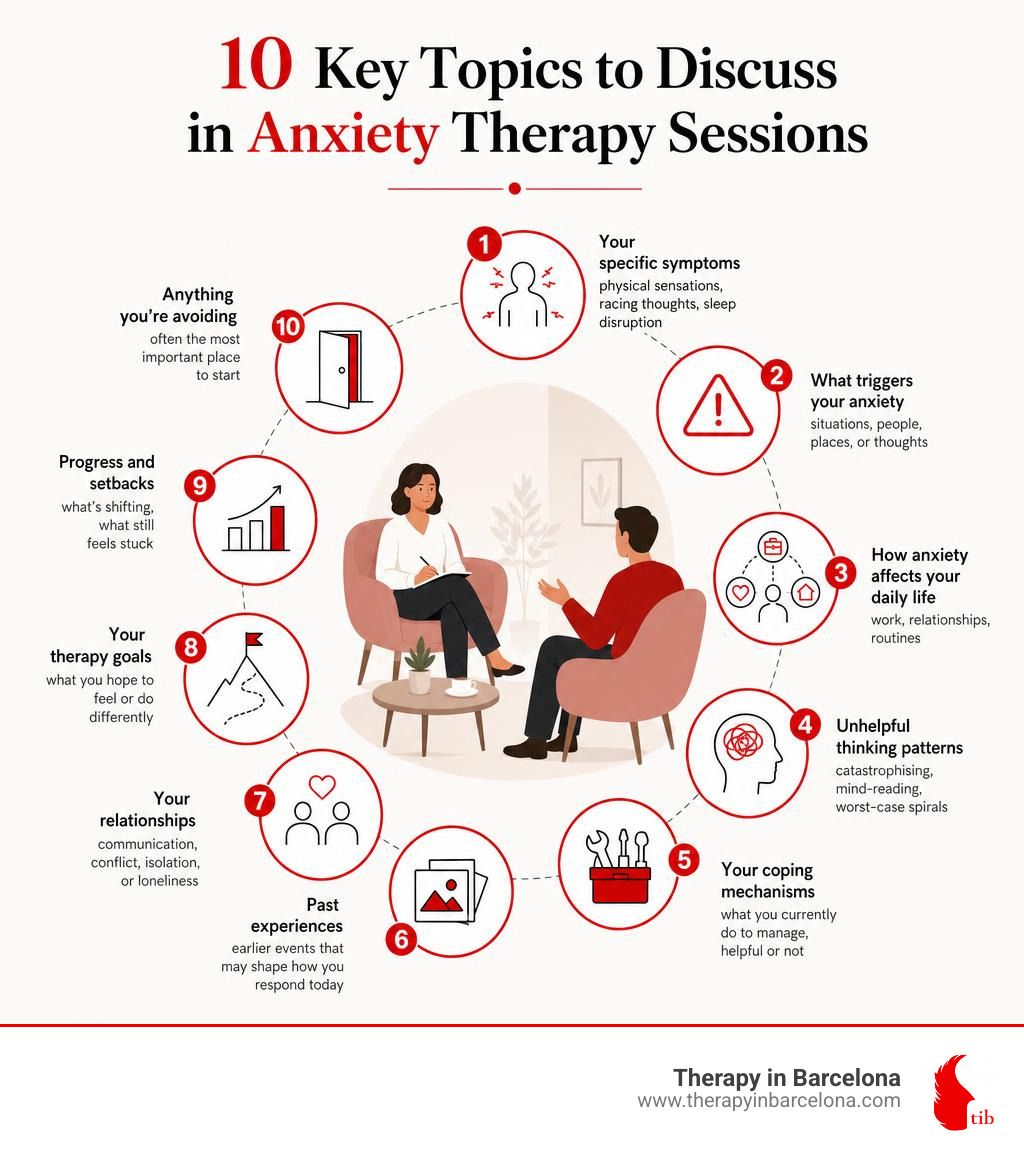
Here is a quick overview of the most useful topics to raise with your therapist:
- Your specific symptoms — physical sensations, racing thoughts, sleep disruption
- What triggers your anxiety — situations, people, places, or thoughts
- How anxiety affects your daily life — work, relationships, routines
- Unhelpful thinking patterns — catastrophising, mind-reading, worst-case spirals
- Your coping mechanisms — what you currently do to manage, helpful or not
- Past experiences — earlier events that may shape how you respond today
- Your relationships — communication, conflict, isolation, or loneliness
- Your therapy goals — what you hope to feel or do differently
- Progress and setbacks — what’s shifting, what still feels stuck
- Anything you’re avoiding — often the most important place to start
Nearly 40 million adults in the United States experience persistent worry and stress, and almost a third of all adults will struggle with overwhelming anxiety at some point in their lives. Yet many people still sit in their first therapy session feeling pressure to say something meaningful — and freeze.
If you are living abroad, that pressure can feel even sharper. Expats navigating cultural adjustment, language barriers, or the quiet isolation of building a new life in a city like Barcelona, Valencia, or Madrid often carry a particular kind of anxiety — one that is hard to name and harder still to explain. Knowing where to start can make all the difference.
This guide walks you through the key topics to raise, what to do when you feel stuck, and how to get the most from every session.
Core Topics: What to Talk About in Therapy for Anxiety
When you begin therapy, you do not need a perfectly polished script. Therapy is a collaborative, evolving space where even the smallest daily frustrations can serve as doorways to deeper healing. If you are wondering where to begin, looking at a structured list of 15 things to discuss can help you organise your thoughts.
Anxiety rarely exists in a vacuum. It is usually woven into your daily routines, your relationships, and how you interact with the world around you. When you sit down with a therapist, you can talk about the immediate stressors of the week, but you can also explore how these stressors connect to older, deeper patterns.
For example, you might discuss how your anxiety flares up when you have to set boundaries with a colleague, or how a simple email from your landlord can trigger a physical sense of dread. By talking about these moments, you and your therapist can begin to map out the underlying beliefs that keep your anxiety active.

How to Know What to Talk About in Therapy for Anxiety During Your First Session
The first session is primarily about building a connection and helping your therapist understand what you are experiencing. You do not need to have your entire life story sorted out. Instead, try focusing on what brought you to seek support right now.
To help structure your thoughts, you might find it useful to look at resources on preparing for your first therapy session or review this guide on how to prepare for your therapy consultation.
Writing down a quick symptom list before you walk in can take the pressure off. You can note down:
- The immediate worries that keep you awake at night.
- How anxiety shows up in your body (such as a tight chest or shallow breathing).
- Any specific situations you have been avoiding lately.
For many expats, anxiety shows up as loneliness, avoidance, or exhaustion from trying to adapt. In your first session, you do not need a polished story. Saying “I feel worn out trying to fit in” can be enough for your therapist to start helping.
Mapping Your Physical Symptoms and Immediate Worries
Anxiety is not just an emotional experience; it is a physical one. When your brain perceives a threat, it activates your nervous system, leading to a cascade of physical sensations.
In your sessions, it is highly beneficial to describe these physical reactions. You might talk about:
- A racing heart during work meetings.
- Persistent sleep disruption or waking up with a sense of dread.
- Sudden waves of panic that seem to come out of nowhere.
- A constant tightness in your shoulders or jaw.
Discussing these feelings of anxiety helps you understand that your body is trying to protect you, even if its alarm system is overreacting. By linking your physical symptoms to your immediate worries, your therapist can help you find practical ways to calm your nervous system in the moment.
Unpacking Unhelpful Thinking Patterns and Cognitive Distortions
Our minds are incredibly creative, but when we are anxious, that creativity often turns toward imagining the worst possible outcomes. These habitual, biased ways of thinking are known as cognitive distortions.
Some of the most common patterns you might discuss in therapy include:
- Catastrophising: Assuming that the worst-case scenario is not only possible but inevitable.
- Mind-reading: Believing you know exactly what others are thinking, usually assuming they are judging or rejecting you.
- All-or-nothing thinking: Viewing situations in black-and-white terms, where any small mistake is seen as a total failure.
Through cognitive restructuring, a core element of stress management techniques, your therapist will help you identify these patterns. Together, you will test the evidence for and against these anxious thoughts, helping you develop more balanced, realistic perspectives.
What to Do When You Have Nothing to Talk About in Therapy
It is entirely common to arrive at a session and feel like you have absolutely nothing to say. Perhaps your week was relatively quiet, or maybe you feel a sense of numbness or “stuckness.”
When this happens, silence is not a waste of time. In fact, feeling stuck is itself a highly valuable therapeutic topic. If you find yourself at a loss, reviewing a list of what to talk about when stuck can give you a few low-pressure starting points.

Deciding What to Talk About in Therapy for Anxiety When You Feel Stuck
When you are unsure what to say, it can be helpful to shift your attention away from your thoughts and focus on your immediate physical experience. Your therapist might invite you to notice what is happening in your body right now.
Sometimes, not knowing what to talk about is a sign of unconscious blocks or resistance. This is not a personal failure; it is a natural way your mind protects itself from uncomfortable feelings. By slowing down and practicing mindfulness for anxiety and stress, you can learn to tolerate these quiet moments and see what naturally surfaces when you stop trying to perform.
Reviewing Recent Wins and Behavioural Experiments
Therapy is not only a space for exploring difficulties; it is also a place to celebrate your progress. If you feel like you have nothing to discuss, try looking back at the small victories from your week.
Did you send an email without proofreading it ten times? Did you stay at a social gathering for thirty minutes instead of leaving immediately? These are significant steps forward.
Your therapist might also help you design small behavioural experiments to try between sessions. For example, if you are working on workplace stress management, your experiment might be to close your laptop at a specific time or decline an extra task. Reviewing how these experiments went—what you predicted would happen versus what actually happened—provides fantastic material for your next session.
Choosing the Right Path: Therapy Modalities and Alternatives
There are several evidence-based therapeutic approaches used to support those experiencing persistent worry and stress. Understanding how they differ can help you feel more active in your treatment plan.
- Cognitive Behavioural Therapy (CBT): Focuses on the relationship between your thoughts, feelings, and behaviours, teaching you practical skills to challenge unhelpful patterns.
- Acceptance and Commitment Therapy (ACT): Encourages you to accept your anxious thoughts and feelings rather than fighting them, while taking action aligned with your personal values.
- Psychodynamic Therapy: Explores how past experiences, early relationships, and unconscious patterns shape your current anxiety.
If you are looking for specialised support as an international, you can find tailored options such as anxiety support for expats or explore practical stress less abroad tips designed for those navigating life in a foreign country.
Comparing Professional Therapy and Self-Help Options
When seeking support for anxiety, it is helpful to look at the different pathways available. Here is a direct comparison of the main options to help you make an informed choice.
The Public Health System
In Spain, the public healthcare system provides mental health services through primary care referrals.
- The Benefit: It is fully funded and accessible to residents.
- The Limitation: Waiting times can be long, and you have very little choice over your clinician or the frequency of your sessions. Additionally, finding an English-speaking therapist within the public system can be incredibly difficult.
Large Online Platforms
Global online therapy platforms connect users with therapists via apps and video calls.
- The Benefit: They offer convenience and a quick setup process.
- The Limitation: These platforms often use automated algorithms rather than human care to match clients. They also lack local, expat-specific cultural understanding, and some users worry about how their personal data is managed, with concerns over data selling.
Local Private Practices
Local private clinics offer in-person and online sessions.
- The Benefit: They provide a more personalised, high-quality private-pay service.
- The Limitation: You have to pay out-of-pocket, though some practices offer sliding-scale fees for those with financial need.
Therapy in Barcelona
Our practice specialises in supporting the international community in Spain and worldwide.
- The Benefit: We offer bespoke, personalised matching rather than automated assignments. Our psychology-trained therapists are expats themselves, meaning they deeply understand the unique challenges of relocating, cultural shock, and building a life abroad. We provide culturally sensitive support in the client’s native language and maintain strict privacy standards, ensuring your personal data is never sold.
- The Limitation: As a private-pay service, our care requires an investment, but we focus entirely on giving you the specific tools and support you need to thrive.
Frequently Asked Questions About Anxiety Therapy
Are there any topics that are completely off-limits in therapy?
In general, there are no forbidden topics in therapy. You are free to discuss your relationships, fears, dreams, and even thoughts you might feel tempted to censor. However, therapists have legal and ethical boundaries regarding confidentiality.
As outlined in this anxiety therapy guide, a therapist is legally required to break confidentiality if there is an imminent threat of harm to yourself or others, or if there is suspected abuse of a child or vulnerable adult. Your therapist will explain these limits clearly during your first session so you can feel safe and secure.
How do I know if my anxiety therapy is actually working?
Progress in therapy is rarely a straight line, but there are clear signs that your work is paying off. You might notice:
- Shrinking avoidance: You find yourself saying “yes” to things that anxiety used to block.
- Fewer reassurance checks: You feel less need to constantly ask others for validation or search the internet for answers.
- Lower intensity: While you might still feel anxious occasionally, the feelings do not overwhelm you as quickly or last as long.
Your therapist might also use structured questionnaires to help you track how your feelings of worry and physical tension shift over time. For more ideas on finding your footing, you can read about how to find calm as an international.
What if I feel uncomfortable opening up to my therapist?
It is completely natural to feel hesitant or awkward at first. Trust takes time to build, and you are entirely in control of how much you share and when you share it. A good therapist will never force you to talk about deep traumas before you feel ready.
If you are feeling nervous, you can bring that exact feeling into the room. Saying, “I want to talk about this, but I feel really nervous,” is a wonderful way to build a strong therapeutic alliance. If you are preparing to start, reading through these common starting therapy questions can help put your mind at ease.
Taking the Next Step
Taking the first step toward managing your anxiety is a courageous decision. You do not need to have all the answers or know exactly what to say before you walk through the door.
Founded in 2011 by Australian Psychologist and expat Leigh Matthews, Therapy in Barcelona offers culturally sensitive support for the international community, with in-person therapy in Barcelona and online sessions worldwide.
If you are ready to explore how therapy can help you find your calm, we invite you to Book a Free Discovery Call today. Together, we can match you with a therapist who truly understands your journey.
