


Finding Support in Spain’s Capital: Why English Speaking Psychologist Madrid Matters

English speaking psychologist Madrid is a common search for internationals in Spain’s capital. If you’re looking for immediate guidance, here’s what you need to know:
- Where to find them: Online directories like Psychology Today, expat-focused platforms like Expat Therapy 4U, and multilingual clinics like SINEWS, Lagasca, and Open Psychology
- Session costs: Typically €60–€100 for individuals, €90–€115 for couples (private-pay service; some therapists offer sliding scale fees—ask directly)
- No referral needed: You can contact private psychologists directly without a doctor’s referral
- Online or in-person: Many therapists offer both formats for flexibility
- Look for: Licensed professionals (COP registration), expat experience, and therapeutic approaches that fit your needs (CBT, ACT, EMDR, etc.)
Moving to Madrid brings excitement and opportunity, but starting over far from home also brings challenges like culture shock, loneliness, and language barriers.
Take Emily, a fictional composite example whose story represents common expat challenges. A 34-year-old from the UK, she moved to Madrid for adventure but found unexpected isolation. Lost in the maze of Spanish bureaucracy and missing old friends, she worries she’s “not doing expat life right.” She wants support but doesn’t know where to start or if anyone will understand what it’s like to feel stuck between two worlds.
Therapy can help. But finding the right therapist in a new country, in your own language, with someone who gets the expat experience isn’t always straightforward. This guide walks you through your options, what to look for, and how to find an English speaking psychologist Madrid who’s the right fit for you.
The Expat Experience: Common Mental Health Problems in Madrid
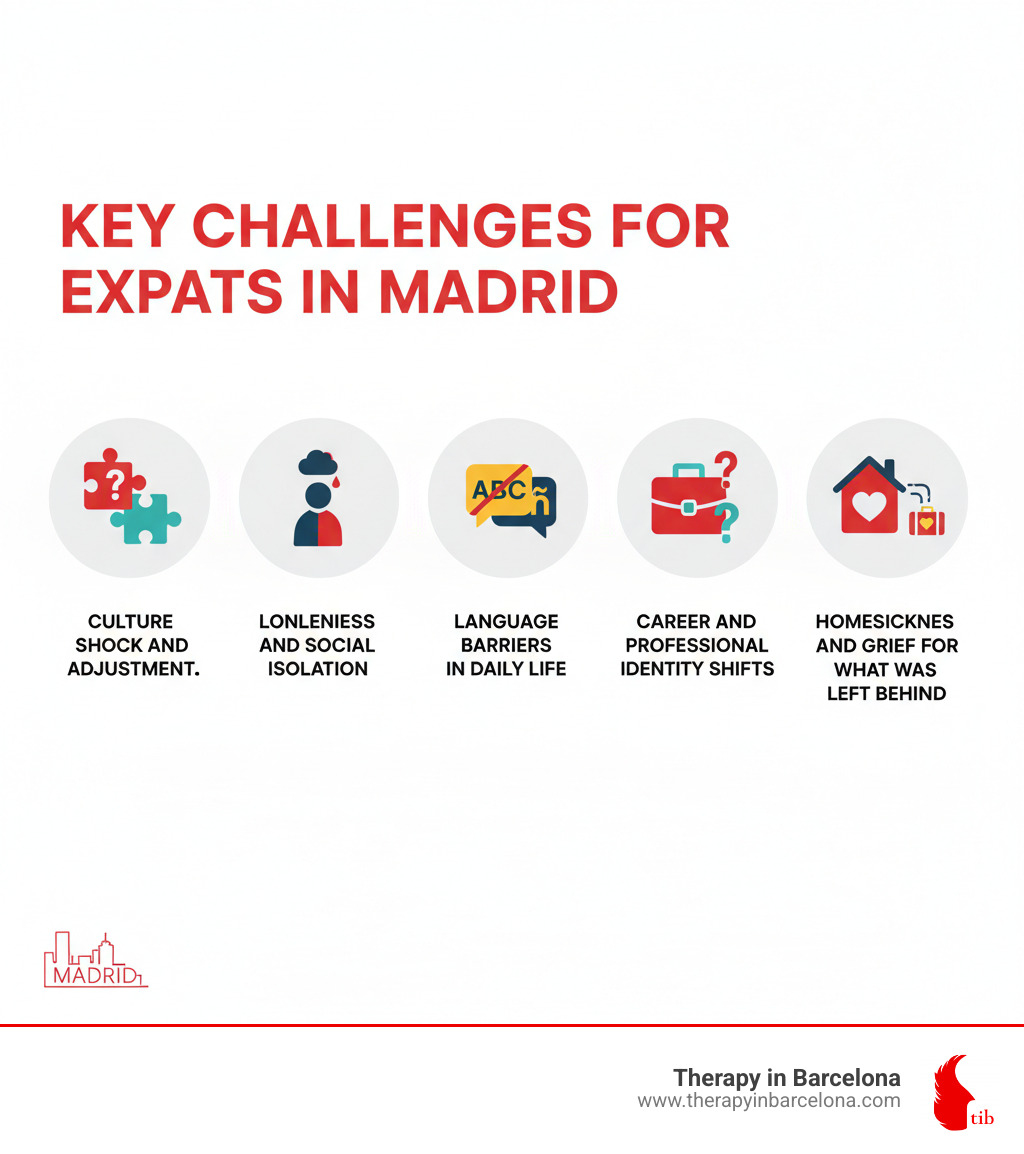
Moving to Madrid—or anywhere in Spain, from Valencia to Málaga to Barcelona—can feel like a dream, but many expats face unexpected emotional challenges. As Madrid’s international community grows, so does the need for mental health support that understands the expat journey. These struggles are layered, personal, and often invisible to others. Read more about expat struggles.
Culture shock is one of the most common. It’s the disorientation when social cues feel foreign, bureaucracy is a maze, and you question if you’ll ever belong. Read about the five stages of culture shock and how psychotherapy can help. Homesickness often follows, bringing a quiet grief for the life and people you left behind. Building new friendships can be exhausting, especially when language barriers make deeper connection feel out of reach, leading to social isolation.
Then there are the professional adjustments—a new workplace culture, a redefined career path, or qualifications that don’t translate as hoped. Beneath it all, many expats face profound identity shifts. Who are you in this new place? How do you reconcile the person you were with the person you’re becoming?
These challenges are real and deserve real support.
Why Therapy in Your Native Language Matters
Imagine trying to explain your deepest fear or a painful memory in a language that isn’t your own. It’s not just difficult—it can make you feel more alone.
Your native language is woven into how you think and feel. It carries the nuance you need to say what you really mean. When you work with an English speaking psychologist Madrid, you aren’t translating your feelings—you’re expressing them fully and freely.
As SINEWS, a multilingual therapy institute in Madrid, puts it: “Language is crucial in any therapeutic process: you need to be able to express yourself freely and to feel understood.”
That’s not a small thing. It’s the foundation of trust and what allows you to build a real connection with your therapist, feel truly heard, and do the deeper work that leads to healing. For more on why this matters, see The Benefits of Choosing English-Speaking and Expat Professionals.
How Therapy Helps with Expat-Specific Issues
Therapy offers a space to unpack the reality of living abroad. An English speaking psychologist Madrid can help you develop coping strategies for culture shock, homesickness, and the daily stresses of a new life. They guide you in building resilience to face the unexpected.
Therapy can also help with relationships—whether that’s improving communication with a partner, understanding family dynamics, or building new friendships. It’s a place to work on re-establishing your identity, exploring who you are now and how to integrate your past and present selves. It’s also a space to process grief for the life you left behind.
Many expats find therapy essential for managing feelings of being overwhelmed, anxious, or persistently down that can surface when the initial excitement fades. Therapy is a space to work through expat-specific challenges like culture shock, homesickness, and identity adjustment.
These services are available across Spain, including cities like Sevilla, Alicante, and Zaragoza. You can explore more specific support options through Madrid Counselling services.
Your Search for an English Speaking Psychologist Madrid: Where to Begin
Searching for an English speaking psychologist Madrid can feel overwhelming when you’re already adjusting to a new city. But you have more options than you might think, and understanding them can help you find the right fit.
Acknowledging Your Options: Public, Private, and Online Care
When looking for mental health support in Madrid, it’s worth knowing your options. The Spanish public healthcare system (Sistema Nacional de Salud) offers psychological services, but it presents challenges for expats. Wait times can stretch for months, and most psychologists in the public system work primarily in Spanish. Discussing complex emotions in a second language can feel limiting, and public system therapists may not specialise in the unique experiences of living abroad.
You’ll also find large online platforms offering therapy in English. These can be convenient, but they often use a generic matching system. You might not get a therapist who understands what it’s like to deal with Spanish bureaucracy or feel caught between two cultures.
There are also many excellent local Spanish-speaking practices. If you’re fluent in Spanish, these can be wonderful resources. But for most internationals, therapy in your native language makes a significant difference.
Private care with expat-focused practices offers something different. Practices like Therapy in Barcelona (providing online services across Spain) specialise in personalised matching. We take time to understand your situation and connect you with a therapist who has relevant experience. The benefits include flexibility, online and in-person options, strict confidentiality, and teams who understand expat life because they’ve lived it themselves. We follow strict privacy standards and never sell your data.
How to Find the Right English Speaking Psychologist Madrid for You
So where do you actually start looking? There are a few practical routes for internationals.
Expat-focused therapy platforms like Expat Therapy 4U and Therapy in Barcelona are designed with internationals in mind. These services understand that finding the right therapist is about finding someone who gets your experience. Therapy in Barcelona, for example, offers online therapy across Spain and takes time to match you with a therapist based on your specific needs. One of our team of therapists is based in the Ibiza neighbourhood in Madrid for in person sessions. You can book a Free Discovery Call to talk through what you’re looking for before committing.
Multilingual clinics in Madrid like SINEWS, Open Psychology, and Lagasca cater to international clients and offer services in English. They are established practices with multidisciplinary teams and are a solid option if you prefer in-person sessions in Madrid.
General directories like Psychology Today can also be useful. You can filter by location, language, and specialisation. The trade-off is doing more legwork yourself: reading profiles, checking credentials, and reaching out to find a good fit. Not all therapists listed will have expat-specific experience, so it’s worth asking directly.
When reviewing therapist profiles, look for more than just credentials. Does their approach resonate with you? Do they mention experience with expat issues? Trust your instincts. And don’t limit yourself geographically. Since many therapists now offer online sessions, you can work with someone in Valencia, Málaga, or Barcelona while living in Madrid. This opens up your options and helps you find a great match, not just a convenient one.
For more detailed guidance, have a look at 5 Smart Ways to Find an English-Speaking Therapist.

What to Look For: Qualifications, Approaches, and Cultural Fit
When you’re searching for an English speaking psychologist Madrid, language is just the starting point. What matters is finding a qualified professional who uses approaches that resonate with you and understands the cultural nuances of expat life.
Verifying Qualifications and Experience
When vetting an English speaking psychologist Madrid, look for a few key indicators. A licensed psychologist is authorised to practise in Spain. A clinical psychologist has additional specialisation in mental health treatment. You’ll also find psychology-trained therapists qualified in other countries, like Leigh Matthews, the Australian Psychologist who founded Therapy in Barcelona. These international professionals often bring equivalent training and invaluable cross-cultural experience.
Look for specialisations too. Whether you’re dealing with feelings of anxiety, difficult past experiences, or relationship challenges, you want someone whose expertise aligns with your needs. Therapy in Barcelona, for example, is a group practice of highly qualified psychology-trained therapists who understand the expat journey firsthand. You can learn more about their team’s credentials through About our team of therapists.
Understanding Common Therapeutic Approaches
Therapy isn’t one-size-fits-all. Different approaches suit different people. Understanding the basics can help you find what feels right.
Cognitive Behavioural Therapy (CBT) is widely recognised for its practical approach to changing unhelpful thinking patterns. It’s effective for managing anxious thoughts, low mood, and stress, offering practical tools. The NHS has a helpful overview of Cognitive Behavioural Therapy (CBT).
Acceptance and Commitment Therapy (ACT) helps you accept difficult feelings while committing to actions that align with your values. EMDR (Eye Movement Desensitization and Reprocessing) is a specialised approach for processing distressing or traumatic memories.
Psychodynamic therapy explores how past experiences shape your present. Systemic therapy is valuable for expat families and couples, viewing you as part of interconnected systems. For relationship issues, the Gottman Method offers research-based strategies .
Therapy in Barcelona offers a wide range of these approaches, including CBT, ACT, Internal Family Systems (IFS), Person-Centred, and more, ensuring you can find an approach that resonates. Learn more about Our Services.
The Value of a Therapist Who is Also an Expat
Working with a therapist who has also lived the expat experience can make a real difference. This isn’t just about empathy—it’s about a lived understanding of what you’re going through.
An expat therapist brings shared experience. They understand the challenges of relocation and cultural adaptation. They’ve likely steered their own homesickness, identity shifts, and intercultural relationships. This creates deep empathy.
They also offer cultural understanding from both sides, grasping the nuances of your home culture and the local Spanish culture. They can help you with biculturalism—integrating different identities without losing yourself. They also have insights into the experiences of Third Culture Kids (TCKs).
Leigh Matthews embodies this. After moving to Barcelona from Australia in 2011, she struggled to find an English-speaking therapist who understood her situation. This inspired her to create Therapy in Barcelona—a sanctuary for expats built on genuine understanding. Her journey provides a unique point of connection for clients across Madrid, Barcelona, Valencia, and beyond. Read more about our founder’s expat journey.

The Practicalities: Cost, Referrals, and Session Types
Understanding the practicalities of therapy—cost, booking, referrals—removes uncertainty and makes it easier to take the first step.
What is the Typical Cost for an English Speaking Psychologist Madrid?
Session fees for an English speaking psychologist Madrid vary based on the therapist’s experience and session type. Generally, individual therapy sessions range from €60 to €100. Couples therapy typically costs more, usually between €90 and €115. These figures are typical for private practices in the city.
It’s important to know that most private psychologists, including Therapy in Barcelona, operate as a private-pay service. This means you pay for sessions directly. However, many therapists understand that finances can be a barrier. Some offer sliding scale fees for those with financial difficulty—it’s always worth asking about this when you first make contact.
Many practices, including ours, also offer a Free Discovery Call. This gives you a chance to discuss your needs and see if the therapist feels like a good fit before you commit to paid sessions.
For more detail on what to expect financially, take a look at Therapist in Madrid: Your Ultimate Guide to Finding the Right Match.
Online vs. In-Person Therapy: A Mobile-Friendly Comparison
Deciding between online or in-person therapy is a personal choice, and both formats have advantages for internationals.
Online Therapy Benefits
Many expats find online therapy offers flexibility for busy schedules, which is invaluable when juggling work, travel, or family. You can have a session on your lunch break, saving commute time.
Online therapy also means you can access your therapist from anywhere. This helps internationals who move or travel often. You also get a wider choice of specialists, allowing you to find someone with specific expertise—whether that’s trauma, couples work, or expat adjustment.
Many clients appreciate the comfort and privacy of their own home. For some, it’s easier to open up in a familiar space. If you move, you can often maintain continuity of care, which is reassuring during transitions. Therapy in Barcelona, for instance, provides online therapy across Spain and worldwide, including the USA and Canada.
In-Person Therapy Benefits
That said, some people value the face-to-face connection and find it easier to engage in the same room. That physical presence can feel grounding.
A therapist’s office creates a dedicated space away from home. It creates a helpful boundary between therapy and daily life, which is useful for those who work from home.
For some, an in-person setting feels more traditional and reassuring. It also means fewer technical issues—no worrying about internet connections.
We also offer face-to-face sessions in our Barcelona office for those who prefer in-person care.
The choice comes down to what feels right for you. Both formats can be effective. What matters most is finding a therapist who understands you.
For more on how online therapy works, explore More on Online Therapy.
Frequently Asked Questions about Finding a Therapist in Madrid
Do I Need a Doctor’s Referral to See a Psychologist in Madrid?
Here’s some good news: for a private English speaking psychologist Madrid, you can reach out directly. There’s no need to steer the Spanish healthcare system or get a GP referral. This self-referral process makes it easier to access support when you need it.
For therapy through Spain’s public healthcare system, you might need a referral and face long wait times and language barriers. But for private care, you are free to choose your therapist and start when you’re ready.
What Types of Services Are Offered?
Expat-focused practices offer a range of services for internationals.
Individual therapy is a common starting point for personal challenges like feeling anxious or down, culture shock, or homesickness. It’s a confidential space to develop strategies to move forward.
Many practices also offer couples counselling. Moving abroad can strain a relationship, and a neutral, culturally aware therapist can make all the difference.
Family therapy helps families adapt to new environments and improve communication. Child and adolescent therapy provides specialised support for younger people, helping them process emotions and steer developmental challenges.
Some practices also offer group therapy, which can be a powerful way to feel less alone by connecting with others facing similar challenges.
These services are available both in-person in Madrid and online, giving you flexibility no matter where you are in Spain—from the capital to the Balearic Islands.
Is Online Therapy as Effective as In-Person Therapy?
This is a common question, and the research is reassuring: yes, for most concerns, online therapy is just as effective as in-person sessions. Research shows that the quality of the therapeutic relationship is what matters most for a positive outcome, not the format .
For expats, online therapy offers particular advantages. It’s convenient, giving you access to a wider pool of specialists who understand the expatriate experience. You can maintain continuity of care if you travel or move. And you can work with therapists who truly get what you’re going through, like the expat-led team at Therapy in Barcelona, which offers online therapy across Spain and worldwide, including the USA and Canada.
If you’re curious about online therapy, many practices offer a Free Discovery Call where you can ask questions and get a feel for the process.
Your Path to Well-being in Madrid
Taking the first step towards mental health support is a meaningful act of self-care. Life abroad is full of possibility, but it can also be messy and hard. Culture shock, homesickness, and feeling misunderstood aren’t signs of failure; they’re part of the expat experience.
Finding an English speaking psychologist Madrid who gets what you’re going through can make all the difference. It’s about working with someone who understands the emotional landscape of living between two worlds.
At Therapy in Barcelona, we’ve built our practice on this understanding. Our approach centres on personalised matching. We don’t just pair you with the next available therapist. Instead, we take time to learn about your concerns and match you with a therapist from our team who has the right training and experience for your situation. This careful process gives your therapy the best chance of success.
Our team is made up of psychology-trained therapists who are also expats themselves. Many of us have steered the challenges of intercultural relationships, career transitions, and raising Third Culture Kids. We work with adults, couples, teens, and families.
We offer support in English, and some of our therapists also speak German, French, Spanish, Afrikaans, Portuguese, Austrian-German, and Swiss-German.
We’ve supported internationals in Spain since 2011. While our name is Therapy in Barcelona, our online services reach expats across Spain—in Madrid, Valencia, Málaga, Alicante, and beyond—and worldwide, including the USA and Canada. We also offer face-to-face sessions in our Barcelona office. This is a private-pay service, but some therapists offer sliding scale fees, so please ask. We keep your information confidential and never sell data.
If you’d like support, we are here to help. Book a Free Discovery Call to talk about what you’re going through and find the right therapist match for you. You don’t have to figure this out alone.
