


Understanding the Core Differences: Acculturation vs Biculturalism
Acculturation vs biculturalism are two concepts that often get used interchangeably — but they describe very different things. If you’ve ever felt caught between two cultures, unsure whether you’re adapting, integrating, or somewhere in between, understanding the difference can be genuinely clarifying.
Here’s the short version:
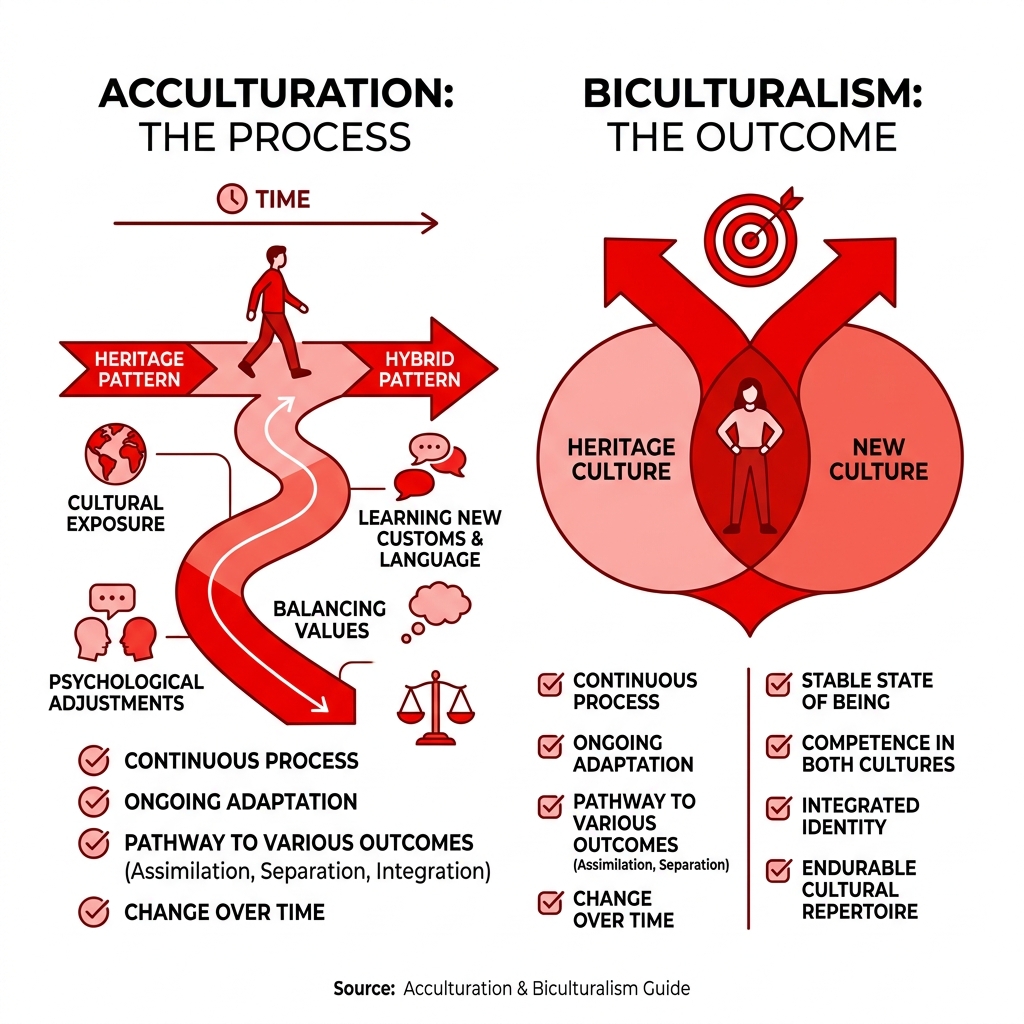
- Acculturation is the process — the ongoing psychological and cultural changes that happen when you’re exposed to a new culture. It’s the journey, not the destination.
- Biculturalism is the outcome — a state in which a person is genuinely comfortable and competent in two distinct cultures, holding values, behaviours, and a sense of identity from both.
In other words, acculturation is what happens to you (and within you) as you adapt. Biculturalism is what you can become through that process — but only under the right conditions.
Across Spain, cities like Barcelona, Valencia, and Madrid are home to large, diverse international communities where these questions of identity and cultural belonging come up daily. For expats, accompanying partners, Third Culture Kids, and long-term immigrants alike, knowing where you stand in this process isn’t just academic — it shapes your emotional well-being, your relationships, and your sense of self.
The difference matters because the path you take through acculturation — whether you assimilate, separate, or integrate — has real consequences for your wellbeing. Research consistently shows that bicultural individuals, those who hold on to their heritage culture while engaging with their new one, tend to report feeling less persistently down or stressed than those who lose one culture in favour of the other.
We’ll explore exactly what each concept means, how they relate, and what the research says about which path tends to support better psychological adjustment.
The Four Paths of Cultural Adaptation: Berry’s Model
One of the most influential frameworks for understanding this journey is John Berry’s model of acculturation strategies. Berry proposed that when we enter a new culture, we face two main questions:
- Is it important to maintain my heritage culture and identity?
- Is it important to seek relationships and participate in the new host culture?
How you answer these questions leads to one of four distinct paths, as explored in research on revisiting the acculturation process.
Integration: The Foundation for Biculturalism
Integration happens when you say “yes” to both questions. You maintain your heritage culture while also actively participating in the new society. This is the path that leads to biculturalism. It allows you to develop a balanced identity where you feel at home in both a traditional Spanish festa and a holiday celebration from your home country.
Assimilation, Separation, and Marginalization
The other three paths often come with higher psychological hurdles:
- Assimilation: You say “yes” to the new culture but “no” to your heritage. This often involves cultural loss. While it might make you feel “accepted” by locals, it can lead to a sense of grief or a “hollow” identity later in life.
- Separation: You say “yes” to your heritage but “no” to the new culture. You might live in an “expat bubble” in Marbella or Alicante, never learning the language or making local friends. While comfortable, this can lead to social isolation and a lack of “roots” in your current home.
- Marginalization: You say “no” to both. This is the most difficult state, often resulting from experiences of discrimination or trauma. It leaves the individual feeling like they belong nowhere, which is a significant risk factor for challenges to emotional well-being.
Many workplaces unintentionally push people toward assimilation, which can limit the unique perspectives bicultural individuals bring to the table.
Defining Biculturalism: Values, Practices, and Identity
Biculturalism isn’t just about being “good at two languages.” It is a multi-layered experience that involves three core components:
- Cultural Practices: These are the visible things—the food you cook, the media you consume, and the festivals you celebrate.
- Core Values: This is deeper. It involves how you view the world. For example, a bicultural person might value the “individualism” of their home culture while also embracing the “collectivism” or “familismo” found in Spanish and Latino cultures.
- Identification: This is the internal sense of belonging. It’s the answer to the question “Who am I?” A bicultural person feels like a member of both groups.
Research on adjustment and biculturalism shows that being able to switch between these cultural “frames” is a sign of high cognitive flexibility.
The Role of Familismo and Collectivism
For many expats moving to Spain or those from Latino backgrounds, the cultural value of familismo (a strong dedication to the family unit) plays a huge role. Research indicates that biculturalism can actually moderate the effects of stress by providing multiple sources of social support. When an individual can blend the self-reliance of Western cultures with the strong family ties of collectivist cultures, they often build a more resilient emotional “safety net.”
Retro-acculturation and Shifting Identities
Identity isn’t static; it’s more like a pendulum. You might move to Barcelona and spend years trying to be “as Spanish as possible” (assimilation). But then, you have a child or experience a major life event, and suddenly you feel a deep need to reconnect with your roots.
This is called retro-acculturation. It’s the process of moving from an assimilated state back toward a bicultural one. We see real-world examples of this when expats start revived language classes for their children or seek out therapy to process the cultural heritage they previously pushed aside.
Emotional Well-being Outcomes and Bicultural Identity Integration (BII)
How you feel about your two cultures matters just as much as how well you speak the languages. This is where Bicultural Identity Integration (BII) comes in.
- High BII: You feel your two cultures are compatible and complementary. You see yourself as a “hyphenated” person (e.g., British-Spanish) and moving between the two feels effortless.
- Low BII: You feel your two cultures are in conflict. You might feel like you have to “choose a side” or that you are a different person depending on who you are talking to.
Integrative Complexity and Cognitive Benefits
Exposure to a second culture can actually make you smarter. Research on integrative complexity shows that bicultural individuals often develop advanced reasoning skills. Because they are used to seeing the world through two different lenses, they are better at perspective-taking and understanding complex social issues. This “cognitive flexibility” is a major asset in global leadership and creative problem-solving.
Emotional Well-being Outcomes for Bicultural Individuals
The data is clear: biculturalism is good for your brain. Studies consistently show that bicultural individuals report feeling less persistently down or unmotivated compared to those who are purely assimilated or separated. By having “the best of both worlds,” they have more tools in their emotional toolkit to handle the stresses of life abroad.
Context Matters: When Biculturalism is Most Adaptive
Biculturalism doesn’t happen in a vacuum. The environment you live in determines how easy—or hard—it is to maintain a dual identity.
In “gateway cities” like Barcelona, Madrid, or Málaga, biculturalism is highly adaptive. These cities are used to internationals, and there is a level of social acceptance for “blended” identities. In these environments, “ethnogenesis” occurs—the creation of new, hybrid cultural groups where being bicultural is the norm, not the exception.
Biculturalism in Multicultural Hubs
In places like Valencia or Alicante, the presence of large international communities makes it easier to find examples of biculturalism in action. You can find English-speaking book clubs, international schools, and local festivals that welcome foreigners. This “bicultural environmental condition” allows you to practice both cultures daily without feeling like an outsider.
Moving Beyond the Acculturation vs Biculturalism Debate: Transculturalism
For some, even biculturalism feels too small. This is often true for Third Culture Kids (TCKs)—children who grow up in a culture different from their parents’. They might have influences from three or four different countries.
In these cases, we talk about transculturalism. This is the process of honouring the complex intersection of multiple identities to create a unique, multifaceted self. It’s not just about balancing two cultures; it’s about accepting that you are a “citizen of the world.” You can find more resources on these complex identities here.
Navigating Your Journey: Support and Resources
Living between cultures is an incredible adventure, but it can also be exhausting. At Therapy in Barcelona, we understand this journey because we are on it too.
Our founder, Leigh Matthews, is an Australian psychologist who moved to Barcelona in 2011. She experienced the challenges of an intercultural marriage, adapting to Spanish family life. She founded Therapy in Barcelona because she realised that expats need more than just a therapist—they need someone who “gets” the unique weight of living abroad.
We provide culturally sensitive support for adults, couples, teens and families navigating these very issues. Whether you are in Barcelona, Madrid, or working as a digital nomad in Gran Canaria, we offer a sanctuary for self-discovery.
Choosing the Right Support for Your Adaptation
When you’re struggling with cultural adjustment, it’s important to know your options. Here is how different services generally compare:
Public Health Services (CatSalut/SNS) Public systems in Spain provide essential care, but they are often overwhelmed. For expats, the main hurdles are long waiting lists and the fact that therapy is almost exclusively conducted in Spanish or Catalan. It can be difficult to find a practitioner who understands the specific nuances of the “expat experience.”
Large Online Therapy Platforms Mass-market platforms offer convenience and lower price points. However, they often use algorithms for matching and have high therapist turnover. Your data may be treated as a commodity, and the “matching” is rarely done by a human who understands your specific cultural context.
Local Private Practices There are many excellent local psychologists in cities like Valencia or Sevilla. However, unless they have lived abroad themselves, there may be a “empathy gap” regarding the specific stresses of relocation, visa anxiety, and the “liminal space” of not belonging.
We offer private-pay therapy with personalised matching. We learn about your story, then match you with a psychology-trained therapist suited to your personality, needs, and cultural journey.
Learn more about our specialised services.
Frequently Asked Questions about Acculturation and Biculturalism
Can an individual be acculturated but not bicultural?
Yes. Acculturation is simply the process of change. If someone moves to a new country and completely assimilates—dropping their original language, values, and traditions—they are “acculturated” to the new society, but they are not bicultural because they no longer maintain their heritage culture.
What is retro-acculturation?
Retro-acculturation is a “re-connection” process. It happens when someone who has previously assimilated or distanced themselves from their heritage culture decides to reclaim it. This is often triggered by major life milestones, like getting married, having children, or the passing of a parent, leading to a renewed interest in heritage language, food, and traditions.
How does biculturalism influence emotional well-being?
Biculturalism can support emotional well-being when both cultures feel accepted and valued. Instead of feeling pressured to choose one identity, a person may feel more flexible, grounded, and able to move between different social worlds. This can reduce inner conflict and make daily challenges feel easier to manage.
Finding Your Path
The journey of acculturation vs biculturalism isn’t about reaching a perfect finish line. It’s about finding a way to live that feels authentic to you. Whether you are navigating the bustling streets of Madrid, the tech hubs of Málaga, or the coastal beauty of San Sebastián, your heritage is an asset, not a burden.
Embracing a bicultural identity allows you to expand your world rather than shrink it. It gives you the flexibility to move between different ways of thinking and the resilience to handle the “messiness” of life abroad.
If you’re feeling lost in the middle of your cultural journey, you don’t have to navigate it alone. We offer support to internationals across Spain and worldwide.
If you’d like support, book a Free Discovery Call today. Let’s find the right match to help you feel at home, wherever you are.
