


Why Therapy for Teenagers Is More Important Than Ever

Therapy for teenagers matters more than ever as nearly half of adolescents in the U.S. have had a mental health condition at some point, and 42% of high school students report persistent sadness or hopelessness, according to scientific research on adolescent mental health. For international families living in Barcelona, these struggles can feel even heavier due to cultural adjustment, language barriers, and the pressure of building a new social world far from home.
Quick Overview: 9 Effective Therapy Options for Teenagers
- Cognitive Behavioural Therapy (CBT) – Tackles negative thought patterns and anxiety
- Dialectical Behaviour Therapy (DBT) – Teaches emotional regulation and mindfulness
- Interpersonal Therapy (IPT) – Improves relationships and communication skills
- Acceptance and Commitment Therapy (ACT) – Builds psychological flexibility
- Exposure Therapy – Gradually faces fears and phobias
- Art & Play Therapy – Uses creative expression for healing
- Family Therapy – Addresses family dynamics and communication
- Group Therapy – Provides peer support and shared experiences
- Online Therapy – Offers flexible, accessible mental health support
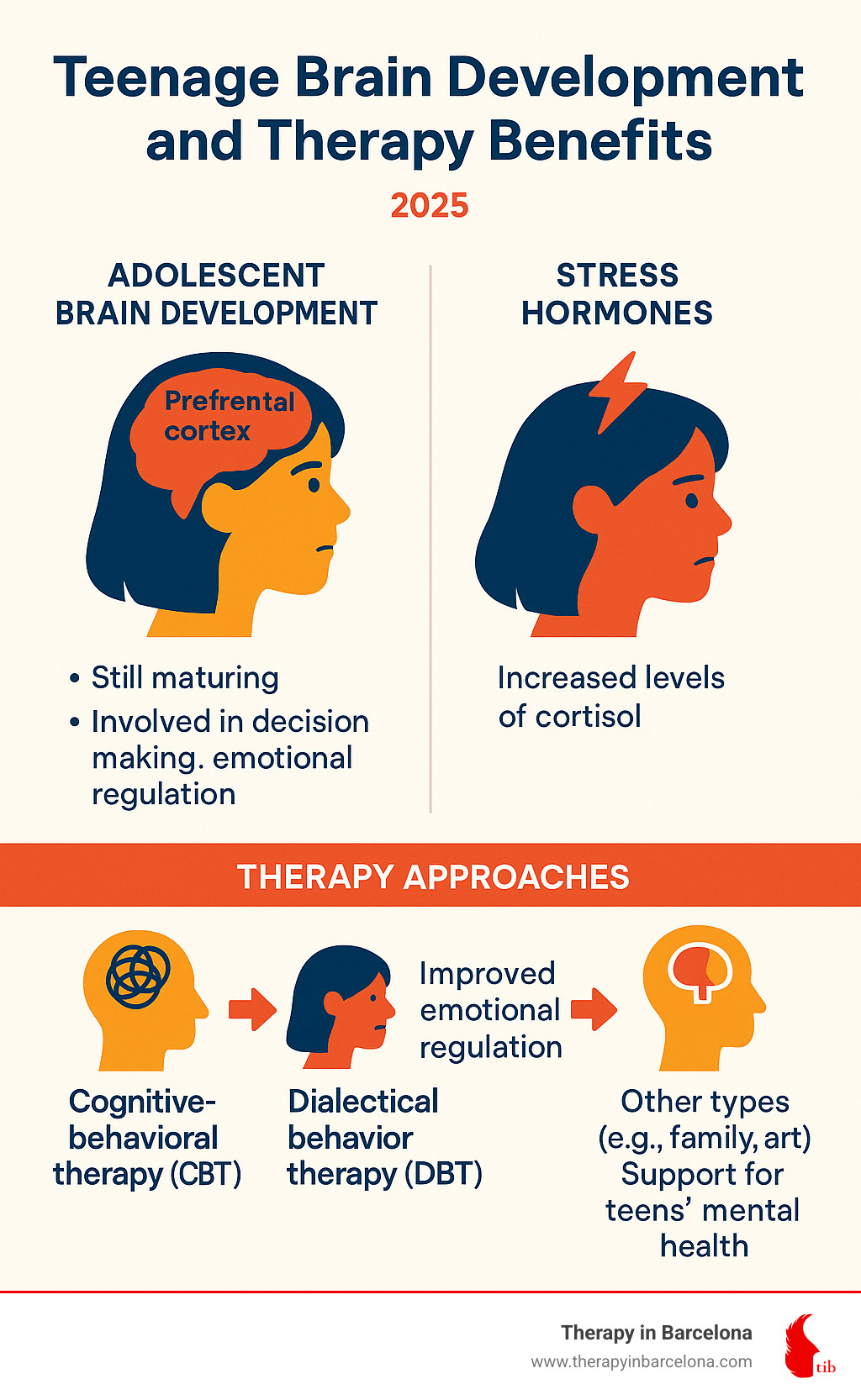
The teenage brain is still developing, particularly areas responsible for decision-making and emotional regulation. This biological reality, combined with academic pressure, social media stress, and for expat teens, the additional challenge of navigating multiple cultures, creates a perfect storm for mental health struggles.
The good news? Research consistently shows that therapy works for teenagers. From traditional talking therapies to creative approaches, there are evidence-based options that can help teens move from angst to awesome, building resilience and coping skills that will serve them throughout their lives.
Why Therapy for Teenagers Matters More Than Ever
The numbers are hard to ignore. Nearly half of adolescents (49.5%) have had a mental health disorder at some point, and 42% of high school students report feeling persistently sad or hopeless. These are not just statistics. They point to millions of teens struggling during a critical stage of growth and change. Scientific research on adolescent mental health
For international teenagers living in Barcelona or other Spanish cities, these universal adolescent struggles become even more complex. Imagine being 16 and trying to figure out who you are whilst also adapting to a new culture, possibly learning a new language, and building friendships from scratch. Many expat teens find themselves caught between worlds—not quite fitting into their new environment, yet feeling increasingly distant from their home culture.
The digital age adds a whole new layer of pressure for teenagers. Social media can create nonstop comparison, making it easy to feel judged, left out, or not good enough. For expat teens who may already be trying to figure out their identity, friendships, and sense of belonging, that pressure can feel even more intense.
But here’s what gives us hope: Scientific research on adolescent mental health consistently shows that early intervention through therapy can dramatically improve outcomes. When teenagers receive appropriate support during these formative years, they’re far more likely to develop healthy coping mechanisms that serve them throughout their lives.
The teenage brain is remarkably adaptable. During adolescence, the areas responsible for executive function, emotional regulation, and decision-making undergo significant changes. This neuroplasticity means that therapeutic interventions during the teenage years can be particularly effective—literally rewiring the brain for better mental health outcomes.
For international families, recognising when therapy for teenagers becomes necessary can be the difference between a teen who struggles through adolescence and one who develops resilience and confidence.
9 Therapy Options at a Glance
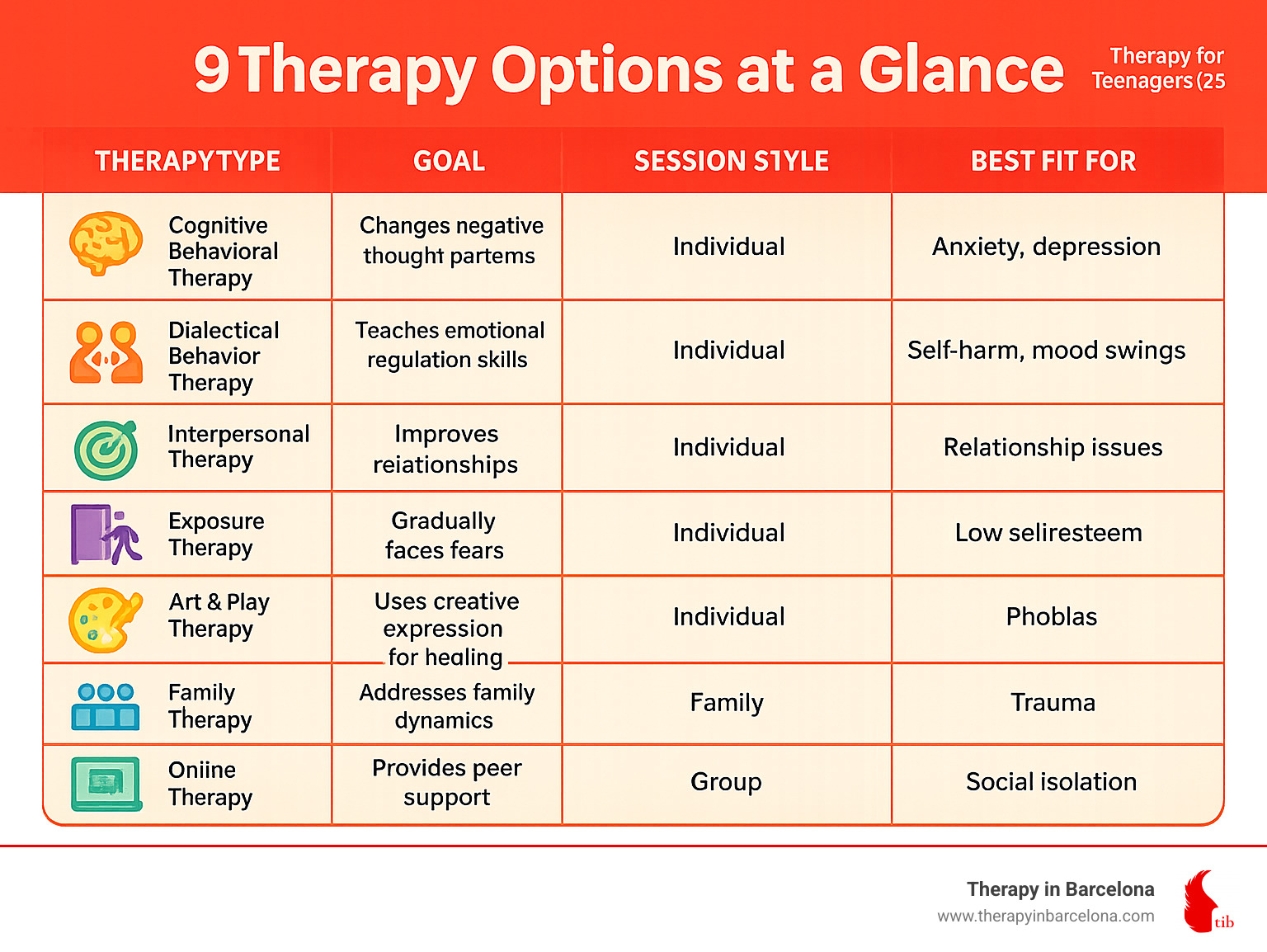
Choosing the right therapeutic approach for your teenager can feel overwhelming, especially when you’re navigating this decision as an international family in Barcelona. The good news is that there are many proven options available, each designed to meet different needs and personality types.
Evidence-based talking therapies form the foundation of most adolescent therapy. These approaches, including Cognitive Behavioural Therapy (CBT), Dialectical Behaviour Therapy (DBT), Interpersonal Therapy (IPT), and Acceptance and Commitment Therapy (ACT), focus on building practical skills through conversation and structured exercises.
For teenagers who struggle to express themselves verbally, creative and experiential approaches can be transformative. Art therapy allows teens to process complex emotions through creative expression, whilst exposure therapy takes a gradual approach to helping teens face their fears.
Systemic and social interventions recognise that teenagers don’t exist in isolation. Family therapy addresses communication patterns within the household, whilst group therapy provides peer support. Online therapy offers flexibility and privacy that many teenagers appreciate.
Most therapeutic approaches involve weekly sessions over several months. The key is finding an approach that resonates with your teenager’s personality, learning style, and specific challenges.
Evidence-Based Talking Therapies
When it comes to therapy for teenagers, traditional talking therapies remain the gold standard for good reason. These approaches work by helping young people understand the connection between their thoughts, feelings, and behaviours, whilst teaching them practical skills for managing the rollercoaster of adolescent emotions.
What makes these therapies particularly powerful for teenagers is their ability to literally rewire the developing brain. Through repeated practice of new thinking patterns and healthier coping strategies, teens can forge more adaptive neural pathways that will support better mental health throughout their lives.
Cognitive Behavioural Therapy – Cornerstone Therapy for Teenagers
CBT stands as the most researched and widely used therapy for teenagers, with proven effectiveness for anxiety, depression, and behavioural challenges. The approach is refreshingly straightforward: help teens identify negative thought patterns and replace them with more balanced, realistic thinking.
In CBT sessions, teenagers become detectives of their own minds. They learn to track their thoughts and notice how these thoughts affect their feelings and behaviours. For example, a teen who thinks “I’m rubbish at everything” might learn to challenge this thought by examining the actual evidence. Eventually, they develop a more balanced perspective like “I struggle with some things, but I’m actually quite good at others.”
Behaviour experiments are another key component that makes CBT particularly engaging for teens. Rather than just talking about fears, young people actually test out their negative predictions in real-life situations. A socially anxious teen might predict that speaking up in class will result in ridicule, then find through gradual exposure that classmates actually respond positively.
For expat teenagers navigating life in Barcelona or other Spanish cities, CBT proves especially valuable. The structured approach helps them challenge unhelpful assumptions about their ability to fit in or succeed in a new culture.
More info about CBT for kids provides detailed insights into how this approach works with younger clients, including teenagers.
Dialectical Behaviour Therapy (DBT)
Originally developed for individuals with intense emotional experiences, DBT has proven remarkably effective for teenagers struggling with emotional regulation, self-harm, and relationship difficulties. Think of it as CBT’s wise cousin that combines practical skills with mindfulness practices.
DBT teaches four core skills: mindfulness, distress tolerance, emotion regulation, and interpersonal effectiveness. Teens learn to observe their emotions like waves in the ocean—acknowledging that even the most intense feelings will eventually crest and recede.
For expat teenagers in Barcelona, DBT’s interpersonal effectiveness skills can be particularly transformative. Learning to communicate needs clearly, set appropriate boundaries, and steer cultural differences in relationships can significantly improve their social experiences in their new environment.
Interpersonal & Acceptance Therapies (IPT + ACT)
Interpersonal Therapy (IPT) focuses specifically on improving relationships and communication skills—something every teenager can relate to. For young people, this often means learning to steer conflicts with friends, communicate more effectively with family members, and build healthier romantic relationships.
Acceptance and Commitment Therapy (ACT) takes a different approach, focusing on psychological flexibility and value-based action. Rather than trying to eliminate difficult thoughts and feelings, ACT teaches teens to accept these experiences whilst still pursuing meaningful goals.
For expat teenagers struggling with identity questions—feeling caught between their home culture and Spanish life—ACT can be particularly helpful. The therapy helps them explore their values across different cultural contexts and make choices that align with what truly matters to them.
Creative & Experiential Approaches

Sometimes words just aren’t enough. Picture a teenager sitting across from a therapist, arms crossed, responding to every question with a shrug or “I don’t know.” This isn’t defiance—it’s often a genuine struggle to put overwhelming feelings into words.
Creative and experiential therapies offer a different pathway to healing, one that doesn’t rely on verbal expression alone. These approaches recognise that our bodies, our creative impulses, and our sensory experiences can access emotions and memories that traditional talking therapy might miss entirely.
Art & Play Therapy
There’s something magical about watching a teenager who’s been struggling to communicate suddenly come alive when handed a paintbrush or a lump of clay. Art therapy creates a bridge between the conscious and unconscious mind, allowing teens to express what they might not even know they’re feeling.
The creative process itself becomes therapeutic. When a socially anxious expat teen creates a collage representing their identity, they’re not just making art—they’re literally piecing together different parts of themselves. The Australian side, the Spanish influences, the international school friendships, the homesickness for their grandmother’s kitchen—all can find expression in colour, texture, and form.
Identity exploration through art is particularly powerful for international teenagers. Creating cultural maps, self-portraits that blend different influences, or abstract representations of “home” can help teens integrate their multiple identities rather than feeling torn between them.
Scientific research on art therapy benefits shows significant improvements in emotional regulation and self-esteem for adolescents.
Exposure Therapy
The idea of facing your fears might sound terrifying, but exposure therapy approaches this challenge with the gentleness of a patient climbing instructor. Instead of throwing teenagers into the deep end, this approach builds courage one small step at a time.
Think of it as creating a “courage curve” rather than a cliff face. A teen with social anxiety might start by making eye contact with a shop assistant, then progress to asking for directions, then joining a conversation at school. Each small success builds confidence for the next challenge.
For expat teenagers, exposure therapy can be particularly valuable for addressing cultural anxiety. The fear of speaking Spanish incorrectly, of not understanding local customs, or of being judged as “foreign” can lead to significant avoidance behaviours. Through gradual exposure, teens learn that these situations are manageable.
Mindfulness-Based Skills
In our hyperconnected world, the ability to be present might be one of the most radical skills we can teach teenagers. Mindfulness practices offer teens a way to step off the hamster wheel of anxious thoughts and overwhelming emotions.
These aren’t lengthy meditation retreats or complicated spiritual practices. Teen-friendly mindfulness might involve a three-minute breathing space before an exam, a body scan to release tension after a difficult day, or simply learning to notice thoughts without being swept away by them.
For international teenagers, mindfulness can be particularly grounding. When homesickness hits or cultural confusion feels overwhelming, the ability to anchor themselves in the present moment provides a reliable refuge.
Systemic & Social Interventions
The truth is, adolescent therapy works best when we recognise that young people don’t exist in a bubble. They’re part of intricate webs of family relationships, school dynamics, and social connections that all influence their wellbeing. This is especially true for expat families, where the threads of these relationships can become tangled by cultural differences, language barriers, and the ongoing stress of adapting to a new country.
Family Therapy for Teenagers
When a teenager is struggling, it’s rarely just about them. Family therapy recognises that mental health challenges often reflect deeper patterns in how family members communicate, set boundaries, and relate to each other. Rather than labelling the teenager as the “problem,” this approach looks at the whole family system.
For expat families, the dynamics can be particularly complex. Parents and teenagers often adapt to their new culture at completely different speeds, creating unexpected friction. A parent might cling to home country traditions whilst their teenager accepts Spanish social norms, leading to conflicts that feel impossible to resolve.
Family therapy helps everyone develop new communication skills and find common ground. Families learn to have conversations about difficult topics without them turning into arguments. They practice listening to each other’s perspectives and finding solutions that work for everyone.
More info about Family Therapy Barcelona provides detailed insights into how this approach can support international families working through the unique challenges of expat life.
Group Therapy
There’s something powerful about finding you’re not alone in your struggles. Group therapy brings together teenagers facing similar challenges, creating a space where they can share experiences, learn from each other, and build genuine connections.
In group settings, teenagers often find that their problems aren’t as unique or shameful as they thought. Hearing a peer describe similar struggles can be incredibly validating. When another group member shares a strategy that worked for them, it carries a different weight than the same advice coming from an adult.
Group therapy is particularly valuable for expat teenagers who may feel isolated in their new environment. Finding other young people who understand the challenges of living between cultures can be deeply healing.
Scientific research on group effectiveness consistently demonstrates that group interventions can be as effective as individual therapy for many teenage mental health concerns.
Online Therapy for Teenagers – Flexible Therapy for Teenagers
The digital generation has accepted online therapy in ways that sometimes surprise their parents. Many teenagers find it easier to open up through a screen than face-to-face, and the flexibility of online sessions fits better with their busy schedules and natural communication preferences.
Online therapy offers multiple ways to connect—video calls for those who want face-to-face interaction, text-based sessions for teenagers who express themselves better in writing, and phone sessions for those who prefer voice-only communication.
The privacy factor is significant for teenagers who worry about stigma or confidentiality. They can participate in sessions from their own bedroom, without concerns about being seen entering a therapist’s office or running into classmates in a waiting room.
For expat families, online therapy opens up possibilities that might not exist locally. Teenagers can work with therapists who understand their cultural background, even if such specialists aren’t available in their city.
More info about online therapy provides evidence-based research demonstrating that online therapeutic interventions can be just as effective as traditional in-person approaches for adolescent mental health concerns.
How to Choose the Right Fit & What to Expect

Finding the right therapy for teenagers isn’t just about picking any qualified professional—it’s about finding someone who truly connects with your teen and understands their unique world. The therapeutic relationship forms the foundation of successful treatment, often mattering more than the specific techniques used.
Understanding Your Teen’s Personality
Every teenager is different, and what works brilliantly for one may fall flat for another. Some teens thrive with structured, goal-oriented approaches like CBT, appreciating clear frameworks and practical tools they can use immediately. Others flourish with creative or experiential methods that allow them to express themselves through art, movement, or play.
Consider how your teenager naturally communicates. Do they open up easily in conversation, or do they struggle to find words for their feelings? These preferences can guide you toward the most suitable therapeutic style.
Matching the Approach to the Challenge
Different mental health challenges often respond better to specific therapeutic approaches. Anxiety and depression frequently improve with CBT’s practical tools for managing thoughts and behaviours. Emotional regulation difficulties might benefit from DBT’s mindfulness and distress tolerance skills. Complex family dynamics often require family therapy to address relationship patterns and communication issues.
Cultural and Language Considerations
For international families, finding a therapist who genuinely understands the expat experience can make an enormous difference. At Therapy in Barcelona, our team includes psychology-trained therapists from diverse cultural backgrounds who have steered their own international journeys.
Language comfort is equally important. Teens need to feel they can express themselves fully and authentically, which often means working in their strongest language with someone who understands their cultural references and context.
The First Session Experience
Walking into that first therapy session can feel daunting for any teenager. Most therapists begin by building rapport and creating a safe space where teens feel comfortable sharing. They’ll explain confidentiality rules clearly—what stays private and what situations might require sharing information with parents or authorities for safety reasons.
The initial session typically involves exploring your teenager’s concerns, goals, and previous experiences with mental health support. Don’t be surprised if your teen feels nervous or uncertain—this is completely normal.
Duration and Frequency Expectations
Most adolescent therapy follows a weekly schedule over several months, though the exact timeline depends on individual circumstances and goals. Some teens benefit from short-term interventions lasting just a few months, particularly for specific issues like exam anxiety or adjustment difficulties.
Regular sessions create consistency and momentum, allowing teens to build trust with their therapist and practice new skills between appointments.
Investment in Your Teen’s Future
Our collaborators set their own prices, click here to see current fees. Once you are matched to a therapist, we will let you know their fees and preferred payment method. Fees range from 80 to 95 Euros for an individual therapy session and from 95-115 Euros for a couples therapy session.
Many families find that investing in their teenager’s mental health provides long-term benefits that extend far beyond the therapy period.
Starting the Journey
Beginning therapy represents a significant step toward better mental health and personal growth. More info about adolescent intake forms provides detailed information about our initial assessment process and what families can expect when taking this important step.
Frequently Asked Questions about Therapy for Teenagers
How do I know my teen is ready for therapy?
Many parents wonder if their teenager’s behaviour is just typical adolescent growing pains or something that warrants professional support. The truth is, therapy isn’t reserved only for crisis situations—it can be incredibly beneficial during normal developmental transitions too.
Several warning signs might indicate your teenager could benefit from therapeutic support. Persistent mood changes lasting more than two weeks often signal that something deeper is happening. When your usually chatty teen becomes withdrawn, or your calm teenager suddenly seems angry all the time, these shifts deserve attention.
Academic performance changes can be particularly telling. If your previously motivated student is suddenly struggling with grades, skipping classes, or expressing hatred for school, this might reflect underlying emotional difficulties rather than simple laziness.
For expat teenagers, additional warning signs might include excessive homesickness that doesn’t improve over time, difficulty adapting to the new culture after several months, or identity confusion about belonging to multiple cultures.
Sleep and appetite changes shouldn’t be ignored either. Whilst teenagers naturally have different sleep patterns, dramatic changes in eating habits or extreme sleep disturbances can indicate emotional distress.
Will parents be told everything?
This is one of the most common concerns both parents and teenagers have about therapy, and it’s completely understandable. The question of confidentiality in teen therapy requires a delicate balance between respecting your teenager’s privacy and ensuring their safety.
Most therapists will discuss confidentiality limits clearly at the beginning of therapy, explaining what they will and won’t share with parents. Generally, therapists aim to keep session content private unless there are serious safety concerns.
The situations that might require breaking confidentiality typically include risk of self-harm, risk of harm to others, or evidence of abuse. These safety exceptions exist to protect your teenager and others, not to betray their trust.
Many therapists find that some level of family involvement actually improves therapeutic outcomes, but this is usually negotiated based on the teenager’s comfort level and the specific circumstances.
How long does therapy usually last?
One of the most practical questions families ask is about the time commitment involved in therapy. The honest answer is that it varies significantly based on individual goals, the complexity of concerns, and the therapeutic approach being used.
Some teenagers benefit from short-term interventions lasting 8-12 sessions, particularly if they’re dealing with specific issues like test anxiety, friendship conflicts, or adjustment to a new school. These focused approaches can provide practical skills and strategies relatively quickly.
Others may need longer-term support over several months or even years, especially if they’re working through more complex issues like trauma, persistent depression, or significant family dynamics.
Most therapy begins with weekly sessions, which provides consistency and momentum for building new skills and processing emotions. As progress is made, the frequency might decrease to fortnightly or monthly sessions.
The most important thing to remember is that therapy is goal-based rather than time-based. When your teenager has developed the skills they need and feels confident managing their challenges, that’s when therapy naturally comes to an end.
Conclusion

The teenage years don’t have to be defined by struggle and angst. Whilst adolescence naturally brings challenges, the right therapeutic support can transform this period into one of growth, self-findy, and empowerment. From evidence-based approaches like CBT and DBT to creative therapies and family interventions, there’s a path forward that matches your teenager’s unique needs and personality.
For international families navigating life in Barcelona and beyond, finding the right support becomes even more crucial. The complexities of cultural adjustment, identity questions, and expat life require therapists who truly understand these experiences. When your teenager is struggling with both typical adolescent challenges and the added pressures of living between cultures, having culturally sensitive support isn’t just helpful—it’s essential.
Therapy isn’t about fixing what’s broken. It’s about building on existing strengths, developing new skills, and creating a foundation for lifelong mental health. The investment you make in your teenager’s wellbeing today will pay dividends for years to come, equipping them with tools to steer whatever life throws their way.
The journey from teenage angst to awesome begins with a single step: reaching out for support. Whether your teen is dealing with anxiety, depression, friendship struggles, or the unique challenges of expat life, there are qualified professionals ready to help.
At Therapy in Barcelona, our psychology-trained therapists bring both professional expertise and personal understanding of the expat experience. Since 2011, we’ve been supporting international families through the challenges of teenage years, offering personalised matching to ensure your teenager connects with someone who truly gets their world.
Seeking therapy is a sign of strength, not weakness. It demonstrates your family’s commitment to mental health and personal growth—values that will serve your teenager well throughout their life. The teenage years are a time of tremendous possibility, and with the right support, this period can become the foundation for a resilient, confident, and emotionally healthy future.
More info about Adolescent Therapy Barcelona provides additional resources and information about accessing therapeutic support for teenagers in the international community.
