


Why Therapy Intake Forms Matter for Internationals in Spain

A therapy intake form is the first structured step in your therapeutic journey. It’s a document that gathers essential information about your background, current concerns, and goals before your first session. For many internationals in Barcelona, Madrid, Valencia, or Málaga, filling out this form can feel daunting, but it’s also the foundation for feeling understood in a new place.
What is a therapy intake form?
- A confidential document completed before or during your first therapy session.
- Gathers personal, medical, and mental health history.
- Captures your presenting concerns and therapy goals.
- Establishes informed consent and confidentiality agreements.
- Helps your therapist understand your unique story and needs.
Why it matters:
Intake forms are more than admin. They help build trust and ensure your therapist has the context to support you safely and effectively. For expats, a well-designed form acknowledges cultural differences, language preferences, and the specific challenges of living abroad—like adjusting to life in Valencia or feeling isolated in Málaga.
What you’ll get from this guide:
This guide explains why intake forms are used, what makes a good one, and how they are adapted for different people. We’ll also show you how Therapy in Barcelona tailors these forms to the needs of internationals, ensuring you feel seen from day one, whether you’re seeking therapy online from the USA or Canada, or face-to-face in Barcelona.
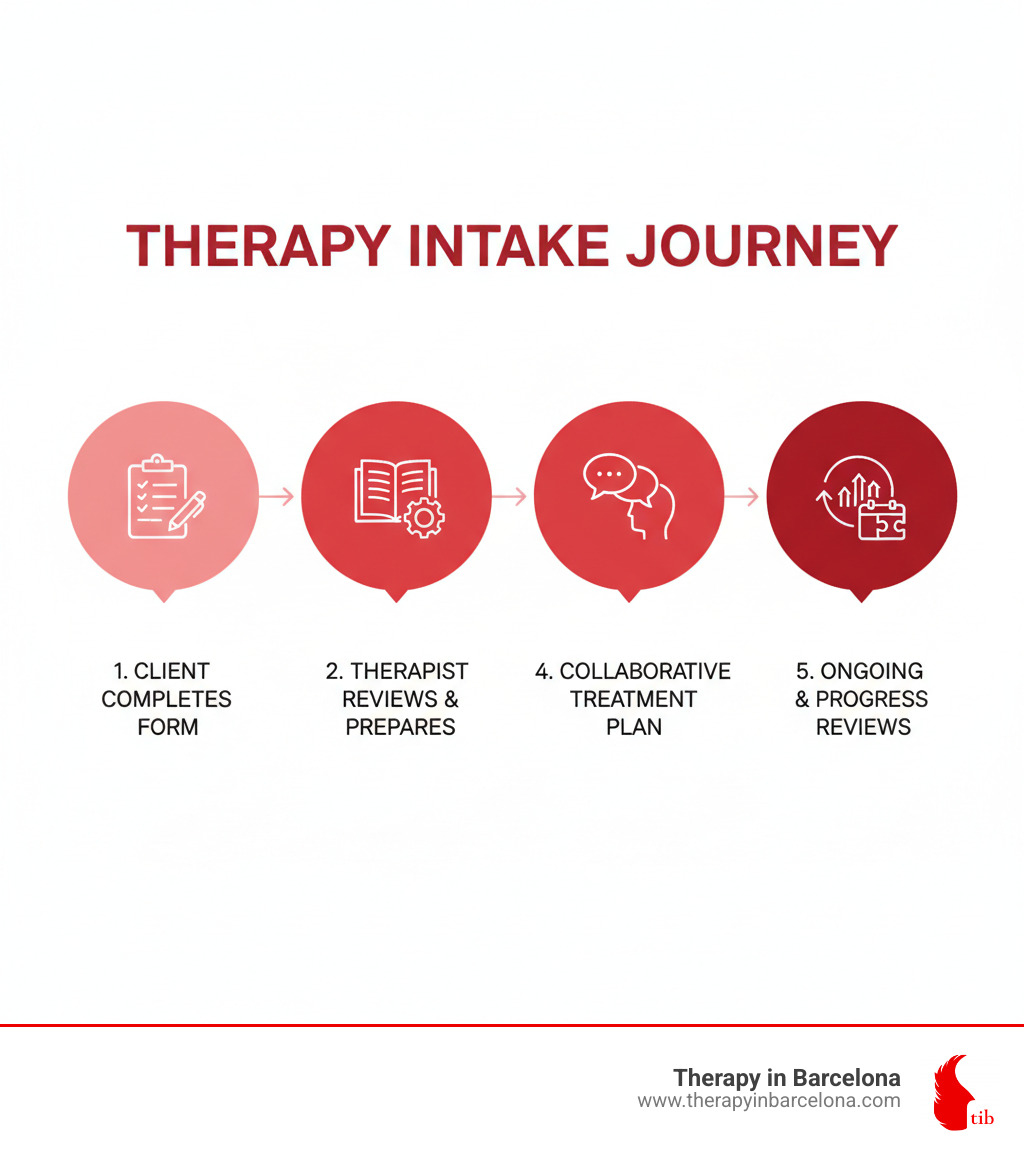
Why Do We Use Therapy Intake Forms?
When you’re new to Barcelona—or any city abroad—and decide to seek therapy, the therapy intake form is one of the first things you’ll encounter. It may feel like just another form, but it serves a vital purpose.
Think of it as the foundation of your therapeutic relationship. Before you even meet, the form gives your therapist a window into your world, helping them understand who you are and what you’re facing. It’s not about ticking boxes; it’s about creating a snapshot of your story so your therapist can arrive prepared and ready to help.
The intake form serves several key purposes:
It gathers essential information for safe, effective care. Your therapist needs to know your background, mental health concerns, and medical history to support you properly.
It also meets legal and ethical requirements. Mental health services in Spain must follow strict standards around confidentiality, informed consent, and data protection (GDPR). The form ensures everything is transparent from the start.
Beyond paperwork, the form sets a professional, confidential framework for your work together. It outlines what therapy is, what to expect, and what your rights are, building trust from the beginning.
Most importantly, it starts the therapeutic relationship. Filling out the form can be a reflective process. As you name your struggles and hopes, your therapist reads your words with care, preparing to meet you where you are. By your first session, they’re not starting from scratch—they’re starting with understanding.
For more on what to expect once the form is done, take a look at our guide on preparing for your first therapy session.
What Makes a Good Intake Form?
A good therapy intake form is like a well-designed map: comprehensive enough to guide but not so cluttered it overwhelms. For internationals in Barcelona, Madrid, or Valencia, a good form is also sensitive to diverse backgrounds, acknowledging that your story might involve multiple languages, cultures, and countries.
The best intake forms feel less like an interrogation and more like the start of a conversation, giving you space to share what matters while gathering the details your therapist needs.
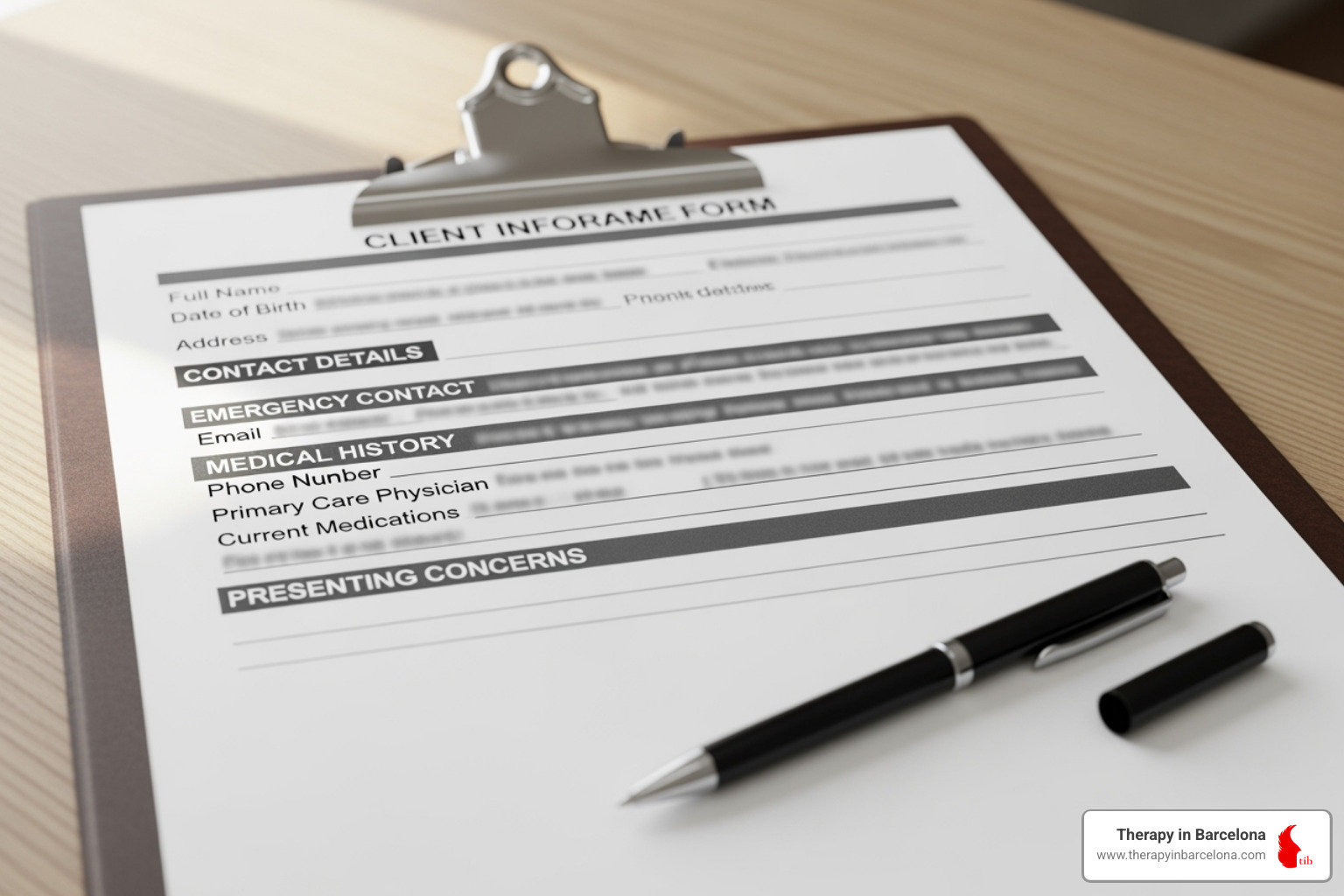
Basic Client Information
This section covers the practical details of who you are and how to reach you.
You’ll be asked for demographics like your name, date of birth, and gender identity. For expats, this often includes nationality and languages spoken. You’ll also provide contact details and an emergency contact, which is crucial for your safety.
The form will cover payment information, including fees and billing. At Therapy in Barcelona, we are a private-pay service, but some therapists offer sliding scale fees for those with financial need.
Finally, you’ll be asked how you found us. This helps us understand how to better support the international community.
Your Story: History and Presenting Concerns
This is where the form gets to the heart of why you’re seeking therapy, aiming to capture a holistic picture of your challenges and experiences.
The most important question is often: What brings you to therapy? This open-ended space allows you to describe, in your own words, why you are seeking support.
Many forms include symptom checklists to help identify patterns of distress, such as feelings of persistent worry, low mood, or stress. Some questionnaires provide a baseline measurement of how you’ve been feeling. Think of them as snapshots, not verdicts.
You’ll also be asked about your medical and mental health history, including any previous therapy you’ve had, medications, and other relevant health information. This helps your therapist tailor their approach from the start.
Family mental health background provides valuable context, helping to understand family patterns and experiences.
For internationals, the social and cultural background section is especially relevant. It explores your education, employment, relationships, and cultural identity. Questions about cultural adjustment, language barriers, and isolation in a new country like Spain are particularly important.
Finally, forms often include questions about substance use patterns (alcohol, tobacco, and other drugs). This isn’t about judgement; it’s about understanding the full picture to ensure your safety and identify any co-occurring concerns.
Life’s Impact: Stress, Strengths, and Goals
Therapy is about growth and building on what you already have. This part of the form looks at both your challenges and your strengths.
Major life events like moving to Spain, a job change in Madrid, or relationship shifts can be significant stressors. This section highlights recent events that might be contributing to how you feel.
Some forms include a simplified life events checklist to help therapists understand the cumulative impact of recent stress.
Just as important is recognising your strengths and coping skills. What helps you through tough times? Identifying your existing strengths is crucial for building resilience in therapy.
Finally, the form asks what you hope to get from therapy. Clarifying your goals ensures your therapist can tailor their approach to what matters most to you. Reflecting on your strengths and well-being is a great way to start this process.
The Legal and Ethical Bits: Informed Consent
This section is your right to know how therapy works and what you’re agreeing to. It’s about transparency, respect, and safety.
Confidentiality and its limits are clearly explained. Therapy is confidential, but there are legal and ethical exceptions, such as a risk of harm to yourself or others. These limits are outlined upfront.
You’ll also learn about your therapist’s qualifications. At Therapy in Barcelona, our team comprises highly qualified, psychology-trained therapists, founded by Australian Psychologist Leigh Matthews.
The form clarifies what therapy is (and isn’t), outlining the nature of psychological services. It also states that while therapy is usually beneficial, there are no guarantees of specific outcomes.
Fees and cancellation policy are spelled out, including costs and policies for rescheduling or cancelling appointments. Therapy in Barcelona is a private-pay service, and some therapists offer sliding scale fees.
Finally, the form outlines your rights and responsibilities, including your right to ask questions and your commitment to participating in the process. In Europe, GDPR (General Data Protection Regulation) further ensures your data privacy.
From Form to First Session: How Intake Works in Practice
Once you’ve filled out your therapy intake form, your therapist reviews your responses not as a verdict, but as a window into your world—a starting point for understanding your story.
Intake forms are a starting point, not a test. There are no right or wrong answers. Your honesty helps your therapist prepare for your first meeting and consider what might be most helpful to explore together.
They are used as a conversation starter. In your first session, your therapist won’t just read from the form. Instead, they’ll use what you’ve shared as a springboard, asking clarifying questions and inviting you to elaborate. This collaborative approach builds rapport and trust.
Therapists show empathy and ask open questions. Your therapist might pick up on a theme you mentioned—like feeling isolated since moving to Valencia—and gently ask you to say more. This isn’t an interrogation; it’s a dialogue aimed at making you feel heard.
How Intake Forms Guide Assessment and Planning
The information from your therapy intake form is a valuable tool for assessment and planning. It helps your therapist spot key themes and set initial goals with you. By reviewing your concerns and history, your therapist can identify patterns and collaboratively define what you want from therapy.
These insights are then used to create a collaborative roadmap. The intake form informs the direction of your sessions, allowing your therapist to tailor their approach—whether that’s Cognitive Behavioural Therapy (CBT), Acceptance and Commitment Therapy (ACT), or another modality—to your specific needs.
To learn more about how Therapy in Barcelona tailors its approach, read about how we address diverse therapy goals.
The Digital Shift: Intake Forms in a Connected World
Technology has made therapy more accessible, and digital therapy intake forms are a key part of that, especially for internationals in Spain.
Digital forms are convenient for clients in Barcelona, Madrid, and abroad. You can complete them at your own pace, from the comfort of your home, without the pressure of a waiting room.
Secure, GDPR-compliant storage means your sensitive information is encrypted and protected, giving you peace of mind.
Online therapy options are seamlessly supported by digital intake forms. Whether you’re seeking therapy online from the USA, Canada, or elsewhere, completing your form electronically is a smooth process.
At Therapy in Barcelona, we use technology to make therapy accessible. You can learn more about our online therapy services.
Storing and Managing Your Information
Your privacy matters. Reputable practices treat your personal information with the utmost care and security.
Secure digital and physical storage protects your information using encrypted systems and locked cabinets.
Data protection (GDPR in Europe) is taken seriously. As a practice in Spain, Therapy in Barcelona adheres strictly to GDPR regulations, ensuring your data is processed lawfully and transparently.
Clear record retention policies mean your information is kept for as long as legally required and then securely disposed of, respecting your privacy throughout the process.
Adapting Intake Forms for Different People and Settings
Just as no two people are alike, no single therapy intake form fits every situation. An effective intake process recognises this diversity and adapts accordingly.

There’s no one-size-fits-all approach. Intake forms are customised for individuals, couples, or families. Cultural sensitivity is also key, especially for expats. For internationals in Barcelona or Valencia, questions about cultural background, adaptation challenges, and identity shifts are crucial. A culturally sensitive form acknowledges these nuances, ensuring you feel understood.
Individual, Couples, and Family Therapy: What’s Different?
The structure of the therapy intake form varies depending on who is seeking therapy.
For individual therapy, an Adult Intake Form focuses on your personal history, symptoms, and goals.
For couples therapy, a Couples Intake Form gathers information from both partners, often including sections for individual perspectives as well as your shared history and goals.
For families, a Family Intake Form gathers input from all participating members to understand family history, roles, and communication styles from multiple viewpoints.
Special Considerations for Children, Teens, and Expats
When working with specific populations, intake forms require extra thoughtfulness.
Child and adolescent forms use age-appropriate language. A Child Intake Form is often completed by parents, focusing on developmental milestones and school performance. For adolescents, forms may be a hybrid, allowing the teen to express their concerns while also gathering parental input.
For expats in Barcelona, Valencia, and beyond, our forms explicitly ask about cultural identity, challenges of living abroad, and language fluency. Our therapists—many of whom are expats themselves—provide culturally informed care. We speak English, and some also speak German, French, Spanish, and other languages.
Intake Forms vs. Other Clinical Documents
It’s easy to confuse a therapy intake form with other clinical documents. They serve different purposes at different stages.
Intake Forms: Completed before or at the first session to gather comprehensive background information and initial goals. You fill them out.
Progress Notes: Written by the therapist after every session to document progress and interventions. These are for the therapist’s internal use.
Standardised Assessments: Objective tools used to measure specific feelings or behaviours at various points in therapy to track change. You often complete these.
Private Practice vs. Other Options: What’s Unique?
Understanding your therapy options can help you choose the right fit.
Public health systems in Spain often use standardised intake forms and may have long wait times. While accessible, they may not offer the cultural sensitivity an expat needs.
Large online platforms offer convenience but may use generic forms and algorithmic matching, potentially overlooking the nuanced needs of expats.
At Therapy in Barcelona, we offer a distinctive approach. Our therapy intake form is designed for personalised matching. We take time to connect you with the therapist best suited to you. Our team of psychology-trained therapists are expats themselves, bringing cultural sensitivity to every interaction. We maintain strict privacy standards under GDPR and never sell your data. As a private-pay service, we focus on providing customised, effective interventions.
Frequently Asked Questions about Therapy Intake Forms
How long should a therapy intake form be?
There’s no magic number, but a good therapy intake form should be thorough without being overwhelming. The goal is to gather important information without it feeling like a burden. Modern digital forms often use branching logic, so you only see questions that apply to you. This keeps the process focused and relevant.
Can I refuse to fill out an intake form?
You have the right to ask questions or express discomfort with certain sections. A good therapist will explain why the information is needed and explore alternatives.
However, therapists require some foundational information to support you safely, such as emergency contact details and basic medical history. The key is open conversation. If a question feels uncomfortable, bring it up. A collaborative discussion about the form can be a great first step in building trust.
How often is intake information updated?
Your initial therapy intake form is a snapshot in time. Information is reviewed and updated as needed, especially after big life changes like moving from Barcelona to Valencia, starting a new relationship, or setting new therapy goals.
Many practices, including Therapy in Barcelona, will briefly review your intake information annually. This ensures your therapist always has a current understanding of your situation, allowing them to adapt their approach as you grow and change.
How Therapy in Barcelona Stands Out
As an international, finding the right support can feel overwhelming. You’re already adjusting to life in a new country—be it Barcelona, Valencia, or Madrid—and you need more than a generic approach to therapy.
At Therapy in Barcelona, we’ve built our practice on a simple truth: expats need more than just a therapist who speaks English. They need someone who truly gets it.
Personalised matching is at the heart of what we do. We don’t just assign you to the next available therapist. We take time to understand your needs from your therapy intake form and initial conversations to match you with the right therapist from our team. As one client put it: “I don’t think you can improve your intake service. I was so happily surprised at the ease and speed my initial request was handled.”
Cultural and linguistic sensitivity runs deep in our team. We speak English and other languages, including German, French, Spanish, and more. But more than that, many of us are expats ourselves. We understand the experience of moving abroad, whether you’re in Barcelona, Málaga, or connecting with us online.
Your privacy is sacred to us. We adhere to strict GDPR standards and never sell your data. Your information is always protected and confidential.
Our team brings real expertise. Therapy in Barcelona was founded by Leigh Matthews, an Australian Psychologist in Barcelona since 2011. Our group practice brings together highly qualified, psychology-trained therapists who support adults, couples, teens, and families.
This is a private-pay service, which allows us to prioritise personalised care. Some therapists offer sliding scale fees, and we encourage you to inquire about this during your Free Discovery Call.
Alternatives: What Else Is Out There?
When searching for therapy as an international, it helps to know your options. Each has its strengths, and understanding them can guide you to the right fit.
Public health system: In Spain, public mental health services are available but often rely on standardised therapy intake forms. Wait times can be long, and the process may feel impersonal and not always designed with expats in mind. The specific challenges of adjusting to life in Barcelona or feeling isolated in Valencia might not be fully captured.
Large online platforms: These platforms offer convenience and quick matching, but the process can feel algorithmic rather than personal. You might be paired based on availability, and the therapist may not have a deep understanding of the expat experience. Privacy policies can also vary.
Local practices: Many local therapy practices across Spain offer excellent, multilingual care. However, not all specialise in expat support. Their intake forms might not explore the specific stressors of cultural adaptation or the sense of dislocation that comes with living far from home. If you’re a digital nomad in Gran Canaria or a student in Zaragoza, you might need a therapist who truly gets the expat journey.
At Therapy in Barcelona, our entire approach is built around the needs of internationals. Our therapy intake form is designed to capture your story as an expat. We match you personally with a therapist who understands your background. We adhere to strict privacy standards, and our team of psychology-trained therapists are expats themselves, bringing empathy to your journey. This personalised, culturally sensitive approach offers something distinctive for internationals in Barcelona, Madrid, Valencia, and beyond—or online, wherever you are.
Conclusion: Your First Step Towards Support
That therapy intake form is more than paperwork. It’s the quiet beginning of an important conversation. For internationals in Barcelona, Madrid, Valencia, or beyond, it’s the bridge between feeling lost and feeling understood.
A well-designed intake process sets the tone for safety, trust, and collaboration. It tells your therapist who you are, what you’re carrying, and what you hope for. When done with care—especially for expats—it makes all the difference.
At Therapy in Barcelona, we personalise every step, starting with how we use your therapy intake form. We use it to truly understand you and match you with the right therapist for your background and goals. Our forms are adapted for the real challenges of expat life, and our team of psychology-trained therapists are expats themselves.
If you’re in Spain—whether in Barcelona, Valencia, or Madrid—or seeking support online from the USA, Canada, or beyond, the first step is a conversation.
Book Your Free Discovery Call.
We offer online therapy worldwide, including the USA and Canada. Your story matters, and we’re here to help you tell it.
