


Introduction: The Key to a Stronger Partnership

Couples communication skills are the foundation of a healthy, lasting relationship. If you’re looking to improve how you and your partner connect, here’s what you need to know:
- Communication is a learnable skill – not an innate trait you either have or don’t have
- The core skills include active listening, using ‘I’ statements, expressing needs clearly, and creating regular check-ins
- Research shows that relationship satisfaction often predicts communication quality, not just the other way around
- Common barriers include criticism, defensiveness, stonewalling, and making assumptions
- Practice matters more than perfection – small, consistent changes build stronger bonds over time
Perhaps you’ve found yourself in the same argument for the hundredth time, or maybe your partner’s words leave you feeling misunderstood rather than supported. You might be living in Barcelona, Valencia, or Madrid, facing not just relationship challenges but also the added pressures of expat life—language barriers, cultural adjustment, and the isolation that can come with building a life far from home.
Many couples assume that if they’re arguing frequently, it means their relationship is doomed. But the truth is more nuanced. How you communicate and how you feel about your relationship often influence each other.
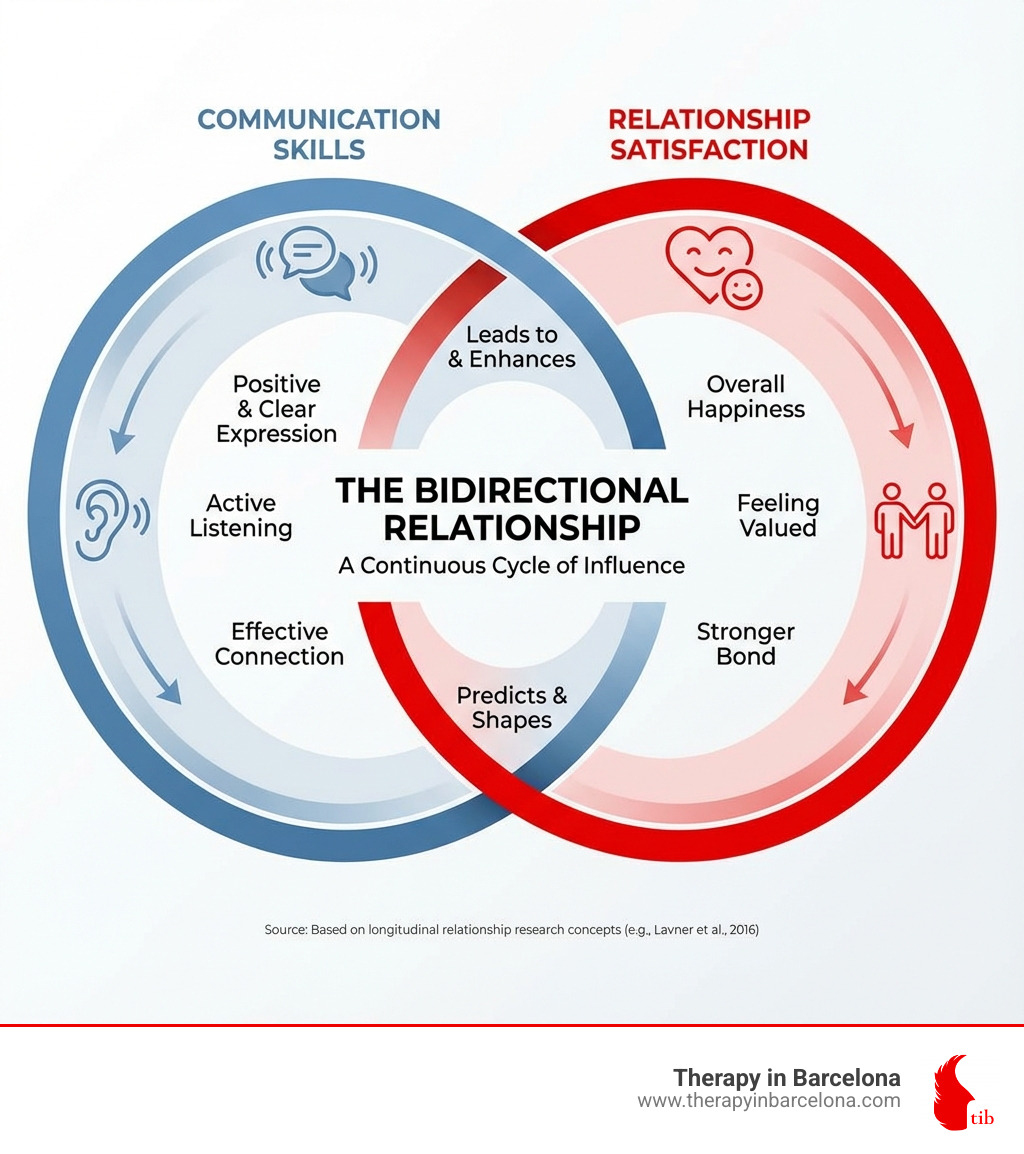
When couples feel more connected and secure, communication may come more easily; and when they communicate with greater care and understanding, that can strengthen their sense of connection. Learning to communicate better can create a positive cycle, but communication difficulties are not always the root cause of relationship problems.
But communication is a skill, which means it can be learned, practised, and improved. Whether you’re a monocultural couple adjusting to life abroad or an intercultural couple navigating different cultural expectations, the tools in this guide can help you move from conflict to connection.
The examples in this guide are fictional composites, but their stories reflect the real challenges many couples encounter. You don’t need to be perfect communicators—you just need to be willing to try, to listen, and to keep showing up for each other.
Why Communication Falters: The Surprising Link Between Satisfaction and Skill
It’s a common belief that poor communication directly causes unhappiness in a relationship. Therapists often hear that “poor communication” is the most commonly cited reason couples seek help. Indeed, cross-sectional studies consistently show that relatively satisfied couples engage in more positive, less negative, and more effective communication. This makes intuitive sense: if you talk well, you feel good.
However, recent longitudinal research challenges this straightforward assumption. A significant study by Lavner, Karney, and Bradbury (2016) explored whether couples’ communication predicts marital satisfaction, or if marital satisfaction predicts communication.
Their findings offer a more nuanced perspective. While some communication-to-satisfaction links were identified, they were generally inconsistent and “not particularly robust.” Instead, they found that “satisfaction was a more consistent predictor of husbands’ and wives’ communication behaviours than the reverse”.
What does this mean? It suggests that your overall happiness and contentment in the relationship might influence how you communicate more strongly than your communication skills alone dictate your satisfaction.
If you’re generally feeling good about your partner and your life together, you’re more likely to approach conversations with positivity, patience, and a willingness to understand. Conversely, if underlying dissatisfaction is simmering, it can make even simple discussions feel tense, leading to more negative or less effective communication patterns.
This insight is crucial, especially for expats adapting to life in cities like Valencia or Alicante, where external stressors like cultural differences, language barriers, or homesickness can impact overall satisfaction.
These factors can inadvertently strain a relationship, leading to communication breakdowns that are more a symptom of deeper issues than the sole cause of unhappiness. Understanding this bidirectional link means that while improving couples communication skills is vital, addressing the root causes of dissatisfaction is equally important for lasting relationship health.
Common Barriers to Effective Dialogue

Even with the best intentions, communication can easily go awry. John Gottman, a renowned relationship researcher, identified what he calls the “Four Horsemen of the Apocalypse” for relationships—criticism, contempt, defensiveness, and stonewalling—which are devastating communication patterns that predict relationship failure.
- Criticism is different from a complaint. A complaint focuses on a specific behaviour (“I’m upset you didn’t take out the rubbish”), while criticism attacks the person (“You’re so lazy; you never help with anything!”).
- Contempt is criticism with a dose of disgust. It involves mocking, sarcasm, eye-rolling, or sneering. It communicates disrespect and is highly corrosive to intimacy.
- Defensiveness is a natural reaction to criticism or contempt, but it blocks effective communication. Instead of listening, you make excuses, play the victim, or counter-attack.
- Stonewalling occurs when one partner disengages, withdrawing physically or emotionally from the conversation. This can be an attempt to self-soothe, but it leaves the other partner feeling ignored and rejected.
These four patterns, identified by Dr. John Gottman, are highly predictive of relationship breakdown.
Beyond these four, other common barriers block healthy dialogue:
- Mind-reading and Assumptions: Expecting your partner to know what you’re thinking or feeling without expressing it, or assuming you know their intentions. This often leads to frustration and misunderstandings.
- Impact of Mental Health: Individual mental health can significantly skew perceptions and communication. For example, feelings of anxiety might lead to overthinking messages, while feeling persistently down might reduce the energy for engaging in conversation.
- Passive-Aggressive Behaviour: Expressing negative feelings indirectly, such as through sarcasm, sulking, or procrastination, rather than direct, open communication. This avoids conflict in the short term but builds resentment.
- Avoiding Conflict Altogether: Many couples believe that not fighting equals having a good relationship. Yet, avoiding necessary discussions and silencing what bothers us can lead to simmering resentment and unresolved issues, which can be more damaging than healthy disagreement.
Why Mastering Couples Communication Skills is Worth It
Despite these challenges, strengthening your couples communication skills can make a meaningful difference to your relationship. The benefits go beyond resolving disagreements; they can deepen understanding, strengthen connection, and help you navigate everyday life together with greater confidence.
Research confirms that couples who are good communicators have a greater chance of having a happier, longer romantic relationship.
For example, a longitudinal analysis published in the Journal of Marriage and Family confirmed that positive communication is a significant predictor of long-term relationship satisfaction. When you can express yourselves clearly and listen effectively, you build a stronger foundation for connection and understanding.
Here’s why it matters:
- Building Trust and Deepening Emotional Intimacy: Open and honest communication fosters a sense of safety, allowing both partners to be vulnerable and authentic. This vulnerability is the bedrock of deep emotional connection.
- Strengthening Friendship: At its core, a strong romantic relationship is often a deep friendship. Regular, positive communication, including sharing thoughts, dreams, and daily experiences, nurtures this bond.
- Better Conflict Resolution: It’s not about avoiding conflict, but learning to steer it constructively. Effective communication allows you to address disagreements, find solutions, and emerge stronger as a couple. This is particularly vital when dealing with the unique challenges of expat life in places like Zaragoza or Gran Canaria.
- Higher Relationship and Sexual Satisfaction: When partners feel heard, understood, and connected, overall relationship satisfaction naturally increases. This positive dynamic often extends to physical intimacy, leading to greater sexual satisfaction.
- Creating a Secure Base for Your Family: For couples with children, healthy communication models positive interaction for them, fostering a stable and secure home environment. It teaches children how to express their needs and resolve conflicts respectfully.
Mastering couples communication skills is about nurturing the “we-ness” of your relationship. It’s about ensuring both partners feel valued, understood, and supported, creating a resilient partnership that can withstand life’s pressures and thrive.
Essential Couples Communication Skills to Build Connection
Effective communication isn’t about grand gestures or flawless dialogue; it’s about consistent, intentional practice of specific skills. These skills create a safe space where both partners feel heard, respected, and validated.

Creating a safe space means fostering an environment where partners feel seen, heard, and validated without fear of judgement. This begins with mutual respect, intentional reflection on communication patterns, and prioritising openness and emotional safety.
Setting ground rules, such as no interrupting, no name-calling, and taking breaks when needed, can provide a framework for these discussions. Empathy—the ability to understand and share the feelings of another—and validation—acknowledging your partner’s emotions, even if you don’t agree with their perspective—are crucial for this safe space to flourish.
Foundational Skill 1: Active and Reflective Listening
Many of us listen to respond, not to understand. Active listening shifts this paradigm, focusing entirely on receiving your partner’s message.
- The Speaker-Listener Technique: This structured method gives both partners a chance to speak and be heard. One person speaks without interruption while the other listens and paraphrases what they heard before switching roles. It helps slow conversations down, reduce misunderstandings, and improve understanding.
- Mirroring and Paraphrasing: As a listener, mirroring means repeating back what you heard in your own words. For example, “So, what I heard you say was…” This confirms understanding and makes your partner feel truly heard.
- Asking Clarifying Questions: Instead of assuming, ask open-ended questions to deepen your understanding. “Could you tell me more about what you mean by that?” or “How did that make you feel?” are great examples.
- Non-Verbal Cues and Eye Contact: Your body language often speaks louder than words. Maintain eye contact (without staring intensely), nod to show engagement, and keep an open posture. Avoid crossing your arms or looking away, which can signal disinterest or defensiveness.
- Open-Ended Questions: These invite more than a “yes” or “no” answer, encouraging deeper sharing. Instead of “Did you have a good day?”, try “What was the most interesting part of your day?” or “How was your day, really?”
For couples adjusting to life in Barcelona, Málaga, or other Spanish cities, these skills are particularly valuable. Language nuances or cultural differences can easily lead to misinterpretations, making deliberate listening even more critical. If you’re interested in exploring these foundational skills further, you can find more information about our therapy services at Therapy in Barcelona.
Foundational Skill 2: Expressing Yourself Clearly and Kindly
How you say something can be just as important as what you say. Learning to express your needs and feelings constructively is a cornerstone of effective communication.
- ‘I’ Statements: This is perhaps the most powerful tool for expressing yourself without blaming. Instead of “You always make me feel ignored,” try “I feel unheard when I’m speaking and you’re looking at your phone.” ‘I’ statements focus on your feelings and experiences, taking responsibility for them, and are proven to reduce the likelihood of arguments escalating.
- The ‘I feel ___ when ___’ Formula: This simple structure helps you articulate your emotions clearly. “I feel [emotion] when [specific situation/action happens], and I wish/want/would like [specific request].” For example, “I feel overwhelmed when the house is messy, and I would like us to create a cleaning schedule together.”
- Stating Positive Needs: Rather than complaining about what you don’t want, articulate what you do want. Instead of “Stop being so messy,” try “I need more order in our home to feel relaxed.” This reframes your request constructively.
- The Sandwich Method: When you need to make a request or offer constructive feedback, try sandwiching it between two positive statements. “I really appreciate how hard you’ve been working lately. Would you be willing to help with the dishes tonight? It would mean a lot to me.” This reduces defensiveness and makes your request more palatable.
- Avoiding Blame and Taking Responsibility for Feelings: Your feelings are yours. While your partner’s actions might trigger them, owning your emotional response helps prevent accusatory language. Nonviolent Communication (NVC) suggests observing without judgment, identifying your feelings and needs, and then making a clear, positive request. This approach, developed by Marshall Rosenberg, fosters empathy and cooperation, leading to stronger, more fulfilling relationships.
Foundational Skill 3: Building Proactive Communication Habits
The best communication doesn’t just happen during conflict; it’s woven into the fabric of your daily life. Proactive habits build a reservoir of goodwill and understanding.
- Daily Check-ins: Even 10-15 minutes of dedicated, distraction-free conversation each day can make a huge difference. This isn’t about solving big problems, but simply reconnecting, sharing about your day, and staying current with each other’s lives. Some couples call this a “Bae Sesh” or a “Reunion at the End of the Day,” explicitly excluding conflict discussion.
- The Stress-Reducing Conversation: This involves one partner sharing about an external stressor (work, family, news) while the other listens without offering advice or solutions. The listener’s role is to empathise, validate, and take their partner’s side. This exercise, from the Gottman Institute, helps partners manage external pressures without letting them spill into the relationship.
- Expressing Gratitude: Regularly acknowledging what you appreciate about your partner, whether through words, notes, or small gestures, builds a positive emotional climate. “Thank you for making dinner tonight; I really appreciate it.” This boosts connection and makes your partner feel valued.
- Reminiscing Exercises: Spending time recalling positive memories, shared adventures, and special moments strengthens your bond and reminds you of the joy you share. This is especially comforting when experiencing the ups and downs of expat life in cities like Sevilla or Marbella.
- Planning Good Times: Actively planning enjoyable activities together, whether it’s a date night, a weekend getaway, or simply an evening walk, reinforces your connection and creates shared positive experiences.
- Scheduling Regular Meetings: Beyond daily check-ins, some couples benefit from a weekly “couples meeting” to discuss logistics, share goals, express appreciation, and address any emerging issues in a structured, calm environment. This prevents small issues from snowballing.
When DIY Isn’t Enough: How Professional Support Can Help
Sometimes, despite your best efforts, communication remains strained, and underlying issues feel too big to tackle on your own. This is a normal part of relationships, and it’s precisely when professional support can offer invaluable guidance.
You might consider seeking therapy if you experience:
- Persistent Conflict: You’re having the same arguments repeatedly, with no resolution.
- Feeling Stuck: You feel disconnected, distant, or unable to move forward in your relationship.
- Infidelity or Betrayal: These significant breaches of trust often require professional help to heal.
- When Exercises Don’t Work: You’ve tried communication techniques, but they don’t seem to stick or lead to lasting change.
- External Stressors Overwhelm: The pressure of being an expat in places like Barcelona, Madrid, or Gran Canaria can make it much harder to communicate effectively.
A neutral third party—a qualified therapist—can provide a safe, unbiased space to explore difficult topics, identify entrenched patterns, and teach you advanced couples communication skills. They can help you understand the deeper dynamics at play, including how past traumas or unmet needs might be influencing your current interactions.
When considering professional support, it’s important to acknowledge the alternatives. You might find public health system services, which can be limited in availability or language options, or large online platforms that offer a quick match but may lack the depth of personalised care and cannot guarantee the same level of client privacy.
Therapy in Barcelona stands out in this landscape, particularly for the international community. We understand the unique challenges of expat life, as our founder, Leigh Matthews, an Australian Psychologist, is an expat herself, having lived in Barcelona since 2011.
Our unique selling point is our personalised therapist matching service, ensuring you and your partner are paired with a psychology-trained therapist who best fits your specific needs and concerns.
We adhere to strict confidentiality standards, and our therapists, many of whom are expats themselves, offer culturally sensitive support in English, as well as other languages like German, French, Spanish, Afrikaans, Portuguese, Austrian-German, and Swiss-German, helping you steer not just relationship issues but also cultural adjustment and the unique stresses of living abroad.
Putting Your Couples Communication Skills to the Test with a Professional
Couples therapy isn’t about blaming or taking sides; it’s about strengthening the relationship as a whole. As therapists often say, there are “three clients in the room: each member of the couple and the relationship itself.”
- How Couples Therapy Works: In a guided setting, a therapist helps you identify destructive communication patterns, provides tools to replace them with healthier ones, and facilitates difficult conversations. Approaches like the Gottman Method, for example, are evidence-based frameworks that help couples build “Love Maps,” manage conflict, turn towards each other, and create shared meaning.
- Addressing Deeper Issues: A therapist can help you uncover the root causes of conflict, whether they stem from individual histories, family-of-origin issues, or the stresses of your expat journey. This deeper understanding is crucial for lasting change.
- Tailoring Therapy to Your Unique Needs: At Therapy in Barcelona, we draw on evidence-based therapeutic approaches to tailor support to your specific situation and goals. Our aim is to equip you with practical skills, strategies, and greater understanding to create meaningful, positive change.
You can learn more about how we support couples by visiting our dedicated couples counselling page: More info about couples counselling.
Frequently Asked Questions about Couples Communication
What if my partner refuses to practice these exercises?
This is a common concern. Communication is a two-way street, but change can start with one person.
- Start with yourself: Focus on improving your own communication habits. Model active listening, use ‘I’ statements, and express appreciation. Your positive changes might inspire your partner.
- Express your desire for connection: Use ‘I’ statements to explain how important improving communication is to you and the relationship. For example, “I feel a bit disconnected when we struggle to talk about things, and I would really love for us to find ways to understand each other better.”
- Suggest seeking professional help together as a team: Frame therapy not as a sign of failure, but as an investment in your shared future. A neutral third party can sometimes break down resistance.
How long does it take to see improvement in our communication?
The timeline for improvement varies greatly for each couple.
- Consistency is key: Small, consistent changes practised over time add up. Just like learning any new skill, new communication habits take practice.
- Varies by couple: Factors like the severity of existing issues, individual willingness to change, and external stressors (like the unique pressures of expat life) all play a role.
- Professional guidance can accelerate progress: A therapist can help you identify core issues more quickly, teach effective strategies, and provide a safe space for practice, often leading to noticeable improvements within weeks or months.
Can communication skills save a relationship on the brink of a breakup?
While communication skills are powerful, they are not a magic fix for every relationship problem.
- It can create a path forward: Improved communication can open channels for partners to address long-standing issues, rebuild trust, and rediscover connection. It’s often a necessary component for healing.
- Requires commitment from both partners: Both individuals must be willing to engage in the process, confront difficult truths, and make changes.
- Often needs to be combined with addressing root problems: Communication skills alone might not be enough if there are deeper issues like unresolved trauma, fundamental value differences, or unaddressed difficulties such as persistent low mood or overwhelming anxiety. A therapist can help assess the situation and guide you through a comprehensive approach.
Conclusion: Your Path to a More Connected Relationship
Improving how you communicate as a couple is an ongoing practice, not a one-time fix. Every conversation is a chance to build resilience, deepen understanding, and strengthen your connection. Small, consistent efforts are what lead to real change.
For those living as expats in Spain—whether you’re in Barcelona, Madrid, or any other city—the challenges can be amplified. But so too can be the strength and connection you build as a couple when you face these challenges together.
At Therapy in Barcelona, we know these challenges first-hand. Our team of psychology-trained expat therapists, led by our founder Leigh Matthews, is dedicated to providing a compassionate and expert space to help you and your partner reconnect.
We believe in customised therapeutic support, ensuring you’re matched with a professional who understands your unique context and can guide you towards a more fulfilling and connected relationship. We support couples both in our Barcelona office and online worldwide, including in the USA and Canada.
If you’d like support, our team offers a compassionate and expert space to help you and your partner reconnect. Book your Free Discovery Call today to explore how we can support your journey towards better communication and a stronger partnership.
