


Understanding Expat Depression: When Your Dream Move Becomes a Struggle

“I have an amazing life abroad, but I feel miserable inside.”
Does this thought sound familiar? That picture-perfect Instagram life of sipping coffee in charming European squares or exploring exotic markets often hides a more complex reality. For many expats, the exciting trip of living abroad can unexpectedly transform into a struggle with profound sadness and isolation.
Expat depression therapy is more than just standard counseling. It’s specialized mental health support designed specifically for people living abroad who experience persistent sadness, isolation, and cultural adjustment difficulties that don’t simply fade with time.
Living in a foreign country brings unique challenges that can trigger depression in even the most resilient individuals. The constant cognitive load of navigating unfamiliar systems, language barriers, and the profound sense of disconnection from your support network creates a perfect storm for mental health challenges.
You’re not alone in this experience. Research shows expatriates face up to 2.5 times higher risk of anxiety and depression compared to their home-country counterparts. This isn’t simply homesickness or temporary culture shock—it’s a legitimate mental health challenge that deserves proper, specialized support.
What makes expat depression different is how deeply it intertwines with identity disruption. When you move abroad, you don’t just change your location—you often need to rebuild your entire sense of self. Your professional identity, social connections, and even the small daily rituals that gave your life structure and meaning are suddenly different or gone completely.
The good news? Specialized expat depression therapy exists to address these unique challenges. Unlike general therapy, expat-focused mental health support recognizes the complex interplay between cultural adjustment, identity shifts, and emotional wellbeing.
If you’re wondering when to seek help, consider reaching out when feelings of sadness persist beyond 2-3 months or begin interfering with your daily functioning. The benefits of culturally-sensitive therapy include working with someone who truly understands the expatriate experience, possibly in your native language, and learning strategies specifically designed for the challenges of cross-cultural living.
At Therapy in Barcelona, we understand that finding culturally sensitive mental health support in your language can feel overwhelming when you’re already struggling. That’s why our approach focuses on matching you with therapists who understand both clinical depression and the expatriate experience—because they’ve lived it too.
What Makes Expat Depression Different?
Living abroad brings unique challenges that transform regular depression into something more complex and layered. Expat depression isn’t simply feeling down while happening to live in another country—it’s a distinctive experience shaped by cultural displacement and identity disruption.
“This culture is driving me crazy!” When this thought becomes a daily companion rather than a passing frustration, it signals something deeper. The constant mental effort required to steer cultural differences—from figuring out how to greet people appropriately to understanding unspoken social rules—can drain your mental resources, creating vulnerability to depression that research shows affects expatriates at up to 2.5 times the rate of their home-country counterparts.
Layers of Loss Abroad
Moving abroad triggers what psychologists call “disenfranchised grief”—a form of loss that often goes unacknowledged because, after all, you chose this trip, didn’t you? This invisible grief manifests through multiple channels simultaneously:
When you relocate internationally, you experience the loss of social support networks as trusted friends and family become distant figures on video calls. You face the loss of cultural competence as skills that made you effective at home suddenly don’t translate. Your identity markers shift dramatically when professional status, community standing, and familiar roles disappear overnight. Perhaps most isolating is the loss of linguistic confidence—the inability to express yourself fully or understand nuance in your new language.
“I felt ashamed for being depressed,” shared one client at Therapy in Barcelona. “I had this amazing opportunity to live in Barcelona, and I couldn’t understand why I wasn’t happy. It made me feel ungrateful and weak.”
This sentiment echoes across the expat experience. The guilt of not enjoying your “dream life” compounds the depression itself, creating a cycle that’s difficult to break without specialized support. Scientific research on mental health consistently shows that expatriates express three times more feelings of depression compared to those living in their home countries.
This isn’t a personal failing or lack of resilience—it’s a natural response to the extraordinary challenges of cross-cultural living. Culture shock moves beyond simple adjustment difficulties into something that can fundamentally challenge your sense of self and belonging. Each small daily failure to steer the new culture correctly—from ordering coffee incorrectly to misunderstanding social cues—chips away at confidence and contributes to a growing sense of isolation.
Expat depression therapy recognizes these unique aspects and addresses them directly, offering support that acknowledges both the visible and invisible challenges of international living. By understanding the specific nature of expat depression, those struggling can find their way back to balance with support that truly meets their needs.
Spotting the Warning Signs Early
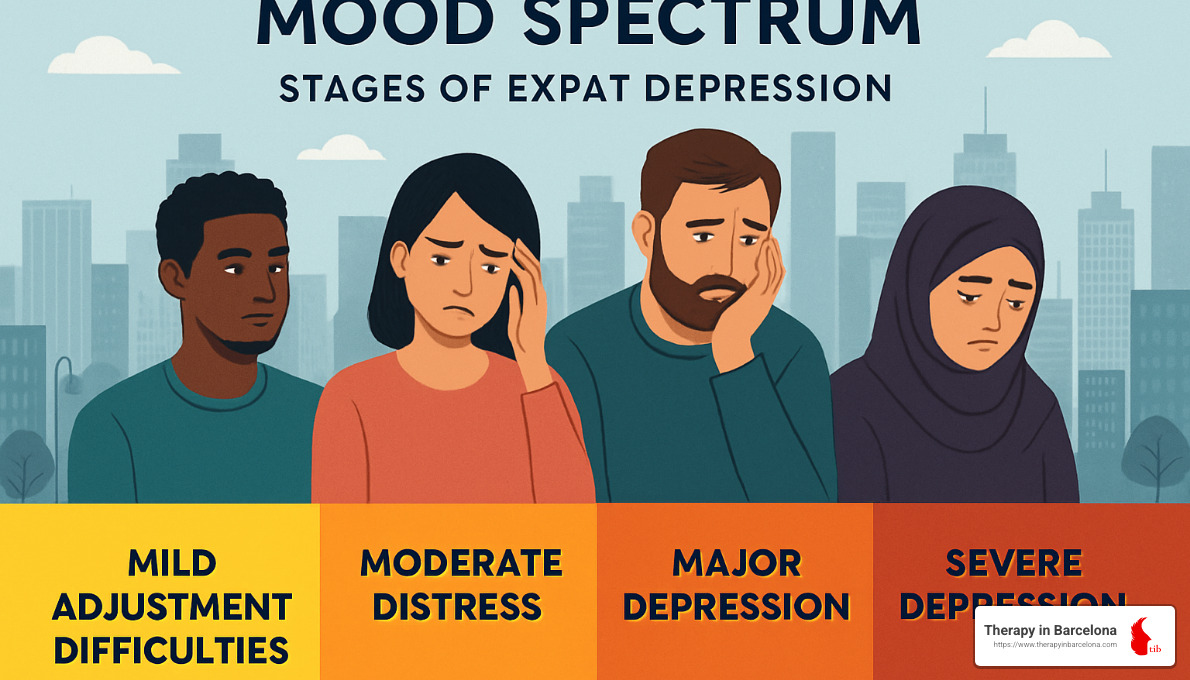
That feeling when you can’t quite put your finger on what’s wrong, but something definitely isn’t right? When living abroad, it can be tricky to distinguish between normal adjustment struggles and something deeper.
Recognizing the signs of expat depression early can make all the difference in your journey abroad. While everyone feels a bit lost when navigating a new culture, certain persistent patterns deserve your attention and possibly expat depression therapy.
Your body and mind will often signal when things aren’t quite right. You might notice a persistent low mood that doesn’t lift even when you’re doing activities you’d normally enjoy. That excitement about exploring your new city? It might be replaced by loss of interest in the very trips that brought you abroad in the first place.
Sleep often tells its own story. Whether you’re lying awake at 3 AM replaying awkward language mistakes or sleeping far more than usual, these sleep disturbances can be telling. Similarly, your relationship with food might change—either losing your appetite or finding yourself reaching for comfort foods more frequently.
“I used to wake up eager to explore Barcelona’s neighborhoods,” one Therapy in Barcelona client shared. “Then suddenly, I could barely drag myself out of bed. Everything felt heavy, including the simplest tasks like grocery shopping in Spanish.”
The mental fog can be equally challenging. Difficulty concentrating might make your work suffer, while feelings of worthlessness or guilt about “not making it work” abroad can create a painful spiral. Many expats also experience social withdrawal, pulling away from both new local connections and loved ones back home.
Pay attention to unexplained physical complaints too—headaches, stomach issues, or general aches that don’t have a clear medical cause. These can sometimes be how our bodies express emotional distress.
Most seriously, if you’re experiencing thoughts of self-harm or suicide, please seek immediate help. Your embassy, local emergency services, or international crisis lines can provide immediate support.
When “Normal Adjustment” Turns Into Depression Red Flags
There’s a well-documented pattern to cultural adjustment that most expats experience—the initial honeymoon phase, followed by crisis, gradual adjustment, and eventually adaptation. But sometimes, this natural cycle gets derailed.
The three-month crash is remarkably common. Research shows many expats experience a significant mood drop around this time, when the novelty has worn off but deeper connections haven’t yet formed. If this persists beyond a few weeks, it may indicate something more serious than adjustment difficulties.
Another red flag is feeling stuck in adaptation. If you’ve been trying genuinely to integrate for six months or more but still feel like an outsider looking in, this prolonged disconnection can be a sign of expat depression.
Perhaps most telling is what many clients describe as a persistent fog—when daily activities feel overwhelming and you can’t seem to “snap out of it” despite trying typical self-help strategies like exercise or socializing.
“At first I thought it was just culture shock,” recalled another Therapy in Barcelona client. “But after six months, I still felt disconnected and hopeless. Even simple things like grocery shopping became overwhelming. That’s when I realized I needed help.”
Understanding these warning signs doesn’t mean you need to steer them alone. In fact, seeking support through expat depression therapy often helps people move through these challenges more quickly, with greater self-awareness and stronger coping skills for future transitions.
Recognizing these patterns isn’t about labeling yourself—it’s about acknowledging when additional support might help you reclaim the vibrant international experience you came for.
Why Moving Abroad Amplifies Vulnerability
Moving abroad creates a perfect storm of risk factors that can trigger depression even in people with no previous history of mental health challenges.

When you leave your home country, you don’t just pack your bags – you uproot your entire support system. This dramatic shift creates unique vulnerabilities that can make expats particularly susceptible to depression.
The daily challenges of navigating a new culture can be emotionally exhausting. Simple tasks like grocery shopping or making a doctor’s appointment suddenly require immense mental energy. This constant cognitive load depletes your psychological resources, leaving you vulnerable when other stressors inevitably arise.
Culture Shock & Identity Stretch
Culture shock isn’t just about amusing misunderstandings or language mix-ups. It’s about fundamental value clashes that can shake your very sense of self.
“I used to be competent and confident,” one Therapy in Barcelona client shared. “Now I feel like a child who can’t even order coffee correctly. It’s exhausting and humiliating.”
When your core values – like directness, privacy, or time management – conflict with local norms, it creates a constant low-level stress that’s hard to escape. Each small cultural misstep creates what psychologists call “micro-failures.” These tiny moments of feeling incompetent accumulate over time, gradually eroding your self-confidence and triggering feelings of inadequacy.
The search for belonging becomes particularly challenging when you’re visibly or culturally different from the local population. This can lead to what researchers call “cultural bereavement” – mourning the loss of your cultural identity while struggling to develop a new one.
Several additional factors can significantly increase your vulnerability to expat depression:
Language barriers often prevent deep connections and authentic self-expression. When you can’t fully articulate your thoughts and feelings, meaningful relationships become harder to form, and isolation can follow.
Social isolation happens on multiple fronts – you’re physically distant from your established support network back home, while simultaneously facing challenges building new connections locally.
Workplace pressure adds another layer of stress, as you’re expected to perform professionally while still adjusting culturally. This expectation to excel despite navigating unfamiliar social norms can be overwhelming.
Trailing spouse syndrome affects partners who’ve given up their own careers or aspirations to follow their partner abroad. Without the structure and social connections of a workplace, accompanying partners often face greater isolation and identity challenges. Research indicates trailing spouses have particularly high rates of depression and anxiety.
Pandemic echoes continue to impact many expats, as COVID-19 severely disrupted the integration process for those who moved during or shortly before the pandemic. The usual avenues for building community were suddenly unavailable, creating deeper isolation.
At Therapy in Barcelona, we’ve seen how these unique stressors can impact even the most resilient internationals. The good news is that with proper support through expat depression therapy, these challenges can be addressed with strategies specifically designed for the expatriate experience.
For more insights on navigating the complexities of international life, our guide on Thriving Abroad: A Guide to Expat Mental Health offers practical strategies for building resilience while living abroad.
Expat Depression Therapy: Your Road Back to Balance
Living abroad can be both thrilling and overwhelming. When the excitement fades and depression sets in, expat depression therapy offers a specialized lifeline that understands the unique intersection of clinical depression and expatriate challenges.
Unlike general therapy, this approach recognizes how cultural adjustment, identity disruption, and mental health intertwine in ways that can be difficult to untangle without specialized support. At Therapy in Barcelona, we combine evidence-based techniques with genuine cultural understanding – our therapists don’t just understand depression clinically, they’ve walked the expatriate path themselves.
“My therapist understood the complexity of my situation immediately,” one client shared with us. “She didn’t just focus on my depression symptoms but helped me steer my cultural identity crisis and build a meaningful life here. It made all the difference.”
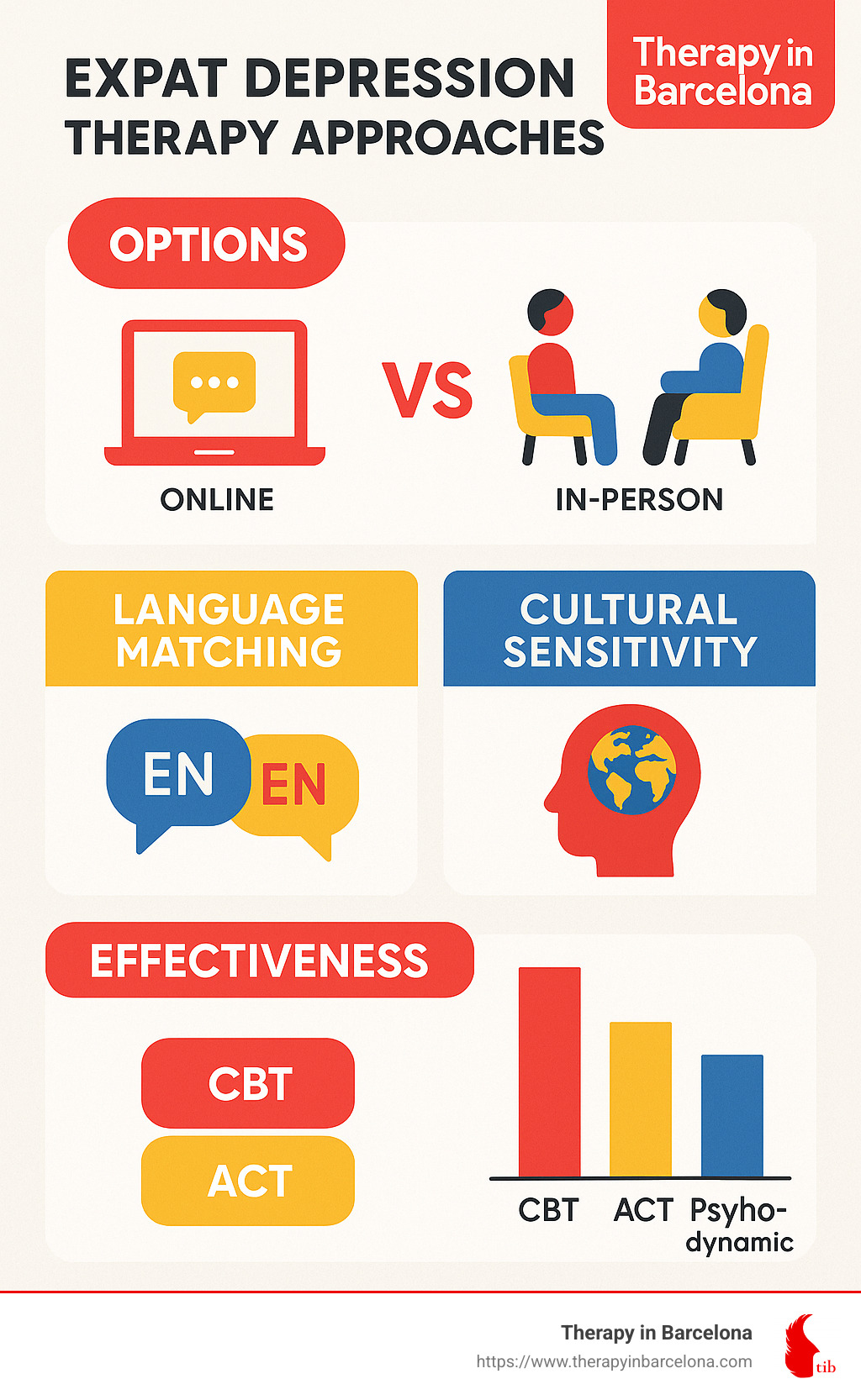
Several therapeutic approaches have proven particularly effective for expats experiencing depression:
Cognitive Behavioral Therapy (CBT) helps you identify and transform negative thought patterns about your expat experience, challenging the “I’ll never belong here” or “I’ve made a terrible mistake” narratives that often accompany expat depression.
Acceptance and Commitment Therapy (ACT) teaches you to accept adjustment difficulties while committing to values-aligned actions, even when cultural barriers make this challenging.
Internal Family Systems (IFS) addresses different “parts” of yourself that may be in conflict during cultural transition – the adventurous part that wanted to move abroad versus the part that longs for familiarity.
Trauma-informed approaches support expats whose experiences include significant loss or trauma, which can be particularly relevant when moves are connected to difficult life circumstances.
How Expat Depression Therapy Works Online
The digital revolution has transformed mental health support for expatriates. No longer limited by geography, you can access specialized care regardless of your location. At Therapy in Barcelona, we offer both in-person sessions at our Barcelona office and secure online therapy for expats worldwide.
Online expat depression therapy provides several distinct advantages:
You can connect with specialists in expatriate mental health even if none exist in your current location. You can receive therapy in your native language, removing the additional cognitive load of expressing complex emotions in a second language. If you relocate again, you maintain continuity of care without starting over with a new therapist. The convenience of online sessions reduces barriers to seeking help, and many expats appreciate the added privacy in communities where mental health stigma exists.
Research confirms what our clients experience – online therapy can be just as effective as in-person treatment for depression, making it a viable option even in remote locations or areas with limited local resources.
Self-Care Alongside Expat Depression Therapy
While professional support forms the cornerstone of recovery, implementing daily self-care strategies amplifies your progress. Consider these practical approaches:
Establish consistent sleep hygiene by maintaining a regular schedule (7-9 hours) and creating a calming bedtime routine. Even when adjusting to a new time zone, prioritize sleep quality.
Engage in regular physical activity – even a 30-minute daily walk through your new neighborhood can boost mood and help you feel more connected to your surroundings.
Pay attention to nutrition, focusing on whole foods while being mindful of how alcohol affects your mood (especially important when living in cultures with different drinking norms).
Practice mindful journaling to document both challenges and positive experiences, creating a balanced perspective on your expatriate journey.
Nurture social connections by maintaining ties with loved ones back home while gradually building new local relationships.
Create predictable routines in your day to reduce the cognitive load that comes with navigating a new culture.
“Therapy gave me tools to manage my depression,” one client reflected, “but establishing daily routines and reconnecting with activities I enjoyed back home helped me feel like myself again.”
By combining professional support with intentional self-care, you create a comprehensive approach to healing that honors both the clinical aspects of depression and the unique challenges of expatriate life.
Comparing Treatment Paths for Expats
Finding the right approach to expat depression therapy can feel overwhelming when you’re already struggling. Let’s explore your options in a way that makes the decision easier.
Different therapeutic approaches offer unique benefits depending on your specific situation and preferences. Some focus on changing thought patterns, while others help you accept difficulties while living according to your values.
“When I started therapy, I was skeptical about which approach would work for my situation,” shares one of our clients. “My therapist explained the options and helped me choose what felt right for me. That personalized guidance made all the difference.”
Research from Harvard Medical School confirms that exercise can be a powerful complement to therapy, acting as a natural mood improver by releasing endorphins and promoting neuroplasticity. This is especially valuable for expats who might feel physically stagnant during major life transitions.
Blended Care Options
Many expats find that a combination of approaches works best for their complex situations. At Therapy in Barcelona, we often recommend these custom combinations:
Therapy + Coaching offers both emotional healing and practical cross-cultural skills development. This pairing works wonderfully for professionals struggling to adapt to new workplace cultures while managing depression symptoms.
Individual + Group Support gives you the best of both worlds – personalized attention for your specific challenges alongside the comfort of connecting with others who truly “get it.” The validation that comes from shared experiences can be incredibly healing when you’re feeling isolated in a new country.
Therapy + Medication might be appropriate for moderate to severe depression. We can help coordinate care between your therapist and a psychiatrist to ensure a comprehensive approach.
“The combination of individual therapy and an expat support group transformed my experience in Barcelona,” one client told us. “My therapist helped me process deeper feelings, while the group reminded me I wasn’t alone in my struggles.”
At Therapy in Barcelona, we don’t believe in one-size-fits-all solutions. We’ll help you determine which approach or combination best suits your unique situation and connect you with additional resources as needed. Our goal is always to provide the most effective support for your specific expat journey.
Finding the Right Therapist Abroad

Finding the right therapist when you’re living abroad can feel like searching for a needle in a haystack. But the connection between you and your therapist is perhaps the most crucial element in successful expat depression therapy. It’s not just about finding someone who speaks your language – it’s about finding someone who truly understands your world.
Therapist Qualifications to Consider
When looking for an expat depression therapy provider, think of it like finding a good travel companion for a difficult journey. You want someone with the right credentials, but also someone who gets you.
Your therapist should have clinical expertise in depression treatment – this is non-negotiable. But equally important is their cultural competence and understanding of expatriate challenges. Ever tried explaining to someone who’s never lived abroad why simple daily tasks can feel overwhelming? A therapist who understands the expat experience won’t need that explained.
Language compatibility is another essential factor. Therapy is deeply personal, and expressing complex emotions is hard enough without struggling to find the right words in a second language. As one client shared with us: “Being able to express myself in English made all the difference. I didn’t have to translate my feelings – I could just feel them.”
While not essential, a therapist with personal experience of expatriate life brings an added dimension of understanding. And of course, proper qualifications ensure you’re working with a qualified professional.
At Therapy in Barcelona, we take matching seriously. We don’t simply assign you to the next available therapist – we carefully consider your specific needs, background, and preferences to find the right fit.
As one client told us: “The matching process made all the difference. My therapist understood both my cultural background and the challenges of living in Spain. I didn’t have to explain basic concepts about being an expat—she got it immediately.”
Platforms & Resources Custom to Expats
Thankfully, there are now several platforms specifically designed to connect expats with appropriate mental health support:
Therapy in Barcelona offers multilingual therapists specializing in expat issues, available both in Barcelona and online. Our team understands the unique challenges of international living because we’ve experienced them ourselves.
It’s Complicated provides a global directory of therapists serving the international community, making it easier to find support no matter where you are.
Expathy has created an app connecting expats with therapists who share cultural backgrounds, helping bridge the cultural understanding gap.
The Truman Group specializes in teletherapy specifically for expatriates, with therapists trained in addressing the unique challenges of international living.
When evaluating these platforms, look beyond convenience. Consider how they vet their therapists, the clarity of information they provide about therapist expertise, their approach to data security, and their experience with expat-specific issues.
Crisis & Emergency Planning
Even with ongoing therapy, having a crisis plan is like packing an emergency kit for your mental health journey. If you’re feeling particularly low or experiencing thoughts of self-harm, knowing exactly what to do can be life-saving.
Make sure you know the local emergency numbers in your country – the equivalent of 911/999 varies from place to place. Keep your embassy contacts handy, as they can often provide emergency resources and support for their citizens abroad.
Familiarize yourself with 24/7 helplines like those offered by the International Association for Suicide Prevention, which provide immediate support regardless of time zone. And know which local hospitals you would go to in an emergency.
At Therapy in Barcelona, we help clients develop personalized crisis plans that account for their specific location and circumstances. We believe that good preparation creates safety nets that catch you when you need them most.
Finding the right expat depression therapy support is a crucial step in your healing journey. While it might take some effort to find the perfect match, the right therapeutic relationship can transform your experience abroad from one of isolation to one of growth and connection.
Building Your Support Network & Lifestyle Resilience
Recovery from expat depression isn’t a solo journey. While expat depression therapy provides essential tools and insights, creating a supportive lifestyle and community around you amplifies your healing and builds long-term resilience.
Think of your support network as scaffolding that holds you up while you rebuild your sense of self in a new country. As one Therapy in Barcelona client beautifully expressed: “Finding my people here changed everything. Having friends who understood both my home culture and my struggles made me feel less alone.”
Connecting with others who “get it” can be transformative. Consider joining expat groups both online and in-person—these communities often become lifelines during difficult transitions. Many of our clients find that volunteering for local causes not only introduces them to like-minded people but also creates a sense of purpose and belonging that counteracts depression.
Taking language classes does double duty: improving your ability to communicate while connecting you with others on the same journey. Even small improvements in language skills can significantly reduce the isolation that fuels expat depression.
Finding your “third places” makes a tremendous difference too. These aren’t home or work, but comfortable spaces where you become a regular—your neighborhood café, a local gym, or community center. Research shows that these familiar spaces create a sense of belonging that’s crucial for mental health.
While building new connections, maintain home connections through regular video calls with friends and family. These touchpoints with your previous life help preserve your sense of continuity and identity during transition.
Lifestyle Factors That Support Recovery
The daily choices you make can either support or undermine your recovery from expat depression. Though drinking is common in expat social circles, limiting alcohol is important since it’s actually a depressant that can worsen mood symptoms. Many clients don’t realize how their increased social drinking abroad impacts their mental health until they cut back.
Sleep prioritization becomes especially important when living abroad. Different noise patterns, unfamiliar light exposure, and jet lag from visits home can all disrupt your sleep cycle, which directly impacts mood regulation. Creating a consistent sleep routine can be a powerful tool in your recovery.
Finding meaningful activities that align with your values provides purpose—a powerful antidote to depression. Whether it’s pursuing a creative passion, exploring your new city, or developing new skills, purpose-driven activities reconnect you with what matters.
Learning to set boundaries is essential during cultural adjustment. It’s okay to decline invitations when you’re feeling overwhelmed, even if you worry about missing opportunities to make friends. Quality connections matter more than quantity.
Remember to celebrate small wins in your cultural adaptation journey. Successfully navigating public transportation, having a brief conversation in the local language, or cooking with unfamiliar ingredients are all achievements worth acknowledging.
Reverse Culture Shock & Repatriation Blues
If returning home is on your horizon, prepare for the often-surprising challenge of repatriation. Many expats experience depression upon returning “home,” finding that either the place has changed—or they have.
As one returning expat shared with us: “Coming home was harder than leaving. I felt like I didn’t fit anywhere anymore. Therapy helped me integrate my experiences abroad into my new life at home.”
Prepare for repatriation by creating meaningful closure in your host country. Farewell rituals and documenting your experience help process the transition. Managing expectations about reintegration is crucial—recognize that it will take time to feel settled again.
Plan for inevitable identity shifts by considering how to integrate your international experience into your life back home. How has living abroad changed your values, perspectives, and goals? Seeking support through repatriation-focused therapy can ease this transition, helping you incorporate your expanded worldview into your next chapter.
At Therapy in Barcelona, we understand that building resilience as an expat requires both professional support and practical lifestyle strategies. Our therapists can help you develop a personalized plan for creating the connections and habits that support your mental health abroad—or as you transition home again.
Frequently Asked Questions about Expat Depression Therapy
Living abroad and struggling with depression brings up a lot of questions. Here are answers to some of the most common concerns we hear from expats considering therapy.
What if I can’t find an English-speaking therapist locally?
This is one of the most common worries we hear, and it’s completely understandable. When you’re already feeling low, the thought of explaining complex emotions in a second language can feel overwhelming.
The good news is that online therapy has transformed access to mental health support for expats. No matter where you’re located—whether it’s a small Spanish coastal town or a busy Asian metropolis—you can connect with an English-speaking therapist who understands both depression and the unique challenges of expatriate life.
At Therapy in Barcelona, we offer secure online sessions to expats worldwide. Many of our clients live nowhere near Barcelona but benefit from working with therapists who understand the expat journey firsthand.
“Finding someone who spoke my language and understood what it meant to be an outsider changed everything,” shared one client who accessed expat depression therapy online from a small town in southern Spain.
Does online expat depression therapy feel as personal as in-person sessions?
It’s natural to wonder if a screen might create a barrier between you and your therapist. Many expats are surprised to find that online therapy can feel just as intimate and effective as sitting in the same room.
Research consistently confirms that the therapeutic alliance—that crucial connection between you and your therapist—develops just as strongly in online formats. What matters most isn’t whether you’re physically in the same space, but finding a therapist who creates a warm, engaging environment and truly understands your experience.
Many of our clients actually prefer online sessions. They appreciate being able to connect from their own comfortable space, eliminating commute time and making therapy more accessible during busy expat lives.
One client reflected: “I was skeptical at first about whether online expat depression therapy would feel ‘real’ enough. But my therapist’s warmth came through the screen just as powerfully, and being able to have sessions from my own living room actually helped me open up more quickly.”
Will international health insurance cover my therapy abroad?
Coverage for mental health services varies significantly depending on your insurance provider and specific plan. Some international health insurance policies include comprehensive mental health coverage, while others offer it as an optional add-on or provide limited coverage.
At Therapy in Barcelona, we can provide the documentation you need to submit reimbursement claims to your insurance company. Many of our clients choose to self-pay for the freedom to select their preferred therapist rather than being limited to in-network providers who might not understand the expat experience.
If insurance coverage is important to you, we recommend:
- Contacting your insurance provider directly to inquire about mental health benefits
- Asking specifically about coverage for online therapy sessions
- Checking if there are any restrictions regarding therapist credentials or location
Even without insurance coverage, many expats find that investing in expat depression therapy is worthwhile for the specialized support it provides during a challenging time. As one client put it: “The cost of therapy seemed high at first, but when I considered what I was spending on temporary fixes that weren’t working—from weekend trips to escape my feelings to self-medication with alcohol—I realized proper support was actually the most economical choice in the long run.”
Investing in your mental health while abroad is just as important as any other aspect of your expatriate experience. You deserve support that truly understands the unique challenges you’re facing.
Conclusion: Your Path Forward Through the Expat Experience
Living abroad opens doors to incredible experiences, but it can also create unique challenges that trigger or deepen depression. If you’re struggling right now, please know that with the right support, you can do more than just recover – you can truly thrive in your international life.
Expat depression therapy offers something special that general therapy often can’t: support that understands both clinical symptoms and the unique challenges of cross-cultural living. Working with therapists who’ve walked in your shoes means gaining tools to steer cultural adjustment, rebuild your sense of identity, and create a life that feels meaningful wherever you are.
At Therapy in Barcelona, we’ve built a team of multilingual, culturally sensitive therapists who understand what you’re going through – many of us are expats ourselves. Whether you prefer in-person sessions in our Barcelona office or online therapy from anywhere in the world, we’re here to provide the personalized support you need.
Reaching out isn’t a sign of weakness – it’s quite the opposite. It shows remarkable courage and self-awareness. As one client beautifully shared with us:
“Therapy didn’t just help me overcome depression—it helped me create a life that feels like home, wherever I am.”
Whether you’re wrestling with recent relocation challenges or long-term expatriate stress, we’re here to help bridge the gap between where you are now and where you want to be. The expat journey can be complicated, but you don’t have to walk it alone.
Ready to take that first step? Contact Therapy in Barcelona for a free, no-obligation discovery call to find the right therapist for your unique expatriate journey.
