


The Hidden Struggles Behind Student Visas
International student mental health challenges are widespread and often overlooked. Recent studies show that international students face unique mental health pressures that differ significantly from those experienced by domestic students.
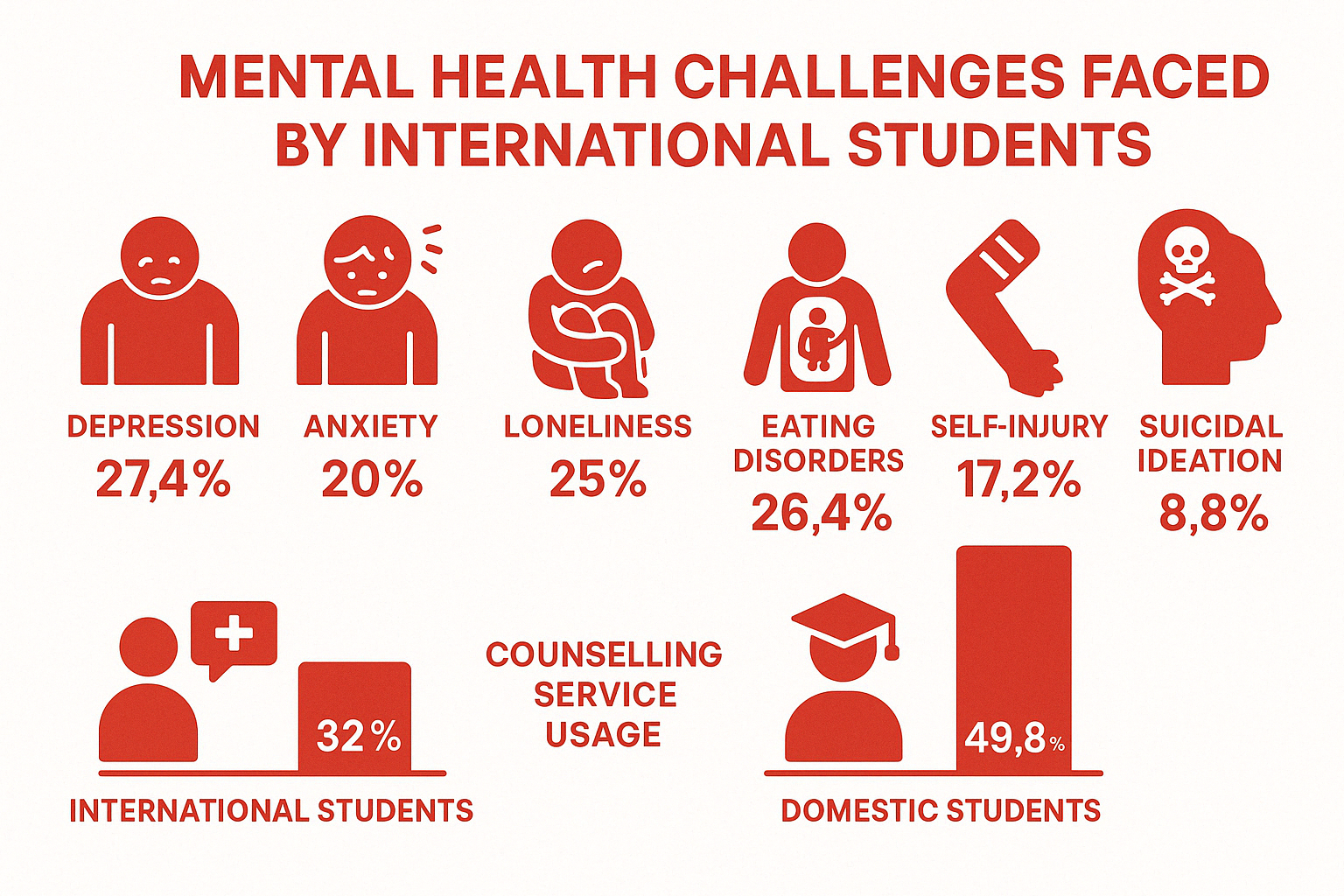
Key International Student Mental Health Statistics:
- 27.4% experience major depressive disorder
- 20% face generalized anxiety disorder
- 36% of international students in the UK report poor mental health
- 25% report feelings of loneliness and isolation
- Only 32% use available counseling services (compared to 49.8% of domestic students)
“I lied in bed for days, did not even go out of my room. But no one knew, or at least, no one asked where I was and how I was doing. I was so invisible. I really wished someone may notice that I was not in the class, or care enough to look for me.” — International student
Studying abroad brings exciting opportunities but also creates a perfect storm of stressors. Moving across continents means leaving behind support networks while facing language barriers, cultural differences, academic pressures, and often financial strain. This combination can trigger or worsen anxiety, depression, and feelings of isolation.
For many international students, these challenges are compounded by the difficulty of navigating unfamiliar mental health systems in a new country. Cultural stigma around seeking help, concerns about confidentiality, and misunderstandings about how counseling works can prevent students from accessing the support they need.
At Therapy in Barcelona, we regularly work with international students struggling to adapt. The good news? With the right support and strategies, it’s possible to move from feeling homesick to hopeful.
As of 2025, these challenges remain highly relevant, emphasizing the ongoing need for targeted support and accessible mental health resources.
Understanding International Student Mental Health Challenges
Living abroad as a student brings incredible opportunities, but it also creates a unique set of mental health challenges that domestic students simply don’t face. International student mental health concerns stem from navigating multiple transitions simultaneously — academic, cultural, social, and linguistic — all while being far from familiar support systems.
The journey of adaptation can be both exhilarating and exhausting. As one Chinese international student shared with researchers: “I felt quite isolated. Like everyone else, I started searching for fellow [students from my country] in my class and on campus. Skepticism had set in. I was not sure if I could adjust in the new environment. By the end of the second month, my enthusiasm had literally died.”
This student’s experience reflects what many internationals feel — an initial excitement that gradually gives way to a more complex emotional landscape.
Common Challenges Faced by International Students:
Most international students find themselves navigating cultural adjustment shock once the honeymoon phase wears off. What initially seemed exciting about your new country suddenly becomes confusing or frustrating. Simple tasks like grocery shopping or understanding classroom norms can become surprisingly draining.
Academic pressure often weighs heavily too. Many international students carry not just their own expectations but those of family members who’ve invested significantly — emotionally and financially — in their education abroad. The pressure to excel can be overwhelming, especially when combined with adapting to different educational systems and expectations.
Even students with strong language skills frequently struggle with language barriers that go beyond the classroom. Academic writing conventions differ across cultures, and the mental fatigue of constantly translating your thoughts can be exhausting. Many students describe the frustration of not being able to express their intelligence or personality fully in their non-native language.
The loss of support networks creates another layer of vulnerability. Being physically distant from family and established friends means navigating stressful situations without your usual emotional anchors. Building new connections takes time, leaving many students feeling isolated during their most challenging adjustment periods.
Financial stress adds another dimension of worry. With international tuition fees typically higher than domestic rates and work restrictions on student visas, many international students face significant financial pressure. This can limit social participation and create constant background anxiety about making ends meet.
Immigration concerns add yet another layer of stress, with academic performance directly linked to visa status. The knowledge that academic struggles could jeopardize your right to remain in the country creates a unique pressure domestic students never experience.
Unfortunately, many international students also face discrimination and microaggressions that can significantly impact their sense of belonging and mental wellbeing. These experiences range from subtle exclusion to more overt forms of prejudice.
What makes these challenges particularly difficult is how they interact and compound each other. Language barriers can exacerbate academic stress, which increases financial worries about maintaining scholarships, creating a cycle of mounting pressure that can feel overwhelming.
The Impact of Language and Communication Barriers on International Student Mental Health
For many international students, language difficulties extend far beyond the classroom, creating what researchers call “second language anxiety” — the persistent stress associated with communicating in a non-native language.
This anxiety can manifest as constant worries: “Did I just make a grammar mistake?” “Did others notice my accent?” “Did they understand what I was trying to say?” These persistent concerns can be mentally exhausting, leading many students to gradually withdraw from social and academic participation.
“I avoided going to counseling because I was afraid I wouldn’t be able to express my feelings properly in English,” explained one Japanese student studying in Barcelona. “I worried that something important would be lost in translation.”
The impact of these communication barriers on mental health can be profound:
Academic performance anxiety develops when students can’t express their knowledge and ideas as clearly as they could in their native language. This can lead to grades that don’t reflect actual understanding, creating frustration and lowered self-esteem.
Social isolation often follows as language barriers make forming connections more challenging. Many international students find themselves gravitating toward peers from similar linguistic backgrounds, which can provide comfort but potentially limit cultural integration.
Perhaps most concerning is the reluctance to seek help when needed. Communication difficulties can prevent students from accessing vital mental health services at times when support is most crucial.
Language is also deeply connected to identity, and struggling with expression can lead to identity challenges and a diminished sense of self. Many students report feeling less competent, funny, or authentic when speaking their non-native language.
At Therapy in Barcelona, we understand these challenges intimately. Our multilingual therapists are experienced in working with clients across language barriers, creating space where communication feels safe rather than stressful.
Cultural Adjustment and Identity Crises in International Students
Cultural adjustment rarely follows a smooth path. Instead, it often includes what researchers call a “crash of expectations” — the jarring realization that life in your host country differs dramatically from what you imagined.
This adjustment process typically moves through several phases:
- The honeymoon phase: Initial excitement and fascination with the new culture
- The crisis phase: Frustration and confusion as cultural differences become apparent
- The recovery phase: Gradual adaptation and development of coping strategies
- The adjustment phase: Finding balance between home and host cultures
During this process, many international students experience profound identity challenges. As you absorb new cultural values and practices, questions naturally arise: “Who am I becoming?” “Am I losing touch with my roots?” “Where do I truly belong?”
These identity questions can be particularly acute for students from collectivist cultures studying in more individualistic societies like Spain or other Western countries. The shift from family-centered decision-making to individual autonomy can create internal conflict and guilt.
Ana, an international student from Colombia studying in Barcelona, described her experience: “I felt caught between two worlds. At home, family always comes first, but here everyone seemed so independent. I started changing how I dressed, how I spoke, even my values were shifting. Sometimes I didn’t recognize myself anymore.”
This phenomenon, sometimes called “cultural bereavement,” involves mourning aspects of identity tied to your home culture while simultaneously trying to construct a new sense of self that integrates elements of both worlds.
The mental health implications can include anxiety about losing cultural connections, depression stemming from identity confusion, and guilt about adopting new cultural practices. Many students describe feeling neither fully “at home” in their host culture nor unchanged enough to fit seamlessly back into their home culture.
At Therapy in Barcelona, we recognize that cultural adjustment isn’t about abandoning one identity for another, but rather developing a more complex, integrated sense of self that honors multiple cultural influences. This understanding forms the foundation of our approach to supporting international student mental health.
For more information on cultural adjustment phases and coping strategies, you can visit the University of the People’s guide on culture shock.
Coping with Isolation and Loneliness
That feeling of being surrounded by people yet completely alone is one of the most painful paradoxes of international student life. It’s also surprisingly common – a Pennsylvania State University study identified loneliness as the fourth most common psychological stressor among international students, with more than 25% reporting such feelings.

When we talk with international students at Therapy in Barcelona, we often hear about different layers of isolation they experience:
There’s the obvious physical distance from family and friends back home – those people who truly “get you” without explanation. Then there’s the more subtle cultural distance that emerges when jokes fall flat, references aren’t understood, or values clash in unexpected ways. Many students also struggle with linguistic isolation, where even those with strong language skills find themselves unable to express nuanced thoughts or emotions with the same richness they could in their native tongue. Finally, there’s the profound social disconnection that comes from watching others effortlessly maintain friendships while your own attempts to connect seem to hit invisible barriers.
Henry, an 18-year-old international freshman, shared his experience with researchers in a way that resonates with many of our clients: “I was doing well academically, but I felt completely alone. Everyone seemed to have their friend groups already formed. I would go days without having a real conversation with anyone.”
This type of persistent isolation can seriously impact international student mental health. Research consistently shows that prolonged loneliness doesn’t just feel bad – it’s linked to higher rates of depression, anxiety, and even physical health problems like compromised immunity and disrupted sleep.
Practical Strategies for Building Connections:
At Therapy in Barcelona, we’ve found several approaches particularly helpful for international students struggling with isolation:
Join international student associations where you’ll immediately find others who understand the unique challenges you’re facing. These groups often become a first social home where you can be yourself without explanation.
Participate in language exchanges which provide structured interaction with locals in a setting where the awkwardness of language learning is expected and acceptd by everyone. These often lead to more natural friendships over time.
Volunteering can be transformative – contributing to community causes not only connects you with like-minded people but also helps counter feelings of purposelessness that sometimes accompany loneliness.
While nothing replaces in-person connection, digital communities specific to your interests or background can provide valuable support during adjustment periods. Just be mindful that these don’t become a substitute for local relationships.
One strategy we’ve seen work wonderfully is establishing routines at local spots. Becoming a regular at a café, gym, or library creates opportunities for those small, repeated interactions that gradually build familiarity and comfort. The barista who remembers your order might become the friend who introduces you to their social circle.
It’s also important to be patient with friendship development. Many international students expect immediate deep connections similar to those they left behind, not realizing that meaningful relationships typically develop more slowly in any culture. Focus on gradual relationship building rather than rushing intimacy.
Finally, don’t underestimate the importance of maintaining connections from home. Regular video calls with family and friends can provide emotional stability while you build your new social network. These connections aren’t holding you back – they’re giving you the security to reach out.
At Therapy in Barcelona, we’ve seen how isolation can compound other adjustment challenges for international students. Our therapists can help you develop personalized strategies for building meaningful connections while honoring your need to adjust at your own pace – because everyone’s journey from feeling like an outsider to finding belonging is uniquely their own.
Managing Financial Stress and Its Impact on Mental Health
Money worries can feel overwhelming when you’re studying abroad. A recent study at a Minnesota university revealed a sobering reality: almost 60% of international students experienced financial stress in the past year alone. This isn’t surprising when you consider the unique financial pressures these students face.
For many international students, financial challenges create a perfect storm of stress. Higher tuition fees mean international students often pay two to three times what domestic students pay. Meanwhile, strict visa restrictions limit how much they can work, creating a frustrating catch-22 situation. One week, your home currency might stretch further; the next, exchange rate fluctuations could suddenly increase your expenses by 10% or more.
“I was constantly calculating every euro I spent,” shares Marco, an international student from Brazil studying in Barcelona. “I couldn’t enjoy simple things like going for coffee with classmates because I was always worried about my bank balance. It made me feel like an outsider.”
Adding to this pressure, many scholarship opportunities explicitly exclude international students, and unexpected expenses – from emergency medical care to urgent travel home – can quickly deplete carefully managed savings. All while many students carry the weight of family expectations, knowing their families have made significant sacrifices to fund their education abroad.
The impact on international student mental health can be profound and far-reaching. Beyond the obvious anxiety and persistent stress, financial worries often lead to disrupted sleep patterns and difficulty concentrating on studies – the very thing you’re there to focus on. Many students describe feelings of shame or inadequacy when unable to participate in social activities due to cost constraints, further deepening isolation at a time when building connections is crucial.
Most concerning of all, financial stress often prevents students from seeking mental health support when they need it most, creating a dangerous cycle where problems compound without intervention.
Practical Financial Management Strategies
If you’re struggling financially as an international student, know that there are concrete steps you can take to regain some control.
Start by creating a realistic budget that works for your actual life. Track your spending for a full month to understand your patterns, then develop a plan that prioritizes necessities while still allowing small pleasures – complete deprivation rarely works long-term.
Many students overlook valuable resources right on campus. Research all available support at your university – many institutions offer emergency funds, food pantries, and specific financial assistance programs for international students facing hardship. The international student office is often your best starting point.
Housing represents one of the biggest expenses for most students. Consider cooperative living arrangements where you can share costs with others while potentially reducing isolation. Similarly, many universities offer campus employment specifically designed to work within international student visa restrictions.
Being transparent with friends about financial limitations can feel vulnerable but often leads to surprising support. Most people understand budget constraints and will happily suggest free or low-cost activities instead.
At Therapy in Barcelona, we regularly work with international students navigating financial stress alongside other adjustment challenges. Our therapists can help you develop healthy coping mechanisms for financial anxiety while connecting you with practical resources. We understand that financial concerns don’t exist in isolation – they affect every aspect of your experience abroad, from academic performance to social connections.
Seeking help early, before financial problems become overwhelming, gives you the most options. If you’re struggling, contact your university’s international student office as soon as possible – they’ve helped countless students in similar situations and can often offer solutions you might not have considered.
Strategies for Supporting Your Mental Health as an International Student
Nurturing your mental health as an international student requires intentional care and awareness. The journey of studying abroad comes with unique challenges, but with the right approaches, you can build resilience and thrive in your new environment.
When we work with international students at Therapy in Barcelona, we often emphasize that self-care isn’t just a luxury—it’s essential for academic success and personal wellbeing. Let’s explore some practical strategies that can make a real difference in your experience abroad.
Self-Care Fundamentals:
Creating stability amidst change is crucial when you’re studying in a new country. Establishing simple daily routines can provide much-needed structure when everything else feels unfamiliar. Try to maintain consistent sleep and wake times, eat regular meals, and create dedicated blocks for both studying and relaxation. These predictable patterns become anchors that help you steer the unpredictable aspects of international student life.
Physical activity is one of your most powerful allies against stress. You don’t need an elaborate gym routine—a daily walk through a local park, joining a university sports club, or even following free online workout videos in your room can make a tremendous difference. Many of my international student clients find that activities like social sports or dance classes serve double duty, providing both exercise and valuable social connections.
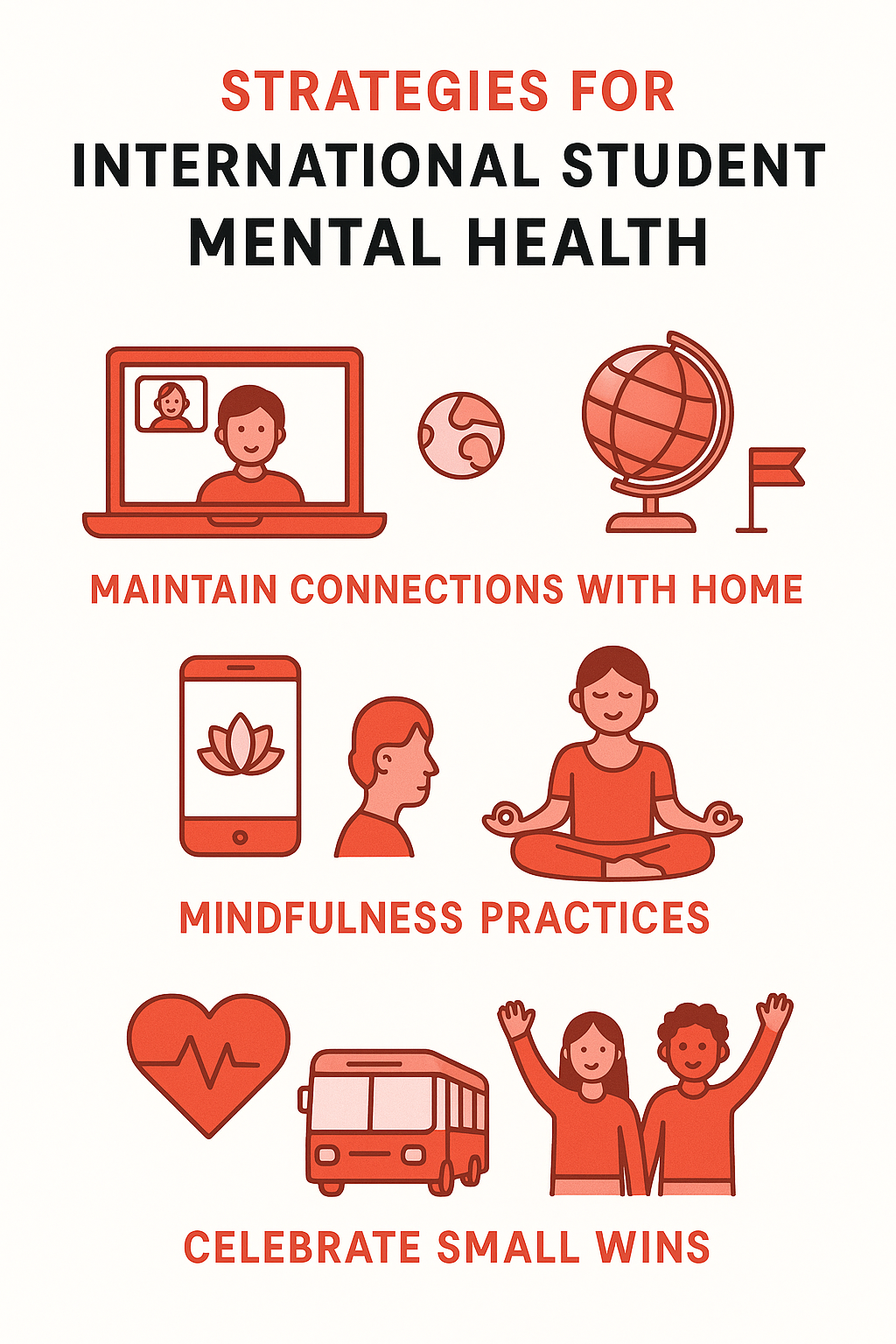
While building a life in your new country, maintaining connections with home provides emotional continuity that’s incredibly important. Schedule regular video calls with family and friends, share your experiences through photos or journals, and find ways to celebrate important cultural holidays, even if in a modified way. One student I worked with created a small altar with meaningful items from home in her Barcelona apartment—a simple yet powerful reminder of her roots.
Mindfulness practices have shown remarkable effectiveness for managing the unique stressors international students face. Apps like Headspace or Calm offer guided meditations specifically designed for students. Even simple breathing exercises between classes can help ground you during overwhelming moments. One international student I counseled found that mindful walking between campus buildings helped him transition between his academic and social worlds.
“Self-care isn’t selfish—it’s essential,” explains Leigh Matthews, Australian Psychologist and founder of Therapy in Barcelona. “As an expat myself, I understand how easy it is to neglect your own wellbeing when navigating a new culture. Small, consistent self-care practices can make a tremendous difference in your ability to thrive abroad.”
Learning to monitor your mental health by recognizing early warning signs is a valuable skill. Pay attention to changes in your sleep patterns, loss of interest in activities you usually enjoy, difficulty concentrating, persistent feelings of sadness or anxiety, withdrawal from social interactions, or changes in appetite. These might indicate it’s time to reach out for additional support.
Don’t forget to celebrate your small wins. Successfully navigating public transportation, contributing to a class discussion, making a new friend, cooking a meal from your home country, or noticing improvement in your language skills—these achievements deserve recognition. Each represents a step in your adaptation journey.
Building Resilience:
Resilience—your ability to adapt and bounce back from challenges—becomes particularly important when you’re facing multiple transitions simultaneously as an international student.
Adopting a growth mindset transforms how you view difficulties. Rather than seeing challenges as evidence of your limitations, you can view them as opportunities to develop new skills and strengths. Each obstacle you overcome—whether navigating a foreign bureaucracy or mastering academic writing in another language—builds valuable capabilities that will serve you throughout life.
Self-compassion is often overlooked but critically important. The tendency to be harshly self-critical when struggling can compound your stress. Try treating yourself with the same kindness you would offer a good friend facing similar challenges. Adjustment takes time for everyone, and struggling doesn’t mean you’re failing—it means you’re growing.
Creating a diverse support network provides multiple perspectives and resources. Include fellow international students who understand your specific challenges, domestic students who can help you steer local systems, faculty mentors who can provide academic guidance, and community members who can offer broader cultural context. This varied network creates a safety net during difficult times.
Deeper cultural engagement can significantly reduce misunderstandings and increase your sense of belonging. Moving beyond tourist experiences to understand the values and social norms of your host culture helps bridge the gap between feeling like an outsider and developing a sense of connection. Many international students find that learning about the history and traditions of their host country provides context that makes daily interactions less confusing.
Maintaining perspective about your journey is essential. Adjustment isn’t linear—you’ll have good days and challenging ones. What matters is the overall trajectory, not any single difficult day or week. The skills you’re developing through this international experience are uniquely valuable, both personally and professionally.
At Therapy in Barcelona, we’ve helped many international students develop personalized strategies for maintaining mental wellbeing while studying abroad. Our therapists understand the unique challenges you face and can provide culturally sensitive support as you steer this important life transition.
Accessing Mental Health Services Abroad
Navigating mental health services in a foreign country can feel like trying to find your way through a maze without a map. But take heart – understanding the common barriers and how to overcome them can make the process far more manageable.
When I speak with international students at Therapy in Barcelona, I often hear the same concerns about seeking help. A 26-year-old international student from the UK studying in Barcelona, shared her initial hesitation:
“I worried that therapy would be too expensive, that my Spanish wasn’t good enough, and honestly, that seeking help meant I was somehow failing at my study abroad experience. Finding an English-speaking therapist who understood expat challenges made all the difference.”
Common Barriers to Accessing Mental Health Support:
The journey to finding support often begins with overcoming several problems. Language concerns frequently top the list, as many international students worry they won’t be able to express complex emotions in a non-native language. This concern is completely valid – after all, discussing your innermost thoughts is challenging enough without adding a language barrier.
Cultural stigma creates another significant obstacle. In many cultures worldwide, seeking mental health support carries substantial stigma, creating internal resistance even when you know you need help. This is compounded by a general lack of information about available services – when you’re new to a country, you simply don’t know what resources exist or how to access them.
Many international students also carry misconceptions about therapy, especially if they’ve never experienced counseling before. Some worry it will be cold and clinical, or that they’ll be judged for their struggles. Financial concerns often prevent students from seeking support, even when affordable options exist, and confidentiality worries can make students fear that seeking help might affect their academic standing or visa status.
Navigating Mental Health Services:
Starting your search for support doesn’t have to be overwhelming. Here are some pathways that have helped other international students:
Start with your university. Most universities offer counseling services specifically for students, often at reduced or no cost. Check if your university offers counseling in your preferred language, ask about the number of sessions available, and inquire about their confidentiality policies. University counseling centers are usually well-versed in the challenges facing international students.
Understand your insurance coverage. If you have student health insurance, take time to review what mental health services are covered, check if there are preferred providers, and understand any copayments or limitations. Many insurance plans offer more mental health coverage than students realize.
Consider telehealth options. The growth of online therapy has been a game-changer for international students. These platforms often offer services in your native language, with flexible scheduling and sometimes lower costs than in-person therapy. This option can be particularly helpful if you’re struggling to find support in your specific language.
Look for culturally sensitive providers. The most effective support comes from therapists who understand your unique challenges. Seek therapists who have experience working with international students, understand cultural differences in expressing and addressing mental health concerns, and ideally have lived abroad themselves. A therapist who recognizes the nuances of your cultural background can make all the difference.
Explore community resources. Many communities offer support groups specifically for international students or expats, sliding scale therapy options, and crisis services accessible to non-citizens. These can provide both professional support and connections with others navigating similar challenges.
At Therapy in Barcelona, we understand these barriers intimately. Our team includes therapists who are expats themselves, offering support in multiple languages and with a deep understanding of the challenges of living abroad. We provide both in-person and online therapy options, making our services accessible to international students throughout Spain and beyond.
Seeking support isn’t a sign of weakness but rather a demonstration of courage and self-awareness. The path to finding the right mental health support might take some navigation, but the right help can transform your study abroad experience from one of struggle to one of growth and fulfillment.
The Role of Universities in Supporting International Student Mental Health
Universities play a crucial role in supporting international student mental health, though the quality and accessibility of services vary significantly between institutions. When these support systems work well, they can make all the difference in an international student’s experience abroad.
Effective University Support Initiatives
The most effective universities recognize that international student support begins before arrival and continues throughout the student’s academic journey. Culturally sensitive orientation programs that go beyond academic expectations make a tremendous difference. These comprehensive programs address mental health resources and how to access them, prepare students for cultural adjustment challenges, offer strategies for building social connections, and provide practical life skills for navigating the new environment.
Peer mentoring programs have proven particularly effective for international students. Being paired with more experienced students – both international and domestic – can reduce that initial feeling of isolation that so many students describe. These mentoring relationships provide practical guidance from those who truly understand the challenges, create immediate social connections, and offer informal emotional support during difficult transitions.
“Universities often underestimate the importance of faculty involvement in supporting international student mental health,” notes Leigh Matthews, founder of Therapy in Barcelona. “As an Australian psychologist who moved to Barcelona in 2011, I’ve seen how a supportive professor can make all the difference for a student struggling with cultural adjustment.”
Indeed, faculty involvement creates another crucial layer of support. Professors who make themselves accessible to international students, understand cultural differences in classroom participation, provide clear expectations and feedback, and connect struggling students with appropriate resources can profoundly impact student wellbeing.
The most forward-thinking universities employ dedicated international student counselors with specialized training. These professionals bring cultural competency training, understanding of immigration stressors, awareness of unique academic pressures, and experience with cultural adjustment issues to their work with international students.
Rather than waiting for students to reach a crisis point, universities with strong support systems engage in proactive outreach. They conduct regular wellbeing check-ins, offer workshops on stress management and cultural adjustment, train faculty to recognize warning signs, and work to destigmatize help-seeking through campus-wide campaigns.
What to Look For in University Support Services
If you’re evaluating a university’s support services as an international student, several key factors are worth considering. Look for the availability of multilingual counselors or translation services – being able to express complex emotions in your native language can make therapy much more effective.
Check the hours of operation to ensure they accommodate different schedules, as international students often juggle unique time commitments. Investigate what crisis support options exist outside regular business hours, when many international students find themselves most in need.
Understanding the confidentiality policies and how they’re communicated is crucial, as many international students worry about how seeking help might affect their visa status. Look for integration between international student services and counseling centers, which indicates a holistic approach to support.
The best university support systems provide cultural competency training for all student support staff and offer prevention programs focused on wellbeing, not just crisis intervention.
If your university’s support services aren’t meeting your needs, don’t hesitate to look beyond campus for additional resources. Many communities have specialized mental health providers experienced in working with international populations, like Therapy in Barcelona, which offers support specifically designed for the international community.
Advocating for your needs is not a sign of weakness but of strength. Your mental health journey as an international student matters, and finding the right support – whether through your university or external resources – can transform your experience abroad.
Finding Professional Support Wherever You Are
When self-help strategies aren’t enough, professional support can make a tremendous difference in your international student mental health. Finding the right help doesn’t have to be overwhelming – here’s how to steer your options.
University counseling services are often your most accessible starting point. They typically offer free or low-cost sessions with counselors who understand academic pressures and the unique challenges international students face. While these services usually provide short-term support (typically 6-10 sessions), they can be invaluable during difficult transitions or acute stress periods.
“Many international students don’t realize their universities offer specialized support,” explains Leigh Matthews, Australian Psychologist and founder of Therapy in Barcelona. “As an expat myself who moved to Barcelona in 2011, I understand how challenging it can be to reach out for help in a new country. But that first step can truly transform your experience abroad.”
If you need more flexibility or longer-term support, private therapy might be worth considering. While potentially more expensive, private therapists can offer more specialized expertise, particularly in areas like cultural adjustment and identity development. Many private practitioners offer sliding scale fees or student discounts – don’t hesitate to ask about payment options.
Group therapy or support groups provide another valuable avenue for support. These settings not only connect you with professional guidance but also with peers facing similar challenges. There’s something uniquely comforting about realizing you’re not alone in your struggles, and hearing how others steer similar situations can provide fresh perspectives on your own challenges.
For some students, medication might be part of a comprehensive approach to mental wellness. If you’re experiencing persistent symptoms that significantly impact your daily functioning, consulting with a psychiatrist can help determine if medication might be beneficial alongside therapy. University health services can typically provide referrals to psychiatrists familiar with student needs.
Finding Culturally Sensitive Support
When seeking a therapist as an international student, cultural understanding matters tremendously. A therapist who has experience with your cultural background – or at least with supporting international students generally – will better understand the nuances of your experience without requiring extensive explanation.
Language access is another crucial consideration. Being able to express yourself in your preferred language, especially when discussing complex emotions, can make therapy significantly more effective. If therapy in your native language isn’t available, ask if translation services might be an option.
Different cultures have different therapy traditions, and approaches vary widely between practitioners. Some therapists take a more directive approach, while others are more collaborative. During initial consultations, don’t hesitate to ask about a therapist’s approach to see if it aligns with your comfort level and expectations.
At Therapy in Barcelona, we specialize in supporting international students and the broader expat community. Our team includes therapists who are themselves expats, bringing understanding of the challenges you’re facing. We offer therapy in multiple languages, both in-person in Barcelona and online for those throughout Spain and internationally.
Our approach emphasizes cultural sensitivity and personalized therapist matching. We understand that seeking help in a foreign country can feel daunting, which is why we’ve created a straightforward process to connect you with the right support for your specific situation.
“I initially hesitated to seek therapy because I worried no one would understand my specific cultural context,” shares one international student from Japan. “Finding a therapist who understood the unique pressures of being an international student – the family expectations, the cultural adjustment, the identity questions – made all the difference.”
If you’re struggling with adjustment, academic pressure, isolation, or any other aspect of your international student experience, reaching out for professional support can be a transformative step toward not just surviving but thriving during your time abroad.
Frequently Asked Questions about International Student Mental Health
How does isolation affect international students’ mental health?
Isolation can cast a long shadow over international student mental health. When we look at the research, it’s striking that loneliness ranks as the fourth most common psychological stressor among international students, with more than a quarter reporting such feelings.
This isolation isn’t just unpleasant – it can have profound effects on wellbeing. Students who experience prolonged loneliness often find themselves sliding toward depression and anxiety. Their academic performance typically suffers as motivation wanes and concentration becomes difficult. Even physical health takes a hit, with isolation affecting everything from sleep quality to immune function.
Perhaps most concerning for international students specifically is how isolation creates a negative cycle. Without social connections, cultural adaptation becomes increasingly difficult, which in turn intensifies feelings of homesickness and disconnection.
“I remember one student who spent three weeks barely leaving his apartment,” shares Leigh Matthews of Therapy in Barcelona. “He described feeling ‘invisible’ on campus – attending classes but never truly being seen. Breaking this isolation became the first crucial step in rebuilding his mental wellbeing.”
The good news is that even small steps can make a difference. Becoming a regular at a local café, joining a student organization related to your interests, or participating in language exchanges can all create those initial connections that gradually reduce isolation and build a sense of belonging.
What strategies can help international students cope with stress?
Managing stress effectively as an international student requires a multi-faceted approach that addresses both the practical challenges of studying abroad and the emotional impact of cultural transition.
Establishing clear routines provides a crucial foundation. When everything feels new and unpredictable, having structured days creates islands of stability. This might mean setting consistent study times, regular meals, and dedicated relaxation periods.
Physical wellbeing forms the cornerstone of stress resilience. Regular exercise – even just a 20-minute walk between classes – can significantly reduce stress hormones. Prioritizing sleep and nutritious eating further strengthens your ability to handle pressure.
Many international students find mindfulness techniques particularly helpful. Simple breathing exercises can be practiced anywhere – before an exam, during a moment of homesickness, or when feeling overwhelmed by language challenges.
“What surprises many of my international student clients,” explains Leigh Matthews, “is how effective setting realistic expectations can be for stress management. Adjusting your academic and social expectations to account for the additional challenges of studying in a new culture isn’t lowering your standards – it’s acknowledging reality.”
Celebrating small victories also plays a vital role in building resilience. Acknowledging your achievements – navigating public transportation successfully, contributing to a class discussion in your second language, or cooking a meal from your home country with local ingredients – builds confidence that transfers to bigger challenges.
Perhaps most importantly, seeking professional support early can prevent stress from snowballing. Don’t wait until you’re overwhelmed before reaching out for help – proactive support is always more effective than crisis intervention.
How can universities better support international student mental health?
Universities play a crucial role in supporting international student mental health, though their approaches vary widely in effectiveness.
The most supportive institutions recognize that international student wellbeing begins with culturally sensitive orientation programs that go far beyond academic information. These comprehensive orientations address mental health resources, cultural adjustment challenges, and practical strategies for building social connections in a new environment.
Peer mentoring programs have proven particularly effective, connecting new international students with experienced students who understand the challenges firsthand. These relationships provide both practical guidance and emotional support during those critical first months.
“Universities often underestimate how important faculty involvement is in supporting international student wellbeing,” notes Leigh Matthews. “A professor who understands cultural differences in classroom participation and provides clear expectations can make an enormous difference for students navigating academic culture shock.”
The most effective universities also take a proactive approach to outreach. Rather than waiting for students to seek help (which many international students are reluctant to do due to cultural stigma or language barriers), they actively check in and offer support through various touchpoints throughout the academic year.
Creating inclusive campus environments requires ongoing effort beyond orientation week. This means addressing discrimination, providing spaces for cultural celebration, and ensuring that international student perspectives are represented in campus decision-making.
Universities must also recognize that practical concerns significantly impact mental health. Issues like housing insecurity, financial stress, and visa anxieties can’t be separated from emotional wellbeing – addressing these practical challenges should be part of any comprehensive support strategy.
The best university approaches understand that international student mental health support must be integrated across campus, not isolated within counseling centers alone. When faculty, residential staff, academic advisors, and student organizations all play a role in supporting international student wellbeing, the safety net becomes much stronger.
Conclusion
The journey from homesick to hopeful as an international student isn’t a straight path. There are ups and downs, challenges and victories, moments of doubt and breakthrough. But with the right support and strategies, you can do more than just survive your time abroad—you can truly thrive during what may become one of the most transformative experiences of your life.
The challenges you face as an international student are real and valid. Whether you’re struggling with language barriers that make it difficult to express yourself, navigating cultural differences that leave you feeling like an outsider, managing academic pressures while far from your support system, or stretching your budget to make ends meet—these are all normal parts of the international student experience.
Struggling doesn’t mean you’re failing. It means you’re navigating one of life’s most complex transitions with courage and determination.
Throughout this guide, we’ve explored the many dimensions of international student mental health. Now, as you continue your own journey, remember these essential takeaways:
Be proactive about building connections. Reach out to fellow international students who understand your experience, but also make efforts to connect with the broader community. Each new relationship creates another anchor in your new home.
Develop consistent self-care practices that honor both your schedule and your cultural background. The practices that sustained you at home may need adaptation abroad, but their importance remains unchanged.
Learn to recognize the early warning signs that you might need additional support. Changes in sleep patterns, persistent sadness, or withdrawal from activities you usually enjoy are signals worth paying attention to.
Familiarize yourself with available resources both on and off campus. Knowing where to turn before you need help makes reaching out much easier when challenges arise.
Don’t hesitate to seek professional help when self-help strategies aren’t enough. Reaching out isn’t a sign of weakness—it’s a demonstration of wisdom and self-awareness.
Practice self-compassion throughout your adjustment process. You wouldn’t judge a friend harshly for struggling with such a major life transition; extend that same kindness to yourself.
“From homesick to hopeful, your mental health journey as an international student is one of courage and resilience. Each step you take to support your wellbeing builds not just academic success but life skills that will serve you long after graduation.”
At Therapy in Barcelona, we’re deeply committed to supporting international students through the unique challenges of studying abroad. Our team of multilingual therapists—many of whom have been international students themselves—offers culturally sensitive support both in-person and online.
If you’re struggling with any aspect of your international student experience, reaching out for help is a sign of strength, not weakness. Taking that first step toward support can transform your study abroad experience from one of struggle to one of growth and fulfillment.
Remember: You don’t have to steer this journey alone. With the right support, you can move from feeling homesick to feeling hopeful about both your present experience and your future possibilities.
