


Why Spain Captures the Hearts of Internationals (And What They Don’t Tell You)

Expats living in Spain report high life satisfaction, drawn by the Mediterranean climate, affordable living, and a culture that values connection. But behind the sunny photos lies a reality of bureaucratic problems, language barriers, and the loneliness that can come with starting over in a new country.
Quick Answer: Expat Life in Spain
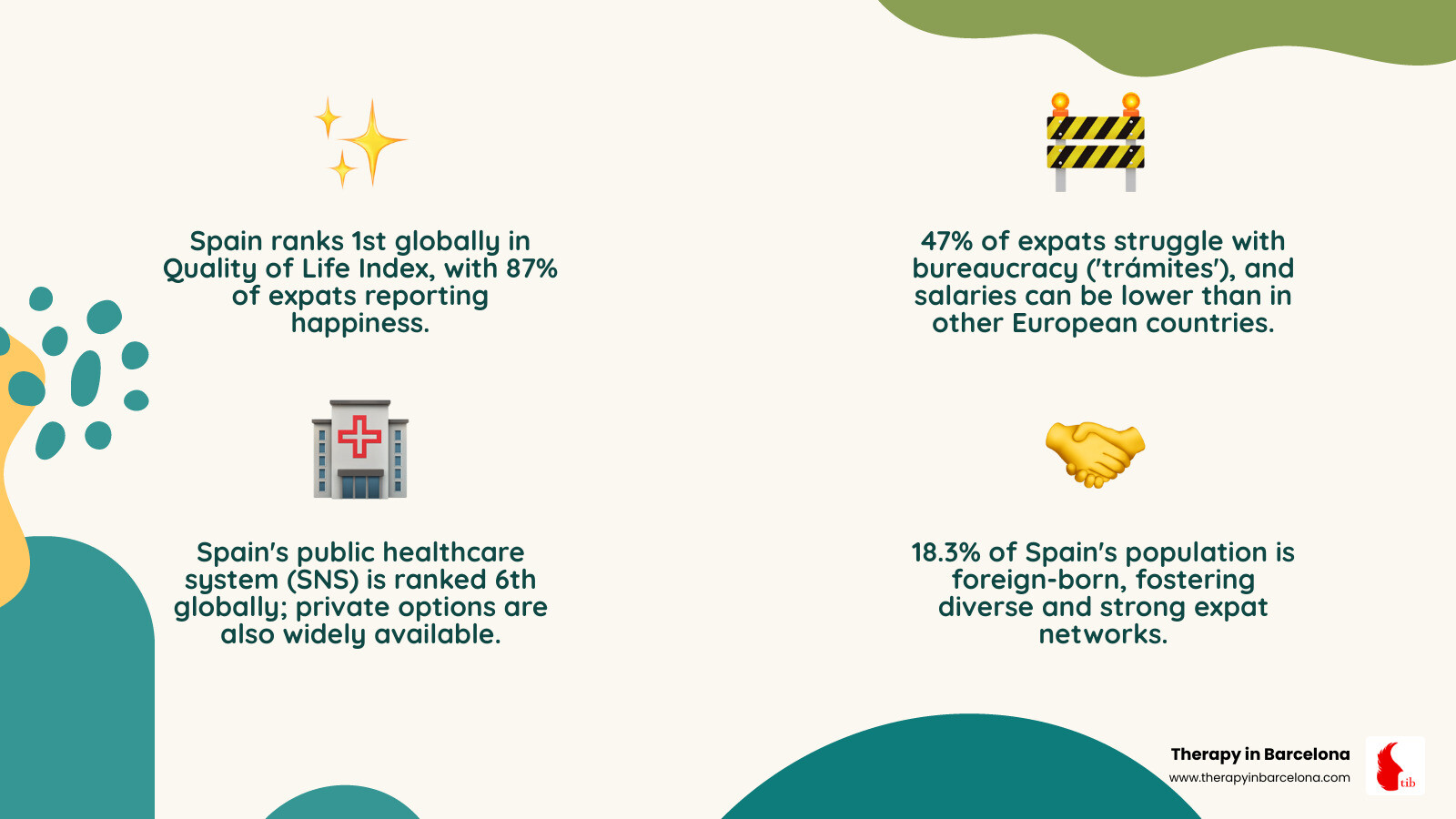
- Quality of Life: Spain is a top country for quality of life, with 87% of expats reporting happiness (vs 72% globally).
- Top Destinations: Madrid, Barcelona, Valencia, Málaga, and Alicante are major hubs for internationals.
- Main Challenges: Bureaucracy (47% struggle), lower salaries than other EU countries, and dual US-Spanish tax rules.
- Healthcare: Spain has an excellent public system (SNS), ranked 6th globally, with private options also available.
- Community: With 18.3% of the population foreign-born, there are strong expat networks but also integration challenges.
- Visas: Common routes for Americans include the non-lucrative visa, Digital Nomad visa, and Golden Visa (ending April 2025).
For many, Spain is a choice to slow down and live more fully. Over 2.5 million foreign-born residents have made this choice. But relocation guides often omit the frustration of administrative delays, the isolation of not speaking fluent Spanish, or the identity crisis of being between two cultures. Take Emily, a 34-year-old from the UK who moved to Barcelona. She is fictional, but her story of finding unexpected loneliness mirrors the experiences of many expats.
This guide covers the practical and psychological aspects of expat life, from healthcare to managing the emotional journey of building a life between two worlds, whether you’re in Valencia, Málaga, or Madrid.
Why Spain? The Allure and the Reality of the Expat Dream
For expats living in Spain, the country offers a different way of life, one that prioritises well-being over work. Spain consistently ranks highly for quality of life, as noted by USNews, inviting people to accept a slower, more intentional pace. Imagine the warm Mediterranean climate in Alicante or Málaga, the history of Seville and Barcelona, and the joy of communal tapas.
But this dream has its practical side. Expats often face a complex bureaucracy, a significant language barrier outside of tourist areas, and a job market with lower salaries and higher unemployment than they may be used to.

The Pros: A Higher Quality of Life
Spain excels in quality of life due to its excellent healthcare, affordable cost of living, and pleasant environment. Expats are drawn to a lifestyle that champions a better work-life balance, strong social connections, and personal security. Spain scores well on the OECD’s Better Life Index for work-life balance, with an average workweek of around 36.3 hours. This focus on life outside of work is tangible.
- Social Connections: Spaniards are famously warm, and 72% of expats report happiness with their social life.
- Safety: Spain has high rankings for personal security, with a lower crime rate contributing to a sense of well-being.
- Healthy Lifestyle: The Mediterranean diet and abundant opportunities for outdoor activities are major benefits, with 91% of expats loving the options.
- Welcoming Culture: 78% of expats find it easy to adapt, and 77% feel genuinely welcomed.
The Cons: Navigating the Practical Problems
While the lifestyle is appealing, expats living in Spain must prepare for some practical frustrations.
First is the infamous bureaucracy. The ‘trámites’ for getting an NIE (Foreigner Identification Number) or residency can be incredibly slow. Nearly half of all expats (47%) struggle with it, so patience is essential.
The language barrier is another hurdle. While English is spoken in hubs like Madrid and Barcelona, it’s not universal. Daily errands and official matters can be challenging without Spanish, and 36% of expats find it difficult to live here without speaking the language.
The job market can also be tough. Spain has a historically high unemployment rate (projected at 11.8% in early 2025, per the National Statistics Institute (INE)). This makes finding a job competitive, and salaries are generally lower than in other Western countries. Finally, while Spain is a stable democracy, regional independence movements can be a background concern for long-term residents.
The First Steps: Visas, Residency, and Finding Your Home
Moving to Spain is an adventure, but the practicalities of relocating can be stressful. From securing paperwork to finding a home in Valencia or Seville, careful planning can make the transition much smoother.

Navigating Visas and Residency for Americans
For Americans wanting to become expats living in Spain, sorting out the visa is the first crucial step.
- Non-Lucrative Visa: Ideal for those with passive income who don’t plan to work in Spain. For 2024-2025, you need to show an annual income of at least $32,000 (plus $8,000 per additional family member). You must apply from the US. More details are on Spain’s official consular services page here.
- Digital Nomad Visa (DNV): For remote workers employed by non-Spanish companies. Freelancers can have Spanish clients, but this must be less than 20% of their business. You’ll need a monthly income of at least €2,762 and proof of work history or qualifications.
- Other Visas: The Golden Visa route via property investment ended on April 3, 2025, though applications submitted before then are still processed. Other options include a Work Visa for those with a job offer, a Self-Employment Visa for entrepreneurs, and a Student Visa for study purposes.
Once in Spain, you must apply for your Foreigner Identity Card (TIE) within one month.
Finding a Place to Live in Spain
After the visa, the next quest is finding a home. Many expats living in Spain choose to rent initially to explore neighbourhoods in cities like Madrid, Barcelona, or Málaga. While Spain has a high homeownership rate, rules and taxes for buyers can change. If you plan to buy, check current regulations on foreign ownership, transfer taxes, and visa implications with a qualified adviser.
Housing costs vary wildly. Madrid and Barcelona are the most expensive, while cities like Zamora and Cáceres are more affordable. Here are some average monthly rents for an 80 m² apartment as of March 2025:
- Madrid: €1,668.80
- Barcelona: €1,605.60
- Valencia: €1,157.60
- Málaga: €1,227.20
- Alicante: €960
Online platforms like Idealista and Fotocasa are essential for your search. Property prices for buyers also differ by region, with the Balearic Islands (€3,353/m²) and Madrid (€2,967/m²) being pricier than Catalonia (€2,317/m²), according to Statista here.
The Emotional Rollercoaster of Relocation
Moving abroad is an emotional journey. Take Sarah, a fictional 34-year-old from the US who moved to Málaga. Her initial excitement gave way to anxiety and feeling overwhelmed. This experience of culture shock and the effort of daily life in a new language is exhausting but normal. It’s common to feel a mix of elation, frustration, and loneliness.
Recognising these feelings as part of the process is the first step. Seeking support, like individual therapy, provides a safe space to process these emotions. At Therapy in Barcelona, our therapists are also expats, offering specialised, culturally sensitive support. We offer online therapy to help you with the complexities of expat life, whether you’re in Barcelona, Madrid, or Alicante. We work in English, and some of our therapists also speak German, French, Spanish, Afrikaans, Portuguese, Austrian-German and Swiss-German. Sessions are available online worldwide and face to face in our Barcelona office. You can find more information about individual therapy for expats here.
Managing Your Life and Finances as an Expat in Spain
Once settled, expats living in Spain must manage their daily life and finances in a new system. This includes budgeting, understanding taxes, and making choices about healthcare and education.
Cost of Living: What to Expect in Cities like Madrid and Alicante
The cost of living in Spain is generally lower than in the US and much of Western Europe, which is a major draw for expats.
- Comparison: Rent in Madrid can be 50-60% lower than in New York City. A single person’s overall cost of living is almost half the US average.
- Key Expenses: Rent varies greatly between pricey cities like Madrid and more affordable ones like Valencia and Alicante. Groceries are cheaper, with a weekly shop for two costing around $60.
- Transportation: A monthly public transport pass in Madrid is about $45.
- Dining Out: An inexpensive lunch might cost $13, while a three-course meal for one at a mid-range restaurant could be $24.
- Budgeting: It’s important to budget carefully, as salaries are also lower. The average disposable income is US$23,999, below the OECD average of US$33,604.
The Complex World of Taxes for Expats living in Spain
Taxes can be a daunting challenge for American expats living in Spain. The US taxes based on citizenship, while Spain taxes based on residency.
- US & Spanish Systems: US citizens must file US tax returns on worldwide income. If you live in Spain for more than 183 days a year, you are a Spanish tax resident and are also taxed on your worldwide income, with rates from 19% to 47%.
- Avoiding Double Taxation: The US-Spain Tax Treaty helps prevent double taxation, but you still must file in both countries.
- Beckham Law: This special tax regime allows eligible expats to be taxed as non-residents for up to six years, often at a flat rate of 24% on Spanish-sourced income up to €600,000. This can offer significant savings.
- Asset Reporting: Spanish tax residents with over €50,000 in foreign assets must file Form 720. US citizens also have reporting requirements like FBAR and FATCA for foreign accounts and assets.
- Investments & Inheritance: Spain does not recognise the tax-free status of US accounts like Roth IRAs. Inheritance tax is also complex, varies by region, and has no spousal exemptions like in the US. Professional advice is essential for financial and estate planning.
Healthcare and Education for Your Family
Spain offers excellent public services, but understanding the system is key for families.
- Public Healthcare (SNS): The public system provides universal, high-quality care and is funded by taxes. Spain’s healthcare is ranked among the best in the world. To access it, you register at a local health centre for a tarjeta sanitaria (health card).
- Private Health Insurance: Many expats choose private insurance to avoid public system waiting times. When choosing a plan, you’ll see options for ‘copago’ (co-payment) or ‘sin copago’ (no co-payment), which affects your monthly premium.
- Schools: Spain has three main school types: free public schools (instruction in Spanish), partially government-funded concertado schools, and private international schools that follow foreign curricula in English. Fees for private schools can range from €6,000 to over €20,000 annually. Choosing a school depends on your priorities for language, curriculum, and budget.
Work, Culture, and Building a Community for Expats living in Spain
Integrating into a new culture, building a social circle, and finding your professional footing are key to a fulfilling life for expats living in Spain.
Understanding Spanish Work Culture and the Job Market
Spanish work culture can be an adjustment. It is highly relationship-based, where trust is built through personal connection and conversation, as described in Erin Meyer’s The Culture Map. Feedback is often indirect and softened.
- Work-Life Balance: Spain strongly emphasises life outside of work, offering around 30 days of paid leave and public holidays. While the traditional ‘siesta’ is less common in cities, a relaxed pace with longer lunch breaks persists.
- Job Market: Salaries are generally lower than in the US or other major European economies. The job market is competitive due to higher unemployment, but there is demand in sectors like IT, engineering, and healthcare. Fluency in Spanish greatly improves job prospects. You can search on platforms like InfoJobs, Indeed España, and LinkedIn.
Overcoming Loneliness and Building Your Social Circle
One of the biggest unspoken challenges for expats living in Spain is loneliness. While Spaniards are welcoming, their social lives often revolve around established groups, which can be hard to break into.
- Making Friends: It can be difficult to form new connections. Many expats find comfort in expat communities but should also make an effort to integrate locally.
- Language Exchange (Intercambio): These groups are a popular way to meet locals and other expats.
- Dating: Dating can also be a challenge. Expat meetup groups and online platforms can be good places to start. Spain is also one of the most LGBTQ+ friendly nations in the world.
- Isolation and Homesickness: It’s normal to feel isolated or homesick. For couples, relocation can also strain the relationship. If you’re struggling, seeking support can be very helpful.
Acknowledging the Alternatives for Support for Expats living in Spain
When seeking mental health support, expats living in Spain have several options. You can go through the public health system, but this often involves long waits and may not be in English. Large online therapy platforms offer convenience but may lack cultural understanding. Local Spanish-speaking practices are another option, but the language barrier can be a hurdle.
At Therapy in Barcelona, we’re a trusted group practice established in 2011. Our psychology-trained therapists are also internationals. We offer bespoke therapist matching, culturally sensitive care, and evidence-based approaches such as CBT, ACT, Schema Therapy, and the Gottman Method for couples. We work with adults, couples, teens, and families. We keep strict privacy standards and do not sell data. You can see us online from anywhere in Spain or the world—including the USA and Canada—or face to face in our Barcelona office. We work in English, and some therapists also speak German, French, Spanish, Afrikaans, Portuguese, Austrian-German and Swiss-German.
Frequently Asked Questions about Living in Spain
Thinking about moving to Spain? It’s natural to have questions. Here are answers to some of the most common ones we hear from expats living in Spain.
Is living in Spain cheaper than in the US?
Yes, in general, living in Spain is significantly more affordable than in the United States. Everyday expenses like rent, groceries, and public transport are much lower. For example, rent in Madrid can be 50-60% cheaper than in New York City. This affordability can improve your quality of life, but salaries are also generally lower, so budgeting is still key.
What are the biggest challenges for expats in Spain?
The most common challenges are the bureaucracy (‘trámites’), which can be slow and complex; the language barrier outside of tourist hubs; and adapting to a more relaxed pace of life, which can feel inefficient at first. Patience and a sense of humour are essential tools for any expat.
Do I still have to pay US taxes if I live in Spain?
Yes, this is a crucial point for American expats living in Spain. As a US citizen, you must file a US tax return every year, reporting your worldwide income. To prevent double taxation, you can use mechanisms like the Foreign Tax Credit and the Foreign Earned Income Exclusion, which can reduce or eliminate your US tax liability. However, the obligation to file the return remains. Seeking professional tax advice is highly recommended.
Conclusion: Embracing Your New Life in Spain with Confidence
Moving to Spain is a transformative experience, full of incredible highs and real challenges. It’s a chance to reinvent yourself and accept a new rhythm of life. But finding your footing takes time, and it’s normal to feel a mix of excitement, frustration, and even loneliness.
When you’re dealing with these ups and downs, reaching out for support is a sign of strength. You might consider the public health system, large online platforms, or local Spanish practices. However, many expats living in Spain find that these options don’t always fully grasp the unique challenges of cultural adjustment and building a life far from home.
At Therapy in Barcelona, you’ll find specialised, culturally sensitive support from psychology-trained therapists who understand life abroad. We carefully match you with a therapist who fits your needs. We are a high-quality private-pay practice with strict privacy—we do not sell data. We see clients online worldwide (including the USA and Canada) and face to face in our Barcelona office. We work in English, and some of our therapists also speak German, French, Spanish, Afrikaans, Portuguese, Austrian-German and Swiss-German. We’ve been a trusted practice in Spain since 2011, supporting adults, couples, teens, and families. If you’d like support, book a Free Discovery Call.
